
Insights on CAD/CAM, CNC Machines, and Industrial Robots
Why Simple Jobs Pay Less: The CAD/CAM Shift Toward Complex Manufacturing
- Andrew Lovygin
Walk into any modern machine shop today and you’ll notice a divide. On one side are the familiar jobs - 2D contours, pockets, drilling - fast, repeatable, and increasingly automated. On the other side, under tighter tolerances and steeper angles, is the high-value frontier: multi-axis milling, hybrid manufacturing, and full digital twins. It’s in this high-tech territory that CAD/CAM vendors are making their real money.
But why? Why are simpler machining jobs - once the bread and butter of the manufacturing software industry - becoming less profitable, while complex ones are generating unprecedented returns? The answer lies at the intersection of economics, technology, and evolving customer expectations.
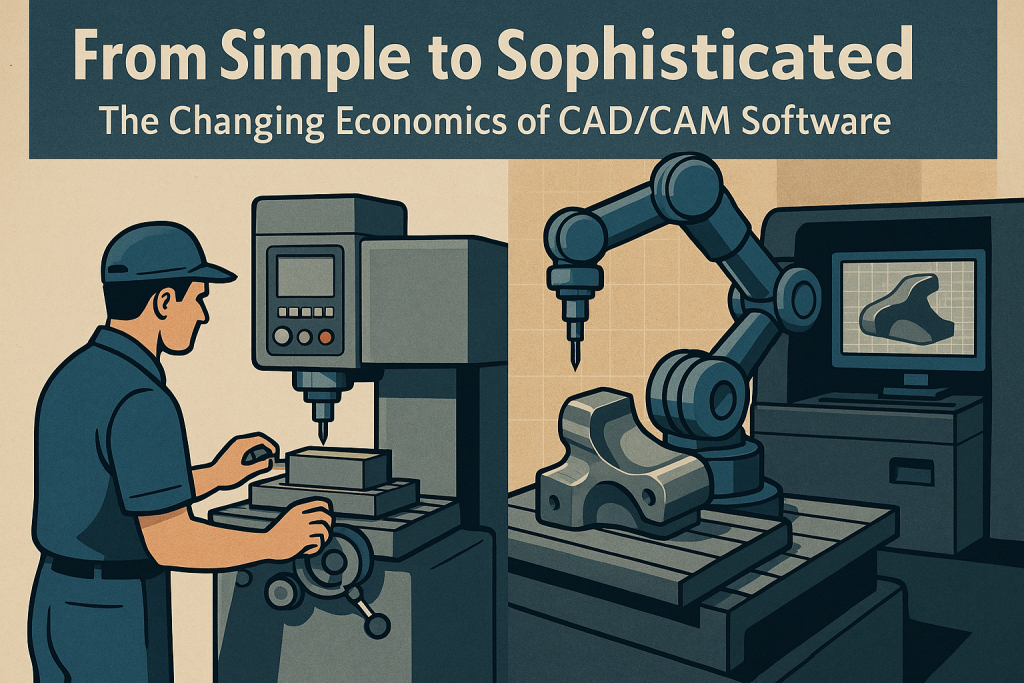
From 2D Profiles to 5-Axis Profit: A Historical Context
CAD/CAM software has its roots in automating the straightforward: converting engineering drawings into toolpaths for 2- or 3-axis milling machines. For decades, this market grew steadily as shops moved from manual programming to digital solutions.
However, as Andrei Kharatsidi, CEO of ENCY Software, notes: “Simple operations have become a commodity. The software to program them is cheap - or even free. The innovation and margins now come from what’s hard to automate.”
Indeed, software vendors like Mastercam, Fusion 360, and SolidCAM originally built their reputations on user-friendly 2.5D workflows. But over time, cloud platforms, open-source toolkits, and machine-native interfaces have dramatically lowered the entry barrier. Today, generating a contour path for a prismatic part might cost less than lunch.
Business Models Under Pressure
At the heart of the shift is the price-performance paradox: the easier the job, the less value the software adds - and the harder it is to charge for. Let’s break this down:
Low-complexity machining is now serviced by:
- Budget CAM plugins bundled with CAD
- Subscription models starting under $100/month
- AI-based automation tools that require minimal input
- Advanced simulation of tool engagement and machine kinematics
- Collision-checked 5-axis toolpath generation
- Digital twin integration for real-time feedback and optimization
For vendors, the equation is simple: low-complexity = low margin; high-complexity = high loyalty + high revenue.
The Tech Factor: When Algorithms Replace Intuition
Automation is another double-edged sword.
In simple jobs, AI-powered assistants can now outperform entry-level programmers. Fusion 360’s "Manufacture Extension" offers automatic toolpath generation for basic operations. SolidWorks CAM, powered by CAMWorks, features knowledge-based machining templates that require zero toolpath design skills.
But for complex parts: impellers, turbine blades, surgical implants - no template can anticipate the challenges. “It’s a level of craftsmanship that still needs deep digital understanding,” says Gerry Grainger, a robotic programming specialist.
Here’s where CAM software becomes less a tool and more a co-pilot, interpreting real-time sensor feedback, optimizing cutter engagement, and minimizing air cuts.
The Customer Side: Expectations Have Evolved
The buyers of CAM software have also changed. Ten years ago, the typical buyer might’ve been a small shop looking to digitize its programming. Today, it's often an engineering team with a digital thread strategy, looking to link CAD, CAM, simulation, and post-processing in one continuous environment.
“In aerospace, medical, or automotive prototyping, you're no longer selling toolpaths. You're selling risk mitigation and time-to-market,” explains Markus Weber, head of CAM strategy at a German manufacturing group.
This trend has led vendors to pivot toward solutions that integrate into larger PLM systems, support model-based definitions, and offer cloud collaboration - all premium features, far removed from drilling a few holes.
Complexity Is the New Scarcity
There’s also an economic logic at play. The more complex the part, the fewer the players who can make it. This exclusivity allows shops to charge more, and software vendors to tie their value to a critical bottleneck in the digital workflow.
We see this in the rise of:
- Multi-tasking machining modules (e.g., mill-turn, Swiss-type lathe support)
- Robotic CAM with offline programming (e.g., SprutCAM, RoboDK, ENCY Robot)
- Additive/subtractive hybrid modules (e.g., Siemens NX AM, PowerMill Hybrid)
Case Studies: How Brands Are Monetizing Complexity
Let’s look at how different vendors have adapted:
- hyperMILL (Open Mind): Offers ultra-high-end toolpath control with strategies like "tangential finishing" and "rest machining by reference," optimized for mold & die. Its complexity gives it pricing power in Europe and Asia.
- ENCY Software: A new entrant emphasizing advanced robot programming and feature-based automation. Their split between ENCY CNC and ENCY Robot mirrors the market trend of specialized solutions for complex workflows.
- ESPRIT EDGE: Focused on digital twins and live-machine simulation, enabling CAM to extend into production monitoring.
- Mastercam & Fusion 360: Still dominant in the entry- and mid-market, but increasingly rely on ecosystem integrations and cloud modules to retain users moving into complex domains.
As software eats complexity, where does that leave the human?
Ironically, the rise of complexity has elevated - not eliminated - the skilled CAM engineer. While simple programming is being commoditized, advanced programming now demands:
- Understanding of kinematics, tooling, machine limits
- Ability to diagnose simulation issues
- Optimization of high-speed machining parameters
Conclusion: Complexity as Strategy
In the end, this is not just a technological shift - it’s a strategic pivot. Vendors are choosing to chase fewer customers with deeper problems rather than more customers with simpler needs. And it’s working. The value is no longer in the toolpath itself, but in what it enables: innovation, precision, and speed-to-market in an ever more demanding manufacturing world.