
Alphacam: CAD/CAM Software Powering Wood, Stone, and Metal Manufacturing
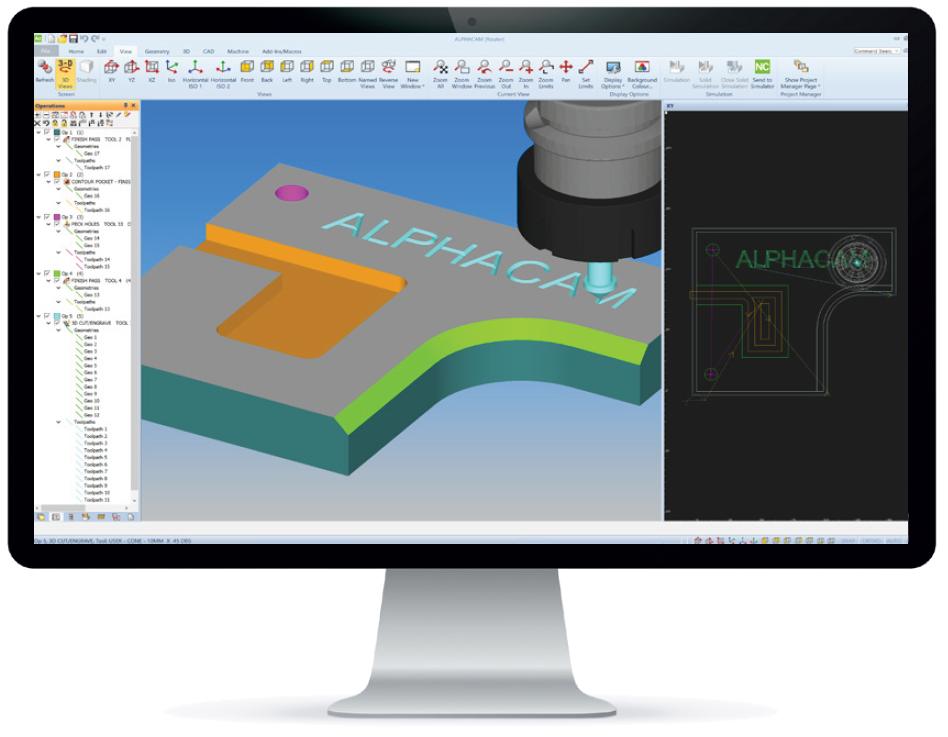
Alphacam is a computer-aided design and manufacturing (CAD/CAM) software system widely used for programming CNC machine tools. Developed with an emphasis on ease of use and flexibility, Alphacam enables manufacturers to design and generate toolpaths for cutting and shaping wood, stone, metals, composites, and other materials. It supports operations ranging from simple 2D profiling and drilling to complex 5-axis machining, making it a versatile solution for a broad range of industries. The software is part of Hexagon AB’s Manufacturing Intelligence division (acquired via Hexagon’s purchase of Vero Software in 2014) and has a long history in the CAD/CAM market.
Areas of Application and Industries
Originally known for its strength in the woodworking sector, Alphacam today serves a diverse user base across multiple industries. Woodworking and Cabinetry are core domains for Alphacam: furniture manufacturers, cabinet shops, and millwork companies use it to program CNC routers for cutting wood panels, machining solid timber, and carving intricate designs. The software’s intuitive interface and robust toolpath strategies have made it popular for tasks such as nested-based manufacturing (automatically fitting multiple part shapes onto sheets of plywood or MDF to minimize waste) and 5-axis carving. For example, Alphacam was used in an innovative historical project to recreate Viking-era furniture: Danish craftsmen employed Alphacam’s 5-axis capabilities to carve complex wooden pillars and benches with authentic detail for an open-air museum, achieving tolerances within 0.3 mm on large timber components. Such case studies highlight how Alphacam can combine advanced CNC techniques with traditional craftsmanship, enabling cost-effective production of intricate woodwork that still requires hand finishing for authenticity.
Beyond wood, stone fabrication has become a major field for Alphacam. The software offers specialized modules for the stone-cutting industry – including support for CNC bridge saws, stone routers, and polishing machines. Stone fabricators use Alphacam to automate the cutting of granite, marble, and engineered stone for kitchen countertops, tiles, and architectural pieces. Alphacam’s stone module includes features like sawing strategies (for straight-line cuts with a diamond blade), 3D carving and engraving on stone surfaces, and toolpath optimization to account for the unique properties of brittle stone materials. A testament to Alphacam’s prominence in this sector is its collaboration with machinery manufacturers: for instance, U.S.-based Park Industries, a leading maker of stone cutting equipment, resells Alphacam as the primary CAM software with its CNC machines. In 2019, Park Industries was recognized as the world’s largest distributor of Alphacam software, marking the second consecutive year it received Alphacam’s top global reseller award. This close partnership means that many granite and marble shops running Park Industries saws and routers rely on Alphacam to program their cuts and tool paths – integrating the software tightly into turnkey solutions for stone fabrication. The stone industry benefits from Alphacam’s ability to generate accurate toolpaths for complex sink cut-outs, curved countertop profiles, inlays, and decorative stone relief work, all while optimizing cutting sequences and tool usage.
Alphacam is also used in metalworking and general fabrication, especially in shops that produce components via routing or drilling rather than heavy milling. While other CAM systems (like Edgecam or Mastercam) are more common in traditional metal machining, Alphacam has found a niche in areas such as sheet-metal routing, aluminum extrusions, composite panels, and even 2-axis machining like waterjet or laser cutting of metal sheets. The software supports these processes by allowing users to import CAD drawings of parts and generate CNC code for various machine types. In fact, Alphacam includes modules to program CNC lasers and waterjet cutters, as well as wire EDMmachines for precise 2-axis profile cutting of metals. This breadth of capability means a manufacturing firm can use Alphacam for a mix of equipment – for example, a company making composite aerospace components might use Alphacam to route carbon fiber parts on a CNC router and also to waterjet-cut metal fixtures or templates.
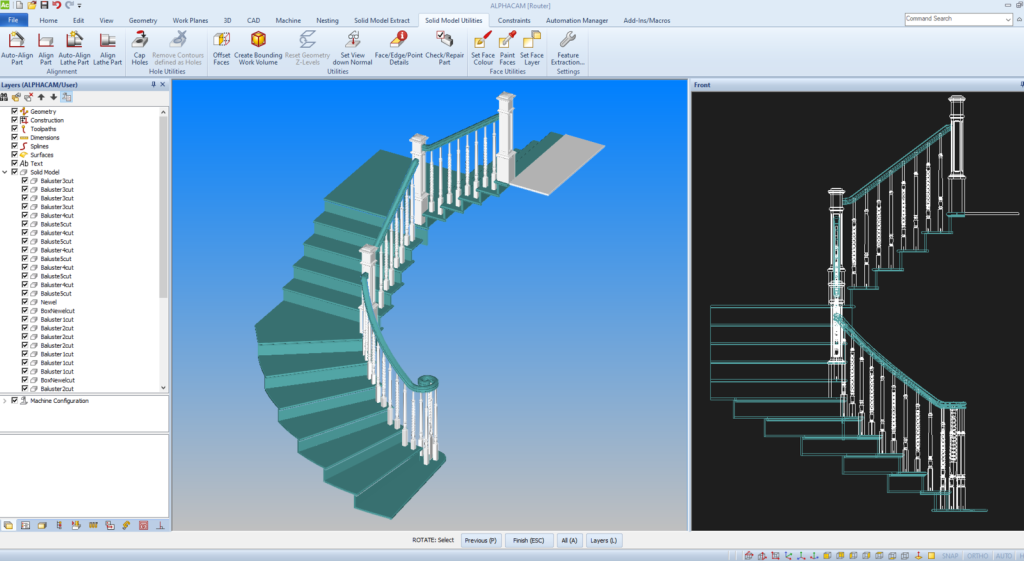
Another notable area is staircase and joinery manufacturing, which often involves complex 3D wooden parts. Alphacam’s 5-axis machining proficiency enables production of helical stair stringers, twisted handrails, or other curved wooden components directly from 3D models. Likewise, makers of musical instruments, custom doors, or decorative panels leverage Alphacam to go from intricate designs to finished products with high precision. The composites and plastics sector also uses Alphacam, since the software’s routing strategies (developed originally for wood) adapt well to machining plastic sheets, foams, and composite laminates. The software has options to manage chip load and heat for plastics, ensuring clean cuts without melting or fraying.
Crucially, Alphacam’s adaptability across industries is enhanced by its support for multilingual and international standards, making it suitable for use worldwide. It can import designs from all major CAD systems (in formats like DXF, DWG, IGES, STEP, and solid model formats), which is essential in industries where designers use various CAD tools. This interoperability means a stone shop can take an architect’s drawing or a woodshop can take a client’s CAD model, bring it into Alphacam, and proceed directly to toolpath planning.
History and Evolution of the Software
Alphacam’s origins date back to the late 20th century, and its journey reflects the rapid consolidation of the CAM software industry over the years. The software was originally developed by a UK-based company called Licom Systems in the 1990s. Licom’s Alphacam quickly gained a reputation in the woodworking sector as a powerful CAM solution, which led to growing adoption among wood product manufacturers who needed more advanced CNC programming capabilities than the basic software that came with their machines. By the end of the 1990s, Alphacam was being used not only for woodworking, but also in some metal and stone applications, as Licom continued to add functionality.
A major turning point came in 2001 when Licom Systems (and the Alphacam product) was acquired by Planit Holdings, a British CAD/CAM group. Planit Holdings at that time was known for software in the woodworking and cabinet design space – its portfolio included cabinet design systems (like Cabinet Vision and Cabinet Ware) and kitchen showroom design tools, and it was looking to expand into CAM software to provide a complete solution from design through manufacturing. Planit’s Group Director Patrick Love later explained that their customers were demanding integrated CAM: “The missing link was really the CAM software, and we were buying lots of Alphacam,” he said, explaining why acquiring Licom was a natural step for Planit. With that acquisition (finalized in September 2001), Alphacam became part of the Planit software suite, immediately giving Planit a foothold in the CAM market. Importantly, this move also pushed Planit beyond purely woodworking software and into the metalworking CAM arena, since Alphacam had capabilities for machining metal components.
Under Planit’s ownership in the 2000s, Alphacam continued to evolve rapidly. Planit invested in development to improve Alphacam’s functionality and integration. During this period, Alphacam’s interface was refined and new modules were introduced. By the mid-2000s, Planit had grown significantly through acquisitions: it purchased the Radan sheet metal CAM system in 2003 and the Edgecam milling/turning CAM system (by acquiring Pathtrace) in 2006, among other additions. Alphacam was one of several brands operating under the Planit umbrella, each targeting different industry segments (wood, metal, sheet metal, etc.). Planit typically allowed these products to maintain their brand identity and focus – Alphacam’s development team remained based in its original office (Coventry, UK) and kept a specialized focus on routing and carving applications, while Edgecam’s team focused on metal cutting, and so on. This strategy meant that Alphacam continued to be developed by experts in its niche even as it benefited from the resources of a larger group. By 2007, Planit Group was recognized as one of the world’s top five CAM software vendors by market share, due in large part to the combined strength of Alphacam and its sister products. Planit reported annual revenues of around £39 million in 2007 and had about 470 employees worldwide at that time, spread across its various product divisions and international offices. This gave Alphacam a solid backing and a global sales network in its formative years.
In a significant industry consolidation, Planit Holdings merged with Vero Software in 2011 (the merger was completed in early 2012). Vero Software, based in Cheltenham, England, was another CAM software company whose products included VISI (CAD/CAM for mold and die), PEPS, and other solutions. The merger, orchestrated by Planit’s private equity owners, essentially combined two major CAM portfolios under the Vero name. After 2012, Alphacam became one of the flagship products of Vero Software. The union of Planit and Vero brought together a large stable of CAM brands (Alphacam, Edgecam, Radan, VISI, WorkNC, Surfcam, etc.) catering to a wide range of manufacturing processes. This also expanded the development resources and global reach for Alphacam. Vero’s leadership continued to invest in improvements and new features for Alphacam, ensuring that it kept pace with technological advancements like improved simulation, better 3D modeling import, and automation capabilities.
In 2014, the Alphacam story took another leap when Hexagon AB, a Swedish industrial technology conglomerate, acquired Vero Software. Hexagon AB is known for its solutions in metrology (measurement systems), geospatial technologies, and manufacturing software. The acquisition was part of Hexagon’s strategy to build an end-to-end manufacturing solution connecting design, production, and quality control. With Vero’s CAM software under its wing, Hexagon could link CAM programming (like Alphacam) with its metrology and automation systems, enabling data to flow from the design stage all the way through to quality inspection on the shop floor. Hexagon’s President and CEO Ola Rollén highlighted the value of adding Vero’s products to the Hexagon family, noting that Vero’s “unique suite of manufacturing software solutions” had the expertise to deliver higher productivity to customers and that combining technologies would help “integrate all data and processes across the manufacturing lifecycle.”
The acquisition deal underscored the importance of Alphacam and its sister products in the broader context of smart manufacturing. At the time of acquisition, Vero Software’s annual revenue was around €80 million (2013), and it had direct offices in major markets including the UK, Germany, France, Italy, the United States, China, Japan, and many others – a testament to how far Alphacam’s reach had grown since its humble beginnings.
Under Hexagon, Alphacam is now developed and marketed by the Hexagon Manufacturing Intelligence division, which continues to release new versions annually. Hexagon has folded the old Vero Software organization into its broader structure but has kept the Alphacam product name and focus intact. Over the past decade, development of Alphacam has accelerated in some cutting-edge areas (for example, accommodating robotic machining and adding more automation tools) thanks to Hexagon’s resources and emphasis on smart factory solutions. In 2018, Hexagon took steps to strengthen Alphacam’s presence in specific regional markets – notably by acquiring Licom Systems GmbH, the long-time German distributor of Alphacam. Licom Systems GmbH had been a joint venture partner handling Alphacam sales and support in Germany since 1996, and Hexagon’s move to acquire it outright was aimed at solidifying market share in German-speaking countries. “The acquisition of Licom Systems guarantees a bright future for the Alphacam business in this important market,” said Steve Sivitter, then CEO of Vero Software, in 2018, emphasizing that the German team’s expertise in woodworking, metalworking, and stone-cutting industries would continue to benefit the Alphacam user community. Today, Alphacam’s development hubs and support teams span multiple countries, but it remains especially rooted in the UK (the original development center) and with strong presence in Europe and North America through Hexagon’s network.
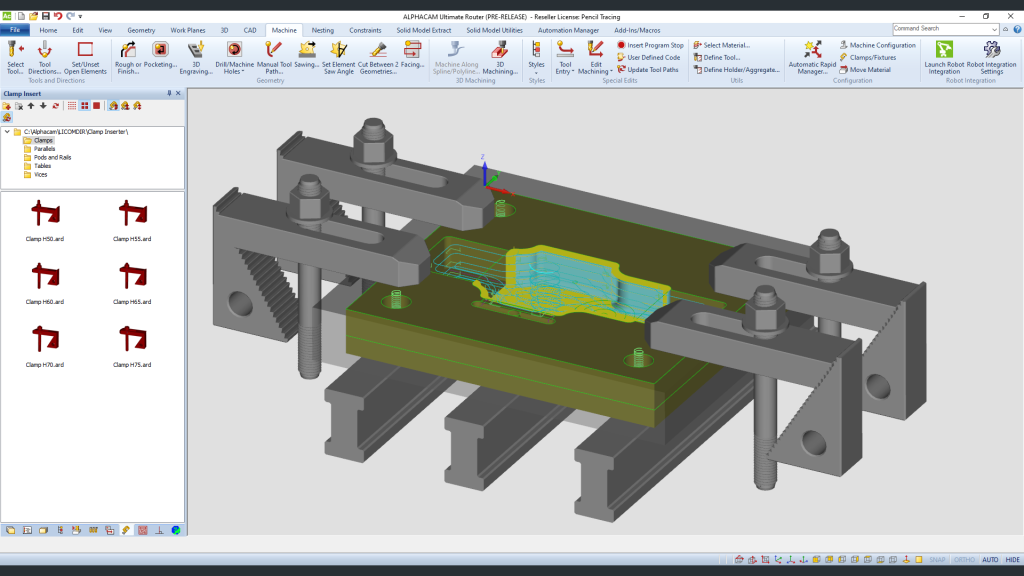
From a founder perspective, Alphacam’s early development was influenced by the trends in CNC software during the 1980s and 1990s. While the original creators at Licom are less publicly documented, the product itself quickly aligned with the needs of CNC router users who were migrating from manual methods to automated CAD/CAM. As part of Planit and later Vero, Alphacam’s evolution was also shaped by cross-pollination with other software – for instance, techniques from metal-cutting CAM were adapted to improve Alphacam’s 3-axis and 5-axis toolpath algorithms, and conversely Alphacam’s user-friendly approaches influenced sister products. Throughout its history, one constant has been Alphacam’s focus on being “intelligent and intuitive” – a phrase often used in its marketing. The goal has been to simplify the CAM programming process so that even complex machining operations can be programmed with a logical workflow, thereby lowering the barrier for shops to adopt advanced CNC capabilities.
Business Footprint and Market Presence
In the decades since its inception, Alphacam has grown into a globally recognized CAM system with a significant market share in its target industries. While exact user counts are proprietary, the scale of Alphacam’s adoption can be gleaned from the size of the companies behind it and the extent of its distribution. By the late 2000s, as part of Planit, Alphacam contributed to a combined customer base of around 50,000 licensed users worldwide across all Planit products. Many of those were Alphacam seats in woodworking and stone companies, since Planit’s strategy was to be the go-to solution provider for those sectors. Alphacam’s user community ranges from small job shops (like a 3-person cabinet shop using a single CNC router) to large manufacturing enterprises (such as furniture factories with multiple production lines, each with CNC machines programmed by Alphacam).
Geographically, Alphacam’s reach is broad. Under Vero Software, the product was sold in over 45 countries through a mix of direct offices and resellers. Key markets include Europe (especially the UK, Germany, Italy, France, Scandinavia where woodworking industries are strong), North America (USA and Canada have many Alphacam users in cabinetry and stone fabrication), and Asia-Pacific (with users in markets like China, where wood products manufacturing is huge, as well as Australia/New Zealand in the timber and fabrication sectors). Localized versions of Alphacam were developed to support various languages and regional units, which helped its international adoption. For example, Alphacam is available in English, German, French, Italian, Spanish, and several other languages, allowing non-English-speaking operators to work more comfortably.
One measure of Alphacam’s market penetration is its partnerships with machine tool manufacturers and distributors. Many CNC machine builders have chosen to bundle or recommend Alphacam to their customers, especially in the woodworking and stone industries. We already noted Park Industries in the stone sector. In the woodworking machinery field, HOMAG Group (one of the world’s largest makers of wood manufacturing machinery, based in Germany) has collaborated closely with Alphacam. HOMAG’s own CNC control software (woodWOP) can interface with Alphacam to extend programming capabilities. In fact, by late 2013 HOMAG and Licom announced that over 850 installationshad linked Alphacam with HOMAG CNC machines (via woodWOP integration), and they set a target to surpass 1,000 such installations by the following year. This indicates a substantial installed base of shared customers who rely on Alphacam for advanced programming on HOMAG equipment. Similarly, other machine brands – such as Biesse and SCM in Italy, or North American router manufacturers – often ensure their machines are compatible with Alphacam post-processors, knowing many clients prefer or already use the software.
In terms of business indicators, Alphacam’s success has contributed to healthy financials for its parent companies over time. As mentioned, the combined Vero Software portfolio (which included Alphacam) was an €80 million/year business by 2013. While Alphacam was just one product among several in that portfolio, it is considered one of the major revenue generators, given the size of the wood and stone market globally and relatively fewer direct competitors focused on those niches. For instance, in CAD/CAM for woodworking, Alphacam’s main competition historically came from only a handful of other specialized systems, giving it a large share of that market. The software has tens of thousands of active users and is often cited as a de facto standard CAM system in cabinetmaking and stone shops.
Another important aspect of Alphacam’s market presence is its reseller and support network. Because small and medium-sized enterprises form a big part of its user base, local value-added resellers (VARs) play a role in selling and supporting Alphacam in different regions. Companies like Planit Canada (which distributes Alphacam in Canada) or other regional partners host training events, user group meetings, and provide frontline technical support. The strong reseller network has helped Alphacam penetrate markets where having local expertise is key – for example, in Latin America and Eastern Europe, Alphacam resellers offer training in local languages and adapt post-processors for locally popular CNC machines.
Alphacam’s user community also intersects with educational institutions. Some technical schools and training centers in woodworking and stone-cutting fields use Alphacam to teach CNC programming, ensuring a pipeline of skilled users familiar with the software. This educational presence further solidifies Alphacam’s position in the market, as graduates often recommend or implement the software in the companies they join.
In summary, Alphacam today enjoys a robust market presence characterized by a wide geographic reach and a deep penetration in specific manufacturing domains. Its longevity and continuous development have earned it a loyal customer base, and the backing of Hexagon provides assurance of ongoing innovation and support. The software’s presence in the portfolios of large industrial suppliers (Hexagon) and on the shop floors of countless factories and workshops around the world underscores its role as a key enabler in modern CNC manufacturing.
Mergers, Acquisitions, and Partnerships
Throughout its history, Alphacam’s corporate ownership and alliances have evolved significantly, mirroring larger trends in the CAD/CAM industry. Many of these changes have already been touched on in the historical narrative, but here we summarize the major mergers, acquisitions, and partnerships that have shaped Alphacam’s trajectory:
-
Licom Systems (Original Developer): Alphacam was created by UK-based Licom Systems, which operated independently through the 1990s. Licom built a user base for Alphacam, especially in Europe. In addition to selling directly, Licom often partnered with CNC machine makers (like SCM in Italy or Homag in Germany) to ensure Alphacam could drive their machines. By 1996, Licom had even set up a joint venture in Germany (Licom Systems GmbH) to better serve German-speaking markets – an early example of a partnership to expand Alphacam’s reach.
-
Acquisition by Planit (2001): Planit Holdings’ purchase of Licom Systems was a pivotal acquisition for both entities. For Planit, it filled a gap in their product line (they now owned a CAM solution to complement their design software). For Alphacam, it meant joining a larger organization with complementary products. This period saw Alphacam partnering more closely with Planit’s other offerings – for example, a cabinet design program could pass data to Alphacam for manufacturing. Planit itself was acquisitive: around the same time, it acquired Cabinet Vision and Cabinet Ware (joining Alphacam in the woodworking segment) and later added other CAM tools. Planit’s strategy was to create a one-stop software suite for manufacturers. Internally, Alphacam’s integration with its new sister products was considered, although the development teams remained largely separate to maintain each product’s specialty.
-
Mergers into Vero (2011–2012): The merger of Planit into Vero Software essentially was more of an acquisition (facilitated by Battery Ventures, a private equity firm that first bought Vero and then Planit). This brought Alphacam under the Vero Software banner. Vero was known for its own CAD/CAM products and had a strong presence in the automotive and tooling industries. Under Vero, Alphacam joined a broader lineup but also benefited from greater R&D synergies. Vero at times pursued an approach of cross-pollinating features – for instance, a sophisticated 3-axis milling routine from one product might be adapted into Alphacam if it could enhance woodworking machining, and vice versa for specialized nesting routines from Alphacam that could benefit sheet metal cutting in Radan. The merger did not lead to any discontinuation of the Alphacam product (on the contrary, Vero emphasized continuing all the brands). Customers largely experienced continuity, aside from noticing the company name change on their software splash screens and support channels. One notable outcome of being under Vero was even wider global sales – Vero had offices or distributors in regions where Planit’s reach was previously limited, bringing Alphacam to new markets.
-
Acquisition by Hexagon (2014): Hexagon AB’s acquisition of Vero Software was a major corporate development. Post-acquisition, Alphacam became part of a Fortune 1000-size corporation. Hexagon’s interest in Alphacam and its sibling CAM products was strategic: it allowed Hexagon to offer solutions spanning from design (CAD), to manufacturing (CAM), to quality control (metrology). In practical terms, Hexagon’s ownership brought more financial stability and investment to Alphacam’s development. It also opened doors for collaboration with other Hexagon products. For example, Hexagon’s metrology equipment (like coordinate measuring machines and laser scanners) could potentially be used in tandem with Alphacam’s output to create closed-loop manufacturing systems. While these integrations are ongoing, Hexagon’s stewardship has clearly positioned Alphacam within a larger vision of smart manufacturing environments. The acquisition was amicable, and Vero’s management, including those overseeing Alphacam, largely stayed on to continue leading the product under Hexagon.
- Licom Systems GmbH (2018): One of the more recent acquisitions specifically related to Alphacam was Hexagon’s move to acquire the remaining shares of Licom Systems GmbH in Germany. This German entity had historically been a partnership venture (with partial ownership by Vero/Planit in the past). By fully bringing it in-house, Hexagon ensured that Alphacam’s German market would be directly served by the company, aligning strategies better. Stephan Schneider, the CEO of Licom Systems GmbH, joined Hexagon’s team to continue leading Alphacam efforts in that region. Germany (and the DACH region) is significant because of the density of woodworking and stone machinery manufacturers and users there – securing that market was vital. The integration was smooth, as Licom Germany had acted as an extension of Alphacam’s team for years. Steve Sivitter’s quote about this deal (noted earlier) highlighted continuity and long-term commitment to Alphacam’s users in those areas.
- Other Partnerships and Collaborations: Alphacam’s development team and sales teams have forged numerous collaborations outside of formal M&A. For instance, Alphacam has technology partnerships with CAD software firms (ensuring compatibility with design systems like SOLIDWORKS or AutoCAD through plug-ins or certified interfaces). It also has collaborated with tooling companies to incorporate tool libraries and cutting parameters for wood and stone tools. On the hardware side, beyond HOMAG, Alphacam works with CNC manufacturers such as SCM Group, Biesse, Weeke, MultiCam, and Thermwood. Some CNC vendors bundle Alphacam with new machine sales, especially if the client needs a more advanced CAM than the machine’s basic software. MultiCam, a U.S.-based CNC router maker, for example, has been an authorized Alphacam reseller, describing Alphacam as “the leading CAM solution for wood, metal, stone, and composite components” that produces reliable, machine-ready CNC code. This kind of endorsement shows how Alphacam is seen as a high-end solution that machine builders trust for their customers.
- Another realm of partnership is with industry organizations and events. Alphacam representatives often participate in trade shows (like LIGNA for woodworking machinery, or TISE for stone fabrication) and sometimes in industry consortiums or standards bodies (for example, supporting standardized formats for cabinetry design to manufacturing data exchange). By staying active in the community, Alphacam influences and adapts to emerging trends – such as the push for digitalization and Industry 4.0 in furniture manufacturing.
Overall, mergers and acquisitions have greatly expanded Alphacam’s footprint – turning a small specialist company (Licom) into part of a global enterprise (Hexagon). Meanwhile, partnerships, whether with machine makers or resellers, have been key to Alphacam’s strategy of remaining close to the practical needs of industry. Each collaboration has, in one way or another, enhanced Alphacam’s capabilities or its accessibility to end-users.
Key Features and Innovations
Alphacam’s longevity in the market is closely tied to its ability to innovate and offer features that meet the evolving needs of manufacturers. From its early days to the latest releases, Alphacam has introduced numerous capabilities that make CNC programming more efficient, flexible, and powerful. Some of the key features and strengths of the system include:
-
Intuitive CAD Interface and Geometry Tools: Alphacam provides an integrated CAD environment where users can draw or import part geometry. Its CAD tools allow creation and editing of 2D drawings or simple 3D shapes directly in the software. This is useful for users who might not have a separate CAD system – for example, a custom woodworker can sketch a contour or engraving pattern in Alphacam and then immediately toolpath it. The interface is designed to be graphical and user-friendly, using icons and dialogs rather than requiring any coding or G-code knowledge. Over time, Alphacam’s developers have refined the interface to align with how CNC programmers think: tools like snapping, trimming, filleting, and offsetting are readily available to clean up geometry before machining. The software also supports parametric drawing through its constraintsfeature (branded as Alphacam “xConstraints” in recent versions), which allows users to create smart parametric templates – for instance, a cabinet outline that can resize automatically based on given width/height/depth parameters, updating toolpaths accordingly.
-
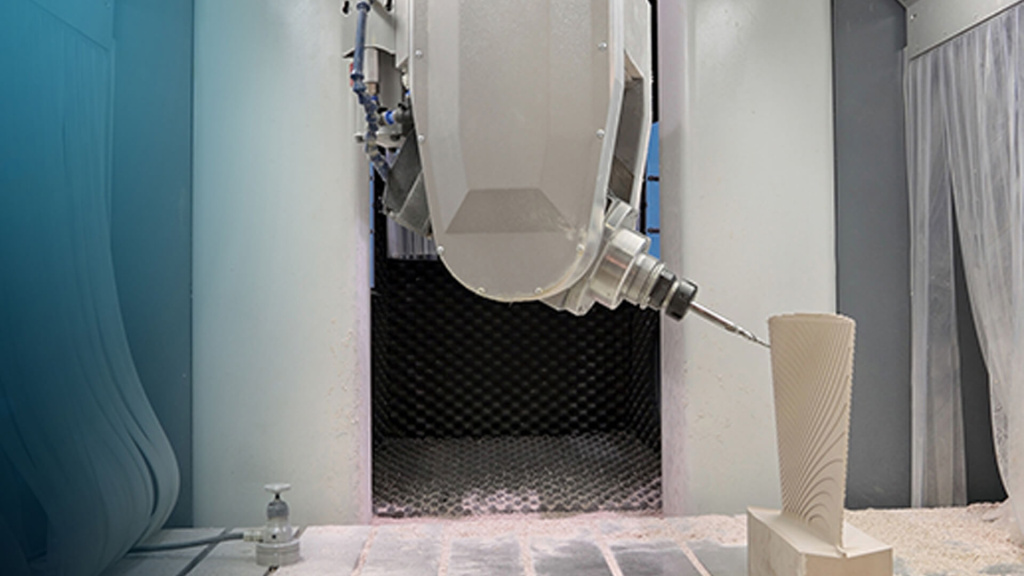
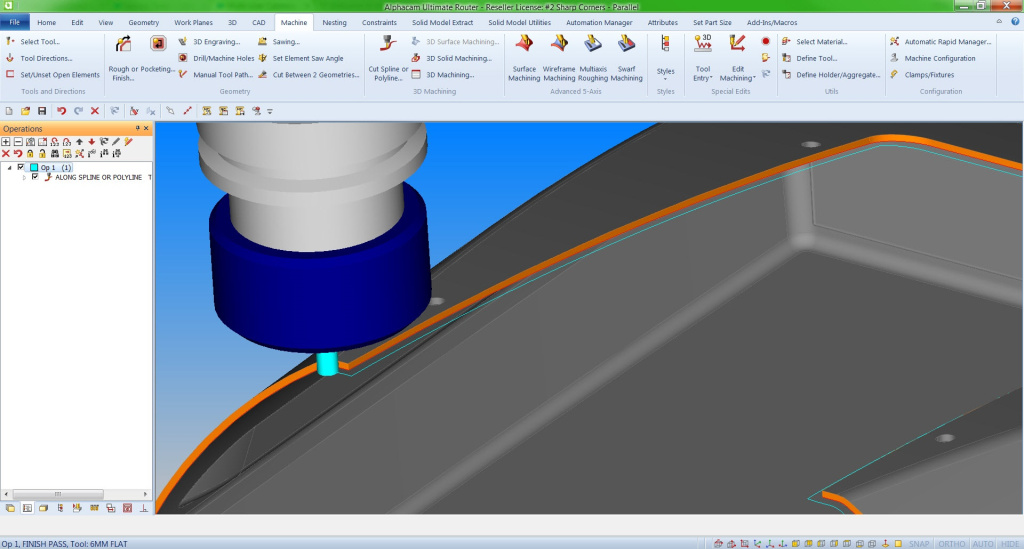
Wide Range of Machining Strategies: One of Alphacam’s greatest strengths is the breadth of machining operations it supports. For 2D machining, it covers profiling (contour cutting), pocketing, drilling (with support for multi-drill heads and drill banks common in cabinet manufacturing), engraving, and nesting (automatically arranging multiple parts on sheet stock). For 3D machining, Alphacam can create 3-axis toolpaths for complex surface sculpting – useful in carving wood or stone reliefs or machining molds. It also supports 4-axis indexed machining (positional machining where a part can be rotated to different angles and machined in stages, often used in 4th-axis rotary tables) and full 5-axis simultaneous machining for intricate freeform shapes. The multi-axis capabilities have been continually improved to handle the unique needs of Alphacam’s user base: in woodworking, 5-axis is often used for things like carving large sculptures or machining complex joinery where the tool needs to approach from various angles; in stone cutting, 5-axis might be used for cutting stone panels at compound angles or shaping edges with a tilted blade. Alphacam provides strategies like swarf cutting (using the side of the tool), 5-axis trimming, and multi-surface machining that can tackle these tasks. The software includes simulation tools so users can preview the multi-axis motion and ensure there are no collisions or gouges before actually running the CNC.
-
Specialized Modules for Industries: Recognizing that one size doesn’t fit all, Alphacam has modular functionality tailored to different applications. For example, Alphacam Router (the core module) focuses on woodworking/router operations, Alphacam Stone includes those stone-specific functions (like saw blade cutting and polishing toolpaths), Alphacam Lathe addresses turning operations for those who have CNC lathes (it can generate profiles and turning toolpaths, supporting multi-axis mill-turn centers to some degree), and Alphacam Wire for EDM programming (allowing 2-axis wire erosion cutting, often used in toolmaking or cutting intricate metal profiles). These modules share the same interface but unlock different sets of tools. This modular approach means a user can configure the software package to their needs – a countertop fabricator might just need the Stone module and 3-axis core, whereas a complex shop building custom staircases might have the 5-axis module and scripting automation add-on. One particularly valued module is nesting (recently marketed as Alphacam “xNesting”), which uses advanced algorithms to pack shapes on material. Alphacam’s nesting is known to handle true-shape (irregular) nesting and even supports things like grain direction control (vital for wood aesthetics) and part labeling for identification.
-
Automation and Customization: A hallmark of Alphacam’s evolution has been adding ways to automate repetitive tasks. Early on, power users could write macros in Alphacam to automate sequences – an approach that has grown into a full-fledged API (application programming interface). Alphacam’s API allows the use of VBScript or other programming languages to create custom programs that drive Alphacam. For instance, a door manufacturer could script Alphacam to take a list of door dimensions from a spreadsheet and automatically generate all the toolpaths for those doors, without manually programming each one. This has enormous productivity benefits for companies making families of similar products with many size variants. Alphacam’s current “xAutomation” capability lets users batch-process files or do parametric job runs. Additionally, Alphacam can integrate with external systems: for example, a cabinet design software can output a parts list that Alphacam reads to program all the parts in one go. Some shops use this to achieve a near “hands-off” CAD-to-CAM workflow where once a design is finalized, Alphacam scripting handles all tooling. On the customization front, Alphacam supports user-defined tools (the ability to define custom cutter shapes for accurate simulation and programming, which is useful if using an unusual bit profile for wood cutting) and tool libraries that can be shared across projects. The software’s flexibility in accommodating custom processes is a big plus – many Alphacam users have crafted their own mini-applications on top of the software to solve niche problems.
-
Integration of CAD and CAM Data: Alphacam places emphasis on reading data from CAD systems accurately. It can import 3D solid models and assemblies (through its “xSolids” module) and allow the user to prepare them for manufacture. This includes extracting 2D profiles from 3D models, or slicing a 3D model to generate toolpaths on different faces. In collaborative workflows, a designer might provide a 3D model of a complex piece of millwork; Alphacam can import that model, and the CAM programmer can then pick edges or surfaces on it to create toolpaths, ensuring that what gets cut matches the original design exactly. This reduces errors that might occur if one were manually redrawing geometry. Alphacam also keeps associated documentation through features like work orders and report generation. It can produce setup sheets, tool lists, and even labels for parts (useful in panel processing to label cut pieces for assembly).
-
Advanced Simulation and Verification: Modern versions of Alphacam include enhanced simulation, where the entire CNC machine kinematics can be visualized. Users can see a virtual representation of their machine tool, complete with spindles, tool changers, clamps, and workpiece, then simulate the machining operation in real-time 3D graphics. This helps identify any potential collisions (like a tool or spindle hitting a clamp) or verify that the tool motions are as expected. For multi-axis operations, simulation is crucial given the complexity, and Alphacam provides this in an integrated way. Additionally, Alphacam can estimate machining time based on the programmed feed rates and machine characteristics, aiding in production planning.
-
Robotics and Emerging Tech: Keeping up with industry trends, Alphacam has ventured into the realm of robotics and additive manufacturing. The Alphacam Robotics feature allows generating toolpaths for 6-axis robotic arms equipped with routing or cutting heads. In some composite trimming applications or artistic carving, a robotic arm can be used instead of a traditional CNC machine. Alphacam’s role is to convert the desired cut paths into commands that a robot controller can use, taking into account the robot’s kinematics. This extension of Alphacam’s post-processing signifies its flexibility in output – whether it’s G-code for a 3-axis router or joint positions for a robot, the software’s core engine can handle it. While still a niche usage, it positions Alphacam as a forward-looking CAM system ready for new forms of “machining” beyond the standard CNC mill.
-
Continuous Improvements and User Feedback: Alphacam’s innovation is also driven by its user base. Annual updates often include features requested by users. For instance, if many users ask for better handling of STL mesh files (perhaps to machine from 3D scans), Alphacam’s team addresses that. The company has historically engaged with its community through forums, beta testing programs, and user group meetings. Over the years, they have added numerous small but impactful features such as common-line cutting (to allow two parts to share a cut line and reduce waste), improved lead-in/lead-out moves for cutting (to avoid material tear-out in wood or chipping in stone), support for aggregate heads on CNC machines (special attachments that allow angled drilling or sawing on a router), and more. These incremental improvements accumulate, keeping Alphacam competitive with other CAM offerings.
In terms of key innovations relative to the competition, one could highlight Alphacam’s early adoption of Windows GUI for CAM in the 1990s, which made it stand out against older text-based or Unix-based CAM systems. It was also ahead in integrating a true shape nesting as part of a CAM package for woodworking, which was a game-changer for cabinet shops moving from manual nesting to automated nesting. Additionally, Alphacam’s dual focus on subtractive toolpaths and saw cutting paths (for stone and wood panel saws) made it somewhat unique, since many CAM systems focus purely on milling/tool bit operations. Alphacam recognized that in woodworking and stone, often a saw blade is used as a “tool” – and it provided specialized support for that, including controlling blade angle, kerf (blade thickness), and sequence of cuts for best results.
The strength of Alphacam can also be seen in how it handles labels and output needed for workshop efficiency. For example, a nested sheet of parts can be accompanied by automatically printed labels, each with a barcode and part information. When those parts go to edge-banding or assembly, workers can scan the barcode to retrieve part info. Alphacam integrates these kinds of shop-floor workflows, demonstrating that it’s not just about generating CNC code, but also about facilitating the entire manufacturing process.
Finally, Alphacam’s reliability and post-processing quality are often cited by long-time users. The software comes with a wide library of post-processors (the component that translates toolpaths into the specific code format a CNC machine understands). Over decades, Alphacam has refined posts for hundreds of machine models. Companies switching from a different CAM to Alphacam frequently do so because Alphacam can produce cleaner, more efficient CNC programs for their specific machine, or because it handles complex tasks more gracefully. In manufacturing, reliability is key – a CAM program that produces correct output every time and can adapt to different tasks builds trust with its users. Alphacam’s “track record of reliable product delivery”, as its parent company once described, has been a cornerstone of its reputation.
Leadership and Vision
The leadership behind Alphacam, from its early founders to its current executives at Hexagon, have often articulated a clear vision for the product: to help manufacturers achieve more with their CNC machinery, in less time and with fewer headaches. Over the years, company leaders have shared insights about how Alphacam fits into the broader strategy and the industry’s future:
During the Planit era, CEO Trevor Semadeni and director Patrick Love viewed Alphacam as central to serving the production needs of their woodworking customers. The acquisition spree in the 2000s was guided by a belief that an integrated software offering would be highly valuable. “We think that in years to come, things will change… for [manufacturing] to function as it needs to, software will be of prime importance,” Patrick Love said in 2006 as Planit was bringing products like Alphacam into its fold. This quote reflects how Planit’s management foresaw the increasing role of CAM software in industries that were just starting to embrace automation.
After the Hexagon acquisition, Hexagon’s top leadership also highlighted the importance of Alphacam and its sister products in enabling end-to-end manufacturing solutions. Ola Rollén, then CEO of Hexagon, stressed that combining CAM with Hexagon’s other technologies would help customers connect all parts of their process – from design to production to inspection – under a cohesive digital thread. This vision aligns with trends like Industry 4.0 and smart factories. It suggested that Alphacam wouldn’t remain an isolated programming tool, but rather would be part of an ecosystem where, for example, a design’s data flows into Alphacam for manufacturing, and then feedback from the manufacturing (like measured deviations) might loop back to adjust designs, all in a continuous improvement cycle.
Steve Sivitter, who served as CEO of Vero Software through the Hexagon transition, was a key figure in guiding Alphacam in the 2010s. He often spoke about focusing on the customers’ needs in specific sectors. In the context of securing Alphacam’s future in regional markets, Sivitter’s reassurance that bringing the German Alphacam team on board “will ensure security and provide the basis of our long-term investment and business development strategy” signaled Hexagon’s commitment to keep investing in Alphacam’s growth. Under his leadership, Alphacam did see investment – including growing the development team and starting initiatives to modernize the software’s architecture and capabilities (some components of Alphacam are being re-engineered to work more seamlessly with cloud services and Hexagon’s Nexus platform, for instance, which is an emerging cloud-based collaboration environment for Hexagon products).
Another voice in Alphacam’s narrative is that of the product managers and engineers who directly drive its development. While not always public figures, they often communicate through release notes and user events. They emphasize that many of Alphacam’s new features come directly from user requests. This culture of listening has been fostered by the leadership to ensure Alphacam remains relevant. As manufacturing technology has advanced (with things like high-speed machining, 5-axis, automation), Alphacam’s team has aimed to bring those advances to traditionally less technologically-served industries like woodworking. The result is that now a cabinetmaker can leverage automation and multi-axis machining in ways that only aerospace companies were doing a couple of decades ago – and Alphacam’s leaders take pride in democratizing such technology for smaller businesses.
In addition, leadership has also focused on the ease-of-use vs. power balance. There is often a tension in CAM software between being very powerful (which can mean complex to use) and being user-friendly (which can mean hiding advanced options). Alphacam has tried to strike a balance by offering simplicity for beginners, but depth for experts. Longtime users sometimes joke about their “love/hate” relationship with the software – loving its capabilities but acknowledging a learning curve. The company’s stance is that training and support are crucial to unlock the full value of the software. To that end, Alphacam’s vendor has invested in training programs, online tutorials, and certified Alphacam trainers around the world. This strategy is somewhat driven from the top, with an understanding that selling the software is only half the battle – making sure customers can effectively use it ensures they stay customers.
The leadership has also navigated challenges such as software piracy (like many popular CAD/CAM tools, Alphacam has had to implement licensing systems and pursue infringement cases to protect its intellectual property). By doing so, they not only secure revenue but also ensure that paying customers are not unfairly undercut by competitors using pirated copies. Vero Software at one point was proactive in monitoring unlicensed usage of Alphacam and converting infringers into legitimate customers through offers and legal pressure, reflecting a business-savvy approach to a common software industry issue.
Looking forward, Alphacam’s custodians at Hexagon are aligning it with the concept of “Smart Manufacturing”. This involves greater connectivity – for instance, exploring how Alphacam can receive IoT data from machines (like tool wear information) and adjust machining strategies accordingly, or how it might integrate with MES (Manufacturing Execution Systems) to schedule jobs optimally. While these are still developing areas, the groundwork being laid by current leadership indicates that Alphacam will not remain static; it will likely transform from a traditional PC-based CAM program into a more connected component of a digital manufacturing platform. What likely won’t change is the core mission succinctly put by one of Alphacam’s long-time managers: “to make CNC machines perform better than you thought possible.” That phrase, used in Alphacam marketing, encapsulates the leadership’s and development team’s goal – empowering users to get the most out of their equipment through smart software.
Conclusion
From its beginnings as a pioneering CAM solution for woodworking, Alphacam has grown into a comprehensive CAD/CAM system that touches many facets of manufacturing. Its journey through different owners and its expanding capabilities mirror the broader changes in manufacturing technology over the last 30 years. Today, Alphacam stands as a mature yet continuously evolving product, backed by the resources of a global tech company but still enjoying the trust and loyalty of small shop users who have been with it for decades. This dual identity – high-end innovation on one hand, and practical shop-floor tool on the other – gives Alphacam a unique position in the CAD/CAM software landscape.
Manufacturers choose Alphacam not just for what it can do today, but for what it has proven over time: consistency, reliability, and adaptation. In an era where digital transformation is the buzzword, Alphacam is a reminder that some parts of that digital backbone in industry have been quietly transforming businesses long before it was trendy – enabling a cabinetmaker to program a CNC router with as much confidence as an aerospace engineer programming a 5-axis mill. With a strong vendor behind it and an active community around it, Alphacam is poised to remain a key player in its domains. Whether it’s carving the ornate details of a wooden cathedral door, slicing through a slab of granite, or churning out components for a metal fixture, Alphacam continues to help turn designs into tangible products with precision and efficiency.
Vendor: Hexagon