
CAMWorks: Integrated CAD/CAM Innovation in CNC Manufacturing
Computer-aided manufacturing (CAM) software plays a pivotal role in modern production, translating digital designs into instructions for CNC machines. One prominent system in this field is CAMWorks, an advanced CAD/CAM solution known for its feature-based automation and seamless integration with popular CAD platforms. Developed and marketed by HCL Technologies (through its HCL Software division), CAMWorks has evolved over decades from a pioneering add-in for SolidWorks into a comprehensive machining platform used worldwide.
General Description and Vendor Background
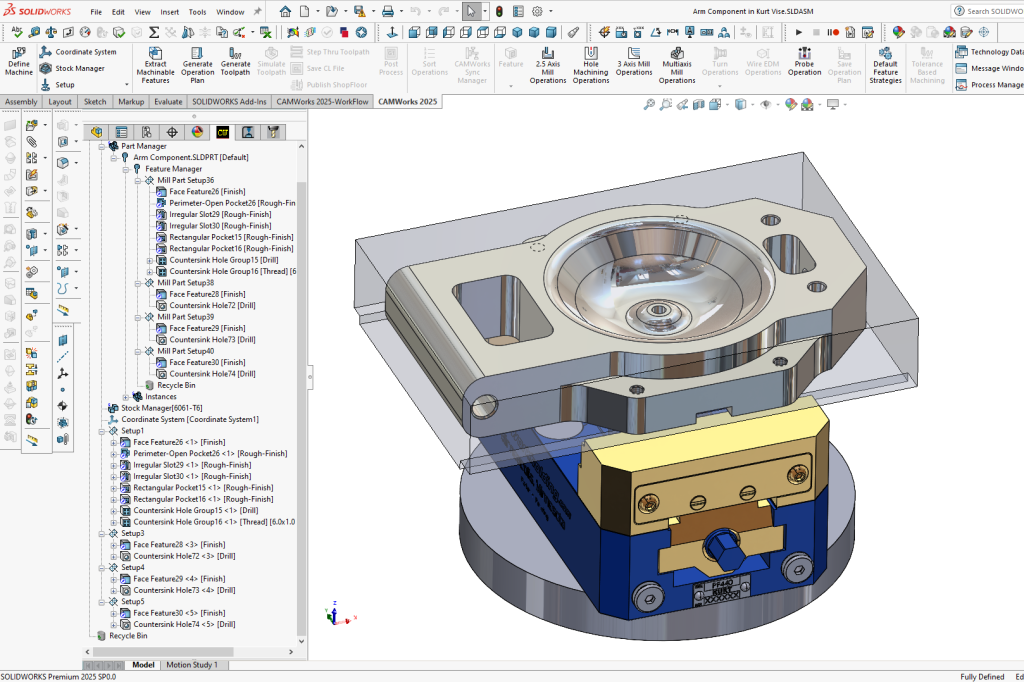
CAMWorks is a professional CAM software system designed to generate efficient toolpaths for CNC milling, turning, and other machining processes directly within a CAD environment. In contrast to standalone CAM programs, CAMWorks is fully embedded within CAD platforms like SOLIDWORKS and Solid Edge, meaning the CAM data and the CAD model coexist in one file. This tight integration allows design changes to automatically update machining operations, eliminating translation steps and reducing errors. CAMWorks uses an intuitive, feature-based approach to CNC programming – recognizing machinable features (such as holes, pockets, or bosses) on 3D models and automatically suggesting how to cut them. By incorporating Automatic Feature Recognition (AFR) and a knowledge-based machining database, the software can intelligently select tools, speeds, and strategies based on best practices, thus streamlining the programming task for users.
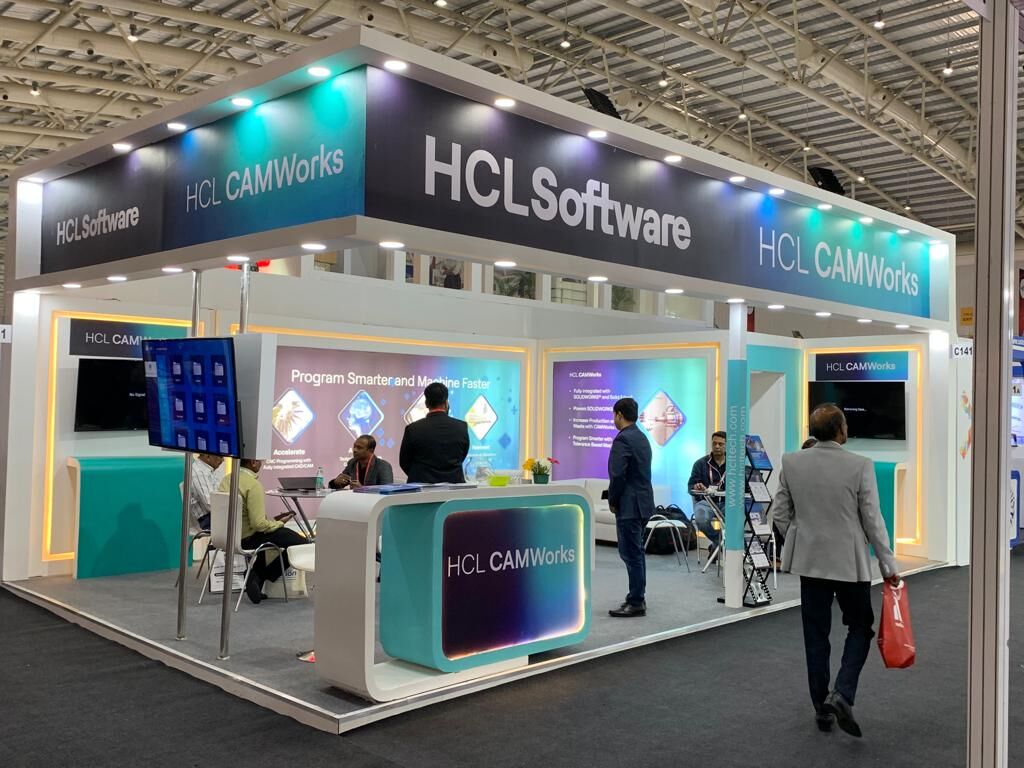
The vendor behind CAMWorks is currently HCL Technologies, a global IT and engineering company headquartered in India. Within HCL, CAMWorks is part of a suite of manufacturing software products (which also includes design for manufacturability tools like DFMPro and visualization software like Glovius). HCL acquired CAMWorks as a result of its 2016 purchase of Geometric Ltd., the company that owned CAMWorks at the time. Today, the product is often branded as “HCL CAMWorks” and continues to be developed by HCL’s Industry Software division, which leverages HCL’s extensive R&D resources worldwide. HCL positions CAMWorks as a key offering in its portfolio of solutions for product development and smart manufacturing, addressing the needs of CNC programmers, machinists, and manufacturing engineers who seek to “program smarter and machine faster.” The official website of CAMWorks (camworks.com) highlights its ability to reduce CNC programming time and improve machining productivity through automation and integration.
In summary, CAMWorks can be described as an integrated CAD/CAM software that emphasizes automation (through feature recognition and knowledge reuse) and integration (working directly inside CAD). Its vendor, HCL Technologies, provides a strong backing in terms of global support and ongoing innovation, continuing a lineage of development that began under smaller specialized companies before HCL’s stewardship.
Areas of Application
As a versatile CAM system, CAMWorks is used across a broad range of manufacturing industries and applications. Its core purpose is to generate toolpaths and NC code for machining parts, which makes it relevant to any sector that produces physical components via CNC machines. Key application areas include:
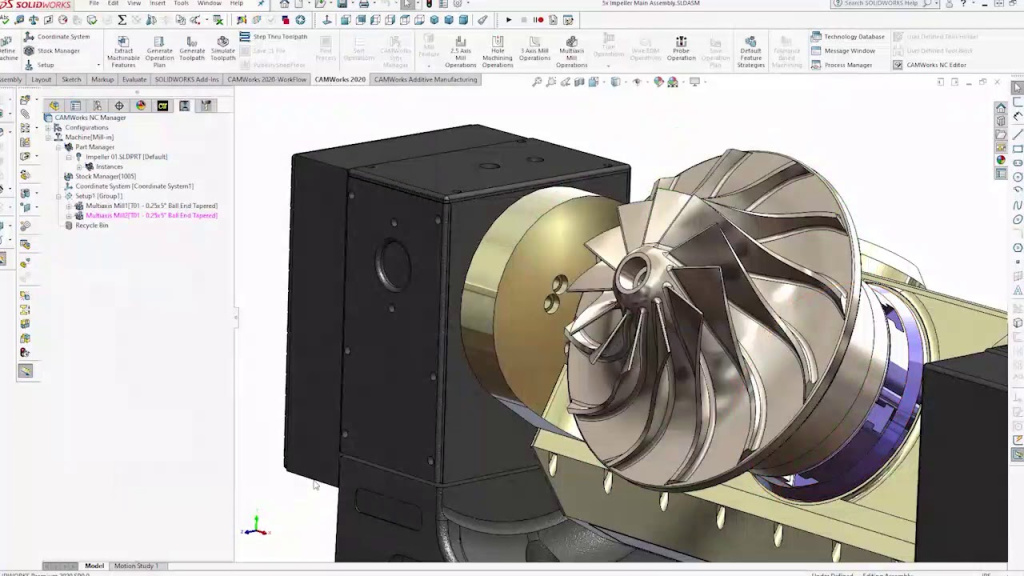
Aerospace and Defense: CAMWorks is employed by aerospace manufacturers to program the milling of complex aerospace components, the multi-axis machining of turbine parts, and the precision drilling of airframe structures. Its support for 5-axis machining and tight tolerances aligns well with aerospace’s demanding requirements.
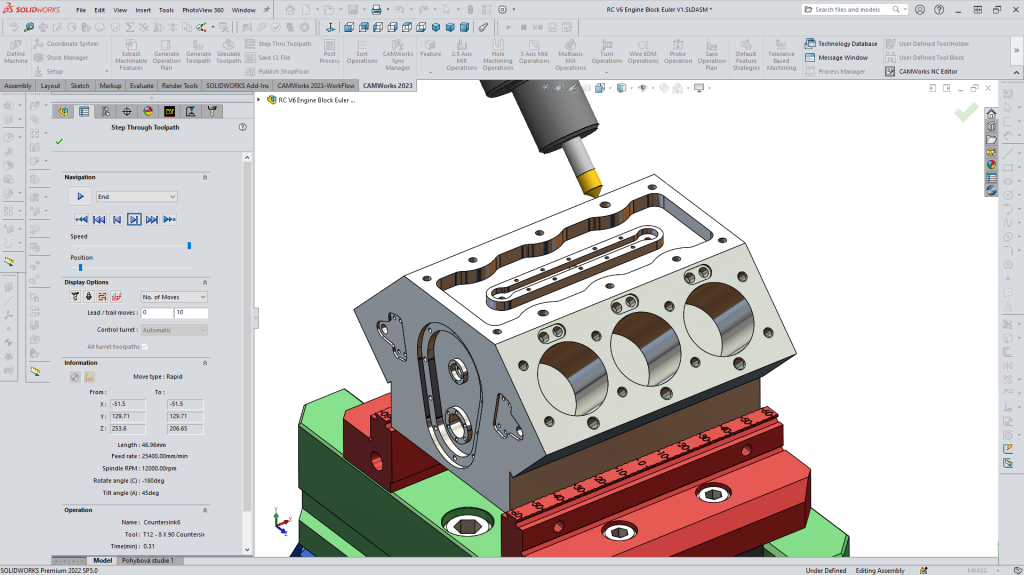
Automotive and Transportation: Automobile and motorsport component makers use CAMWorks to machine engine parts, transmission components, molds for tires or body panels, and other critical pieces. The software’s automation helps speed up programming of high-volume parts while maintaining consistency – valuable in automotive production.
Mold, Die, and Tooling: A traditional stronghold for CAM software, the mold and die industry benefits from CAMWorks’ feature-based approach for core/cavity machining, electrode creation, and repetitive features like pockets and holes. In fact, the company has noted a commitment to serving “the needs of the mold making and machining industries.” Mold makers can leverage CAMWorks to quickly program cavities and cores directly on SOLIDWORKS models of injection molds or die-casting tools, with the CAM operations updating if the design changes. This reduces rework when engineering changes occur on tooling.
General Machining and Job Shops: Many job shops and contract manufacturers use CAMWorks to program a variety of jobs – from simple 2.5-axis milled plates to multi-axis milled parts and turned shafts. Small and mid-sized machine shops appreciate the integration with CAD (since they often receive SOLIDWORKS files from clients) and the automation that can cut down programming time on repeat jobs. CAMWorks is suitable for mill-turn centers and lathes as well, supporting turning and live-tooling operations for complex turned-milled parts, which is valuable for shops making parts like valves, fittings, and machine components.
Electronics and Computer Hardware: CAMWorks has been used in the computer/electronics industry, for example in programming CNC milling of enclosures, heat sinks, and precision components for devices. Its ability to handle both simple 2D machining and intricate 3D surfaces makes it flexible for various component types.
Woodworking and Others: Interestingly, CAMWorks has found application in woodworking and wood products manufacturing. CNC router users in the woodworking field can use the software to program carvings, cabinetry components, or composite material parts. The software’s feature recognition can identify pockets or slots in wood panels just as it does in metal parts, aiding furniture or cabinetry production. Additionally, CAMWorks’ broad applicability means it is also employed in industries like medical device manufacturing (for surgical instruments or implants), oil & gas (for machining of equipment parts), and education (for teaching integrated CAD/CAM).
Underlying all these industries, the common theme is CNC machining – CAMWorks primarily focuses on subtractive manufacturing processes. It covers 2.5-axis and 3-axis milling, 3+2 positional machining, full 4 and 5-axis simultaneous milling, turning (2-axis lathes up to multi-turret, multi-spindle lathes), mill-turn (multi-axis machines that combine milling and turning), and wire EDM for cutting hard materials with electrical discharge. By offering modules for each of these processes under one integrated platform, CAMWorks can be the central CAM programming tool in a manufacturing company that has a mix of different CNC machine types.
Another area of application for CAMWorks is in design-to-manufacturing workflows aligned with smart manufacturing initiatives. Because CAMWorks can interpret model-based definition (MBD) data – such as tolerance and surface finish information embedded in 3D CAD models – it is used to support model-based enterprise processeswhere 2D drawings are minimized. In these scenarios, CAMWorks reads the PMI (product manufacturing information) directly from the 3D model and uses it to guide machining decisions. This capability ties into Industry 4.0 goals of using digital data throughout the production lifecycle, and has been promoted in contexts like “Smart Manufacturing”and “Industry 4.0” adoption on the shop floor.
In summary, CAMWorks’ application areas span from high-end aerospace machining to everyday job shop work. Its integration with CAD and automation of programming make it especially attractive wherever companies want to shorten the cycle from design to finished part – whether that’s in large enterprises or small machine shops across various industrial sectors.
History of CAMWorks: Founders and Product Evolution
The story of CAMWorks traces back to the 1980s and involves multiple companies over the years. The software’s origins lie with a U.S. company called TekSoft, Inc., and an Indian engineering software firm named Geometric Ltd.Through their collaboration and successive corporate changes, CAMWorks grew from an idea to a globally deployed product. Here is a chronological overview of its history and evolution:
TekSoft’s Early CAM Innovations (1980s–1990s): TekSoft, Inc. was founded in 1981 in Scottsdale, Arizona by Gary Fulton (and associates), initially focusing on PC-based CAD/CAM solutions. During the 1980s, TekSoft developed a product line called ProCAM, which was a standalone CAD/CAM system for tasks like 2D milling and turning. ProCAM built TekSoft’s reputation for easy-to-use, affordable CAM software, helping the company gain thousands of users worldwide by the early 1990s. As the industry moved toward solid modeling and Windows-based CAD in the mid-90s, TekSoft sought to create a more integrated CAM solution that could work directly with these new CAD systems.
Birth of CAMWorks (mid-1990s): In 1996, TekSoft partnered with Geometric Ltd. (an engineering software development firm based in Mumbai, India) to develop a revolutionary CAM program that would work inside the emerging 3D CAD packages. This collaboration produced CAMWorks, which was introduced commercially in 1997. CAMWorks distinguished itself as the first fully integrated CAM solution for SOLIDWORKS, a then-new 3D mechanical CAD software that was quickly gaining popularity. Upon its first release in 1997, CAMWorks became a Certified Gold Partner product for SOLIDWORKS – meaning it was fully endorsed and integrated into the SOLIDWORKS environment. This gave CAMWorks a significant early advantage, positioning it as the CAM extension of choice for companies adopting SOLIDWORKS for design. The founders of this vision, Gary Fulton of TekSoft and the development team at Geometric led by CEO Manu Parpia, recognized that feature-based machining and CAD integration were the future of CAM software.
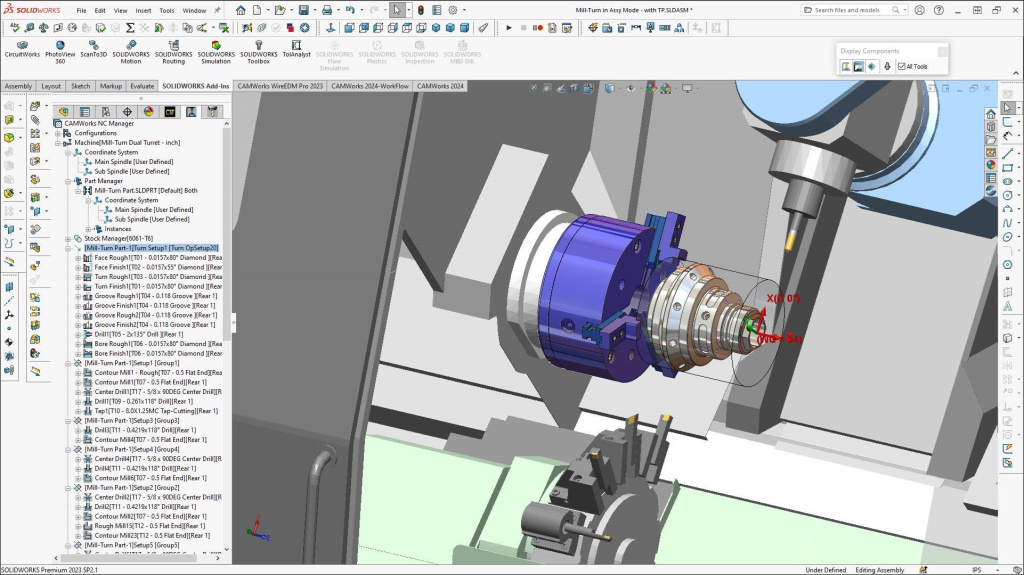
Feature and Capability Growth (2000–2002): In the late 1990s and early 2000s, CAMWorks rapidly evolved its technical capabilities. By 2000, the software had introduced a high-end 3-axis machining core, allowing for sophisticated surface and contour milling required in tool & die work and complex part manufacturing. By 2002, CAMWorks added support for 4-axis and 5-axis simultaneous machining, as well as more advanced multi-axis strategies. This meant CAMWorks could be used not only for simple prismatic parts but also for complex aerospace or automotive components that demand multi-axis CNC machines. During this period, CAMWorks also expanded to cover turning and mill-turn applications, and integrated Wire EDM functionality, making it a broad CAM suite. The early 2000s established CAMWorks as a full-spectrum CAM product, not limited to 3-axis milling.
Geometric’s Acquisition of TekSoft (2005): A major turning point came in 2005 when Geometric Ltd. acquired TekSoft, Inc. This acquisition formalized what had been a long-running partnership: Geometric had been a development partner for CAMWorks for about a decade, contributing offshore development talent, while TekSoft marketed and sold the product in North America and beyond. By 2005, TekSoft had an installed base of over 30,000 licenses of its products (CAMWorks and ProCAM) across 40 countries, with a network of 140 resellers distributing the software. Recognizing the value of this technology and its market, Geometric purchased TekSoft and its CAMWorks business (in a deal valued at around $2.7 million). TekSoft’s co-founder Gary Fulton stepped down from the presidency (after 23 years at the helm) at the time of acquisition, and a new president, Mike Coleman, was appointed to lead the now Geometric-owned TekSoft subsidiary. The acquisition meant that CAMWorks now belonged entirely to Geometric, allowing closer integration of development and marketing. Geometric, as an engineering software and services company, provided a strong financial backing and global reach for CAMWorks. Mike Coleman noted at the time that with Geometric as a parent, TekSoft would “have the resources to continue to develop, distribute and support CAMWorks… one of the premier CAM solutions on the market today.” Under Geometric, the Scottsdale, AZ office remained a key development and support center (Geometric Americas, Inc.), working in tandem with Geometric’s large development team in India.
Product Enhancements and New Markets (2005–2010s): After the acquisition, CAMWorks development continued aggressively. Geometric invested in R&D that led to new modules and improvements:
In 2007, for instance, CAMWorks introduced modules like CAMWorks Nesting (later branded as NESTINGWorks) for optimized layout of parts for sheet cutting, and continued refining its Automatic Feature Recognition algorithms.
The software was continually updated to stay compatible with new versions of CAD software (each year’s SOLIDWORKS release).
By the early 2010s, Geometric pushed CAMWorks into another CAD platform: Solid Edge (by Siemens PLM Software). In 2013, Geometric launched CAMWorks for Solid Edge, touted as the first fully embedded CAM solution inside Solid Edge, similar to what CAMWorks had done for SOLIDWORKS. This expansion meant CAMWorks technology could now serve the Solid Edge user community, providing an alternative to Siemens’ own CAM products. Although adoption by Solid Edge users started modestly, it marked a broadening of CAMWorks’ reach beyond the SOLIDWORKS ecosystem.
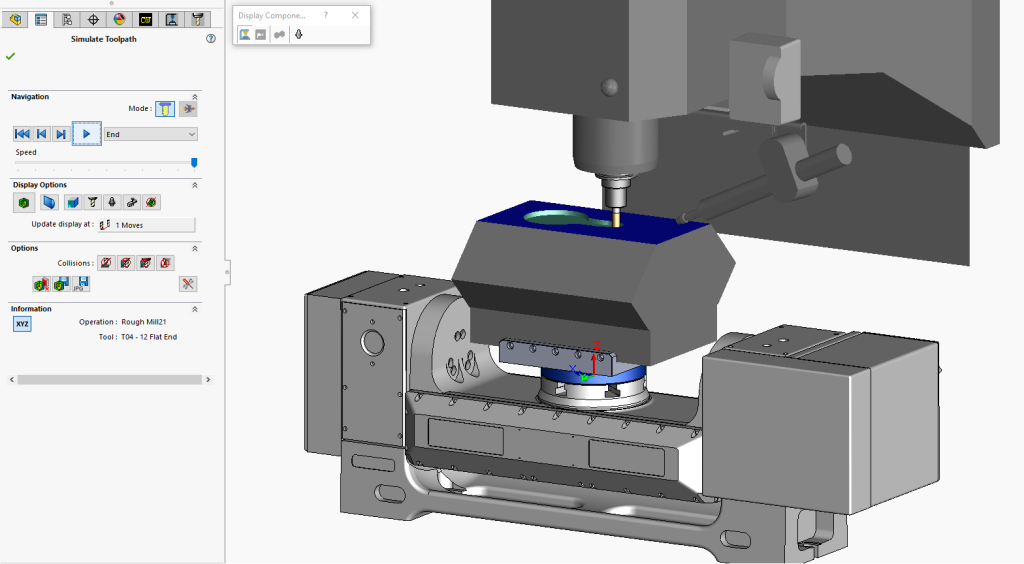
Also around 2013, CAMWorks Virtual Machine was introduced – a machine tool simulation module that could simulate the actual G-code on a virtual 3D model of the CNC machine. This gave users the ability to verify and prove-out their programs within CAMWorks itself, checking for collisions or mistakes before ever running the code on a real machine.
The company also focused on high-speed machining strategies by integrating a toolpath engine called VoluMill. VoluMill (licensed from Celeritive Technologies) provided high-efficiency toolpaths for rough milling, allowing CAMWorks users to significantly reduce cycle times by maintaining constant cutter load. This integration reflected CAMWorks’ strategy of bringing in specialized technology (like VoluMill for toolpaths or simulation engines) to augment its capabilities.
Smart Manufacturing Features (2015–2017): As the manufacturing industry moved towards model-based definition and Industry 4.0 practices, CAMWorks kept pace. In the mid-2010s, Geometric added Tolerance-Based Machining (TBM) to CAMWorks. This innovative feature allows CAMWorks to read GD&T (Geometric Dimensioning & Tolerancing) information and surface finish data directly from the 3D CAD model (for example, using SOLIDWORKS’ DimXpert annotations or MBD data), and then automatically adjust machining strategies to meet those tolerance requirements. For instance, if a hole has a tight positional tolerance, the software might select a boring operation instead of a simple drill to ensure accuracy. TBM was a unique capability that few CAM systems had at the time, and it positioned CAMWorks as a leader in leveraging CAD model intelligence. A related concept introduced was “Machine to the Mean,” wherein CAMWorks would interpret the allowable tolerance ranges on a part and program the cutting toolpaths to the nominal “mean” dimensions – this helped reconcile differences between how designers define parts (with tolerances) and how machinists need to program them (to a specific size aiming for the middle of the tolerance band). Long-standing issues of design vs. manufacturing interpretation could be reduced by this approach.
Entrance of Dassault Systèmes and SOLIDWORKS CAM (2017): Another watershed moment came in 2017. Dassault Systèmes (the parent company of SOLIDWORKS) chose CAMWorks technology to power a new integrated CAM offering called SOLIDWORKS CAM. Announced at SOLIDWORKS World 2017 and released as part of SOLIDWORKS 2018, SOLIDWORKS CAM is essentially a built-in CAM application based on CAMWorks. This meant that every user of SOLIDWORKS on subscription would now have access to 2.5-axis milling and basic turning CAM inside the CAD software, at no extra cost, with an upgrade path to the full CAMWorks product for more advanced needs. The inclusion of CAMWorks’ engine into SOLIDWORKS marked a significant collaboration and validation of CAMWorks’ technology. It suddenly expanded the potential user base of CAMWorks by exposing it to SOLIDWORKS’ enormous global user community (hundreds of thousands of engineers). Geometric/CAMWorks became deeply embedded in Dassault’s ecosystem – the software was described as extending SOLIDWORKS’ “smart manufacturing” capabilities with feature-based machining intelligence. This partnership was the culmination of a long relationship (CAMWorks had been a Gold Partner since 1997) and effectively made CAMWorks technology part of the standard toolset for SOLIDWORKS users. It also meant CAMWorks had to scale its support and robustness, as it would be distributed broadly.
Acquisition by HCL Technologies (2016–2017): Running parallel to the above, in April 2016 Geometric Ltd. agreed to be acquired by HCL Technologies, an $11-billion global IT engineering firm. The deal was completed by mid-2017 after regulatory approvals. Under the acquisition, HCL took over all of Geometric’s products and services (except a joint venture Geometric had with Dassault, which Dassault separately acquired). CAMWorks, as one of Geometric’s flagship intellectual properties, thus became part of HCL. Geometric’s founder and CEO Manu Parpia, who had led the company since 1994 (and was initially hesitant to sell), noted that the deal was “fair and reasonable” and that combining with a larger player would benefit customers and employees. For HCL, the acquisition was strategic: it strengthened HCL’s presence in the engineering software domain, adding CAMWorks and associated technologies to HCL’s portfolio. HCL folded Geometric’s team into its Engineering and R&D Services division. Post-acquisition, the branding of CAMWorks gradually shifted to emphasize HCL – for example, the website and product literature began using HCL CAMWorks branding around 2018. The development centers (in India and Scottsdale, AZ) continued operating, now as part of HCL. HCL’s global reach and resources also opened opportunities to bundle CAMWorks with broader solutions and to invest in further innovation.
Recent Developments (2018–2025): In the years since becoming an HCL product, CAMWorks has seen continued enhancements:
In 2018, HCL partnered with Materialise (a leader in 3D printing software) to introduce a hybrid manufacturing platform. CAMWorks was expanded with additive manufacturing capabilities by integrating Materialise’s technology, allowing users to plan metal 3D printing (additive) and CNC machining (subtractive) in one combined workflow. This was one of the first integrated CAD/CAM solutions for hybrid manufacturing within SOLIDWORKS. HCL’s engineering leadership highlighted the importance of this, with HCL executive GH Rao stating they were “very excited about the potential hybrid manufacturing offers to the future of CAD/CAM, combining advanced integrated CAM technology from HCL with innovative 3D printing technology.” This move positioned CAMWorks towards emerging manufacturing methods.
CAMWorks 2019 and 2020 releases added further automation and intelligence. For instance, the software introduced an Additive Manufacturing module (letting users generate laser deposition toolpaths for metal printing) and extended Tolerance-Based Machining to support turning operations as well. The interface was refined and new strategies like barrel mill tool support (for efficient 5-axis finishing) were added as manufacturing trends evolved.
In 2021, CAMWorks was among the first CAM systems to integrate Sandvik Coromant’s PrimeTurning™ methodology (through a partnership with Sandvik). PrimeTurning is a new turning process allowing pulling the tool in reverse direction for higher efficiency, and CAMWorks incorporated this to let users program turning in a novel way for improved productivity. Likewise, HCL adopted technologies from partners like ModuleWorks to keep simulation and toolpath generation state-of-the-art.
By 2023–2025, CAMWorks has continued annual releases (often numbered by year, e.g. CAMWorks 2023, CAMWorks 2024, etc.) with incremental improvements. The focus remains on deeper CAD integration (supporting the latest SOLIDWORKS and also Dassault’s 3DEXPERIENCE platform), more automation in programming (leveraging things like artificial intelligence for feature recognition enhancements), and addressing user feedback to streamline workflows. The CAMWorks ShopFloor product, introduced in 2019, has matured as well – this is a specialized application for machinists that uses CAMWorks data to provide 3D digital setup sheets and allow machine operators to visualize and simulate jobs in a lightweight interface on the shop floor, thereby reducing miscommunication between programming and production.
Throughout its evolution, CAMWorks has been shaped by its founders and leaders at each phase. Gary Fulton, the co-founder of TekSoft, provided the initial vision of integrated, easy-to-use CAM that persists in the product ethos. Manu Parpia, founder of Geometric, nurtured CAMWorks through critical growth years and ensured the company behind it remained innovative (he was instrumental in embracing ideas like feature recognition early on). After HCL’s takeover, executives like GH Rao (President of Engineering R&D at HCL) have championed CAMWorks as part of a broader strategy to offer end-to-end engineering solutions, investing in new features that align with industry trends (e.g., Industry 4.0 compatibility, additive manufacturing). Meanwhile, long-time CAMWorks technical leaders and product managers – people like Jim Foster (Vice President of CAMWorks Sales & Marketing) and the engineering teams – have stayed with the product across these transitions, contributing continuity and deep expertise.
From a prototype in 1996 to a modern integrated CAM platform in 2025, CAMWorks’ history is a case study in how a software product can evolve through innovation and strategic partnerships, while adapting to the changing ownership in the software industry. Each era – TekSoft, Geometric, and HCL – added layers to the product’s capabilities and market reach, without losing the core identity of what CAMWorks is: integrated, intelligent CAM for the CAD user.
Business Performance and Market Presence
CAMWorks’ business performance can be viewed in terms of its adoption, user base, and role within its parent companies over time. While detailed financial figures for the CAMWorks product line alone are not publicly disclosed, several indicators illustrate its market presence and commercial trajectory:
User Base and Adoption: By the mid-2000s, CAMWorks had achieved a significant user base thanks to TekSoft’s global sales network. As noted, TekSoft had over 30,000 licenses installed worldwide by 2005, a considerable number for a CAM solution. These users ranged from small shops to large OEMs, spread across North America, Europe, and Asia. This established customer base provided a steady revenue stream through software licenses and maintenance contracts. After Geometric’s acquisition, the user base continued to grow, particularly as CAMWorks piggybacked on the success of SOLIDWORKS in the market. Many SOLIDWORKS customers who needed CAM opted for CAMWorks due to its Gold Partner status and integrated nature. With the introduction of SOLIDWORKS CAM in 2017 (which essentially put a basic version of CAMWorks into every seat of SOLIDWORKS on subscription), the potential reach of CAMWorks technology expanded dramatically. Suddenly, hundreds of thousands of SOLIDWORKS users had exposure to CAMWorks’ feature-based CAM (in the form of SOLIDWORKS CAM Standard). This likely translated into increased upgrades and sales of the full CAMWorks for users who outgrew the basic version. While not every SOLIDWORKS user is a machinist, the bundling effectively gave CAMWorks an unparalleled market presence by bundling. By being the backbone of SOLIDWORKS CAM, CAMWorks has arguably one of the largest installed footprints of any CAM engine in the world (even if many of those seats are the limited version). HCL has capitalized on this by offering seamless upgrade paths, encouraging companies to adopt more advanced modules (like 5-axis, turning, etc.) via CAMWorks once they get started with the free SOLIDWORKS CAM.
Revenue Contributions: Geometric Ltd., the previous owner, was a publicly traded company and in its fiscal year ending March 2015, it reported revenues of roughly INR 11 billion (about USD $180 million). This included all of Geometric’s businesses (software products and engineering services). CAMWorks was one of Geometric’s key proprietary products (others included DFMPro and certain PLM tools). While Geometric did not break out individual product revenues in public reports, CAMWorks was a significant contributor, given its widespread adoption. It’s reasonable to infer that CAMWorks brought in tens of millions of dollars in annual revenue by the mid-2010s (considering license sales, subscription renewals, training, and services). After HCL’s acquisition, CAMWorks became part of HCL’s Engineering and R&D Services (ERS) segment. HCL’s ERS business was a $1.2 billion operation around the time of the acquisition, and adding Geometric’s offerings bolstered that. Post-acquisition, HCL reorganized software products like CAMWorks under a division called HCL Software (focused on software IP products). While HCL also does not publicly detail CAMWorks-specific finances, the company has indicated that the acquisition “strengthens HCL’s presence” in manufacturing and PLM software. CAMWorks now benefits from HCL’s global sales force and existing relationships with large manufacturing clients, which can drive more enterprise-scale deals (for example, selling CAMWorks along with HCL’s engineering services as a bundle to big automotive or aerospace firms). The business model for CAMWorks also evolved to include subscription licensing, following industry trends – some recent reports indicate CAMWorks is moving toward subscription-only licensing for future versions, a shift that could increase recurring revenue.
Global Reach and Reseller Network: CAMWorks has an extensive global reach. From early on, the software has been sold in the Americas, Europe, and Asia-Pacific. TekSoft’s original reseller network covered dozens of countries (40+ by 2005), and under Geometric and HCL this network has remained crucial. There are master distributors and resellers in all major industrial regions – for example, in Europe (UK, Germany, Italy, etc.), East Asia (China, Japan, Korea), and India/Middle East. Notably, HCL has kept a presence in the United States for CAMWorks (the former TekSoft office in Scottsdale, AZ, and an office in Troy, Michigan for sales and support). This ensures North American customers have local contacts. The large number of value-added resellers (VARs)not only sell CAMWorks but also provide localized training and support, which has helped adoption in non-English-speaking markets. CAMWorks is available in multiple languages via these partners. The success of some resellers has been recognized by HCL; for instance, Access Manufacturing Systems (a U.S. reseller) was awarded CAMWorks Top Sales Partner of the Year multiple times for its strong performance, reflecting healthy sales in the CAM channel. Overall, CAMWorks can be found in machine shops from Detroit to Düsseldorf to Dongguan, underscoring its global penetration.
Competition and Market Position: In the CAM software market, CAMWorks competes with both standalone CAM systems (like Mastercam, EdgeCAM, HyperMill, and Fusion 360/Mastercam for SOLIDWORKS) and other integrated CAM offerings (like Autodesk’s Inventor CAM or Siemens NX CAM). While Mastercam has historically led the CAM market in sheer number of seats, CAMWorks carved out a significant niche by being the first integrated CAM for SOLIDWORKS and maintaining that status. Many SOLIDWORKS-centric companies adopted CAMWorks instead of switching to a different CAD or using an external CAM that requires file transfers. This gave CAMWorks a loyal user community. Over time, other CAM solutions also integrated with CAD (Autodesk’s HSM for SolidWorks came later, and there are options like GibbsCAM integration), but CAMWorks’ early mover advantage and Dassault’s official backing through SOLIDWORKS CAM have kept it highly relevant. In terms of market share, independent industry analysts have often listed CAMWorks among the top CAM software systems worldwide by install base, though usually behind giants like Mastercam. The strategy of bundling with SOLIDWORKS likely elevated its rank. For HCL, CAMWorks is a strategic product that opens doors to manufacturing clients – it might not rival HCL’s largest revenue generators in IT services, but it provides high margin software revenue and a prestigious reference list of manufacturing customers.
Notable Users: While specific customer names are not always public, over the years CAMWorks has been used by companies such as Boeing (reported use in some aerospace divisions), Samsung Electronics (for certain component fabrication), and numerous mid-size manufacturers and job shops. The mold-making industry, for example, includes many CAMWorks users for injection mold tooling. Additionally, because of SOLIDWORKS CAM’s distribution, many educational institutions and mechanical engineering programs have indirectly used CAMWorks technology to teach CAM basics within SOLIDWORKS, potentially influencing the next generation of CAM programmers to be familiar with it.
In conclusion, the business performance of CAMWorks can be characterized by steady growth, expanding reach, and integration into a larger ecosystem. From a start-up product in the 90s to a component of a multi-billion-dollar tech company’s portfolio today, CAMWorks has proven commercially resilient. Backed by HCL, the software’s development and support are well-funded, and its market presence is likely to remain strong, especially given the foothold in the SOLIDWORKS community and the continuous advancements that keep it competitive. The move towards trends like subscription licensing and Industry 4.0 integration also indicate that CAMWorks’ business model is adapting to current market demands, positioning it for sustained performance.
Mergers, Acquisitions, and Partnerships
The journey of CAMWorks is intertwined with several key mergers, acquisitions, and partnerships that have shaped its direction. Understanding these corporate and collaborative moves provides insight into how CAMWorks grew its capabilities and market footprint:
TekSoft and Geometric Partnership (Pre-2005): Long before any mergers, the foundational partnership was between TekSoft, Inc. and Geometric Ltd. in the mid-1990s. TekSoft had CAM domain expertise and market access, while Geometric had software development expertise and an offshore team. Their partnership produced CAMWorks and lasted nearly a decade under a contract development relationship. This close working relationship foreshadowed later merger activity.
OnCourse Technologies and Early Investment: Around the early 2000s, TekSoft was actually part of a holding structure called OnCourse Technologies, which owned TekSoft and a reseller (Cimtronics). OnCourse’s involvement indicated investor interest in TekSoft’s products. This set the stage for Geometric’s acquisition – Geometric, along with TekSoft management, bought out TekSoft from OnCourse in 2005. While not widely publicized, this shows that even prior to Geometric’s full control, TekSoft had gone through corporate changes involving investor groups, a common pattern for growing software companies.
Geometric’s Acquisition of TekSoft (2005): In January 2005, Geometric Software Solutions Ltd. acquired TekSoft, including the CAMWorks product line. This was a friendly acquisition that essentially merged TekSoft’s operations into Geometric’s fold. TekSoft’s leadership took roles in the combined entity (with TekSoft’s new President working closely with Geometric’s team). Post-acquisition, TekSoft was renamed Geometric Americas, Inc., continuing as the North American arm for CAMWorks. For Geometric, this merger was significant – it transformed Geometric from primarily a services provider and OEM developer into an owner of a commercially successful CAM product. Geometric now controlled the IP of CAMWorks, which allowed more freedom in strategic development (e.g., expanding to Solid Edge, investing in new modules). It also meant Geometric could directly reap license revenues rather than just development fees. The integration was smooth since the companies had collaborated for years. The acquisition also included Cimtronics (TekSoft’s top reseller), which was spun off to TekSoft’s former owner Gary Fulton – indicating a careful structuring to keep the sales channel stable. Geometric’s move was seen as a win-win: TekSoft got financial stability and development muscle, and Geometric got a product business with global customers.
Joint Venture with Dassault Systèmes (2007): Shortly after acquiring TekSoft, Geometric entered a joint venture with Dassault Systèmes called 3DPLM (in 2007). This JV was primarily to handle development and support for certain Dassault PLM products (like CATIA and ENOVIA) out of India. While CAMWorks was not directly part of that JV (CAMWorks remained Geometric’s own product), the JV indicated how closely Geometric was working with Dassault. This relationship likely helped later when Dassault considered whom to partner with for SOLIDWORKS CAM. Geometric’s credibility with Dassault and a decade of being a Gold Partner with SOLIDWORKS made CAMWorks an obvious choice.
CAMWorks for Solid Edge Collaboration (2013): One notable partnership was with Siemens PLM Softwareto create CAMWorks for Solid Edge. Geometric collaborated with Siemens (the maker of Solid Edge CAD) to embed CAMWorks into Solid Edge. This partnership was announced in 2013 as delivering the “first fully embedded CAM inside Solid Edge.” The collaboration entailed technical integration and co-marketing: Siemens welcomed an independent CAM solution to support Solid Edge users, and Geometric gained a new channel via Siemens’ customer base. While Siemens had its own CAM (NX CAM and the older CAM Express), the partnership suggested that an easier, integrated solution was needed for Solid Edge mid-market customers. Geometric likely worked with Siemens’ API and certification process to ensure CAMWorks behaved like a native part of Solid Edge. The partnership was significant in expanding CAMWorks beyond the Dassault universe. However, it is noted in industry commentary that the uptake of CAMWorks for Solid Edge (sometimes abbreviated CW4SE) was limited, perhaps due to competition with Siemens’ offerings and the Solid Edge market size. Still, the collaboration demonstrated CAMWorks’ flexibility to integrate with multiple CAD systems and showed Geometric’s willingness to partner even with a competitor of Dassault in the CAD space.
HCL’s Acquisition of Geometric (2016): In April 2016, a major corporate development occurred: HCL Technologies Ltd. announced the acquisition of Geometric Ltd. This effectively meant HCL was acquiring CAMWorks (along with Geometric’s other businesses), since Geometric would cease to exist independently. This deal was complex due to the Dassault joint venture – ultimately HCL acquired Geometric’s primary business (including CAMWorks) while Dassault Systèmes simultaneously acquired Geometric’s 50% stake in the 3DPLM JV. The result was CAMWorks and all related IP becoming part of HCL. This acquisition was driven by HCL’s strategy to strengthen its engineering software and services portfolio; multiple bidders were interested in Geometric, but HCL’s offer prevailed. After completion in mid-2017, Geometric’s teams were absorbed into HCL. HCL retained the development centers in Mumbai, Pune (India) and kept the Geometric Americas office running. The integration into HCL brought CAMWorks more resources for development, and potentially new sales synergies (HCL could cross-sell CAMWorks to its manufacturing clients and include it in broader projects). Under HCL, CAMWorks is now categorized under HCLSoftware, a division focusing on software products (HCLSoftware notably also acquired IBM’s some software products around the same time, indicating a push into software IP business). The transition seems to have been successful – HCL kept key personnel and continued releasing new CAMWorks versions annually without interruption.
Partnership with Dassault Systèmes – SOLIDWORKS CAM (2017): As mentioned earlier, one of the most impactful partnerships for CAMWorks has been with Dassault Systèmes in launching SOLIDWORKS CAM. This collaboration, formally unveiled in 2017, essentially made CAMWorks the engine inside SOLIDWORKS CAM. Dassault and HCL (Geometric) worked together to create a version of CAMWorks that could be packaged within SOLIDWORKS’ user interface and licensed appropriately. SOLIDWORKS CAM (Standard) became a built-in feature for SOLIDWORKS users, and an optional SOLIDWORKS CAM Professional (with 3+2 machining and turning) was offered as an upsell, which corresponded to CAMWorks bundles. The partnership involved co-development (ensuring smooth integration and that the CAMWorks TechDB and features fit Dassault’s vision of an easy CAM tool). It also involved coordinated marketing – SOLIDWORKS World events and press releases featured CAMWorks as a partner solution enabling “smart manufacturing.” For CAMWorks, this collaboration massively increased its credibility and visibility. For Dassault, it filled a longstanding gap (having an in-house CAM solution for SOLIDWORKS). Even though CAMWorks was now part of HCL during the final roll-out, the partnership agreements were in place from Geometric days, and HCL has honored and continued them. SOLIDWORKS CAM remains powered by CAMWorks to this day, indicating a durable collaboration.
Technology Partnerships (2010s): Aside from big corporate moves, CAMWorks’ team has engaged in numerous technology partnerships to enhance the product:
The integration of VoluMill for high-speed machining was done via partnership with its developer, Celeritive.
CAMWorks’ simulation and verification likely leverage components from industry-standard providers like ModuleWorks or MachineWorks (common in CAM software) – in fact, when adding PrimeTurning, HCL worked with ModuleWorks (which developed the PrimeTurning toolpath engine) to integrate that capability.
A partnership with Sandvik Coromant (the cutting tool giant) was announced to bring Sandvik’s PrimeTurning methodology into CAMWorks. In this partnership, Sandvik provided the know-how and tool libraries for PrimeTurning, while HCL integrated them. Sandvik’s product manager for PrimeTurning commented that partnering with CAMWorks was vital to bring the new technique to CAMWorks users, reflecting a collaborative effort to introduce innovation to end-users.
HCL also collaborates with SOLIDWORKS on the 3DEXPERIENCE platform front: for example, “CAMWorks for 3DEXPERIENCE SOLIDWORKS” indicates working with Dassault to ensure CAMWorks technology is available in the connected cloud-based versions of SOLIDWORKS.
Additionally, CAMWorks is involved in partnerships for education (such as programs with universities or training centers to certify students on CAMWorks, often in cooperation with SOLIDWORKS academic programs).
Reseller and OEM Partnerships: CAMWorks has been offered as an OEM product in certain cases. For example, some machine tool vendors have bundled CAMWorks with their machines or offered it as a recommended CAM system due to its ease of use. One such case historically was S TAuto (a machine tool dealer) bundling CAMWorks for certain CNC mills. The details of OEM deals are not always public, but it’s known CAMWorks has been part of machine manufacturer solution portfolios (similar to how Mastercam or others have OEM deals). The extensive reseller network itself is a partnership model – companies like GoEngineer, CATI, and others that are major CAD resellers also partner with HCL to sell CAMWorks, often alongside SOLIDWORKS. These partnerships amplify the market reach and also provide feedback loops for improvement via close contact with end-users.
In summary, CAMWorks’ trajectory has been heavily influenced by strategic acquisitions (TekSoft into Geometric, Geometric into HCL) which brought stability and scale, and by key partnerships (with CAD companies like SOLIDWORKS and Solid Edge, and with technology providers like Materialise and Sandvik) which extended the software’s capabilities and user base. The ability of CAMWorks to be a “team player” – fitting into larger platforms and working with industry leaders – has been one of its strengths. As of 2025, CAMWorks finds itself backed by a tech giant (HCL) yet still collaborating closely with other industry leaders, a balance that bodes well for its continued relevance in the CAD/CAM landscape.
Innovations, Unique Features, and Strengths
From its inception, CAMWorks has been positioned as an innovative solution in the CAM market. Over the years, it introduced or popularized several concepts that set it apart from traditional CAM systems. Here we highlight the key innovations, unique features, and overall strengths that define CAMWorks:
Feature-Based Machining and Automatic Feature Recognition: The flagship innovation of CAMWorks is its feature-based approach to CAM programming. Unlike CAM software that works mainly with geometric toolpaths drawn manually by the programmer, CAMWorks identifies manufacturing “features” directly from the solid model. These features include prismatic shapes like holes, pockets, slots, bosses, and more complex multi-surface features. Once features are identified, CAMWorks can automatically apply appropriate machining operations to them through its knowledge base. This capability, known as Automatic Feature Recognition (AFR), was a groundbreaking feature when CAMWorks introduced it. It significantly reduces the tedious work of defining toolpath geometry for each cut – instead, the software does initial recognition and suggests operations. For example, if a block has a through-hole, CAMWorks will recognize the cylindrical hole feature and automatically propose a drilling operation with an appropriate drill size, depth, and strategy. The programmer can then adjust or accept it. This saves time, especially on parts with many features (e.g., a mold plate with dozens of holes and pockets). CAMWorks was among the first to bring robust feature recognition to market, and over time it has refined AFR to handle an expanding variety of cases (including features on turned parts, multi-axis features, etc.). This approach aligns with how designers think (in terms of features) and thus creates a more intuitive programming workflow, especially for those users who are design engineers wearing a CAM hat.
Knowledge-Based Machining (TechDB): Hand-in-hand with feature recognition is the idea of knowledge-based machining. CAMWorks includes a Technology Database (TechDB) – essentially a customizable database of machining strategies and rules. Users (or the default library) can define rules like: “for a hole of diameter X in material Y, use a drill of size X, with these speeds/feeds and this depth strategy.” When CAMWorks recognizes features, it consults the TechDB to automatically apply the predefined best practices. This means experienced CAM programmers can input their shop’s knowledge into CAMWorks, and then even less-experienced users can generate consistent results by relying on those stored processes. It’s a form of automation and standardization– ensuring that machining is done the “preferred way” every time a feature is encountered. The TechDB can be edited via a user-friendly interface or exported/imported, allowing companies to share knowledge libraries across multiple installations. Knowledge-based machining significantly cuts down programming time for repeat jobs and ensures consistency (one of CAMWorks’ slogans is “capture and reuse your best practices”). This concept, while not unique only to CAMWorks, was a strong focus of CAMWorks early on and remains a core strength. Many competitors added similar capabilities later, but CAMWorks’ implementation is highly regarded for the depth of customization it offers.
Full CAD Integration and Associativity: A defining strength of CAMWorks is that it is embedded within CAD software (like SOLIDWORKS). This means the CAM interface appears as just another tab in the CAD program. The tight integration yields several benefits:
There is one file containing both CAD and CAM data, so data management is simplified (no need to manage separate model and toolpath files).
Model associativity: If the 3D design model is modified (say a hole diameter changes or a pocket moves), CAMWorks will flag the change and can update the machining operations automatically to accommodate it. Toolpaths stay linked to the geometry, reducing re-programming effort when designs iterate. This is crucial in environments with frequent engineering changes.
The user operates in a single familiar CAD environment – for a SOLIDWORKS user, CAMWorks feels like a natural extension, with a consistent look and feel. They don’t have to learn an entirely different UI paradigm.
Eliminating export/import: Without integration, a designer exports a file (like IGES or STEP) and the CAM programmer imports it into CAM software, possibly causing translation errors or version mismatches. CAMWorks bypasses this, improving reliability and saving time. It also means no loss of model intelligence – things like feature information, colors, PMI, etc., are all present to the CAM program since it’s looking directly at the native model.
This deep integration was an innovative approach when first implemented. Over time, the integration has only gotten tighter – for instance, CAMWorks supports SOLIDWORKS configurations (multiple design variants in one file) and can create CAM setups for each configuration. It also integrates with SOLIDWORKS’s API, allowing automation and macros that can drive both design and CAM changes together. The result is what CAMWorks often markets as a “single source of truth” for design and manufacturing data.
Machining Intelligence and Automation: Beyond recognizing features, CAMWorks incorporates what it calls “machining intelligence” to automate many decisions a programmer would otherwise make manually. We’ve mentioned TechDB for knowledge reuse. Additionally, CAMWorks can automatically select cutting tools from a tool crib that fits the feature dimensions, pick cutting conditions from material libraries, and even sequence operations in a logical order (e.g., do roughing before finishing, machine all features on one plane before indexing to another, etc.). The goal is to minimize the number of manual inputs required from the user. In a highly optimized scenario, a part can be programmed almost completely automatically by CAMWorks after loading the model – the user might just review and tweak a few parameters. While in practice complex parts do need human finesse, the automation can easily save significant programming time (the company has often cited examples of reducing programming time by 50% or more, and with Tolerance-Based Machining they claim up to 70% reduction for certain tasks). This automation especially shines in high-volume production where similar features repeat; CAMWorks excels at recognizing patterns and applying the same method repeatedly without fatigue or oversight.
Tolerance-Based Machining (TBM) and “Machine to the Mean”: A newer unique feature (introduced around 2017) is Tolerance-Based Machining. CAMWorks can utilize 3D PMI data – which includes dimensional tolerances, surface finish requirements, and GD&T – to adapt how it machines a part. For example, if a boss is marked with a +/-0.01 mm tolerance, CAMWorks might choose a finer finishing pass or a different tool than it would for a boss with a +/-0.1 mm tolerance. It essentially reads the design intent in terms of precision and quality directly from the model. By doing so, it helps ensure the manufactured part meets the design specifications without the programmer having to manually adjust every operation for tolerance. One manifestation of this is the “Machine to the Mean” concept, where if a tolerance range is given, CAMWorks will target the mean dimension by default. This strategy helps in achieving a balanced approach that maximizes the chance of a part staying within tolerance after manufacturing variability. These features are particularly valuable in model-based enterprises and align with digital twin philosophies – the CAM software is directly consuming digital design intent and turning it into manufacturing intent. It reduces the interpretation errors that can occur when humans read drawings or models and decide how to adjust machining. TBM is relatively rare in CAM offerings, making CAMWorks stand out for companies heavily using MBD (Model-Based Definition).
Multi-axis and Advanced Machining Capabilities: While ease-of-use and automation are big selling points, CAMWorks also prides itself on having the technical depth for advanced machining:
Its 5-axis simultaneous machining module allows complex surfacing operations needed in aerospace and medical industries. Users can do swarf cutting, 5-axis contouring, and more, with control over tool axis and avoidance strategies.
Mill-Turn and complex lathes are supported, including synchronization for multi-turret machines, part transfer between spindles, Y-axis milling on lathes, etc. This caters to the growing use of multitasking CNC machines.
Wire EDM functionality in CAMWorks can program 2-axis and 4-axis (tapered) wire EDM cuts with tab control, glue stops, etc., which is critical for tool and die shops.
High-speed machining: with VoluMill integrated, CAMWorks offers high-efficiency roughing toolpaths. This allows users to drastically reduce roughing times and prolong tool life by using advanced trochoidal-like motion. High-speed strategies are a must-have for modern CAM, and CAMWorks includes them natively through this integration.
Specialty tool support: CAMWorks keeps up with modern cutting tool advancements. For instance, it added support for new shapes like barrel mills (circle segment cutters) which are used for efficient finishing in 5-axis machining. Not every CAM software has built-in strategies for these unique tools, but CAMWorks does, demonstrating its commitment to staying current with machining technology.
Sandvik PrimeTurning™: As discussed, CAMWorks was an early adopter of this new turning method, showing its willingness to incorporate novel manufacturing techniques that can give users a productivity edge.
True G-code Simulation (Virtual Machine): CAMWorks provides an integrated simulation environment called Virtual Machine, which can simulate the actual CNC machine’s movements using the post-processed G-code. This is an important feature for ensuring that the generated code will run without issues on the machine. It accounts for kinematics of specific machine models (e.g., a 5-axis mill’s rotary limits or a lathe’s turret positions) and checks for collisions or over-travel using the same code that will be sent to the machine’s controller. By simulating the true G-code rather than just the toolpath, CAMWorks helps users avoid costly errors and crashes. This is a strength particularly valued by users with complex multi-axis machines where mistakes can be very expensive. Virtual Machine includes a library of machine models and controllers (the software supports many common CNC controllers like Fanuc, Siemens, Haas, etc.). It effectively provides a virtual dry-run of the machining process.
Extensibility and Customization: CAMWorks can be tailored to specific needs. It has a robust API (application programming interface) and supports macro recording. This means users can automate repetitive tasks or integrate CAMWorks with other systems (for example, linking CAMWorks to an ERP/MES system to fetch tooling data or feed estimated machining times back to quoting software). CAMWorks’ openness allows power users to create add-ons or scripts. Additionally, because it resides inside SOLIDWORKS, it can work in concert with other SOLIDWORKS add-ins (like DriveWorks for automation, or PDM systems for data management). This flexibility and integration potential is a strength for companies looking to build streamlined digital process chains.
Ease of Use and UI: A perhaps less quantifiable strength but often cited by users is CAMWorks’ user-friendly interface, especially for those already familiar with SOLIDWORKS. The learning curve for a design engineer to start doing CAM is smaller with CAMWorks than with many standalone CAM packages, since the environment is the same and the concept of features is familiar. CAMWorks uses interactive graphics, wizard-style dialogs for operations, and offers helpful defaults, which collectively lower the barrier to entry. TekSoft’s legacy was one of “ease of use” (as they advertised since the ProCAM days), and that focus has carried through. Many CAMWorks adopters note that new programmers can become productive faster, which is an asset for businesses that can’t afford long training cycles.
Continuous Updates and Support: Finally, an important strength is that CAMWorks is a mature, actively developed product with a consistent update cadence. Every year (aligned with SOLIDWORKS release cycles), HCL releases a new version of CAMWorks with enhancements, bug fixes, and support for new CAD versions. This reliability means users can count on the software to evolve with their needs and with operating system/hardware changes. The backing by HCL ensures that support is available globally, and there’s an extensive knowledge base and community (forums, user groups). CAMWorks also offers certified training programs. All these factors (regular improvements, support, training) contribute to its strength as a solution that companies can invest in long-term.
In summary, CAMWorks’ unique value lies in its automation (feature recognition & TechDB), integration (embedded CAD/CAM), and breadth of capability (from 2-axis to 5-axis and beyond). These, combined with ongoing innovation such as tolerance-based machining and embracing new techniques like hybrid manufacturing, make CAMWorks a comprehensive and forward-looking CAM system. Its strengths align well with the needs of modern manufacturing: the need to do things faster, with fewer errors, with smarter use of digital data, and to handle complex tasks when needed. While no CAM system is perfect for every scenario, CAMWorks has carved a strong position by focusing on those strengths and continuously expanding what it can do.
Leadership Perspectives and Quotes
The evolution and success of CAMWorks have been guided by the vision of its leaders, from the founding team at TekSoft and Geometric to the current leadership under HCL. These leaders have often articulated the philosophy and direction of CAMWorks in public statements. Here we highlight a few notable quotes from company leadership that shed light on their perspective about the software and company:
Michael Coleman – former President of TekSoft (circa 2005): Upon the acquisition of TekSoft by Geometric in 2005, Michael Coleman, who was appointed TekSoft’s president, emphasized the continuity of CAMWorks’ mission. He stated, “With Geometric as a strong financial partner, TekSoft will have the resources to continue to develop, distribute and support CAMWorks, a SOLIDWORKS Certified Gold Product for machining that is one of the premier CAM solutions on the market today.” This quote reflects the pride in CAMWorks’ status as a leading integrated CAM tool and confidence that the Geometric partnership would bolster its development. Coleman also highlighted TekSoft’s “commitment to meet the needs of the mold making and machining industries” – reinforcing that the company understood its core user base and would keep innovating for those users. These remarks came at a time of transition and helped assure customers and resellers that CAMWorks would continue strong under new ownership.
Jim Foster – VP of Channel Sales & Marketing for CAMWorks (Geometric/HCL): In a press release for CAMWorks 2017 (Geometric’s last release before HCL’s takeover), Jim Foster spoke about the software’s strategic direction. He said, “The additions to CAMWorks 2017 reinforce our vision of providing customers with a level of CNC programming automation well beyond the industry norm. As the design and manufacturing world continues to adopt SOLIDWORKS Model Based Definition (MBD), Product Manufacturing Information (PMI), and worldwide initiatives like Smart Manufacturing and Industry 4.0, CAMWorks will lead in providing faster design-to-manufacturing solutions.” This quote encapsulates the company’s focus on automation and alignment with new industry trends. Foster is essentially saying that CAMWorks isn’t just keeping up with trends like MBD and Industry 4.0, but aiming to lead by integrating those trends (such as using PMI for automation) into CAM programming. It’s a clear statement of CAMWorks positioning itself at the forefront of smart manufacturing practices and leveraging its unique strengths (like tolerance-based machining) to differentiate from “industry norm” CAM software.
Manu Parpia – Founder and CEO of Geometric Ltd.: While Parpia generally spoke from the corporate perspective, at the time of HCL’s acquisition he noted the benefits of the deal. In interviews he mentioned, “I welcome this as a truly synergistic transaction, as both our employees and customers will benefit… Our customers will have access to a wide range of engineering services which complement Geometric’s offerings.”Although this quote was about the acquisition overall, it reflects Parpia’s view that CAMWorks (as part of Geometric’s offerings) would thrive under HCL due to synergy. He, as the founder who guided CAMWorks for nearly two decades, believed that joining a larger entity would provide the product more opportunities and support, rather than stifling it. Parpia’s leadership had established CAMWorks as a respected product, and his approval of HCL’s stewardship was a positive signal to the market that the product was in good hands.
GH Rao – President of Engineering and R&D Services, HCL Technologies: Representing HCL’s top engineering management, GH Rao has spoken about CAMWorks in the context of new ventures, like the hybrid manufacturing partnership. He said in 2018, “We are very excited with the new partnership and the potential hybrid manufacturing offers to the future of computer-aided design and manufacturing. By combining advanced integrated CAM technology from HCL with the innovative 3D printing technology from Materialise, we look forward to enabling companies to create innovative products which can be brought to the market faster and at a lower cost.” This quote illustrates HCL’s forward-looking approach with CAMWorks. Rao identifies CAMWorks as “advanced integrated CAM technology” – essentially acknowledging that integration (CAMWorks’ core philosophy) is a key to unlocking future manufacturing workflows like hybrid manufacturing. His focus on bringing products to market faster and cheaper echoes the value proposition CAMWorks has always had (productivity and efficiency), but now extended to new domains (additive+subtractive). It also shows how HCL leadership sees CAMWorks not just as a CAM tool, but as part of a bigger picture in digital manufacturing innovation.
User and Partner Testimonials: While not company leadership per se, it’s worth noting that SOLIDWORKS executives have also commented on the partnership. For example, during the launch of SOLIDWORKS CAM, the SOLIDWORKS CEO Gian Paolo Bassi highlighted that adding CAM (via CAMWorks) was about enabling “smart manufacturing” and giving users the tools to go from design to manufacture in one system. This external leadership perspective underscores the value that Dassault saw in CAMWorks technology. Additionally, reseller leaders like Dave Dulong, President of Access Manufacturing (top CAMWorks reseller), praised CAMWorks by saying their goal is to “deliver the most advanced CAM solution on the market to machining companies” and being recognized by HCL for their success indicates how CAMWorks is viewed as a leading solution by those who sell and support it daily.
These quotes collectively paint a picture of a leadership team that has consistently emphasized innovation, automation, and meeting industry needs for CAMWorks. From TekSoft’s early promise of a premier CAM solution, to Geometric’s vision of automating CNC programming beyond norms, to HCL’s excitement about integrating CAMWorks into next-gen manufacturing paradigms – the leadership messaging aligns well with the development trajectory of the product itself. It’s evident that a strong belief in the integrated CAD/CAM approach and in pushing the technology envelope has been at the heart of CAMWorks’ stewardship. The result of that leadership vision is seen in how CAMWorks has maintained its relevance and competitive edge through decades of technological and market changes.
Vendor: HCL