
Tebis: Four Decades of CAD/CAM Innovation in Manufacturing
The information is currently being reviewed and updated. If you notice any errors or inaccuracies, please let us know.
Introduction
On the outskirts of Munich in the mid-1980s, two young engineers set out with a bold vision: to make advanced computer-aided manufacturing technology accessible to ordinary machine shops. That vision gave birth to Tebis, a CAD/CAM software system that has quietly become a backbone of modern toolmaking and industrial production. Over the past 40 years, Tebis has evolved from a startup project digitizing paper blueprints into a comprehensive digital manufacturing platform used by automotive giants and aerospace specialists alike. It’s a story of steady innovation and adaptation – of how an independent German company transformed niche engineering expertise into a global CAD/CAM powerhouse.
Today, Tebis Technische Informationssysteme AG (the company behind Tebis software) stands as a leading provider of CAD/CAM and MES solutions for manufacturing. Headquartered in Martinsried, Germany, Tebis remains owner-managed and proudly independent even as it serves a worldwide customer base. The software itself has grown into an expansive suite for designing, planning, and controlling complex machining processes. But Tebis is more than just code – it’s a reflection of decades of industry know-how, close partnerships with manufacturers, and a relentless focus on improving how things are made. In an era when product development cycles are shrinking and quality demands are rising, Tebis continues to give companies an edge by automating and optimizing their production workflows.
Overview and Vendor
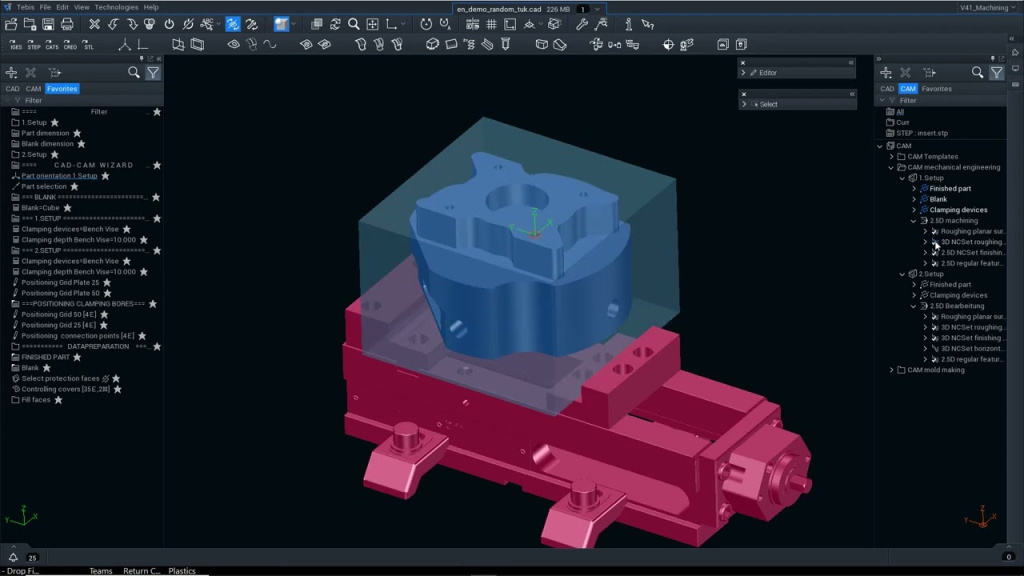
Tebis is a high-end computer-aided design and manufacturing system – essentially a software platform that lets engineers and machinists plan, simulate, and execute complex machining tasks with precision and efficiency. In practical terms, Tebis allows users to create 3D digital models of parts or tools, develop optimal toolpaths for CNC machines (milling, drilling, turning, etc.), simulate those machining processes virtually to avoid errors, and ultimately generate the NC code that runs on real factory equipment. It’s a one-stop environment to go from virtual design to physical manufacture.
The software is developed and sold by Tebis Technische Informationssysteme AG, commonly known as Tebis AG. The company was founded in Germany and remains headquartered in the Munich suburb of Martinsried. Tebis AG has grown into a worldwide organization with offices and subsidiaries across Europe, Asia, and North America – including locations in Germany, the United States, the UK, Sweden, France, Italy, Spain, Portugal, China, and more. With around 400 employees globally and annual revenues exceeding €50 million, Tebis AG has the scale of a mid-sized tech firm yet retains the ethos of a highly specialized engineering company. Unusually for a tech company of its age and reach, Tebis is still privately owned and managed by its original founders and board members, ensuring a continuity of vision over the decades.
As a software product, Tebis distinguishes itself by covering a broad spectrum of the manufacturing process. It is both a CAD system (for design and geometry modeling) and a CAM system (for programming manufacturing operations). In fact, Tebis positions itself as a complete solution for end-to-end production: from early design stages and feasibility analysis, through NC programming and toolpath optimization, to shop-floor execution and even production monitoring. In recent years, Tebis has also integrated a manufacturing execution system (MES) component – known as ProLeiS – which helps with scheduling, resource management, and real-time tracking of jobs in the workshop. This integration of CAD, CAM, and MES under one roof is a key part of Tebis’s value proposition, allowing companies to manage the entire digital thread of manufacturing within a unified environment.
The vendor, Tebis AG, prides itself on offering not just software, but also expert consulting and services to ensure customers succeed with the technology. “We see ourselves as a specialist in software, services and consulting with the goal of continuously improving our customers’ processes and accompanying them through the digital transition,” says Bernhard Rindfleisch, one of Tebis’s founders and long-time board members. In other words, Tebis AG doesn’t simply drop a software package at a client’s door; they work closely with manufacturers to tailor the system to their specific machines, train their staff, and optimize their workflows. This hands-on, partnership-driven approach has been in the company’s DNA from the start and remains a cornerstone of its success.
Key Application Areas and Industries
From its earliest days, Tebis was engineered with a clear focus on industries that demand extremely precise and efficient machining of complex parts. Over time, the software has become a staple in several key sectors:
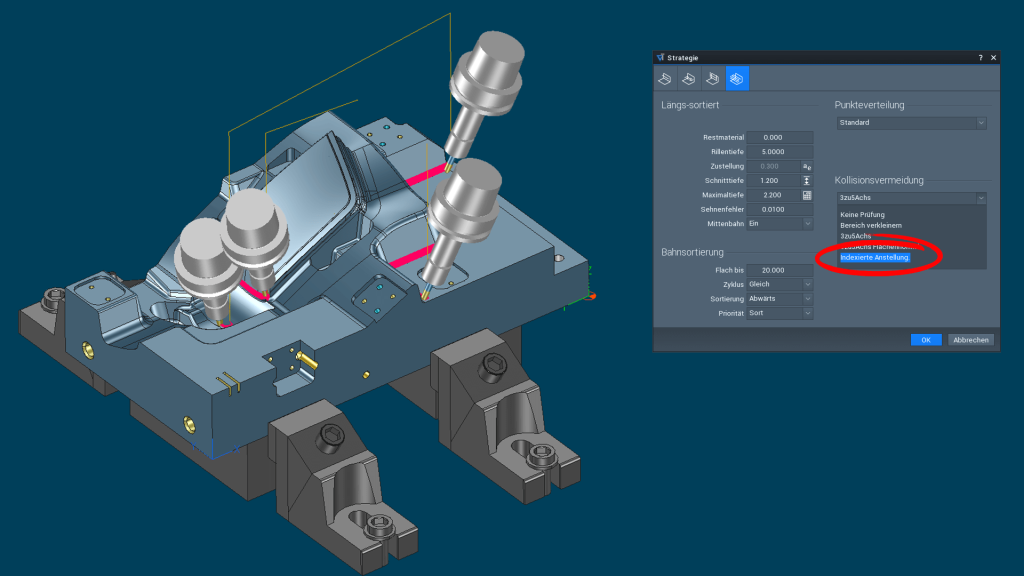
Automotive Tool & Die: One of the strongest domains for Tebis is the automotive industry, particularly in die manufacturing. Car manufacturers and their suppliers use Tebis to design and machine large stamping dies, molds, and fixtures used in producing car body panels and components. Companies like BMW, Volkswagen, Daimler, Ford, and Porsche have been noted as Tebis users for crafting the specialized tooling their factories require. The software excels at handling the free-form surfaces and fine tolerances needed for automotive body dies, and it supports processes like 5-axis milling and deep-hole drilling which are common in this field.
Mold & Pattern Making: Tebis is widely adopted in mold making for plastics and in pattern making (model prototyping). Mold manufacturers use it to design cavities and cores for injection molds, ensuring complex geometries can be machined to mirror finishes. The CAM capabilities – including high-speed cutting (HSC) strategies and electrode design for EDM – are tailored to typical mold shop needs. Companies such as Hella Werkzeug-Technologiezentrum or Schneider Form (specialists in injection molds) have leveraged Tebis to boost productivity and quality in mold fabrication.
Aerospace and Defense: In the aerospace sector, precision and reliability are paramount. Tebis’s ability to produce collision-free toolpaths and simulate the entire machining environment has attracted aerospace manufacturers and their subcontractors. The software is used to machine airframe components, turbine parts, and complex assemblies from high-performance materials. For example, Toyota Motorsport (which also handles aerospace projects) and various European aerospace suppliers rely on Tebis to meet strict requirements. Its support for multi-axis milling and composite machining processes (like trimming or laser cutting of composite parts) makes it suitable for advanced aerospace applications.
General Mechanical Engineering & Production Machining: Beyond molds and dies, Tebis is also used by job shops and engineering companies for general production machining – especially for one-off or small batch parts that require elaborate CAM programming. It’s not uncommon to see Tebis driving the CNC mills at specialist manufacturers of large machinery, energy sector components, or precision equipment. The software’s versatility (covering milling, turning, drilling, and even niche processes like laser hardening) means a single system can program a variety of machines on a shop floor. This “ultimate CAD/CAM versatility in a single application,”as Tebis marketing touts, appeals to shops that want to consolidate their programming tools.
Model Making and Prototyping: Tebis also has roots in industrial model making, which involves creating full-scale models or prototypes of designs (for example, concept car models, styling prototypes, or architectural models). The software’s origins in surface digitization and NC milling of models have carried forward into modern features for reverse engineering (converting physical objects to CAD data) and 5-axis machining of foam, wood, or aluminum models. Design studios and model shops use Tebis to quickly go from a concept to a tangible model with high accuracy, which is essential for iterative design processes.
At its core, Tebis is designed for single-part manufacturing environments where each component or tool is unique and the emphasis is on precision and optimal machining strategy rather than mass production of identical parts. Whether it’s a giant press die for an SUV door panel or a tiny electrode for an EDM process, Tebis provides the tools to design, machine, and inspect the piece efficiently. The software’s broad interface support also means it plays well in heterogeneous environments – it can import design data from all major CAD systems (CATIA, NX, SolidWorks, Creo, etc.) and export NC programs compatible with virtually any CNC machine controller. This interoperability has helped Tebis find a place in many different manufacturing ecosystems.
Origins and Evolution of the Tebis System
The story of Tebis began in 1984, amid a wave of industrial digitalization that was just starting to reach smaller manufacturing firms. Bernhard Rindfleisch and Jens Hagen, two entrepreneurial engineers in Munich, founded a small partnership (GbR) that year to offer consulting, training, and custom programming services. Rindfleisch’s driving vision – as company lore recalls – was to “make computer-aided NC technology and largely automated manufacturing accessible to small and medium-sized companies.” In the early 1980s, CAD/CAM technology was often confined to big corporations with mainframe computers or expensive workstations. The Tebis founders sensed an opportunity to bring those benefits to the broader market by leveraging personal computers and clever software.
Within the first six months of operation, the team pivoted sharply toward developing their own CAD/CAM solution. By 1986, Tebis had launched its Version 1.0, which achieved a notable milestone: it was one of the first 3D CAD/CAM systems to run on a PC (MS-DOS). In an era when most CAD systems were 2D and ran on specialized hardware, Tebis 1.0 stood out. The early software was primitive by today’s standards – it required two monitors (one text-based for commands, one graphical for the geometry display) and inputs were made via a digitizer tablet with a paper overlay that acted as the menu interface. Yet, this setup allowed users to digitize paper drawings and generate basic NC toolpaths for milling machines. Tebis effectively turned a PC into a drafting board and NC programming station, opening the door for smaller shops to embrace computer-aided manufacturing.
Through the late 1980s and 1990s, Tebis iteratively expanded its capabilities and modernized its platform:
In 1989, Tebis Version 2.0 introduced an interactive graphical user interface. Rather than typing cryptic commands, users could navigate menus on-screen – albeit in a distinct Tebis-styled interface that did not yet conform to standard Windows UI. This was a major usability leap that let programmers visualize and animate 3D geometries in real time on the screen, making it easier to create and adjust toolpaths.
By 1990, Tebis unveiled a breakthrough technology called Automill® (arriving with Version 2.1). Automill allowed NC toolpaths to be calculated across multiple surfaces of a model seamlessly, instead of programmers having to manually program one surface patch at a time. This was revolutionary for the day: Tebis could automatically generate a continuous milling program for an entire part, even if that part’s CAD model was only a mesh or collection of surfaces. As Rindfleisch explains, Tebis Automill enabled “NC programming of complete components across surfaces as early as 1990,” essentially making Tebis an early pioneer of automated multi-surface machining. This automation not only saved huge amounts of programming time, it also improved consistency and part quality – and it’s a capability that Tebis’s developers have continuously refined since.
In 1993, Version 3.0 was released, marking Tebis’s transition to higher-performance computing platforms. The software was re-engineered to run on various UNIX workstations (such as HP-UX, IRIX, AIX, and SCO Unix), which were popular in engineering departments at the time for their superior graphics and memory handling. This move gave Tebis users access to what was then considered remarkable computing power for rendering and calculating complex toolpaths. Throughout the 1990s, Tebis 3.x evolved rapidly: Version 3.1 brought a more advanced iteration of Automill (improving surface machining precision by basing calculations on exact CAD geometry), Version 3.2 introduced interactive CAD modeling functions so users could modify part geometries within Tebis, and Version 3.3 added a tool library and parametric data management for NC jobs – allowing consistent reuse of cutting parameters and tools across projects.
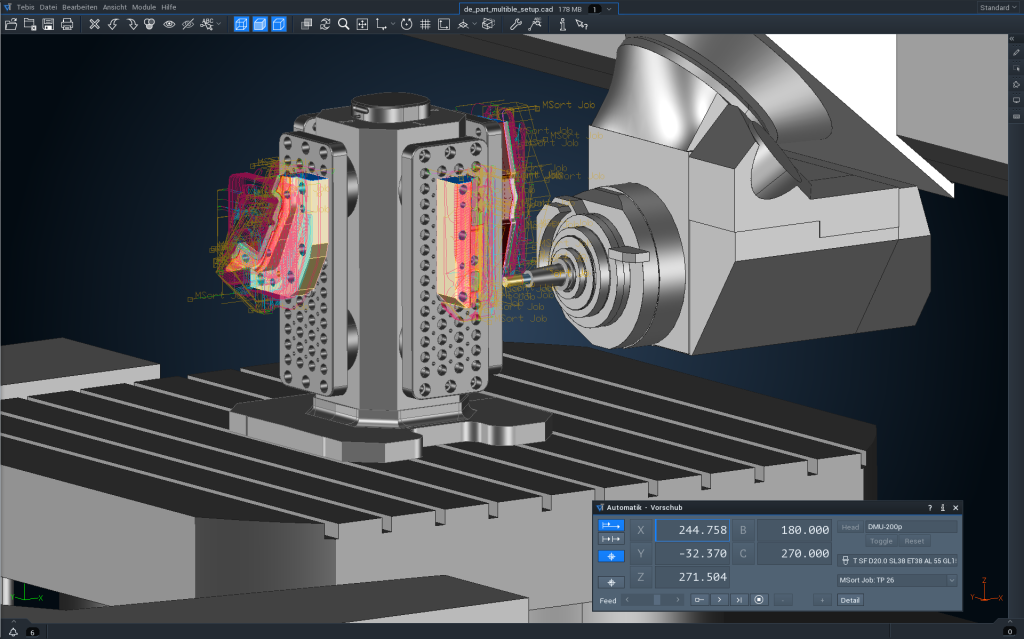
By the late 90s, Tebis was positioning itself as a full-suite solution. In 1997, the company opened a second development site in Norderstedt (near Hamburg), and around the same time, Tebis added CAQ (computer-aided quality) modules for measurement and inspection. The inclusion of quality-check functions alongside CAD/CAM was another step toward covering the whole process chain. A notable achievement in 2000 was the introduction of “digital twin” machine simulation. Tebis enabled users to integrate virtual models of their CNC machines, complete with their specific kinematics and limitations, into the programming environment. This meant one could simulate the entire machining operation, detecting any collisions or issues virtually before anything was cut on the real machine. In single-part manufacturing (like die or mold making), this was a game-changer for reliability – Tebis became a pioneer in leveraging digital twins to ensure error-free machining.
The early 2000s saw Tebis continue to mature and expand. In 2001, the company established branches in the UK, Spain, and Portugal, tapping into new markets. The software, now on Version 3.4 and 3.5, gained a standardized module framework and a central Job Manager to orchestrate the numerous steps in a manufacturing project. By capturing all the operations – from roughing to finishing, from milling to electrode spark erosion – under a Job Manager, Tebis allowed programmers to plan and track the entire process within one project file. This era also saw the software’s knowledge-based machining capabilities grow: in 2004 Tebis introduced features to capture a customer’s proprietary manufacturing knowledge (such as standard setups, preferred tools, machining strategies) into templates and libraries inside the system. A programmer could, for example, apply a saved template for “machining an injection mold cavity of medium size” and Tebis would preload the tried-and-true speeds, feeds, and tool choices for that scenario – effectively institutionalizing best practices and saving time.
Expansion and Corporate Milestones: As Tebis’s product became more sophisticated, the business itself grew steadily. The small partnership from 1984 had become Tebis GmbH, and in 1991 it formally reorganized as Tebis AG, a joint-stock company (though not publicly traded) to support larger growth. Throughout the 90s and 2000s, Tebis AG followed its major customers across the globe. It opened new offices in Sweden, Italy, France, and the USA by the mid-1990s, often strategically locating near automotive industry hubs. For instance, Tebis’s U.S. branch was established in proximity to Detroit – aligning with the big-three automakers’ needs for die-making software. By 2012, Tebis had also planted a flag in Asia with a branch in China, signaling its intent to compete in the booming Asian manufacturing market. This international presence helped Tebis gather a diverse user base and also informed the software’s development to handle various languages and standards (today Tebis is available in over a dozen languages, including Chinese and Japanese, reflecting its global user community).
Modernization in the 2010s: A significant leap came with Tebis Version 4.0, launched in 2015. This release unveiled a completely modern user interface and an “industry-oriented” product structure. After decades of using its own GUI paradigms, Tebis redesigned the look-and-feel to be more in line with contemporary software, making it more intuitive for a new generation of users. Under the hood, 4.0 also enhanced feature-based automation: it introduced the ability to recognize and program standard features (like holes, pockets, slots) automatically, and expanded the support to new manufacturing methods. Notably, Version 4.0 was the first Tebis edition to support CNC turning (lathes) and the programming of industrial robots for machining. It even incorporated processes like laser hardening and laser cladding (used in tool repair and strengthening). This broadened Tebis’s reach beyond its traditional milling stronghold, allowing clients to program all kinds of equipment – mill, lathe, robot, laser – within one system.
Entering the Parametric Era: After an intensive development effort, Tebis Version 4.1 was rolled out in 2020. This marked one of the most profound upgrades in the software’s history: Tebis added an internally-developed parametric-associative CAD kernel to its platform. In essence, Tebis 4.1 transformed the CAD side of the system into a full hybrid modeling environment that can handle both free-form surface modeling (Tebis’s legacy strength) and solid modeling with history and parameters (a feature expected from modern CAD like SolidWorks or CATIA). Now, users can create parametric designs – meaning parts that have features driven by dimensions and constraints, which can be altered and updated automatically. For Tebis users, this is especially useful in tooling design: for example, a mold base or fixture can be designed with parametric relations so if a part’s size changes, the fixture adapts accordingly without starting from scratch. Additionally, Tebis 4.1 extended the concept of its template-based automation into the CAD realm. Engineers can develop CAD templates for common types of tooling components (like a mold insert or a die shoe) and reuse those, saving time whenever similar projects arise. With 4.1’s release, Tebis finally offered a truly end-to-end CAD/CAM where design changes and manufacturing plans are associative – a change in the design model can ripple through to update toolpaths, reflecting a more modern, efficient workflow. As Dr. Thomas Wrede of Tebis puts it, Version 4.1 delivered “an extensively automatable design environment for equipment like molds, dies and fixtures” which “saves an enormous amount of time in manufacturing-related design in the event of changes.” In complex manufacturing, where design tweaks late in the game can be costly, this capability is invaluable.
Throughout its evolution, Tebis has balanced continuity with innovation. Many of the foundational ideas from its early days – like helping smaller companies automate machining, or integrating the process chain – remained guiding principles as new features were layered on. The company often took a steady, perhaps conservative approach: rather than chasing every trend, Tebis methodically developed solutions it believed in (sometimes over many years) and ensured they were robust for industrial use. For instance, while parametric CAD arrived relatively late to Tebis, it was implemented in a way that harmonized with the system’s existing strengths in surface modeling and automation. This thoughtful evolution has earned Tebis a reputation for reliability and technical depth. Longtime users frequently note that a lot of the “tribal knowledge” of toolmakers is embedded into Tebis’s functions – a result of the company’s close engagement with those users over decades.
Business Footprint and Market Presence
Over the course of four decades, Tebis AG has grown from a tiny German startup into a global player in CAD/CAM, albeit one that operates a bit under the radar compared to industry giants. The company’s business trajectory reflects steady growth aligned with manufacturing cycles and technological milestones:
Customer Base and Users: Tebis’s user community spans some of the most demanding manufacturing organizations in the world. It is used by roughly 2,000 companies worldwide, with a cumulative installed base of around 9,000 software seats (as of the mid-2010s, and likely over ten thousand by now). These numbers, while modest next to mass-market engineering software, underscore Tebis’s focus on a high-value niche – each installation often represents a mission-critical tool in a toolmaking department or machine shop. The clientele includes major automotive OEMs and their suppliers (for example, virtually every German car manufacturer’s tooling division has Tebis programmers), prominent aerospace suppliers, and countless specialized mold makers, pattern shops, and engineering service providers. The loyalty of these customers is strong; some have used Tebis for 20+ years and continue to upgrade and expand it. This stickiness can be credited to Tebis’s consistent results – once a company has fine-tuned its manufacturing templates and process around Tebis, switching to something else would risk losing that accumulated expertise.
Global Reach: Tebis AG has a direct presence in about a dozen countries and additionally works through distributors and partners in other regions. Its home market of Germany accounts for a significant portion of revenue (the company historically has had very deep penetration in the German-speaking tool and die industry). However, international markets have grown in importance. In the early 2010s, Tebis noted double-digit sales growth in Asia and other European countries. The opening of Tebis China in 2012, for instance, laid the groundwork for adoption by Chinese automotive and aerospace toolmakers. Tebis’s North American arm (Tebis America Inc.) has headquarters in Michigan to serve the automotive heartland and has steadily been bringing on US and Canadian customers. The company also maintains a network of technical partners and training centers, ensuring that wherever Tebis is sold, there are local experts who understand the needs of that region’s manufacturers.
Revenue and Scale: By 2011, Tebis AG had achieved yearly sales of around €40 million, which was at that time the highest in its history. Growth accelerated through the 2010s, and as of recent reports the company generates over €50 million in annual revenue. This is a solid figure for a specialized software firm and reflects healthy growth but also the focused scope of the business (for comparison, software giants in the CAD/CAM space that serve broader markets often have revenues in the hundreds of millions or billions). Tebis’s revenue comes not just from software licenses, but also from maintenance contracts (ongoing support and updates for users) and from services like consulting and training. The mix indicates a balanced business – in some years, new software license sales surged by 50% or more (for example, coming out of the late-2000s recession, Tebis saw a strong rebound as manufacturers invested in new CAD/CAM tech), while in other years services took the lead. The company is profitable and reinvests heavily in R&D; its relatively small size compared to corporate competitors has not prevented it from funding ambitious multi-year development efforts (like the parametric kernel project).
Industry Recognition: While Tebis doesn’t trumpet itself in mass media, industry analysts have taken note of its standing. CAD/CAM market research firm CIMdata has repeatedly listed Tebis among the top-ranking CAM software providers globally in terms of market share in the specialized mold, tool and die segment. Tebis AG often describes itself as a “premium” provider – meaning its product is not the cheapest, but aims to deliver higher value in capability and support. The company’s success has earned it regional business accolades as well. In 2015, Tebis was named one of “Bavaria’s Best 50” companies by the Bavarian State Ministry of Economic Affairs, an award that recognizes fast-growing mid-sized companies in the region. And in 2018, Tebis’s consulting arm won a prestigious “Best of Consulting – Mittelstand” award from the German business magazine Wirtschaftswoche, which identified Tebis Consulting’s work as exemplary in helping mid-sized manufacturers compete better. These honors, as Rindfleisch noted, “encourage us along our successful journey,” reinforcing that the company’s efforts are noticed beyond just its customer circle.
Major Clients and Projects: One way to gauge Tebis’s impact is by looking at the end-products that its users create. Virtually every time you drive a car, you’re benefiting from Tebis in a hidden way – the stamping die that shaped that car’s fender or door panel may have been programmed with Tebis for a flawless surface finish. When an airplane manufacturer machines a large titanium wing section with complex curves, Tebis might be in the background ensuring each toolpath is precisely calculated and collision-free. Even consumer goods can have a Tebis connection: the injection mold that produced your plastic toothbrush or phone case could have been designed and milled with Tebis. The software’s pervasive presence in these tooling and prototyping processes means it has an indirect yet wide influence on manufacturing quality and efficiency across many products we use daily.
Interestingly, despite its growth, Tebis AG has remained independent and founder-led. Bernhard Rindfleisch, who started it all in 1984, continues to be deeply involved (he has served in roles from CEO to Chairman of the Board). This continuity of leadership is somewhat rare in the tech world and has likely helped Tebis maintain a clear focus on long-term product quality over short-term gains. The leadership team has expanded to include experts like Dr. Thomas Wrede (a board member who has helped guide technical strategy) and others who share a background in engineering and manufacturing. There have been no major shifts in ownership or strategy – unlike many competitors in CAD/CAM that have been acquired by larger corporations – allowing Tebis to chart its own course. This stability is a selling point for some customers: they know the company they partnered with decades ago is fundamentally the same one supporting them today, just more experienced and capable.
Strategic Partnerships, Mergers, and Expansions
To augment its organic growth, Tebis has pursued targeted acquisitions and collaborations over the years, aiming to round out its technology and better serve its users. Two key acquisitions stand out:
DCAM (2007): In 2007, Tebis acquired a Berlin-based software firm called DCAM GmbH, which specialized in wire EDM (electrical discharge machining) software. Prior to the acquisition, Tebis had a partnership with DCAM to integrate their wire-cutting capabilities. Wire EDM is a process often used in tool and die shops alongside milling – for cutting very precise contours in hardened steel, for instance. By bringing DCAM’s expertise and technology in-house, Tebis was able to offer a native Wire EDM module fully integrated into its CAD/CAM suite. This meant users could handle all major fabrication steps (milling, drilling, EDM, etc.) within one system. The integration was completed in subsequent versions of Tebis, making it a more all-encompassing solution for die makers (who frequently machine parts and then wire-cut finer details or ejector pin holes, etc.).
ID GmbH / ProLeiS MES (2017): Perhaps the most significant expansion of Tebis’s scope came with its venture into MES (Manufacturing Execution System) territory. For nearly 20 years Tebis had worked alongside a partner company, ID Ingenieurgesellschaft für Datentechnik (ID GmbH), on shop-floor data and production planning solutions. This partnership produced a system called ProLeiS, which was used in some large tooling companies to manage scheduling, materials, and production status. In 2017, Tebis acquired the ProLeiS business outright, along with its development team. This move officially brought MES into the Tebis product lineup – allowing Tebis to say it offers not just CAD/CAM, but also the software to manage and monitor the entire manufacturing operation. The ProLeiS MES (now marketed as Tebis ProLeiS) can be integrated directly into the Tebis interface, providing users with a dashboard of all jobs, their progress, machine workloads, and so forth. Dr. Wrede highlights the importance of this, noting that after installing ProLeiS, “Tebis customers have a clear picture of scheduled, ongoing and potential projects. This allows them to control their resources, optimize production performance and ensure on-time delivery.” In essence, the MES addition positions Tebis as a key enabler for companies moving toward Industry 4.0 – offering digital connectivity from the initial design all the way to the final product rolling out of the workshop.
Apart from acquisitions, Tebis has actively forged partnerships and collaborations to stay connected with the broader manufacturing ecosystem:
Machine Tool Builders (e.g. DMG MORI) – A notable partnership was announced in 2022 between Tebis and DMG MORI, one of the world’s largest machine tool manufacturers. Under DMG MORI’s “Qualified Products” program, Tebis became a certified CAM partner and developed special CAM software bundles optimized for DMG MORI machines. For example, the “Tebis DMQP” packages offer tailored solutions for specific DMG MORI machining centers (like 5-axis milling or mill-turn machines) and are sold directly through DMG MORI with the machine. This collaboration means that a customer buying a new DMG MORI machine can get a turnkey Tebis programming environment configured for that machine, with all postprocessors and parameters ready to go. “We see a great match in the strategic alignment of DMG MORI and Tebis,” Dr. Wrede explained at the partnership’s launch. “Automating manufacturing processes is a comprehensive procedure that can only succeed if suppliers work together as partners and offer solutions from a single source.” By teaming up, Tebis and DMG MORI aim to provide users a smoother path to automation – from CAM programming to machine operation – all validated and supported by both companies. Such partnerships also reflect Tebis’s recognition that in modern factories, collaboration between software providers and hardware builders is crucial to deliver integrated solutions.
Peripheral Hardware (3Dconnexion) – On the user-experience front, Tebis collaborates with hardware makers like 3Dconnexion, known for their SpaceMouse devices used in 3D CAD navigation. Tebis’s UK branch, for instance, recently worked with 3Dconnexion to optimize how the SpaceMouse can be used to pan, zoom, and rotate models in Tebis’s CAD/CAM environment. This kind of partnership is more about enhancing daily productivity for designers and NC programmers; it shows Tebis’s commitment to leveraging even input device technology to streamline workflows. It might seem minor compared to big software modules, but for an operator spending hours interacting with Tebis, such integrations can reduce fatigue and improve precision in manipulating complex 3D models.
Educational and Research Institutions – Tebis has made inroads into technical education and research by providing its software to universities, vocational schools, and research centers. Many institutions use Tebis in their manufacturing labs to train the next generation of toolmakers and CAM programmers. This not only helps spread knowledge of the software, but also allows Tebis to stay abreast of academic developments and ensure that its tools meet the future needs of industry (for example, by working with research institutes on topics like new machining strategies or process optimization techniques).
Industry Networks and Events – The company actively participates in industry associations related to tool and mold making (such as the VDWF and VDMA in Germany) and often presents at conferences or hosts its own user events. Tebis has organized “Tebis Open House” events where they showcase new technology, often bringing in partner companies (machine tool vendors, cutting tool manufacturers, etc.) to exhibit alongside. These events foster a community feeling and help Tebis cement itself as an integral node in the manufacturing network.
Through these strategic moves – be it acquiring complementary technologies or partnering with big industry players – Tebis has managed to extend its reach without losing focus. Every partnership or acquisition has been tightly aligned with its core domain of expertise. By integrating CAM with MES, or aligning with machine tool builders, Tebis effectively builds a moat around its niche: a rival would have to match not just its software features but also its ecosystem relationships and process knowledge to compete head-on.
Innovations, Technical Features, and Competitive Strengths
What has allowed Tebis to endure and thrive in the competitive CAD/CAM software market is its reputation for technical excellence in certain critical areas. Tebis might not have the flashiest marketing or the largest market share overall, but among professionals it’s known for doing a few things exceptionally well:
Automation and Knowledge-Based Machining: Automation is arguably the drumbeat behind all of Tebis’s innovations. The system has long enabled users to capture their manufacturing methods and reuse them. The Automill® concept introduced in 1990 was a forerunner of what we now call feature-based machining or knowledge-based CAM. It automated multi-surface toolpath generation at a time when most CAM programmers had to program point-to-point. Over the years, Tebis expanded this with machining templates, process libraries, and standard features recognition. In practice, this means a Tebis user can often program a complex part by applying pre-defined templates that handle everything from tool selection to cutting strategies, drastically reducing manual programming time. The result is not just speed, but also consistency and reliability – the same best-practice approach is applied every time, minimizing human error. This has been a huge competitive strength, especially for companies that produce a variety of similar parts (like families of dies or molds); they can standardize programming such that even less-experienced CAM operators can generate results on par with veteran programmers. One mold shop owner famously remarked that after implementing Tebis templates, “we can program five variants of a mold in almost the same time it once took to do one – and the outcomes are predictably right.” That kind of efficiency gain is a strong selling point.
Surface Quality and Precision: In high-end toolmaking, the quality of machined surfaces – how smooth and accurate they are – is a make-or-break factor. Tebis has distinguished itself with algorithms that produce excellent surface finish and precision, reducing the need for manual polishing or rework. As early as Version 3.1 (in 1997), Tebis made a unique mark by calculating toolpaths on exact mathematical surface definitions (NURBS/B-rep surfaces) rather than faceted approximations. This yields very smooth cutter movements. Users often note that Tebis-s programmed toolpaths result in parts that are “right first time,” matching the 3D design with minimal deviation. In competitive evaluations, Tebis’s CAM output has been praised for its accuracy especially on complex free-form shapes. While it’s hard to quantify software “surface quality,” the feedback from shops is telling – some have stuck with Tebis even as cheaper systems emerged, precisely because they trust the quality of Tebis output to meet their stringent demands.
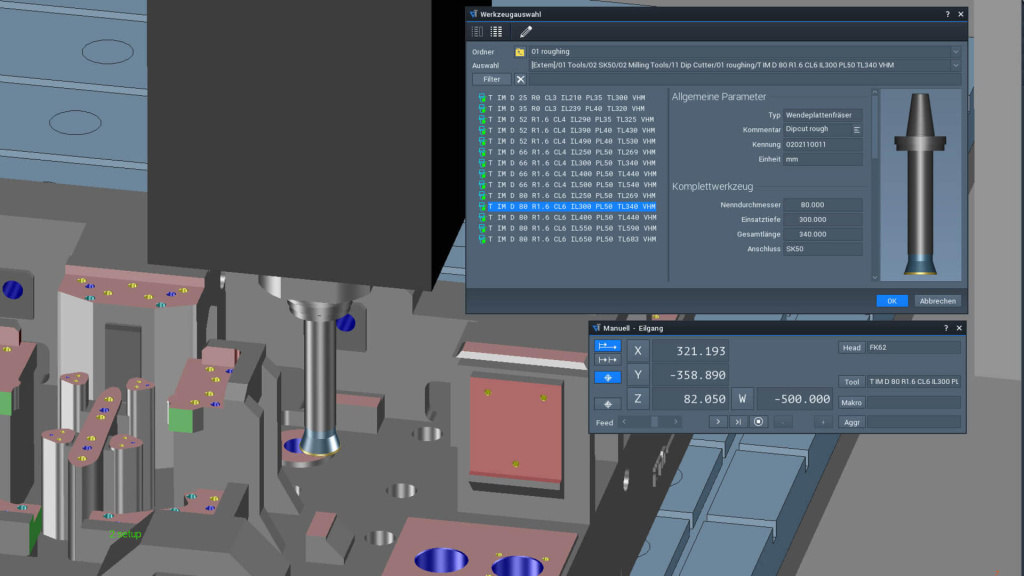
Integrated Simulation and Safety: Tebis was ahead of the curve in embedding full machine simulation (with collision detection) directly into the CAM programming workflow. By the time Version 4.0 arrived, the Tebis NC Simulator was fully integrated – meaning while creating toolpaths, users could at any point simulate the tool, holder, and machine motion on a virtual model of their CNC machine to check for any conflicts or gouges. This concept of digital twin simulation ensures that by the time the NC code is on the actual machine, there are no surprises. All machine components – axes limits, rotary tables, tool changers, clamps, etc. – can be accounted for. Tebis even simulates things like material stock and intermediate states of the workpiece. The benefit is enhanced safety (avoiding costly crashes or scrap parts) and the confidence to run complex programs unattended. Many competitors now offer similar simulation modules, but Tebis’s long experience means their solution is robust and deeply ingrained in how programmers use the software. It’s not an extra step; it’s part of the normal programming sequence.
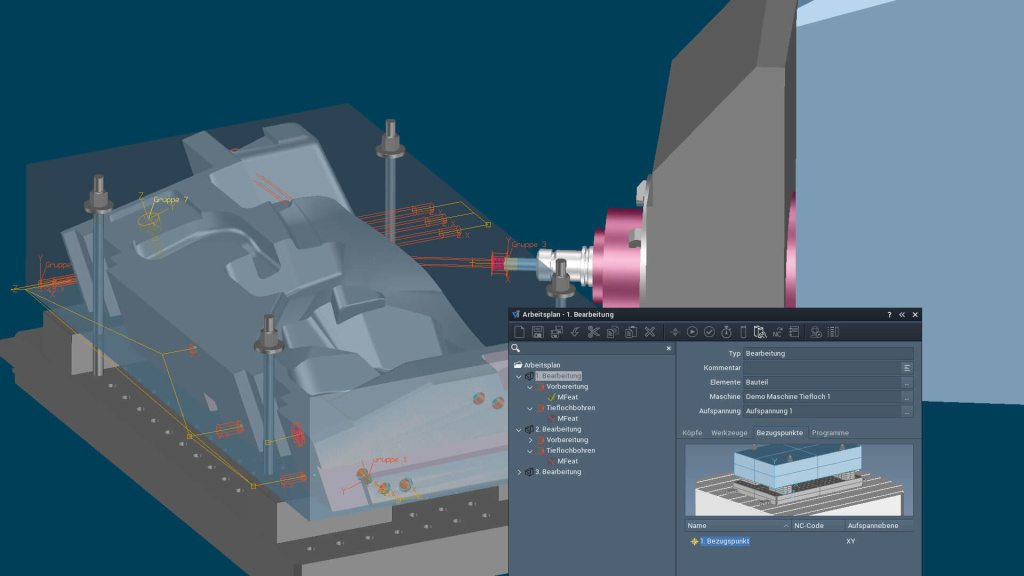
Breadth of Process Coverage: One of Tebis’s selling points is that it’s not limited to just milling or one type of machining. It supports 2.5D and 3D milling, 5-axis simultaneous milling, turning (lathe operations), mill-turn machining, drilling (including deep-hole drilling cycles), wire EDM, sinker EDM (electrode-based), laser cutting, laser welding/cladding, and even CMM measurement routines. Few CAM systems cover that many different processes under one roof. This breadth means a company can invest in one software platform for virtually all of its machining needs, rather than a patchwork of specialized programs. And Tebis strives to ensure these various modules share a consistent interface and data model – for example, the same geometry can have both milling toolpaths and inspection points defined on it. The learning curve is thus reduced and data flows more easily (no exporting to different software for each step).
CAD for CAM and Reverse Engineering: Tebis historically has been stronger on the CAM side than pure design, but it developed a niche in what might be called “CAD for CAM” – the ability to quickly clean up or modify design data to make it suitable for manufacturing. Toolmakers often receive imperfect CAD models from product designers (surfaces may have gaps, geometry might not be optimized for machining, etc.). Tebis includes powerful surface editing and morphing tools that allow users to reconstruct or adjust shapes for manufacturing needs. One example is the “Morphing” or Springback compensation feature, used in die making: after initial tryouts, a sheet metal die might need certain areas tweaked to account for material springback; Tebis lets engineers morph the CAD surfaces of the die based on measurement feedback, so the next machined iteration produces a more accurate part. This kind of specialized CAD functionality is highly valued by die and mold makers and is not commonly found in general-purpose CAD packages. Additionally, Tebis’s reverse engineeringmodule can convert scanned point clouds or mesh data into smooth surface models, which is useful when working from physical prototypes or legacy parts that have no existing CAD.
Consulting and Process Optimization: While not a software feature per se, Tebis’s integration of consulting services into its offering has become a technical strength in outcome. The company formed a dedicated Tebis Consulting division which has accumulated decades of best practices in manufacturing workflows. They don’t just teach how to use the software; they often advise on reorganizing a customer’s process to exploit automation better or to eliminate bottlenecks. For instance, Tebis consultants might help a factory implement a new cell-based manufacturing layout or a data management strategy to go paperless, using ProLeiS MES and Tebis together. This holistic approach often leads to technical innovations tailored to a client – some automation templates or customizations in Tebis come directly out of consulting projects and then get generalized for other users. The synergy of having software developers and in-house consultants means Tebis can quickly translate real-world shop problems into software enhancements. As Rindfleisch puts it, “No consulting or software company in our industry has more expertise in software development, software services and consulting. This makes us unique.” In competitive terms, a rival might sell a CAM program, but Tebis can sell a solution that includes rethinking the customer’s manufacturing strategy.
Reliability and Continuity: Many long-time Tebis users praise an intangible but important aspect: confidence. They trust that a toolpath generated by Tebis will run correctly, that the post-processor will output correct code for their specific machine, and that if they run into any snags, Tebis support will help them promptly. This reliability is the result of years of incremental improvements and cautious testing. The company tends not to introduce gimmicky features without full validation. In toolmaking, a software error can translate into a broken machine or a missed deadline on a project worth hundreds of thousands of dollars – so trust in the CAM system is paramount. Tebis has earned that trust in its niche, which is a competitive strength that can’t be easily measured on a feature checklist but often wins repeat business.
All these factors combine to position Tebis as a premium solution. It might not compete on price with more mass-market CAM software, but for companies where downtime or quality issues are far more costly than software licenses, Tebis’s strengths justify the investment. The ability to differentiate from competition through these strengths is something the company leadership often emphasizes. “Two key distinguishing features are our broad range of CAD/CAM and MES software and our excellent software-related services,” says Rindfleisch. “Another key differentiator is our industry-related consulting expertise… No other company in our industry has more expertise in software development, software services and consulting. This makes us unique.” In short, Tebis’s competitive edge lies in the combination of an advanced, all-in-one technical platform with a deep well of manufacturing knowledge to back it up.
Leadership and Vision
One of the defining aspects of Tebis AG’s journey is the consistent vision and philosophy imparted by its leadership. The company’s top management, which still includes founder Bernhard Rindfleisch (now Chairman of the Board) and board member Dr. Thomas Wrede, are not typical corporate executives but rather engineer-innovators who remain closely connected to the product and its users. Their outlook on the industry and the company’s role in it has guided Tebis’s evolution.
From the beginning, Rindfleisch espoused a customer-centric and quality-driven ethos. “The basis for our success lies in our close relationships with our customers – to those responsible for manufacturing as well as the actual users,” he explains. This philosophy manifests in Tebis’s practice of forming tight feedback loops with clients. Many of the software’s features have been shaped by direct input from the toolmakers on the ground. Tebis developers frequently visit customer sites, and user group meetings are held to discuss upcoming improvements. By understanding customer needs in detail, Tebis leadership ensures the company remains relevant and ahead of problems. Rindfleisch’s statement that “Our customers’ productivity is close to our hearts” isn’t just a slogan – it reflects in how quickly Tebis provides solutions when a customer encounters a challenge. For example, if a new kind of 5-axis machine enters the market and a client buys it, Tebis works swiftly to support it with posts and kinematics so that the client’s workflow isn’t disrupted.
Another aspect of the vision is a long-term commitment to innovation in manufacturing technology. “We’ve continued to set trends in future-oriented technology since Tebis was founded in 1984,” Rindfleisch notes. This is backed up by Tebis’s track record of introducing new ideas (like Automill, digital twins, etc.) often years before they became industry buzzwords. The leadership’s future gaze currently is focused on areas such as further automation, standardization, and digital integration of the manufacturing process – essentially extending the principles Tebis has always stood for. Challenges on the horizon, as Dr. Wrede outlines, include adapting to trends like e-mobility (electric vehicles, which may change the kinds of parts being made and the methods to make them) and tackling the digitization and networking of production (the Industry 4.0 vision). There is also an acute awareness of skills shortages in manufacturing; Tebis sees its software as part of the solution here by embedding expert knowledge and providing guidance so that less experienced workers can perform at a higher level. “We’re working intensively to facilitate work with structured processes and to ensure the reliability and efficiency of those processes,” Wrede says, highlighting a focus on making complex technology more approachable and dependable.
The Tebis leadership also holds a clear stance on how to help clients navigate the road to Industry 4.0 and smart manufacturing. As Wrede describes, the strategy is to digitally model each customer’s unique manufacturing environment (machines, tools, processes, human know-how) inside Tebis and ProLeiS. By doing so, the software becomes a mirror of the real shop, and decisions can be made based on data and simulation. Once everything is digitally connected – CAD to CAM to MES – companies can respond faster to changes and manage costs and deadlines more effectively. “Companies with this kind of end-to-end CAD/CAM and MES structure have a much easier time meeting cost and deadline requirements while also delivering top quality,” Wrede observes. This vision essentially paints Tebis as an enabler of the smart factory, particularly for custom manufacturing operations. Rather than a black box AI or a generic platform, Tebis offers a tailored intelligence built on the specifics of each user’s setup.
It’s worth noting that despite their deep technical focus, Tebis’s leaders have also maintained a human touch in how they run the business. Employees at Tebis often spend their entire careers there, reflecting a culture that values expertise and loyalty. The company engages in community initiatives and is mindful of its role as a medium-sized employer. “We’re fully committed to the community,” Rindfleisch has said, emphasizing social responsibility alongside business goals. In an era when tech companies frequently chase disruption for its own sake, Tebis’s leadership style is more about continuous improvement and stability. This might not grab headlines, but it has built a sustainable enterprise.
Looking ahead, Tebis’s leadership appears committed to keeping the company at the forefront of specialized manufacturing software. They hint at further developments in automation (perhaps AI-driven in the future), cloud or data connectivity enhancements, and expanding the MES capabilities. But whatever new tech comes, it’s likely to be folded into the product with the same deliberation and alignment to customer needs that Tebis has shown so far. The vision remains what it was in 1984: empower manufacturers – especially the “little giants” of the industry, the toolmakers and mold builders – with technology that makes them more efficient and competitive.
Conclusion
Tebis’s journey from a tiny Munich consultancy to a global CAD/CAM solutions provider is a testament to the power of focus and deep expertise in a niche. In the highly competitive world of manufacturing software, dominated by conglomerates and buzzword-heavy newcomers, Tebis carved out and sustained a domain by sticking to what it does best: enabling the precise, efficient production of complex, one-of-a-kind parts and tooling. Over 40 years, the company has navigated immense technological shifts – from the era of DOS and drafting arms to today’s Industry 4.0 landscape – yet it has managed to keep its core mission in sight and bring its loyal users along every step of the way.
If you walk into a mold shop or a toolroom that uses Tebis, you might not immediately sense the drama of cutting-edge technology; what you’ll see is work getting done – big steel blocks being transformed into intricate shapes with apparent ease, programmers trusting their CAM system to handle a surprise design change overnight, machines cutting confidently through tough alloys without a collision. Tebis operates in these behind-the-scenes moments. It might not be flashy, but it is quietly shaping the products and tools that shape our world. Every improvement the Tebis team makes, whether it’s a 10% faster toolpath strategy or a new way to automate fixture design, amplifies across industries in the form of lower costs, shorter lead times, and higher quality goods.
In a sense, Tebis’s story is also the story of modern manufacturing: gradually replacing trial-and-error craftsmanship with digitized knowledge and automation, while still relying on the insight of experienced humans. It shows how a software company can succeed not by diluting its focus, but by continuously digging deeper into its chosen field and expanding around it thoughtfully – adding services, acquiring allied technologies, partnering where it makes sense. The result is a company that, at 40 years old, is still innovating vigorously and helping its clients tackle contemporary challenges.
As manufacturing enters an era of smart factories and AI-driven processes, Tebis finds itself in an interesting position. It has much of the groundwork already laid – a digital twin approach, a repository of expert strategies, and an integrated planning system. The future could see Tebis leveraging more artificial intelligence or cloud computing to further enhance automation, or integrating additive manufacturing (3D printing) processes as those become relevant to toolmakers. Given its track record, Tebis will likely approach any such expansion with the same measured, customer-informed strategy that has served it well so far.
For now, Tebis remains a cornerstone in tooling departments and machine shops around the world, quietly enabling innovation in other products by ensuring the tools to make those products are top-notch. In the words of its founder Bernhard Rindfleisch, “Tebis software is the foundation of our success because it sets global standards for the highest quality and productivity.” That foundation, built over decades, positions Tebis as not just a software vendor, but a partner in process excellence. And as long as cars need stamping dies, airplanes need precision molds, and new gadgets need prototypes, Tebis is poised to keep playing its behind-the-scenes role – making sure the manufacturers who make the world’s goods can do so with confidence, efficiency, and a touch of Bavarian engineering flair.
Vendor: Tebis