
TopSolid CAM: An Integrated CAD/CAM Leader in Manufacturing
The information is currently being reviewed and updated. If you notice any errors or inaccuracies, please let us know.
TopSolid CAM is a fully integrated computer-aided design and manufacturing (CAD/CAM) system known for its unique all-in-one approach to product design and machining. Developed and sold by the French company TopSolid SAS (formerly Missler Software), TopSolid CAM combines powerful 3D CAD modeling, advanced CAM toolpath programming, and built-in data management into a single platform. This integration allows engineers and machinists to design parts and generate CNC machining programs within the same environment, streamlining workflow from initial concept to finished product. With over four decades of industry experience behind it, the TopSolid product family has become a prominent solution in global manufacturing, targeting industries where efficiency and precision are paramount.
TopSolid’s vendor, TopSolid SAS, is headquartered in Évry, France and has evolved from a small domestic firm into an international CAD/CAM provider. The company positions TopSolid CAM as a high-end yet accessible solution for manufacturers who need tightly integrated design-to-production capabilities. In contrast to many rivals that offer separate CAD and CAM products, TopSolid delivers a comprehensive suite under one roof. Engineers can design complex 3D parts, simulate assemblies, manage bills of materials, and then seamlessly transition to generating toolpaths for milling or turning operations – all without leaving the TopSolid ecosystem. This end-to-end integration is a core strength of TopSolid CAM and a key reason it has gained a reputation for reliability and productivity in the manufacturing sector.
Key Application Areas
TopSolid CAM is used across a broad range of industries and application domains. Its primary market is mechanical manufacturing, encompassing machinery producers, industrial equipment makers, and precision part suppliers. These users benefit from TopSolid’s ability to handle complex prismatic parts, multi-axis machining, and tight tolerances common in aerospace, automotive, and defense manufacturing. Major aerospace contractors (such as satellite launch vehicle manufacturers and aircraft systems suppliers) and automotive OEMs have employed TopSolid for tasks ranging from engine component machining to custom tool fabrication.
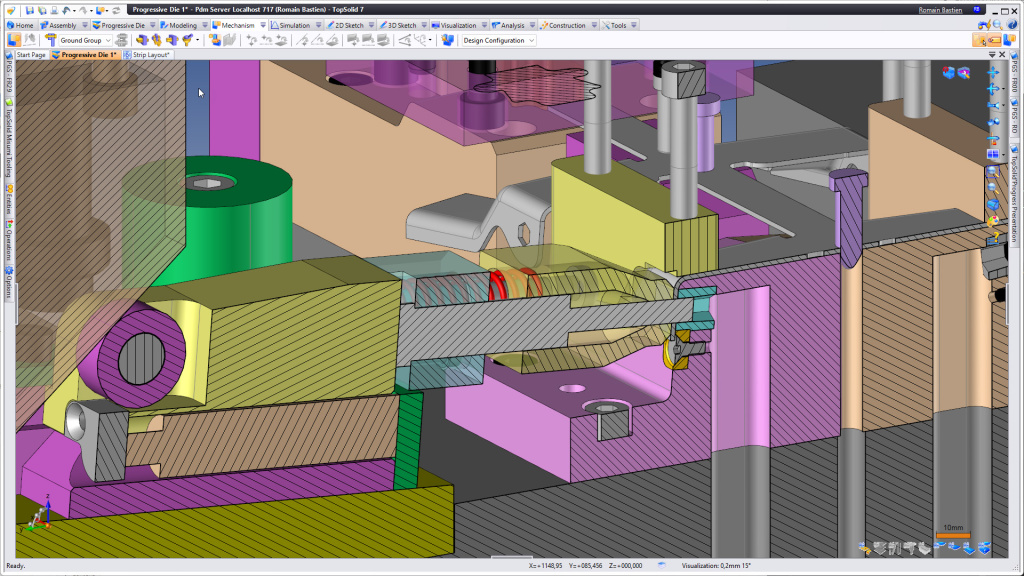
Another important domain is tooling and mold making. TopSolid offers specialized modules (like TopSolid’Mold for mold design and TopSolid’Progress for progressive dies) which cater to toolmakers and injection mold manufacturers. These industries require intricate cavity design and electrode machining – tasks well served by TopSolid’s robust surface modeling and CAM capabilities. By using TopSolid, tooling engineers can design mold bases or die sets and automatically generate the CNC operations needed to cut them, ensuring consistency between the design intent and the manufactured tooling.
TopSolid is also a leading CAD/CAM solution in the sheet metal fabrication sector. The software includes dedicated functionality for sheet metal design (unfolding, bending allowances, etc.) and manufacturing. It can generate CNC programs for laser cutting, punching, and bending operations. Through partnerships with sheet metal technology specialists, TopSolid has integrated advanced features like blank development and forming simulation directly into its platform. This makes it valuable to manufacturers of metal enclosures, automotive body parts, and other formed sheet components, allowing them to design, flatten, and tool their parts efficiently.
Notably, TopSolid stands out in the woodworking and furniture industry as well. Unlike most general-purpose CAD/CAM tools, TopSolid has a module called TopSolid’Wood tailored to wood and cabinetry design. Furniture makers and carpentry workshops use it to design cabinetry, assemblies with complex joinery, and to program CNC routers for cutting wood panels. The woodworking focus – complete with specialized libraries of hardware and joints – has made TopSolid’Wood a popular choice for custom furniture and kitchen manufacturers, an area where few mainstream CAD/CAM systems compete at the same depth. In summary, wherever a machine interacts with material to shape or produce a part – be it metal or wood – TopSolid CAM finds a role. This includes precision machining, mold and die manufacturing, sheet metal work, and wood product manufacturing among others.
Origins and Evolution
The roots of TopSolid CAM trace back to the late 1970s in France. The company began in 1977 as Missler Mécanique, a small mechanical engineering firm founded by the Missler brothers in Évry. In its early years, the firm focused on numerical control (NC) machining services and even manufactured bandsaw machines, but soon the founders recognized the growing importance of software in manufacturing. By 1980 the company had developed its first NC software in collaboration with computer maker Olivetti, planting the seed for a future in CAD/CAM development.
In 1984, Michel Goujon – one of the key figures in the company – spearheaded the creation of Missler Informatique, a dedicated software arm of the business, joined by Jean-Pierre Lugarini. The new division’s mission was to develop and market CAD/CAM software to improve manufacturing processes. Its first product, known as GTL3, was an early computer-aided manufacturing solution that helped put Missler on the map as a French CAD/CAM developer. By the late 1980s, Missler Informatique expanded its offerings: in 1988 it released Surf3D, a PC-based 3D surface modeling program aimed at mold makers, giving users the ability to design complex free-form surfaces for tooling. This was followed in 1990 by GPS (Gestion de Production Simplifiée), an early enterprise resource planning system tailored for subcontractors, indicating that even then the company envisioned an integrated approach spanning design, manufacturing, and business management.
A pivotal moment in TopSolid’s evolution came in the early 1990s through strategic alliances. In 1992 Missler Informatique formed an alliance with a smaller French software publisher called TopCad. TopCad, founded by Christian Arber and Jean-Luc Rolland, was the creator of a 3D CAD software named TopSolid. At the same time Missler also partnered with a specialist in sheet metal software, Catalpa. These collaborations proved transformative: Missler gained access to a robust 3D solid modeling CAD (the TopSolid CAD technology) and deep expertise in sheet metal design. By 1994, Missler had integrated the Parasolid geometric modeling kernel – the same powerful 3D engine used by leading CAD systems worldwide – into its software. This ensured that the emerging TopSolid platform would be built on industry-proven solid modeling foundations, supporting reliable and precise geometric calculations. The mid-90s set the stage for Missler to offer a true hybrid solution: combining TopCad’s design capabilities with its own manufacturing software and new sheet metal tools, all under one roof.
The turn of the millennium saw Missler unify and brand these developments into a single company and product line. In 2001, the various Missler entities (mechanical, software, alliances) formally merged into one organization, Missler Software, with Michel Goujon and Christian Arber at the helm. Christian Arber – who had brought in the original TopSolid CAD know-how – took on a leading role in driving the unified product vision. The TopSolid name, originally from the TopCad side, was adopted as the flagship brand for the integrated suite. Missler Software now offered TopSolid as a comprehensive CAD/CAM solution with specialized modules (for design, machining, sheet metal, etc.), reflecting the combined heritage of the merged companies. The early 2000s also brought growth through acquisition: in 2002, Missler Software acquired the CAM software line GOelan and its developer (a company named CN Industries). GOelan was a well-regarded CAM system in France, and by incorporating it, Missler enriched TopSolid’Cam’s capabilities—particularly in 2D machining and easy-to-use programming. The company now had around 200 employees and annual sales approaching $20 million by 2002, indicating the commercial success of its integrated approach.
Throughout the 2000s, TopSolid continued to evolve in technology and reach. In 2005, Missler Software’s management team executed a management buyout, gaining a majority stake in the company and reaffirming their commitment to independent, long-term growth. By the second half of the decade, it became clear that in order to stay ahead technologically, a major overhaul of the software was needed. Much of the core code traced its lineage to the 1990s (or earlier), and computing technology had leapt forward (with 64-bit processors, multi-core computing, modern user interface frameworks, etc.). Thus, Missler undertook an ambitious project: TopSolid 7, the next-generation platform, rewritten from scratch. After six years of R&D, the new TopSolid 7 was launched in 2009, marking a significant milestone in the product’s evolution. Unlike an incremental update, TopSolid 7 was a ground-up redesign of both the CAD and CAM components. It introduced a modern graphical user interface, incorporated Microsoft’s C#/.NET framework as its development base, and deeply embedded a PDM (Product Data Management) system at its core. This was a bold move – essentially creating a new platform while continuing to support the older TopSolid 6 – but it aimed to equip customers with up-to-date technology to handle increasingly complex design and manufacturing requirements. Early adopters in mechanical engineering reported substantial productivity gains (the company cited 20–30% time savings in some cases) thanks to the new architecture and features.
In the 2010s, TopSolid grew beyond its French origins into a truly global player. By 2012, Missler Software opened a U.S. subsidiary in Chicago, recognizing the importance of the North American market. This presence aimed to support existing U.S. TopSolid users and to market the newly minted TopSolid 7 solution more aggressively abroad. Over the next several years, the company celebrated its 30th anniversary in 2015 with steady growth and a widening international footprint. TopSolid 7 matured with frequent updates – for instance, version 7.12 launched in 2018, bringing improvements like support for new tool types (barrel cutters) and “dynamic machining” strategies to reduce cycle times. By this time TopSolid had firmly established itself in Europe and made inroads in Asia and the Americas through reseller partnerships. In 2019, the company made a symbolic change: Missler Software officially rebranded itself as TopSolid SAS, adopting the name of its core product. This change reflected how synonymous the TopSolid product brand had become with the company’s identity. It also simplified international marketing – many overseas customers knew the software as “TopSolid” and were unaware of the Missler name, so aligning the corporate name eliminated confusion. The rebranding came on the heels of new investment and leadership transitions (with a new generation of managers taking majority ownership in 2018), marking the start of a fresh chapter focused on global expansion under the unified TopSolid banner.
Technical Innovations and Features
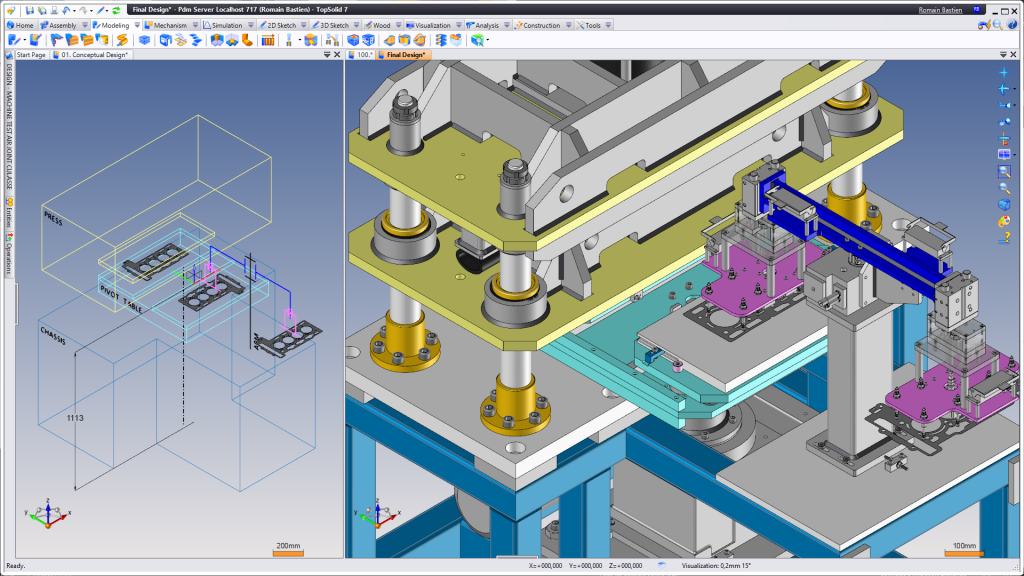
TopSolid CAM’s technology stands out for its deep integration of CAD, CAM, and PDM in one platform. From a functionality standpoint, TopSolid provides a single environment where the entire process – design, simulation, documentation, and manufacturing – is interconnected. All TopSolid modules (whether TopSolid’Design for CAD or TopSolid’Cam for manufacturing) share a common data model and interface, which means changes propagate seamlessly. If a designer modifies a part’s geometry, any associated toolpaths or machining setups in TopSolid CAM update automatically to reflect the change. This parametric associativity between design and manufacturing data helps eliminate errors that can occur when using separate CAD and CAM software. It ensures that the CAD model and the CAM program are always in sync, a critical advantage when dealing with last-minute design revisions on a tight production schedule.
Another major innovation of TopSolid is its integrated PDM capabilities. Product data management (PDM) refers to tracking and controlling all the information related to a design (CAD files, versions, BOMs, etc.). In many companies, PDM is handled by separate systems (or not at all), but TopSolid builds it into the core of the CAD/CAM system. Every TopSolid project inherently has revision control, access permissions, and a structured data repository behind it. Notably, when TopSolid 7 was introduced, it was advertised as the first CAD/CAM platform to be “PDM-based” from inception. In practical terms, users benefit from always working on the latest version of a file, with a full history of changes available and no extra effort needed to manage file references – the software handles it in the background. “You don’t even know the PDM is there,” observed Bill Genc, a Technical Director at TopSolid’s U.S. office, emphasizing how transparent the data management is to the end user. This means designers and programmers can collaborate more easily, even across different sites, without worrying about lost files or version mismatches. For companies, the built-in PDM reduces the need to invest in a separate data management system and streamlines collaboration between engineering and manufacturing teams.
TopSolid CAM’s feature set covers the full spectrum of modern machining needs. On the CAD side, TopSolid’Design provides robust solid and surface modeling tools based on the Parasolid kernel – widely regarded as one of the most powerful 3D modeling engines. This gives TopSolid reliable geometry creation and editing capabilities on par with larger CAD systems. Designers can create complex shapes, free-form surfaces, and detailed assemblies with confidence that the geometry is accurate and watertight for manufacturing. The software also supports importing and exporting all standard industry formats (IGES, STEP, DXF, etc.), which is vital for working in a heterogeneous supply chain. For instance, a subcontractor can import a client’s SolidWorks or CATIA model into TopSolid, then proceed to tool it for machining without needing a separate CAD translator.
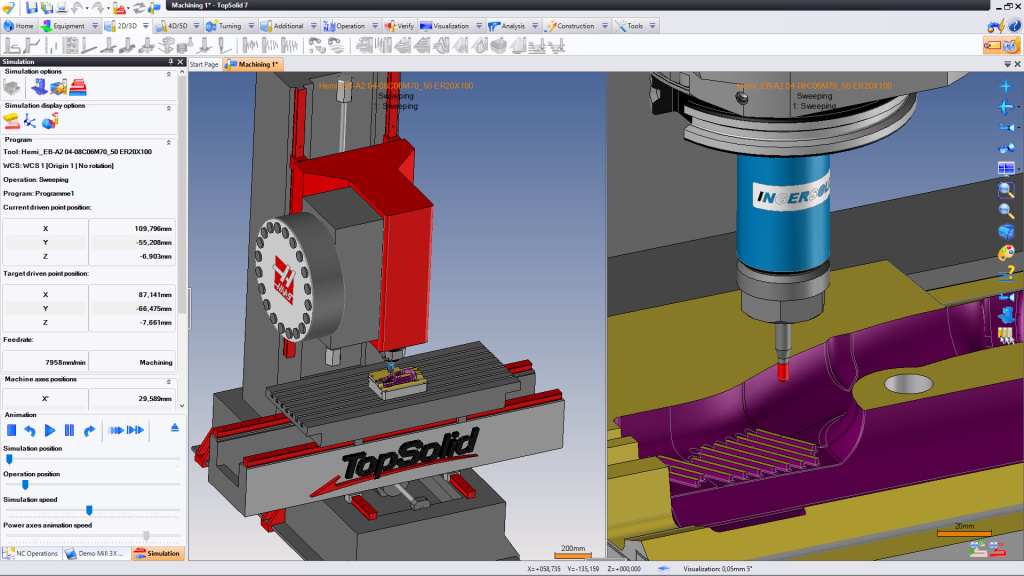
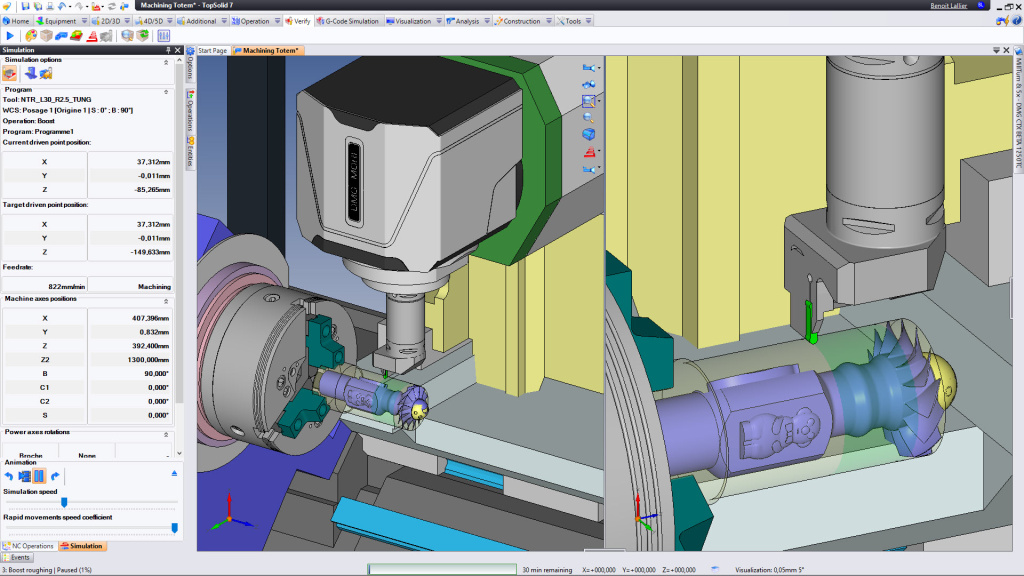
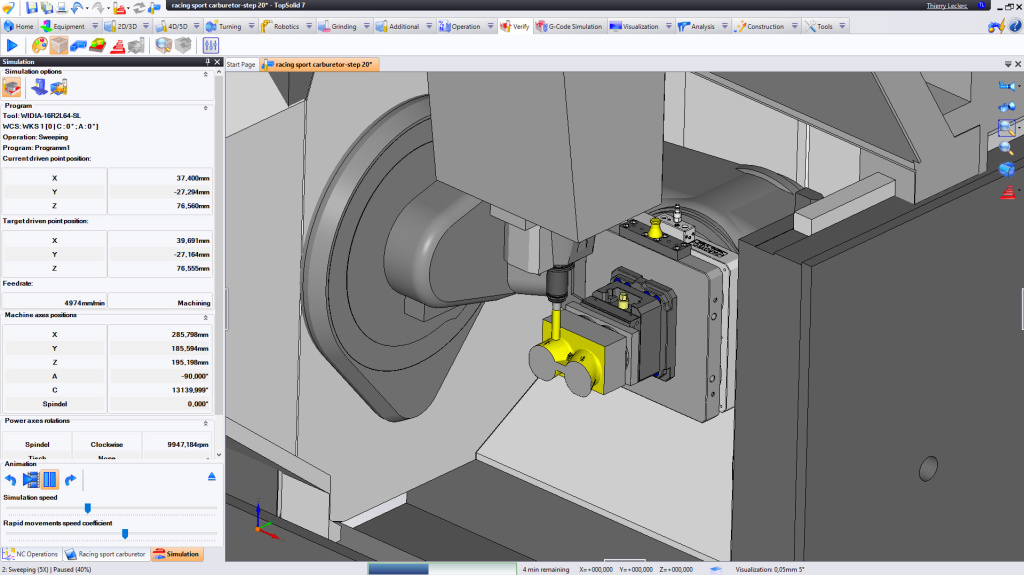
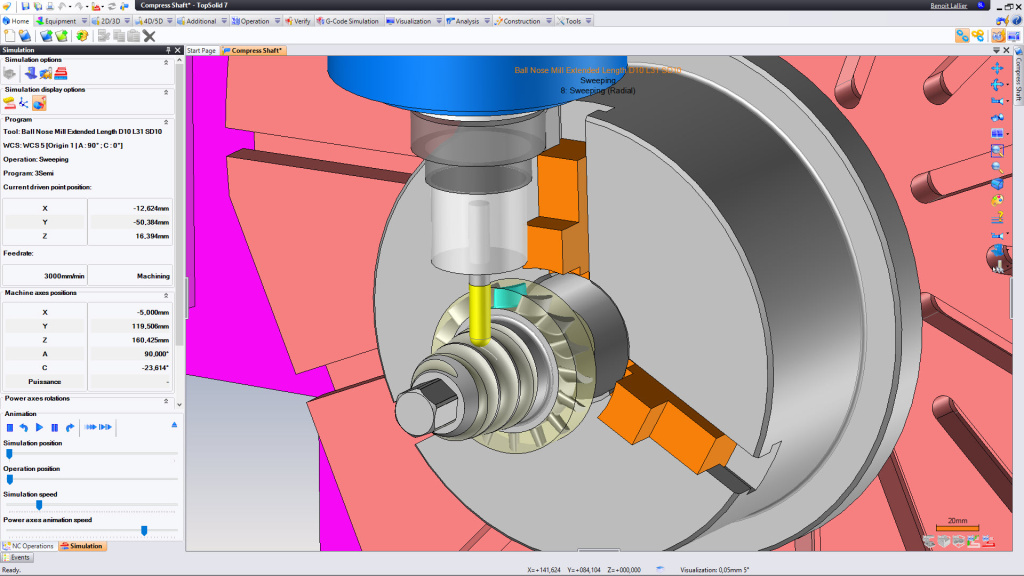
On the CAM side, TopSolid’Cam is equipped to program a wide array of machine tools: from 2-axis lathes and 3-axis milling machines up to multi-spindle mill-turn centers and 5-axis machining centers. Its CAM engine can generate sophisticated toolpaths for operations like high-speed machining, 5-axis simultaneous milling, drilling, tapping, and wire EDM. The integration with CAD means that setup and workholding can be designed and considered directly in the CAM environment – for example, the user can position a part on a virtual machine table or chuck, add fixtures (modeled as CAD objects), and then ensure toolpaths avoid collisions with those fixtures. Toolpath simulation and verification are built in, allowing users to visualize how the cutting tools will move and to detect any potential collisions or errors before sending the program to the shop floor.
TopSolid CAM keeps pace with the latest machining strategies. Recent versions introduced support for “barrel cutters” (tools with large-radius profiles that allow efficient finishing of complex surfaces) and dynamic machiningtechniques (toolpath algorithms that maximize material removal rates and extend tool life by maintaining constant cutter engagement, similar to what some might call adaptive clearing or high-efficiency machining). These capabilities put TopSolid CAM in line with contemporary CAM products that emphasize efficiency and intelligent toolpaths. Another advanced feature is the ability to program multiple parts in a single setup or program – useful for situations like machining several parts on one large pallet, or programming a family of parts together to optimize tool changes. The software’s continuous development is evident: the company reportedly introduces hundreds of improvements and new features in its major releases each year, often guided by user feedback and emerging industry trends.
Because TopSolid is a modular suite, it offers industry-specific extensions that enhance its core functions. For example, TopSolid’Wood adds woodworking-specific tools on top of the general CAD/CAM: users get libraries of wooden joints (dovetails, mortise-and-tenon, etc.), automated generation of cut lists and panel optimization for furniture, and specialized post-processors for woodworking CNC machines. For sheet metal, TopSolid includes modules to automatically unfold sheet metal parts, calculate optimal blanks (even integrating metal forming simulation results, through a partnership with AutoForm Engineering), and design complete die layouts (as in TopSolid’Progress for tool design). These targeted features mean that out-of-the-box, the software can handle niche processes without extensive customization. A tooling engineer using TopSolid’Mold, for instance, can import a plastic part model, design a mold around it with standard mold base components, run cooling channel design, and then have TopSolid CAM generate the toolpaths to cut cavity and core inserts – all within one consistent interface.
To highlight some of TopSolid CAM’s standout strengths, here is a summary of key features and differentiators:
-
Full CAD/CAM/PDM Integration: One of the only solutions in its class that unifies design, manufacturing, and data management. All changes update across the board, and data is centrally managed for version control. This results in less manual data transfer and fewer errors.
-
Parametric & Associative Workflow: The CAD and CAM functions are deeply associative. If the CAD model changes, machining operations (toolpaths, setups, etc.) are automatically updated. This supports an efficient engineering change process and ensures consistency.
-
Industry-Specific Modules: TopSolid offers tailored modules for domains like mold making (TopSolid’Mold), sheet metal fabrication (TopSolid’SheetMetal and Progress), woodworking (TopSolid’Wood), and others. These provide specialized tools, libraries, and automation for those industries, all built on the same core platform.
-
Advanced Machining Capabilities: Supports complex multi-axis machining (simultaneous 5-axis milling, mill-turn multitasking machines, etc.) and modern strategies like high-speed machining and adaptive toolpaths. The software can handle intricate operations needed for aerospace and medical parts as well as high-volume production programming.
-
Modern Architecture & Ease of Use: TopSolid 7 was a complete redesign using modern software architecture, resulting in a clean, updated user interface aligned with Windows standards. The developers leveraged multi-core processing, 64-bit computing, and even introduced a “TopSolid’Virtual” module for virtual reality and digital factory simulations. Despite its breadth, the interface remains consistent across modules, reducing the learning curve. Users often note that the system is comparatively easy to learn for such an extensive package – a result of careful UI design and continuity in the look-and-feel between CAD and CAM functions.
From a technology perspective, TopSolid’s philosophy has been to leverage the best available components and continually refactor its software to stay current. A telling example came in the mid-2000s when Missler Software evaluated various 3D modeling kernels (even considering developing one in-house) to ensure TopSolid had the best geometric engine. The evaluation concluded that the Parasolid kernel was still the optimal choice “based on functionality, openness, quality, performance, support and industry acceptance,” and so TopSolid renewed its commitment to Parasolid as the geometric foundation of its CAD/CAM tools. This decision illustrates how the company balances in-house innovation with strategic use of proven technology to deliver a reliable product. It also underscores a broader point: TopSolid CAM isn’t built on a hodgepodge of acquired components; rather, it’s a tightly integrated system, where each piece – whether internally developed or licensed – is chosen and tuned to serve the overall efficiency of the solution.
Business Performance and Global Presence
TopSolid SAS has demonstrated solid business performance, especially in the past decade, reflecting the strong uptake of TopSolid CAM and its companion products worldwide. As of the most recent figures, the company’s annual turnover is in the range of €65 million (2023), a significant jump from around €30 million in 2015. This growth has been fueled by international expansion and continuous product development that attracted new customers. TopSolid SAS invests heavily in R&D (approximately 30% of its yearly revenue is reinvested into software development), which is well above industry average – a sign of its commitment to innovation and long-term technical advancement. This investment has paid off in the form of a competitive, up-to-date product that drives sales both in existing markets and new ones.
In terms of user base, TopSolid has a widespread adoption. The company reports over 120,000 licenses worldwide, indicating a substantial number of installations ranging from small machine shops to large manufacturing enterprises. While originally most of TopSolid’s customers were in France and francophone countries (not surprising given its origins), today more than 70% of its software sales are outside of France. The software is available in multiple languages and supports standards for various locales, which has helped its international acceptance.
TopSolid SAS has a direct presence or sales offices in several key regions: across France’s major industrial centers (Paris, Lyon, Toulouse, Nantes and more), elsewhere in Europe (for example, subsidiaries or offices in Belgium, Switzerland, Italy, Czech Republic, and the Netherlands), in North America (TopSolid USA based near Chicago), and in Asia (notably an office in Shanghai, China). In addition to these offices, TopSolid relies on a network of authorized resellers and partners – around 60 to 80 value-added resellers worldwide – to distribute and support the software in regions where it doesn’t have a direct subsidiary. This network spans all continents, giving TopSolid a truly global footprint, from Oceania to Africa and the Americas. For instance, a manufacturing firm in Turkey or Brazil might be served by a local TopSolid distributor who provides training and support in the local language, while the core software development remains centralized in France.
The company’s global customer list includes well-known industrial names across sectors, underlining its credibility. Companies such as Arianespace (a European space launch provider), Safran (aerospace and defense contractor), Thales (defense and electronics), PSA/Stellantis (automotive), Panasonic and Sanyo (electronics), and Husqvarna(outdoor power equipment) have used TopSolid solutions in various capacities. These references show that TopSolid CAM is robust enough to meet the demanding standards of aerospace and automotive industries, yet versatile for use in consumer products and machinery as well. At the same time, TopSolid serves countless smaller manufacturers and suppliers who form the backbone of the supply chain. The ability to cater to both large corporations and small-medium enterprises gives TopSolid a broad market reach.
Within its home market of France, TopSolid (Missler) has long been recognized as one of the top CAD/CAM providers – traditionally ranked as the second largest CAD/CAM company in France, behind industry giant Dassault Systèmes. This is no small feat in a country known for CAD/CAM innovation (Dassault’s CATIA and SolidWorks being internationally dominant products). On the global stage, TopSolid SAS is sometimes counted among the top 10 CAD/CAM vendors worldwide by market share. While the CAD/CAM market includes behemoths like Siemens (NX software) and Dassault, TopSolid has carved out a strong position in the mid-market and upper-mid-market segment, often competing successfully against both niche CAM specialists and larger PLM suites when customers seek an integrated solution. The company’s strong financial performance – profitable and growing – has allowed it to remain independent and invest in further growth.
Crucially, TopSolid’s strategy to expand internationally has begun to bear fruit in markets like the United States and China, which are traditionally tough for foreign CAD/CAM vendors to penetrate. Participation in major trade shows (such as the biannual IMTS in Chicago, where TopSolid regularly exhibits live demonstrations) and localizing the software for new markets have helped raise its profile. The establishment of TopSolid USA in 2012, for example, led to a marked increase in North American customers for TopSolid CAM, particularly among companies that were looking for an alternative to juggling separate CAD and CAM systems. As manufacturing continues to globalize, TopSolid SAS’s widespread partner network and its ability to support customers in multiple languages and time zones will be vital for sustaining this growth trajectory.
Corporate Growth, Mergers and Partnerships
The journey of TopSolid from a small French outfit to a global software company has been marked by strategic corporate moves, mergers, and partnerships. Early on, the formation of Missler Software itself was a result of merging complementary companies (Missler’s own teams with TopCad and Catalpa in the early 1990s). This gave birth to the integrated TopSolid suite by bringing different expertise under one roof. The year 2001’s consolidation of all Missler’s activities into Missler Software was effectively a merger that laid the groundwork for scaling the business. By uniting the development of CAD, CAM, ERP, and other tools in one company, they could offer a more integrated product and a single point of contact for customers.
Over the years, Missler Software (now TopSolid SAS) also executed targeted acquisitions to enhance its technology. A notable example was the acquisition of the GOelan CAM software line in 2002. GOelan was a CAM package known for ease of use in production machining; by acquiring it, Missler not only absorbed a competing product but also inherited a user base and additional development talent. The best elements of GOelan were later unified into TopSolid CAM (TopSolid 7’s CAM module can be seen as a successor combining the strengths of both TopSolid 6 CAM and GOelan V5). Similarly, integrating CN Industries (the firm behind GOelan) brought in expertise and perhaps customer relationships in sectors like fabrication. These moves were aimed at expanding TopSolid’s capabilities and market reach, ensuring that the company had solutions for a variety of manufacturing processes under one umbrella.
Strategic partnerships have also played a role in TopSolid’s evolution. Instead of building everything in-house, the company partnered with technology specialists when appropriate. One example is the long-term partnership with Siemens PLM (UGS) for Parasolid, which has been continuously renewed to keep TopSolid’s modeling kernel state-of-the-art. Another example is TopSolid’s collaboration with AutoForm Engineering in the mid-2000s: AutoForm is a leader in sheet metal forming simulation. Recognizing that sheet metal tool designers would benefit from forming analysis, Missler worked closely with AutoForm to create modules like BlankWizard and FormingWizard within TopSolid. These add-ons, introduced around 2005–2006, allowed TopSolid users to calculate optimal blank shapes and analyze material thinning in stamped parts by leveraging AutoForm’s algorithms, all directly inside TopSolid’Progress (the sheet metal die design module). This partnership enhanced TopSolid’s attractiveness to automotive toolmakers and sheet metal fabricators by offering capabilities that normally required separate, expensive software. TopSolid has also engaged in marketing and technical partnerships with CNC machine tool and controller vendors. For instance, agreements with companies like ICAM Technologies (for NC post-processing software) have ensured that TopSolid CAM can output high-quality CNC code for virtually any machine, and that customers have access to advanced simulation of machine motions and verification of G-code. By maintaining an ecosystem of such partnerships, TopSolid SAS extends its platform’s functionality and keeps it compatible with the latest manufacturing hardware and techniques.
On the corporate side, TopSolid’s ownership and leadership have seen planned transitions aligned with its growth strategy. The 2005 management buyout was an important step that allowed the founding management team greater control to pursue a long-term vision, likely freeing the company from some external shareholder pressures. A decade later, in 2015, Missler Software took in an outside investor (iXO Private Equity) as a minority stakeholder, raising capital to help buy out some original shareholders and fund further expansion. According to company statements at the time, this move was to “rejuvenate the management team and speed up international development” – essentially, to bring in fresh leadership and push into new markets, as the French domestic market was by then mature. Indeed, by 2015 about one-third of sales were exports, and the company saw an opportunity to grow that significantly.
The real inflection point came in 2018 when a consortium of financial investors (including French investment firms Siparex, Bpifrance, and IRDI) teamed up with TopSolid’s management to acquire a majority stake in the company. This was another management-led buyout, but with significant backing to fuel expansion. It provided an exit for the earlier investor and perhaps some of the original owners, while injecting resources for TopSolid’s next phase. The result was a more internationally ambitious TopSolid, one prepared to scale up operations in North America and Asia. The following year’s rebranding from Missler Software to TopSolid was both a practical marketing decision and a symbolic capstone to these ownership changes. It signaled that the company’s future identity was firmly tied to the TopSolid product line and that it was shedding any remaining image of being a small, family-named business to present itself as a global software brand.
Through all these changes, TopSolid SAS has managed to preserve continuity in its mission. It has remained independent (not absorbed by a larger competitor, which is somewhat rare in the CAD/CAM industry these days) and has continued to focus on the integrated CAD/CAM niche it excels in. The infusion of new capital and leadership talent in recent years has accelerated growth while the company culture of engineering-driven innovation stays intact. Strategic partnerships and acquisitions have expanded the product’s reach without diluting its integrated philosophy. In summary, TopSolid’s corporate journey reflects a careful balancing act: growing and evolving through mergers and partnerships while maintaining a clear, consistent vision of providing an all-in-one manufacturing solution.
Leadership and Vision
TopSolid’s trajectory has been guided by a leadership team passionate about manufacturing technology and innovation. From the early days with Michel Goujon and the Missler brothers, to the long tenure of Christian Arber as CEO, the company’s leaders have often been engineers first and businessmen second – which has influenced TopSolid’s product-centric focus. They understood the needs of machinists and designers because they came from that world. This is evident in how the company talks about its software. “TopSolid is above all an integrated CAD/CAM solution for companies that wish to produce and manufacture what they have designed,” Christian Arber once explained, highlighting that the software was built to bridge the gap between design intent and actual production. This vision – enabling companies to seamlessly go from idea to finished part – has been the North Star for TopSolid’s development roadmap.
Under the leadership of Arber and his team, the company was not afraid to make bold decisions to realize this vision. The complete rewrite that resulted in TopSolid 7 was one such daring move that many established software companies shy away from, due to the risks and cost. But TopSolid’s leadership saw it as necessary to serve their customers’ future needs. They envisioned a modern platform that could last decades, and they executed it. In doing so, they communicated openly with their user community about the changes. Rather than abruptly forcing users to switch, they promoted a “gentle migration” – allowing clients to continue with TopSolid 6 while gradually adopting TopSolid 7 as it developed. This showed a respect for the end-users’ own workflows and investments, reflecting a leadership style that balances innovation with practicality. It likely helped maintain customer loyalty during the transition period, a time when less thoughtful moves could have alienated users.
TopSolid’s executives have consistently emphasized innovation, integration, and customer benefit in their messaging. For example, when introducing the new generation, the company’s export director Arnaud de Boisboissel pointed out that TopSolid 7 was the only CAD/CAM software on the global market at that time to be completely re-engineered from the ground up – a point of pride that underscored their commitment to modernizing technology. The result, as another team member enthused, was something “phenomenal” in terms of user experience and capability. After the launch of TopSolid 7, Bill Genc (Technical Director for the U.S. branch) lauded the achievement by saying, “For the first time on the market, you now have a CAD/CAM product that is running on a seemingly transparent PDM platform.” This quote encapsulates TopSolid’s vision of an ideal CAD/CAM system: one where advanced technology (like integrated data management) works behind the scenes to empower the user without adding complexity. In other words, the user can focus on designing and machining, while the software intelligently handles data and process integration in the background.
The current leadership, which includes the newer management team post-2018, appears to uphold the same core philosophy while pushing TopSolid into new territories. They have the challenge of scaling the business globally, but they also benefit from the strong foundation built over years. The fact that TopSolid SAS spends roughly a third of its revenue on R&D speaks to a leadership priority on long-term product excellence over short-term profit-taking. In an industry where some competitors have cut R&D or merely patched old systems, TopSolid’s approach is to keep advancing the technology aggressively. CEO and management communications often mention the goal of being at the cutting edge of manufacturing software and providing customers with the latest tools to handle emerging challenges (such as the shift to Industry 4.0, smart factories, and the need for digital continuity). They envision TopSolid as not just a CAD/CAM tool, but as a platform for the “integrated digital factory.” In fact, the company uses that term to describe its suite, which now even includes modules for shop-floor monitoring and quality control (TopSolid’ShopFloor and TopSolid’Inspection), showing a drive to cover more aspects of the manufacturing process in one ecosystem.
Leadership’s vision extends to maintaining a close relationship with the user base. TopSolid has an active presence through its blog, user forums, and annual user meetings where feedback is gathered. This ensures the software evolves in step with what users need. Many enhancements in TopSolid CAM have been driven by specific customer requests or observed trends (for example, as 5-axis machines became more common among mid-sized firms, TopSolid invested in making 5-axis programming more accessible and template-driven). The vision is to offer a solution that can grow with a customer – a small workshop might start using TopSolid for simple 3-axis milling, then years later still find value in the same system when they expand into multi-axis machining or add an ERP system. TopSolid’s all-in-one nature makes this growth possible without a company having to switch platforms or retrain staff on new software.
In conclusion, the story of TopSolid CAM is one of sustained innovation led by a clear vision: to provide manufacturers with an integrated, efficient, and forward-looking CAD/CAM solution. From its French origins to a global footprint, from drafting boards to virtual reality, TopSolid has kept one foot in the practical realities of the shop floor and the other in the evolving world of digital design. The result is a CAD/CAM system that uniquely combines broad functionality with coherence and simplicity. As manufacturing enters an era of smart factories and increased automation, TopSolid CAM’s leadership is positioning the software to be a central platform for those developments – staying true to their belief that design and manufacturing work best hand-in-hand. With a strong foundation, a loyal user community, and continuous drive for improvement, TopSolid CAM is poised to remain a prominent player in the CAD/CAM industry for years to come, carrying forward the vision its founders and leaders have championed: to help companies make what they design, efficiently and flawlessly.
Vendor: TopSolid