
ZW3D: A 30-Year Journey from Pioneering CAD/CAM to Global Player
The information is currently being reviewed and updated. If you notice any errors or inaccuracies, please let us know.
Introduction
In the world of computer-aided design and manufacturing software, some names dominate the headlines while others quietly build a legacy. ZW3D CAM is one of those under-the-radar success stories – a powerful all-in-one CAD/CAM solution with roots stretching back to the mid-1980s. Today, it stands as a key offering of ZWSOFT, a Chinese engineering software vendor that has grown into a global player. ZW3D combines robust 3D design capabilities with advanced computer-aided manufacturing (CAM) tools in a single package, allowing engineers and machinists to take products from concept to production within one platform.
Despite its relatively low profile in the West, ZW3D has amassed a devoted user base and a reputation for technical innovation, cost-effectiveness, and steady evolution over decades. This feature story explores the origins of ZW3D, its development through mergers and innovation, the industries it serves, and the vision driving its growth.
Origins: From Florida’s First Solid Modeler to ZW3D
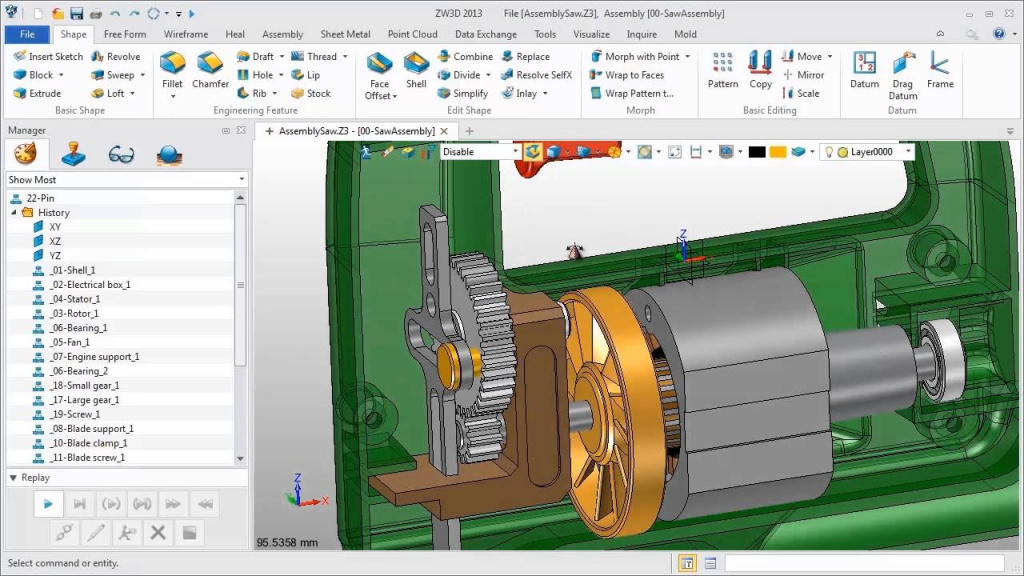
The story of ZW3D begins far from ZWSOFT’s Guangzhou headquarters – in fact, it starts in Florida in 1985. That year, two engineers, Mark Vorwaller and Forrest Blair, founded a company called Control Automation, Inc. (CAI) with a focus on robotics and automation software. In the course of their early projects, they developed an in-house PC-based solid modeling software to help program robotic workcells. This pioneering modeler was eventually sold under the name ModelMATE to other software vendors, making it one of the first commercial solid modeling tools available on personal computers in the 1980s.
By 1989, Vorwaller and his team embarked on an ambitious new direction: creating a hybrid modeling kernel that could handle both precise geometric constraints and freeform surface modeling. A partnership with a large Japanese firm helped drive this innovation in blending variational and parametric modeling techniques. Reflecting the shift, the company was renamed Varimetrix in 1994. Over the next few years, the small Florida-based team refined their all-in-one CAD/CAM system, which offered an uncommon combination of powerful solid modeling, complex surfacing, and integrated machining in one software.
The breakthrough came in 1999, when Varimetrix released its flagship VX CAD/CAM product – the culmination of those years of development. The software’s success prompted another rebranding of the company simply to VX Corporation, aligning the company name with its product. VX CAD/CAM gained recognition for its “hybrid” modeling approach, meaning users could seamlessly use solids and surfaces together, and even apply solid features to surface geometry. This eliminated many of the traditional boundaries between different modeling methods. It was also known for being able to work directly with imported geometry without needing to rebuild models as solids – a significant practical advantage in real-world design environments. VX’s ability to mix parametric, history-based modeling with direct editing of geometry foreshadowed trends that larger CAD developers would only embrace years later.
In these early days, marketing was not VX’s strong suit – it was a technically driven company that relied largely on word-of-mouth among engineers. “Blending these modeling technologies gives VX customers superior power and flexibility,” explained Mark Vorwaller, who served as CEO of VX. He emphasized robust hybrid modeling, speed with large assemblies, and built-in CAM as key differentiators of the system. Indeed, VX was a fully integrated CAD/CAM solution well before “all-in-one” became a buzzword, offering modules for 2D drafting, 3D design, mold and die tooling, and multi-axis machining in a unified environment.
VX Corporation’s innovations did not go unnoticed. In 2000, Japanese machine tool maker Shin Nippon Koki (SNK) partnered with VX to distribute the software globally, providing a boost in reaching manufacturing customers worldwide. VX’s product was even honored with a NASA Tech Briefs award in 2002, recognizing it as a leading engineering innovation – notably, the first CAD/CAM package to truly integrate design-through-manufacturing in one system. Around this time, the company introduced its proprietary next-generation geometric kernel called “Overdrive™.” Overdrive brought lightning-fast modeling computations and further optimized the hybrid solid-surface modeling that VX was known for. “When it comes to modeling, the Overdrive kernel of ZW3D is among the fastest I’ve ever seen,” one manufacturing expert later remarked, underscoring the kernel’s performance edge. With its advanced surfacing (even enabling Class-A automotive surface quality) and efficient toolpath generation up to 5-axis, the VX solution quietly secured a niche of loyal users in industries like product design and mold making through the early 2000s.
ZWSOFT Enters the Picture
While VX was building its CAD/CAM technology in the United States, on the other side of the world a separate story was unfolding. In 1998, a new software company called ZWCAD Software Co., Ltd. was founded in Guangzhou, China by an engineer named Du Yulin (known as Truman Du). Initially, ZWCAD focused on creating an affordable 2D CAD program as an alternative to well-known drafting software like AutoCAD. Through the early 2000s, ZWCAD grew rapidly in the Chinese market by offering comparable functionality to industry leaders at a fraction of the cost. By 2004, ZWCAD had launched a global strategy, expanding distribution beyond China. The company (eventually renamed ZWSOFT Co., Ltd.) became the dominant CAD vendor in China and started gaining users worldwide with its budget-friendly 2D CAD solution.
However, Truman Du and his team had their sights set higher – they recognized that to be a true full-service CAD/CAM provider, ZWSOFT needed a strong 3D modeling and CAM product in its portfolio. Rather than developing 3D software entirely from scratch, ZWSOFT sought an acquisition. That opportunity came in 2010 when ZWSOFT identified VX Corporation as an ideal match. VX had the proven technology and 25 years of development experience in 3D, while ZWSOFT had marketing muscle, a growing global reseller network, and a vision to compete head-to-head with the major CAD players.
In August 2010, ZWSOFT acquired VX Corporation, including all its technology and the core development team based in Melbourne, Florida. This merger was a strategic leap for ZWSOFT – overnight the Chinese company “leapt into the 3D league,” as industry observers put it, by obtaining an advanced 3D CAD/CAM system to complement its 2D offerings. At the time of the acquisition, ZWSOFT already claimed more than 180,000 users in over 80 countriesfor its CAD products, and it made clear that adding VX’s capabilities was aimed at making ZWSOFT a world leader in both 2D and 3D CAD/CAM.
For VX’s staff and existing customers, the deal brought reassurance that development would continue. ZWSOFT kept the Florida R&D office as a division of the company – effectively making VX a wholly owned subsidiary – and promised to augment the small VX team with additional engineers from its large development centers in China. By combining forces, the new parent-subsidiary hoped to accelerate improvements and expand the software’s reach globally. Mark Vorwaller, the VX co-founder, stayed on and took a leadership role as President of ZWSOFT’s American division to oversee continuity. “We will now be aided by a much larger international team,” the company announced, signaling that the product’s evolution would benefit from ZWSOFT’s resources.
The first visible outcome of the merger was the rebranding of the software. In early 2011, VX CAD/CAM was relaunched under a new name: ZW3D. This name aligned with ZWSOFT’s branding (similar to its ZWCAD product) and marked the start of a “new era of budget-friendly 3D CAD/CAM,” as ZWSOFT proclaimed. After a year of joint efforts between the Florida and China R&D groups, ZW3D 2011 debuted in June 2011, making its public premiere at ZWSOFT’s annual partner conference in Guangzhou. The all-in-one 3D solution was positioned to deliver enterprise-level mechanical design and manufacturing capabilities “at a fraction of the cost of comparable systems,” directly appealing to cost-conscious customers who might otherwise consider mid-range CAD/CAM packages like SolidWorks, Creo, or Inventor. By acquiring VX, ZWSOFT also gained complete ownership of a proprietary modeling kernel (the aforementioned Overdrive). This was a significant strategic asset – few CAD companies besides giants like Dassault Systèmes or Siemens can claim to own their kernel technology. ZWSOFT touted that owning the core 3D kernel set it apart from many competitors who rely on third-party kernels, giving ZW3D an edge in flexibility and independence for future development.
Growth and Market Presence
Since becoming part of ZWSOFT, ZW3D has steadily grown its user base and capabilities. ZWSOFT as a whole has experienced remarkable expansion in the past decade. The company implemented an aggressive global distribution strategy, working with a network of over 800 resellers worldwide to reach customers in diverse markets. As of the mid-2020s, ZWSOFT reports that it has sold its products to over 1.4 million licensed users in more than 90 countries, spanning industries from architecture and construction (via its ZWCAD line) to manufacturing and engineering (with ZW3D and other tools). ZW3D itself is used by tens of thousands of professionals, contributing to that total and establishing a foothold particularly among small to mid-size manufacturers looking for an affordable integrated CAD/CAM package.
ZWSOFT’s growth has also been reflected in its corporate milestones. In March 2021, ZWSOFT went public on the Shanghai Stock Exchange’s STAR Market, a board for high-tech companies. The IPO provided additional capital to invest in R&D and expansion. By 2024, the company’s annual revenues had grown to the equivalent of over $120 million, with a substantial portion reinvested into development (ZWSOFT consistently allocates around 30% of revenue to R&D). The company has opened multiple R&D centers beyond its Guangzhou headquarters – including in Wuhan, Shanghai, Beijing, Xi’an, and an international office in Florida – to tap into talent pools and stay at the cutting edge of engineering software. Today, ZWSOFT employs over 600 people and has established itself as the leading domestic CAD/CAM provider in China while also making inroads globally against more established Western rivals.
One of ZWSOFT’s strategies for growth has been forming strategic partnerships and broadening its product ecosystem. Early on, the VX acquisition came with a valuable partnership: the historical alliance with SNK in Japan for machine tool integration. Building on that concept, ZWSOFT struck new collaborations to enhance ZW3D’s functionality. For example, ZW3D is integrated with TraceParts for ready-made 3D component libraries, with KeyShot for high-quality rendering and visualization, with Forming Technologies Inc. (FTI) for sheet metal forming simulation, and with Eureka for CNC machining simulation. These collaborations allow ZW3D users to access specialized tools (like photorealistic rendering or NC code verification) seamlessly from within the ZW3D environment. ZWSOFT has also actively engaged in educational partnerships – by 2020 it had provided software and curricula to over 3,000 educational institutions and over 70,000 secondary schools, aiming to train the next generation of designers and engineers on its platforms. This outreach not only builds good will but also cultivates a skilled user base familiar with ZW3D from the classroom to the factory.
In terms of mergers and acquisitions beyond VX, ZWSOFT has continued to look for opportunities to enhance its technology stack. In late 2023, the company acquired CHAM Ltd., a UK-based developer of computational fluid dynamics (CFD) software. While this acquisition was outside the CAD/CAM domain, it signaled ZWSOFT’s intent to expand into simulation and analysis tools, complementing design and manufacturing. By incorporating a respected CFD solution, ZWSOFT aims to offer more CAE (computer-aided engineering) capabilities alongside ZW3D – such as fluid flow and thermal analysis – to move toward a comprehensive multi-physics platform. This move reflects the company’s broader vision of “all-in-one CAx” (Computer-Aided technologies) solutions, providing everything from drafting and modeling to simulation and machining under one roof.
Applications and Industries
ZW3D CAM is a general-purpose 3D CAD/CAM package, but its impact is most visible in the manufacturing sector. The software is used in a wide array of application areas and industries that design and produce physical products. Typical users of ZW3D include mechanical engineers, product designers, CNC machinists, and mold makers. Small and medium-sized manufacturers have been particularly drawn to ZW3D for its value proposition – it offers many of the advanced features of high-end 3D CAD/CAM systems without the exorbitant cost or steep learning curve.
Key industries leveraging ZW3D CAM include:
-
Automotive and Transportation – Suppliers design auto parts and tooling, such as engine components, brackets, and interior parts, using ZW3D’s modeling. Its CAM module then generates toolpaths to machine these parts or the molds that shape them. For example, the software’s ability to handle smoothly contoured surface designs makes it suitable for car body parts and lighting components. ZW3D has been used in projects ranging from custom car mods to railway equipment design.
-
Consumer Products and Electronics – Companies developing gadgets, appliances, and consumer goods benefit from ZW3D’s hybrid modeling to create the ergonomic freeform shapes often required. The integrated mold design functions (like core and cavity splitting, even on complex surfaces) speed up the process of moving from design to injection mold manufacturing. One user in product development praised, “ZW3D really helped us design a product to not only work well but also look best,” highlighting how industrial design aesthetics can be realized via its surfacing capabilities.
-
Tooling and Mold/Die Making – ZW3D inherited a strong reputation in mold design from its VX lineage. It provides dedicated tools for mold base creation, electrode design for EDM, and CNC strategies tuned for mold and die machining. Even if a client provides only surface models of a part, ZW3D’s non-solid mold parting feature allows moldmakers to create proper cores, cavities, and parting surfaces without needing a perfectly solid input. This has made it a go-to solution for many mold shops and die manufacturers seeking efficiency. It was no coincidence that ZW3D (as VX) was recognized by NASA Tech Briefs for bridging design and manufacturing – mold makers can finish an entire workflow in one system.
-
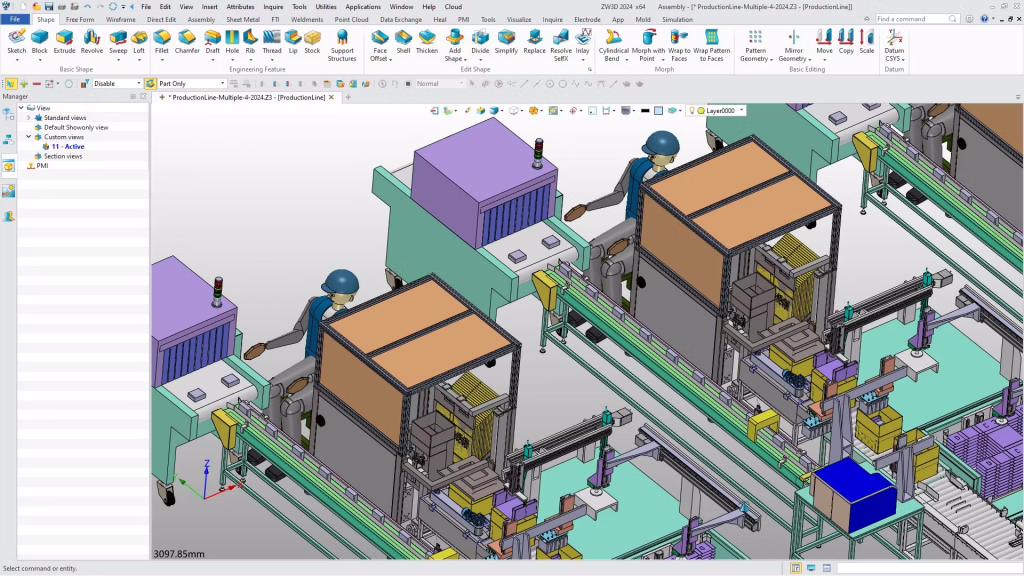
Machinery and Equipment – General machine design is another area, including designing mechanical assemblies like gearboxes, jigs and fixtures, and custom industrial machinery. ZW3D’s assembly design environment handles large assemblies with many parts, and the CAM can program operations like 2-axis turning for shafts or 5-axis milling for complex prismatic parts. Companies in the aerospace supply chain have also used ZW3D for fixture design and multi-axis machining of components.
-
Education and Training – Because of its breadth, ZW3D is used in technical education to teach students the end-to-end product development cycle. Engineering programs in some universities introduce ZW3D so students get exposure to both CAD modeling and CNC machining concepts on one platform. This helps future engineers understand how a design on screen translates to a part on a machine without switching software.
-
Others – Niche sectors like jewelry design, medical devices, and even shipbuilding have adopters of ZW3D, leveraging specific features (such as sheet metal design or 4-axis engraving). Its flexibility with imported data means it’s often used in environments where models come from various sources and need to be edited or machined.
One indicator of ZW3D’s broad adoption is that it’s truly worldwide: it’s available in 15+ languages – from English and Chinese to German, Japanese, Korean, Vietnamese, and more – reflecting the diverse locales of its users. “It’s all around us, used to design and machine auto parts, consumer products, electronics, molds…,” observed Colin Lin, Director of ZW3D Overseas Business, marveling at the range of everyday items that have been created with the software. Indeed, many users might not realize that a product they use or a part in their car had its digital origins in ZW3D.
Technical Innovations and Standout Features
Over the course of three decades, ZW3D (and its VX predecessor) has introduced a number of innovations that make it stand out in the CAD/CAM software landscape. From the beginning, the system was conceived as a comprehensive toolset for the entire design-to-manufacturing process. Here are some of the technical strengths and notable featuresthat define ZW3D CAM:
-
Solid-Surface Hybrid Modeling: ZW3D’s modeling kernel allows solids and surfaces to coexist seamlessly in the same design. A designer can, for example, model most of a part as a solid, then trim or shape it with surface operations, and even combine the two – such as intersecting surfaces to cut solids or thickening surfaces into solids. This hybrid approach, introduced fully in 1999, was industry-leading. It eliminates the frustration of being confined to one modeling paradigm. Users don’t need to convert surface models into solids to do solid operations; ZW3D can directly add features like fillets or holes onto surface bodies. This is extremely useful in handling complex geometries (common in consumer product designs and molds) where purely solid modelers struggle. The hybrid modeling is powered by the proprietary Overdrive™ geometric kernel, which ZWSOFT now proudly claims as self-developed IP. Overdrive is known for its computational speed and has been tuned over years for stability on large models.
-
Parametric and Direct Modeling Fusion: ZW3D offers traditional history-based parametric modeling – you build features step by step, and you can go back and change a sketch or dimension to update the model. At the same time, it provides direct editing tools that let you push, pull, and tweak geometry on the fly without worrying about the feature tree. What’s unique is that ZW3D can capture direct edits in its history (a “hybrid history-direct modeling” approach). This gives users flexibility: intricate, rule-driven parts can be built with parametric sketches and constraints, but if an imported part has no history, the user can immediately modify it via direct operations (move a face, resize a pocket, etc.). Mark Vorwaller highlighted this as a key difference: the ability to “immediately work with any imported part – no solids required,” meaning ZW3D doesn’t force a time-consuming healing process before you can edit foreign CAD data. This capability is crucial in real-world workflows where models often come from clients or other CAD systems.
-
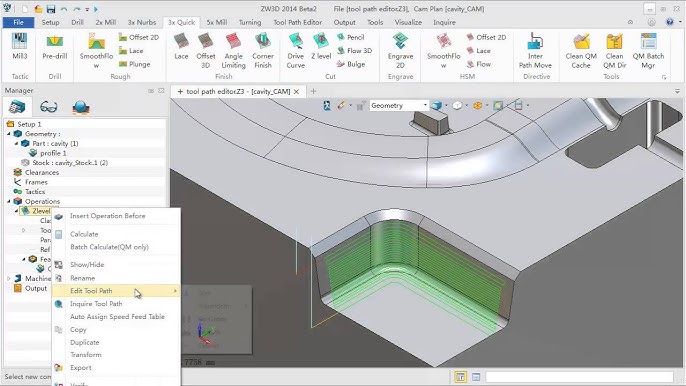
All-in-One CAD/CAM Environment: True to its roots, ZW3D integrates a full suite of CAD and CAM in one software. The CAM module is not an afterthought or separate application – it’s built into the same interface and directly associative to the CAD data. A user can design a part (or import one), switch to the CAM tab, and start creating toolpaths for milling or turning without any data transfer. If the design changes, toolpaths update accordingly. ZW3D CAM supports a range from 2-axis machining (simple cuts, drilling) up through 3-axis milling (for complex surface machining) and up to simultaneous 4- and 5-axis machining for intricate multi-sided or continuous curved surfaces. It also includes lathe (turning) operations and even has capabilities for sheet metal fabrication and welding structures via additional modules. Within CAM, users get a rich set of strategies: roughing, finishing, high-speed machining (including a specialized VoluMill™ high-efficiency toolpath plugin for 2-5 axis roughing), and drilling cycles. ZW3D’s CAM excels in mold & die machining with dedicated routines for things like cavity rest machining and electrode milling. Post-processing in ZW3D is flexible – it comes with a library of CNC post-processors and allows customization so that the generated G-code can be tailored to virtually any CNC machine controller. The software also features toolpath simulation and verification; users can run the cutter through a digital block of material to check for gouges or collisions, and even simulate the entire machine kinematics in 5-axis scenarios to ensure there are no surprises on the shop floor.
-
Mold Design & Specialized Tools: One standout area of ZW3D is its focus on mold design. The software includes an array of mold-specific functions like core and cavity separation, automatic draft angle analysis, mold base assembly libraries, slide and lifter design, and cooling line planning. Uniquely, ZW3D can perform “non-solid mold parting,” meaning it can create core and cavity geometry directly from a set of surfaces or even open meshes, which is very forgiving when working with clients’ surface models that might not form a perfect solid. ZW3D also has built-in applications for reverse engineering (point cloud and STL mesh handling), sheet metal design (with unfold/refold, bend allowances), electrode extraction for EDM, and even piping and wiring harness design for more complex product assemblies. This breadth of features means many companies find they can accomplish most of their design tasks without needing to purchase multiple software packages.
-
Ease of Use and Learning: Over the years, ZW3D’s user interface has evolved to become more intuitive, adopting modern UI conventions like ribbon toolbars and context-sensitive menus. One interesting legacy feature is “Show-n-Tell”, an integrated tutorial system that acts like an interactive 3D textbook. This e-learning approach, carried over from the VX days, allows new users to learn the software at their own pace by following built-in 3D guides and lessons. While high-end CAD/CAM software can be notoriously complex, ZW3D has a reputation for a relatively gentle learning curve for the feature set it offers. The integration of CAD and CAM also means users don’t have to learn two separate programs – designers and machinists work in the same environment, which can smooth out team collaboration and reduce errors.
-
Cross-Platform Compatibility: In practical terms, ZW3D recognizes that no software works in isolation in a typical company. It places emphasis on data exchange – the ability to import and export all major 3D CAD formats. ZW3D can directly open files from systems like CATIA, Inventor, SolidWorks, Creo, NX, and more (often through licensed translators), as well as neutral formats like STEP, IGES, and Parasolid. This is essential for working with clients or partners who use different CAD tools. Not only can it import these models, but thanks to its direct editing, ZW3D can let you modify them without needing the original feature history. On export, it ensures that designs made in ZW3D can be saved out to neutral or native formats required by customers or downstream processes. This high compatibility has been a selling point, especially for smaller suppliers who must adapt to whatever file format their big customers hand them.
Collectively, these features position ZW3D as a versatile, end-to-end solution. It’s often described as covering the entire product development journey “from art to part” – meaning from initial concept sketches (which can be done in 2D within ZW3D or imported) to 3D detailed design, and straight through to G-code for CNC machines to cut the part. While each individual capability might be matched by a competing product, few other packages combine everything under one umbrella with a perpetual licensing model (ZW3D is sold as a one-time purchase, which many customers prefer over subscriptions). It’s this combination of breadth and affordability that makes ZW3D stand out, especially for companies that need both CAD and CAM but cannot afford multiple software seats or expensive annual fees.
Leadership and Vision
Behind ZW3D’s long-running development is a story of vision and leadership – spanning from its original founder to the current executives steering its future. Mark Vorwaller’s philosophy in the early VX days set the tone by prioritizing technical excellence over flashy marketing. That ethos of “let the product speak for itself” carried through as VX technology became ZW3D. However, joining the ZWSOFT family added new dimensions to the leadership approach. ZWSOFT’s CEO, Truman Du, has been vocal about focusing on the needs of users and the importance of continuous innovation. “As the CAD market keeps changing, I thought people might have questions about the current and future state of the CAD/CAM industry and ZWSOFT. I’m looking forward to reading what our users have to say and what they want…,” Du said in an initiative to openly solicit feedback from the CAD community. This reflects a customer-centric attitude that likely contributed to ZW3D’s user-driven improvements.
Within the ZW3D product line, leaders like Colin Lin (who oversees overseas business) emphasize staying attuned to real-world usage. “The development process we are and will be using is similar to what we used 30 years ago: listen to our users and partners, filter out the good ideas from the bad ones, and make our software better,” Colin said, commenting on ZW3D’s 30th anniversary. This statement harks back to the importance of user feedback in shaping the tool – a process that started when Mark Vorwaller would personally engage with the small VX user base in the 90s, and continues now with ZWSOFT hosting forums, “Talk to Truman” Q&As, and international user conferences (branded ZWorld) where users can share their ideas directly with developers.
Mark Vorwaller, who bridged the old and new eras of the software, also provided perspective on the journey during the 30-year anniversary celebration in 2015. Reflecting on how far the product had come since 1986, he remarked metaphorically that “30 is an age of vitality and energy for humans, almost vintage for a car, an eternity for an ant, and next to nothing for a star… What 30 means to us is the amazing amount of experience that we’ve gathered – 30 years of global partnerships, 30 years of services, and 30 years spent collaborating and inventing.” That “inventing” is key – ZW3D’s team has never stopped adding and refining features each year. The company releases a major new version annually (e.g., ZW3D 2023, ZW3D 2024, etc.), each time incorporating user-requested enhancements and often introducing cutting-edge elements. In 2024, for instance, ZW3D introduced AI-driven features to assist with design and machining tasks, pointing towards an increasingly intelligent CAD/CAM environment.
ZWSOFT’s official mission has been encapsulated in the phrase “Empowering Sustainable Innovation with All-in-One CAx Solutions.” This mission underlines that the company sees ZW3D not just as a software tool to sell, but as part of a broader ecosystem enabling innovators – whether they’re entrepreneurs developing greener products or students learning to design – to create efficiently and sustainably. With the combination of a 2D drafting platform, a 3D CAD/CAM platform (ZW3D), and now expanded simulation capabilities, ZWSOFT envisions itself as a one-stop provider for engineers.
It’s worth noting that ZW3D’s rise also aligns with a larger trend: the growth of indigenous technology in China. Just as China has aimed to develop its own solutions in various tech fields, ZW3D represents one of the first home-grown 3D CAD/CAM kernels to gain wide usage. In 2023, ZW3D earned the “China Copyright Gold Award” for domestically developed industrial software – a point of pride as it underscores reducing reliance on foreign CAD kernels and software. This national recognition also indicates the support and importance placed on developing robust engineering software within the country.
Conclusion and Outlook
From its humble beginnings as a university project-turned-startup in Florida to its current status as a globally marketed product under a Chinese tech firm, ZW3D CAM’s journey is a remarkable tale of persistence in innovation. It has survived and thrived through multiple decades, a major acquisition, and rapid changes in the CAD/CAM industry. Today, ZW3D stands as a mature, feature-rich solution that caters to a spectrum of users – from independent job shop machinists to large OEM manufacturers, and from veteran designers who have followed it since the VX days to young engineers just discovering it as an alternative to the usual industry staples.
ZW3D’s strengths lie in its integration of capabilities and its affordability. In an era when many CAD/CAM vendors are pushing subscription pricing and segmented product offerings, ZW3D’s all-in-one perpetual license model and moderate price point are refreshing to many in the industry. This has carved out a growing niche for ZW3D, especially in emerging markets and small enterprises that demand value. Moreover, the continuous enhancement of its core technologies – such as improving the Overdrive kernel, adding AI assistance, or expanding multi-physics simulation – keeps ZW3D relevant as manufacturing evolves into the era of smart factories and complex, optimized designs.
The road ahead for ZW3D CAM will likely involve deeper integration with simulation (thanks to acquisitions like CHAM), cloud collaboration features (as hinted by ZWSOFT’s work on web-based data access), and further performance tuning to handle ever-larger models and assemblies. Its vendor, ZWSOFT, has clearly signaled commitment to long-term R&D, so users can expect ZW3D to remain on the cutting edge of mid-range CAD/CAM. As Colin Lin put it, the goal is for ZW3D to develop “towards an ideal solution for the middle CAD/CAM market” – essentially to be the go-to choice for companies that need robust capabilities without the enterprise price tag or complexity.
In a domain often dominated by a few big names, ZW3D CAM has proven that a blend of technical ingenuity, strategic partnerships, and customer-centric development can yield a competitive product with its own loyal following. As it enters its next decades, ZW3D is poised to keep turning heads – even if quietly – in the global design and manufacturing community. It serves as an example of how cross-border collaboration (American kernel know-how meets Chinese market savvy) can create a unique contender in CAD/CAM. For those seeking an alternative path from design to manufacturing, ZW3D’s rich history and evolving story make it a software solution worth knowing.
Vendor: ZWSOFT