
Siemens NX CAM: History, Applications, and Innovations
The information is currently being reviewed and updated. If you notice any errors or inaccuracies, please let us know.
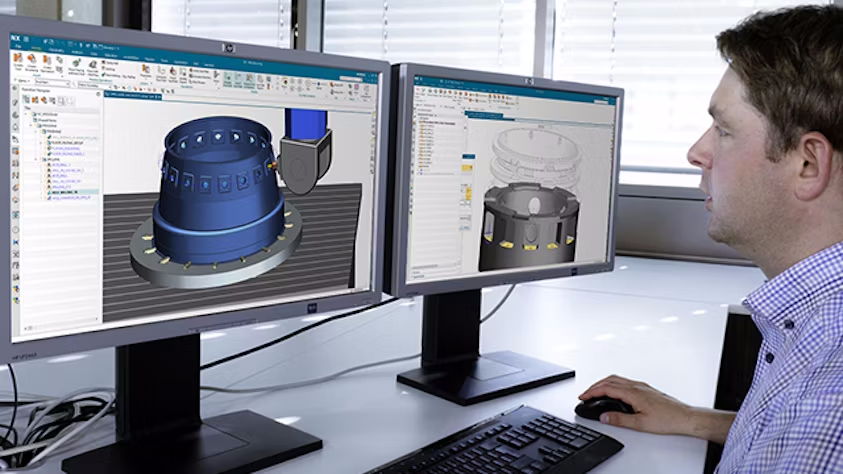
Siemens NX CAM is a high-end computer-aided manufacturing (CAM) software system widely used for programming and controlling machining processes in industries such as automotive and aerospace. Developed by Siemens Digital Industries Software, NX CAM allows manufacturers to create precise instructions for computer numerical control (CNC) machine tools directly from digital product designs. The software is part of the broader Siemens NX suite, which integrates computer-aided design (CAD), CAM, and computer-aided engineering (CAE) capabilities into a single platform. This integration enables companies to streamline product development from initial design through engineering analysis to final manufacturing within one environment.
First introduced in the 1970s, NX CAM has evolved over five decades into one of the industry’s leading manufacturing software solutions. It offers advanced features for complex multi-axis milling, turning, and drilling operations, as well as simulation tools to visualize and verify machining processes before any real cutting takes place. Siemens positions NX CAM as a key component of the “digital thread” in modern factories—connecting design data to production execution as part of a fully digitalized manufacturing strategy. In practice, this means NX CAM is employed to build everything from airplane engines and automotive molds to smartphones and industrial machinery components, helping companies improve efficiency, accuracy, and time-to-market. NX is frequently grouped with Dassault Systèmes’ CATIA and PTC’s Creo as one of the “Big Three” platforms in the high-end CAD/CAM market, and it also competes with mid-range tools like Autodesk Inventor.
Applications and Use Cases
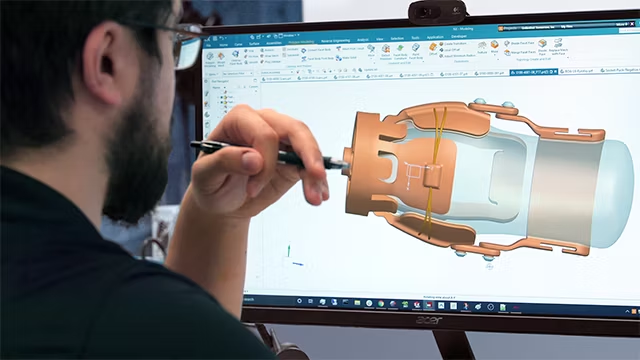
NX CAM is used across a wide range of manufacturing sectors and applications. Key industries and tasks include:
-
Aerospace & Defense: Programming the machining of aircraft structural parts, engine components, and complex military hardware. NX CAM’s multi-axis capabilities and precision are vital for meeting the tight tolerances required in this sector.
-
Automotive: Designing and manufacturing powertrain parts, body molds, and assembly fixtures. Major carmakers (for example, General Motors) and their suppliers use NX CAM to produce engine blocks, transmission components, and stamping dies reliably at high volume.
-
Industrial Machinery: Handling large, complex equipment components such as those in heavy machinery, industrial robots, and production lines. The software’s support for multi-axis milling and mill-turn machines helps machine builders fabricate parts with fewer setups. Manufacturers of heavy industrial equipment and robotics use NX CAM to ensure accuracy and efficiency when machining massive parts and tight-tolerance assemblies.
-
Consumer Products & Electronics: Creating molds, dies, and precision parts for products like appliances, smartphones, and medical devices. NX CAM’s high-speed machining strategies improve surface finish and reduce cycle times for mass-produced items.
-
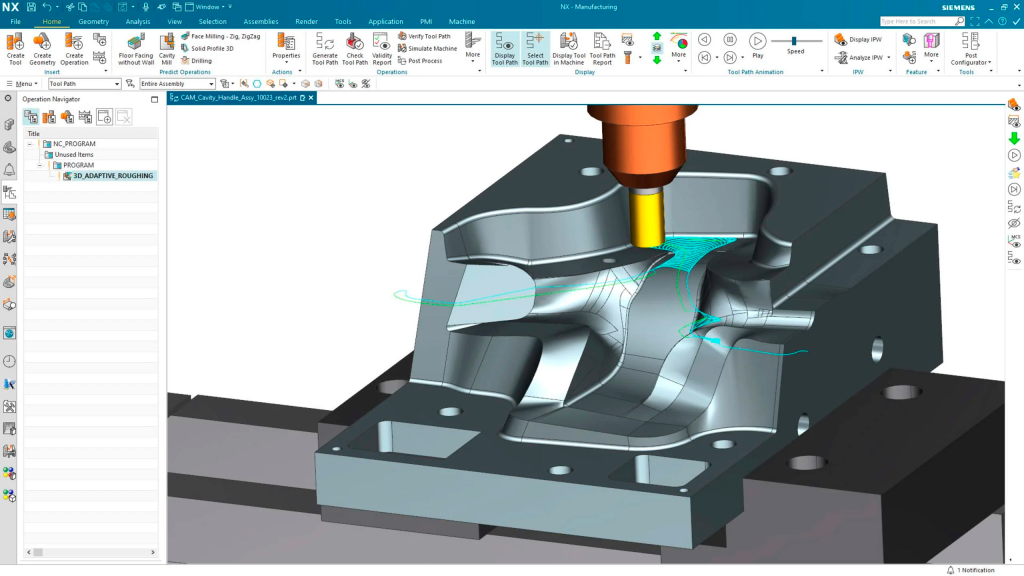
Mold, Tool & Die Making: Building injection molds, press dies, and cutting tools that demand exceptional accuracy. Toolmakers leverage NX’s integrated CAD/CAM to iterate designs and directly generate toolpaths for mold cavities and complex die surfaces.
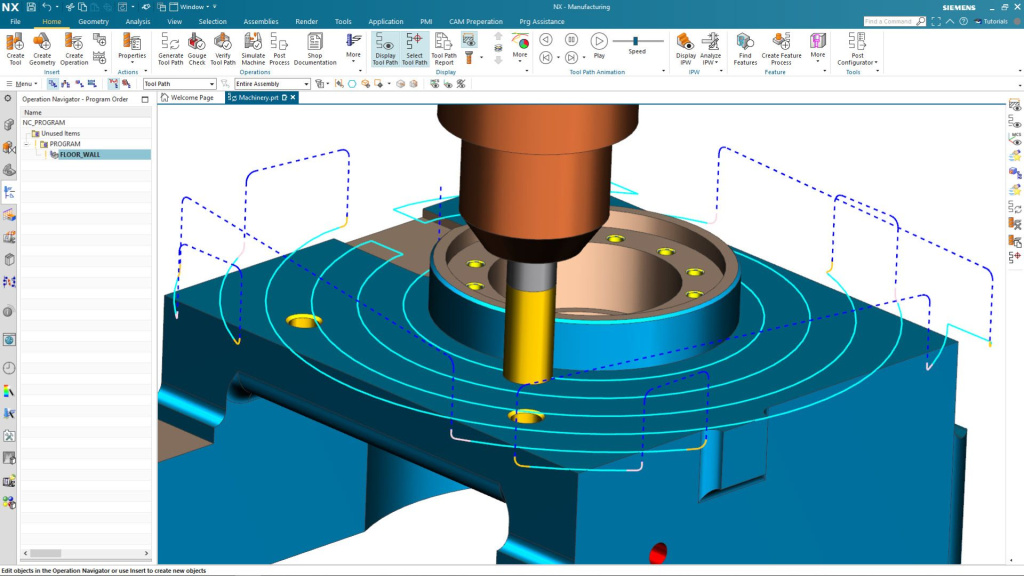
In each of these scenarios, NX CAM provides an end-to-end solution—from preparing 3D models for manufacturability, to generating optimized toolpaths, simulating the entire machining process, and outputting G-code programs for a variety of CNC machines. The software is especially valued in environments where design changes are frequent; because NX’s CAD and CAM share the same data model, any design update can automatically propagate to the manufacturing instructions, reducing rework.
History and Evolution
The origins of Siemens NX CAM date back to the dawn of commercial CAD/CAM technology in the 1960s. In 1963, computer scientist John Wright founded a company called United Computing, which in 1972 released UNIAPT, one of the world’s first end-user CAM software programs. UNIAPT enabled aerospace manufacturers like McDonnell Douglas to program NC (numerical control) machine tools using a minicomputer rather than the expensive mainframe systems of the era. This early software — essentially a batch processing tool based on the APT language — demonstrated the cost savings and efficiency gains that digital part programming could offer.
United Computing soon expanded beyond machining code generation. In 1973, the company acquired the Automated Drafting and Machining (ADAM) software code created by Dr. Patrick Hanratty’s MCS, which it used to develop a product called UNI-GRAPHICS. By 1975, Unigraphics was being sold commercially as an integrated CAD/CAM system that combined graphical design with computer-controlled manufacturing. This made Unigraphics one of the first true CAD/CAM packages available to industry.
As the product gained traction, larger industry players took notice. In 1976, aerospace manufacturer McDonnell Douglas acquired United Computing and continued to advance the Unigraphics software internally. Under McDonnell Douglas, Unigraphics achieved a major milestone in 1983 with the release of UniSolids, the industry’s first interactive solid modeling software module. This allowed engineers to create 3D solid models and represented a leap forward in CAD technology that would later prove essential for CAM (since solid models could be directly used for toolpath generation).
By the late 1980s, Unigraphics had become a staple at large manufacturers. In 1987, General Motors selected Unigraphics as a company-wide standard, and by 1991 the software (and the team developing it) had been sold to GM’s information technology subsidiary, Electronic Data Systems (EDS). This move came as McDonnell Douglas faced financial difficulties, and it placed Unigraphics under the wing of EDS, which was then looking after GM’s CAD/CAM needs. Unigraphics subsequently became GM’s corporate CAD system in the early 1990s. By 1992, over 21,000 seatsof Unigraphics were reportedly in use worldwide, reflecting its widespread adoption in automotive and other industries.
The late 1990s brought further consolidation. EDS spun off its engineering software division as Unigraphics Solutions (UGS), which in 2000 acquired another CAD/CAM pioneer, SDRC, makers of the I-DEAS CAD software. UGS set out to merge the best capabilities of Unigraphics and I-DEAS into a unified next-generation product. The result was unveiled in 2002 as NX – the new name signaling “Next Generation.” The first version of NX combined core elements of both predecessor systems and began the process of phasing them into a single, consolidated platform.
In 2007, a significant technology leap came with the introduction of Synchronous Technology in NX 5. Synchronous Technology allowed users to edit 3D models parametrically or directly without rebuilding them from scratch, blending the benefits of history-based and history-free modeling. This innovation, initially unique to Siemens’ NX and Solid Edge products, exemplified NX’s focus on giving engineers more flexibility in design-to-manufacturing workflows.
Over the past decade, NX CAM (and the broader NX suite) has continued to evolve with regular updates. Siemens shifted NX to a continuous release model, delivering new features approximately every six months to keep pace with industry needs. Recent releases have expanded capabilities in areas like additive manufacturing (3D printing), robotics (for programming automated cells), and cloud integration. Through it all, NX CAM has retained a core philosophy established in its early years: providing an integrated environment where product design and manufacturing engineering proceed hand-in-hand. As Vynce Paradise, head of Siemens NX CAM, put it: “CAM is in our DNA. The CAM tools in NX are targeted at the professional users — programmers and manufacturing engineers.” This long lineage, dating back to United Computing’s efforts in the 1960s, underpins the modern software’s rich functionality.
Mergers and Acquisitions
Throughout its history, NX CAM’s ownership and organizational home have shifted through several major corporate moves. Key mergers and acquisitions include:
-
McDonnell Douglas (1976): United Computing (the original developer of NX’s predecessor software) was purchased by McDonnell Douglas in 1976, bringing the Unigraphics system in-house to a major aerospace OEM. This provided resources for further development and tied the software closely to real-world manufacturing challenges in aerospace.
-
Electronic Data Systems (1991): In 1991, McDonnell Douglas sold its information technology and software units amid financial pressures. EDS, then a subsidiary of General Motors, acquired the Unigraphics business. Under EDS, Unigraphics was positioned as a strategic CAD/CAM solution for the automotive sector, given GM’s involvement. EDS eventually spun off this unit as an independent company, UGS.
-
UGS and SDRC Merger (2001): After operating as Unigraphics Solutions, the company merged with SDRC in 2001 (following UGS’s acquisition of SDRC’s I-DEAS software). This merger was more of a product integration than a corporate merger, but it was pivotal: it led to the creation of NX as a unified product, merging two leading CAD/CAM technologies into one.
-
Siemens Acquisition (2007): In January 2007, German technology conglomerate Siemens AG announced it would acquire UGS for $3.5 billion. At the time, UGS was owned by private equity firms Bain Capital, Silver Lake Partners, and Warburg Pincus, who had bought it from EDS in 2004. The Siemens deal folded UGS and NX into the Siemens Automation & Drives division, marking the formation of Siemens PLM Software (now Siemens Digital Industries Software). Siemens leadership saw strategic value in marrying UGS’s software expertise with Siemens’ industrial automation business. “With the acquisition of UGS, we can combine its competence in the sector of digital factories with our leading know-how in industrial automation. This combination makes our customers’ processes faster, better and more cost efficient,” said Klaus Kleinfeld, then CEO of Siemens AG, upon announcing the deal. At the time, UGS had around 7,300 employees and annual revenue of roughly $1.15 billion (2005), underscoring the commercial success of NX and its companion PLM products.
Since becoming part of Siemens, NX CAM has been a flagship offering in the company’s digital factory and Product Lifecycle Management (PLM) portfolio. Siemens continued to invest in related acquisitions to expand this portfolio – for example, acquiring electronics design software maker Mentor Graphics in 2017 and, more recently, simulation software firm Altair Engineering in 2024 – further broadening the ecosystem around NX. Today, the NX CAM product line operates under Siemens Digital Industries Software, delivering solutions as part of the Siemens Xceleratorportfolio (the new name for its integrated suite of software and services).
Partnerships and Collaborations
Siemens has also engaged in many partnerships to enhance NX CAM and integrate it with industry tools and workflows. These collaborations often aim to streamline the digital thread between design, planning, and production:
-
Machine Tool OEMs: Siemens works closely with CNC machine tool manufacturers such as DMG MORI. In many cases, machine builders offer Siemens NX as a recommended CAM solution alongside Siemens Sinumerik CNC controllers, providing customers with a tightly integrated CAD/CAM-to-controller pipeline. Joint initiatives, like training programs and tech demos, are common to ensure NX CAM fully leverages the latest 5-axis machines and automation equipment.
-
Cutting Tool Integration: In 2025, Siemens announced a partnership with Kennametal, a major cutting tool manufacturer, to integrate Kennametal’s tooling data directly into NX CAM. This integration, delivered through Siemens’ cloud-based Tool Manager, allows NX CAM users to access up-to-date tool specifications and recommended cutting parameters from Kennametal’s catalog while programming. By eliminating manual data entry for tool setup, the collaboration helps reduce errors and setup time for customers.
-
AI and Automation Startups: Siemens has embraced partnerships with startups to bring emerging tech into NX CAM. In 2024, it teamed up with UK-based software firm CloudNC to incorporate an artificial intelligence add-on called CAM Assist into NX CAM. CAM Assist uses AI to automatically generate machining strategies for certain features, accelerating the programming of CNC operations. “Enabling our customers to use CloudNC’s technology to automate CNC programming in NX CAM exemplifies our dedication to continuous advancements,”said Armin Grunewald, a Vice President at Siemens Digital Industries Software, highlighting how the open architecture of NX welcomes third-party innovation.
-
Academic and Workforce Development: Siemens frequently collaborates with universities and technical institutes to train the next generation of engineers in NX tools. The company provides academic licenses and curricula for NX CAM, and has alliances with institutions to ensure students and apprentices enter industry familiar with the software’s capabilities. These educational partnerships help maintain a pipeline of skilled NX CAM users globally.
Through such collaborations, Siemens extends NX CAM’s value beyond what it develops in-house. The openness of NX (for example, support for custom post-processors, plug-ins, and cloud services) means an ecosystem of partners contributes to specialized needs—whether it’s a tool library from a cutting tool vendor or a custom automation script from a systems integrator. This ecosystem approach strengthens NX CAM’s position as a hub in digital manufacturing environments.
Key Features and Competitive Strengths
As one of the leading CAM solutions, Siemens NX CAM is distinguished by several key features and strengths:
-
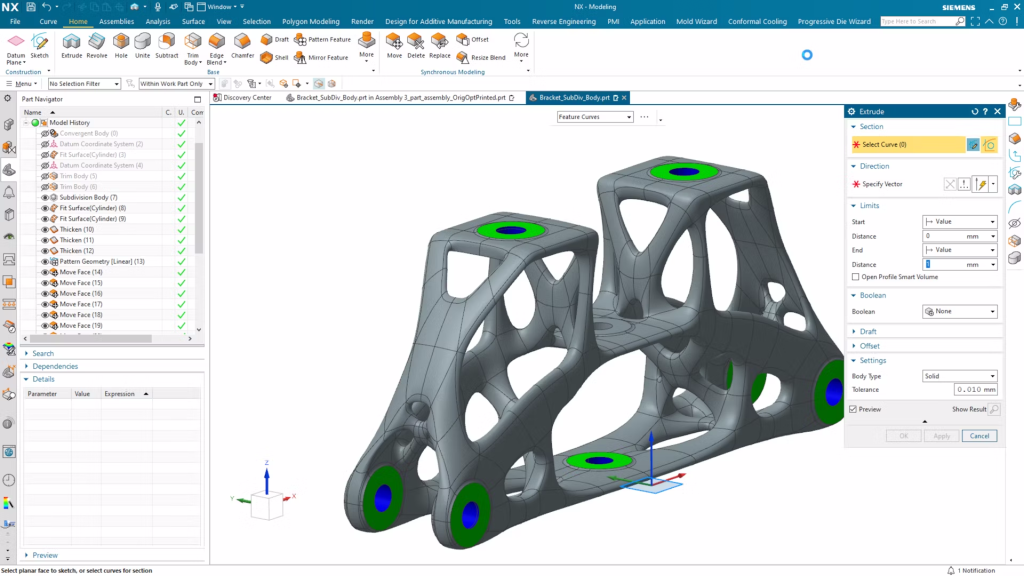
Integrated CAD/CAM Environment: NX provides a single, unified platform for design and manufacturing. Engineers can design a part in NX CAD and seamlessly switch to NX CAM to generate toolpaths, without data translation. This tight integration reduces errors and ensures that any design changes automatically update the machining operations. It also facilitates better collaboration between design engineers and NC programmers, who are effectively working in the same system.
-
Advanced Multi-Axis Machining: NX CAM supports everything from 2.5-axis milling and turning up to complex 5-axis simultaneous machining and multi-channel mill-turn centers. It includes an array of high-end machining strategies – for instance, smooth high-speed milling paths for mold and die work, adaptive clearing for roughing, and automated 5-axis conversion of 3-axis toolpaths. This breadth allows companies to program diverse equipment with one software. A machine tool simulation module uses the actual G-code and digital twins of machines to verify that multi-axis moves won’t cause collisions or errors.
-
Feature-Based and AI-Driven Automation: A major competitive strength of NX CAM is its emphasis on automating routine programming tasks. The software’s feature-based machining capability can recognize geometric features (holes, pockets, slots, etc.) on a part and automatically generate optimized toolpaths for them, based on predefined templates and rules. This can drastically cut programming time (Siemens cites up to 90% reduction in some cases). The incorporation of AI tools like CAM Assist further underscores this strength, as NX CAM begins leveraging machine learning to suggest or create operations for the programmer.
-
Complete Digital Manufacturing Suite: NX CAM is part of Siemens’ larger Xcelerator portfolio, which includes Product Lifecycle Management (Teamcenter), simulation (Simcenter), and Manufacturing Execution (Opcenter) solutions. When combined with these, NX CAM fits into a comprehensive digital thread. For example, tool libraries and machining knowledge can be managed in Teamcenter, or inspection programs for coordinate measuring machines (CMM) can be generated alongside machining operations. This end-to-end coverage – from design and simulation to shop floor execution – is a competitive differentiator, especially for large enterprises seeking a unified system.
-
Continuous Innovation and Support: Backed by Siemens, NX CAM benefits from steady R&D investment and long-term support. Siemens has consistently introduced new capabilities (such as robotics programming, on-machine probing integration, and additive manufacturing processes in NX) to keep the software ahead of evolving industry needs. The company also shifted to a flexible subscription and update model, ensuring customers receive new features biannually rather than waiting for major version releases. This approach, combined with Siemens’ global support network, gives users confidence in NX CAM as a future-proof platform. As senior Siemens executive Zvi Feuer remarked on NX’s longevity: “NX … is more than a new version of software, it is a hallmark of our fifty years in the CAM business. It represents our longstanding dedication and commitment to work with our customers … to help transform their manufacturing operations into engines for profitable business growth.”
These strengths have helped NX CAM earn a top-tier reputation. It is frequently benchmarked against other high-end manufacturing software like Dassault Systèmes’ CATIA and PTC’s Creo, and often comes out ahead in breadth of functionality. In 2024, NX CAM was ranked the #1 CAM software by G2, a peer review platform, reflecting strong user satisfaction. While standalone CAM products (such as Mastercam or HyperMill) are also popular, Siemens leverages NX CAM’s integration and enterprise scalability as key selling points, especially for companies aiming to digitalize their entire product lifecycle.
Global Market and Usage
NX CAM is firmly established as a global tool in manufacturing. It is one of the top software choices for large automotive and aerospace firms, many of which have standardized their design-to-manufacturing workflows around NX. As of the mid-2020s, one industry survey identified over 3,500 companies worldwide using Siemens NX software in some capacity. The user community is strongest in North America and Europe – for instance, the United States alone accounts for roughly 40% of known NX deployments – but adoption in Asia (notably in countries like India, China, and Japan) has also grown steadily.
NX’s longevity has led to deep entrenchment in its customers’ operations; once adopted, the software often becomes a long-term backbone for product development and production due to high switching costs and the extensive training of engineers on the platform. In market analyses, Siemens NX CAM is typically classified as a “bundled” or PLM-integrated CAM solution – part of a larger engineering software platform – whereas many rivals (e.g. Mastercam, HyperMill) are standalone CAM products. This distinction means NX CAM tends to be adopted by larger enterprises seeking an all-in-one system, while standalone CAM tools often serve smaller operations or niche applications. Overall, demand for advanced CAM software is rising; industry forecasts project the CAM software market will exceed $3 billion in annual revenue by 2026, with steady growth as manufacturers continue investing in digital processes.
Conclusion
From its pioneering beginnings with UNIAPT in the 1970s to its current role in powering digital factories, Siemens NX CAM exemplifies the evolution of manufacturing software. Its long history has yielded a mature, robust system that today underpins production at thousands of companies around the world.
As of 2023, Siemens’ industrial software segment (which includes NX CAM) reported roughly €7.3 billion in annual revenue – evidence of the growing importance of software solutions in modern manufacturing.
As manufacturing enters the era of Industry 4.0 — with smarter machines, AI-driven processes, and a push for greater efficiency — NX CAM continues to adapt and innovate. Siemens’ ongoing investments and partnerships indicate that NX CAM will remain a cornerstone of the company’s industrial software offerings in years to come.
Vendor: Siemens