
VERICUT: 35 Years of CNC Simulation and Optimization
The information is currently being reviewed and updated. If you notice any errors or inaccuracies, please let us know.
Introduction
VERICUT is a prominent software system for verifying and simulating CNC machining operations before any real cutting occurs. Developed by the California-based company CGTech, VERICUT creates a virtual “digital twin” of CNC machines to test and optimize tool paths in a 3D environment. Manufacturers use VERICUT to detect programming errors, collisions, or inefficiencies in their NC (numerical control) code, thereby preventing costly machine crashes and scrapped parts on the shop floor. Over the past three decades, this software has become widely regarded as the industry standard for CNC simulation and toolpath optimization.
Origins and History
The story of VERICUT dates back to the late 1980s. CGTech was founded in 1988 by Jon Prun, a software engineer who recognized a pressing need in the CNC machining industry: a way to verify NC tool paths without consuming valuable machine time or risking damage to expensive equipment. At the time, CNC programmers often had to manually “prove out” new programs on real machines, which was both time-consuming and potentially dangerous if the code contained errors. Prun’s startup, CGTech (headquartered in Irvine, California), set out to solve this problem. The result was VERICUT – introduced in 1988 as the first widely available software tool to test and simulate CNC machine tool paths in a virtual environment.
In essence, VERICUT allowed manufacturers to run their CNC programs on a computer, visualizing the cutting process on a 3D model of the raw material and machine, instead of on an actual machine tool. This was a revolutionary concept at the time: NC program verification through 3D material removal simulation, which “revolutionized NC program verification” by using a three-dimensional solid model to mimic the machining process.
From the outset, VERICUT gained traction among industrial users who saw the value in virtual testing. Early versions ran on UNIX workstations and were later ported to Windows as PC computing power grew. By the 1990s, many leading manufacturers had adopted VERICUT to streamline their CNC programming workflow. The software found a particular stronghold in the aerospace industry, where complex multi-axis machining and costly materials made trial-and-error iteration especially undesirable. Companies like Boeing and Airbus were among the notable early adopters. Automotive manufacturers (e.g. General Motors) and defense contractors also became users of the software in its early years. As CGTech expanded its customer base, it remained a privately held company run by its founders, steadily reinvesting in development. In fact, for decades CGTech was 100% self-financed, which the company has said allowed it “to plan long-term without concern of investors, stock price, or parent company pressure”.
Throughout the 2000s, VERICUT’s capabilities and user base grew in tandem. New features were added regularly, driven by feedback from the manufacturing community. “VERICUT development is driven by our customers’ needs, and we always welcome feedback from users and partners. It is the reason we host nearly 40 free VERICUT user group meetings each year,” Jon Prun noted during the software’s 25th anniversary. By 2009, more than 2,000 companies worldwide had adopted VERICUT, and these included a large share of Fortune 500 manufacturers. A 2011 market analysis ranked CGTech as the largest independent provider of NC verification and simulation software based on revenue, with over 9,000 installed seats of VERICUT around the world. In addition to its corporate headquarters in the U.S., CGTech established subsidiaries across Europe and Asia – including the United Kingdom, France, Germany, Italy, Japan, China, India, Singapore, Brazil, and South Korea – to support its growing international clientele. By 2013, the company’s customer list included “thousands of companies in virtually every manufacturing industry, including every major aerospace and automotive company,” a testament to how ubiquitous the tool had become in those sectors.
Over time, CGTech not only enhanced VERICUT’s core simulation algorithms but also introduced complementary products and modules to extend its functionality. In the 1990s and 2000s, graphical simulation of full CNC machines (beyond just the cutting tool and workpiece) became a focus. VERICUT evolved to simulate complete machine kinematics – including multi-axis mills, lathes, and mill/turn centers – detecting collisions or over-travel on machine components as well as the cutting tool. Another major area of development was NC program optimization. Early on, CGTech released a module called OptiPath, and more recently a physics-based module called VERICUT Force, which analyze cutting conditions and automatically adjust feed rates for optimal machining performance.
These optimization tools can significantly reduce cycle times (often by 10–25% or more) while improving tool life and part quality by ensuring cutting parameters stay within safe limits. CGTech also expanded into emerging manufacturing technologies. For instance, it developed VERICUT Composite Programming and Composite Simulation to support automated fiber placement and tape-laying machines used in composite part manufacturing. Likewise, as additive manufacturing gained traction, CGTech added modules to simulate additive and hybrid machining processes, enabling users to verify metal 3D printing and laser cladding operations in the same environment. By continuously broadening VERICUT’s scope, CGTech ensured the software kept pace with the changing landscape of manufacturing. “The software has grown to be the leader in the NC program verification space and has since expanded its original capabilities to include physics-based optimization with its Force module, composites programming and simulation, as well as additive and hybrid processes,” the company noted on its 35th anniversary.
A significant turning point in VERICUT’s corporate story came in late 2020. In October of that year, CGTech was acquired by Sandvik AB, a Swedish engineering conglomerate best known for its cutting tools and machining solutions. Sandvik announced an agreement to buy CGTech, calling it “a global market leader in software for NC/CNC simulation, verification and optimization,” and highlighting that VERICUT would complement Sandvik’s existing portfolio of machining products. The deal placed CGTech under the Sandvik Coromant division (Sandvik’s machining solutions arm), aligning VERICUT with a larger strategy of digital manufacturing offerings. At the time of acquisition, CGTech was reported to have about 180 employees, and generated roughly SEK 470 million in revenue in 2019 (approximately USD $50 million). Sandvik’s leadership saw the move as a way to strengthen their presence in the CAM and simulation space. “This is in line with our strategic focus to grow… in the digital manufacturing space, with special focus on software solutions close to machining,” Sandvik CEO Stefan Widing said of the CGTech purchase.
The acquisition closed by the end of 2020 after regulatory approvals, marking the first time in its history that CGTech was part of a larger corporate parent. Despite the change in ownership, CGTech continued to operate much as before, still focusing on its flagship product and maintaining its global team of simulation experts. In 2024, the company announced a rebranding, officially adopting the name of its star product. “CGTech proudly unveils a new brand identity as it rebrands to Vericut,” the company stated in September 2024, aligning its corporate identity with the name that had become synonymous with CNC simulation excellence. Shin Voeks, who by then served as president of CGTech, explained that “the transition to Vericut is more than a name change; it represents our vision for the future… building on our legacy of excellence and pushing the boundaries of what’s possible in manufacturing technology”. This rebranding reflects how closely the software’s legacy is tied to the company itself, as VERICUT moves forward into its next chapter under the Sandvik umbrella.
Software Features and Innovations
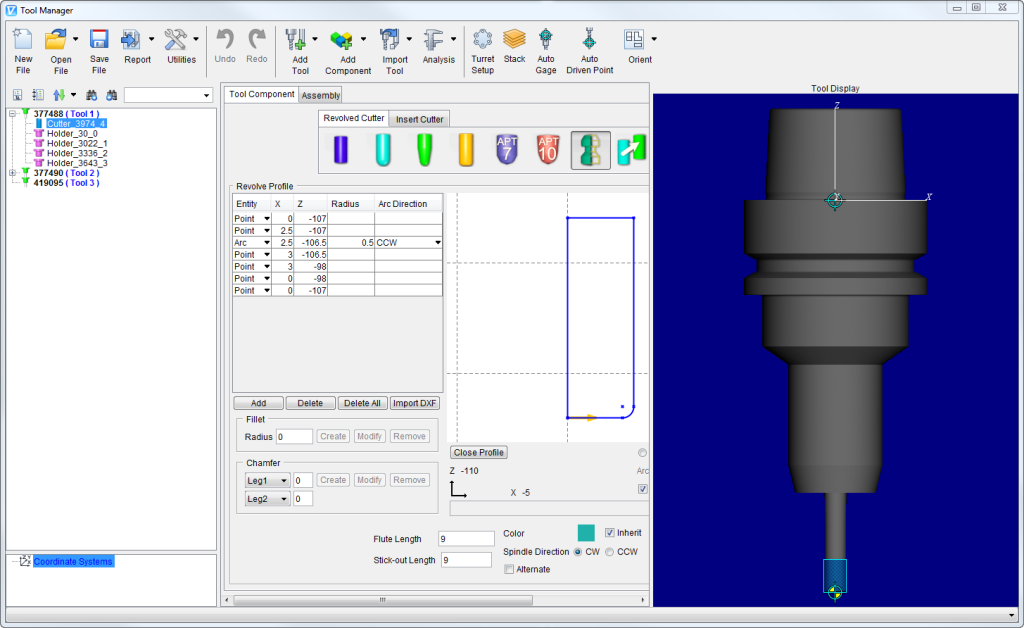
At its core, VERICUT is a tool for simulation, verification, and optimization in CNC machining. The software operates by reading the same NC code that would run on a real CNC machine, and simulating the entire machining process on a computer. Users can load a CAD model of the raw stock material, along with digital models of cutting tools and machine components, then watch as VERICUT’s graphics window displays a step-by-step removal of material, resulting in a virtual finished part. This digital machining process is not just a visual animation—it is a precise verification. VERICUT detects programming mistakes that could lead to crashes or scrapped parts, such as tool collisions with fixtures, gouges in the workpiece, or axis over-travel errors. If any such issue is found, the software flags the exact line of NC code causing the problem, allowing the CNC programmer to correct it before actual machining. By catching errors virtually, companies avoid damaging expensive machines, wasting raw materials, or incurring downtime on the shop floor.
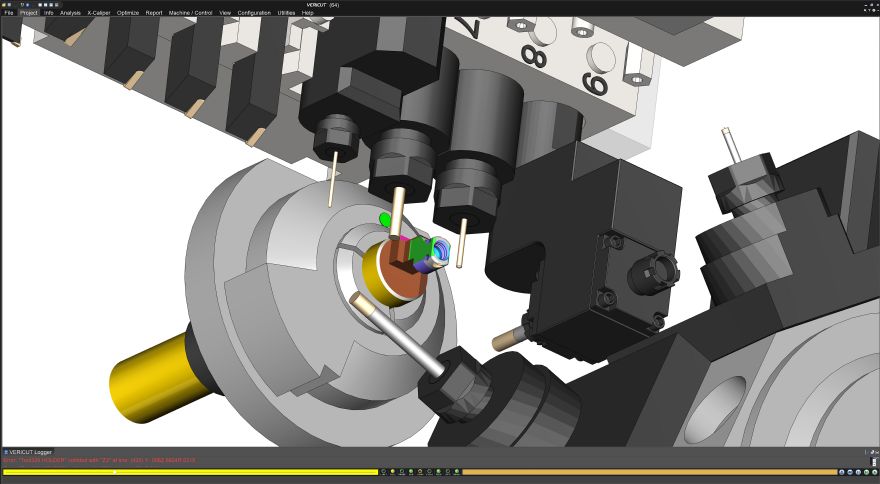
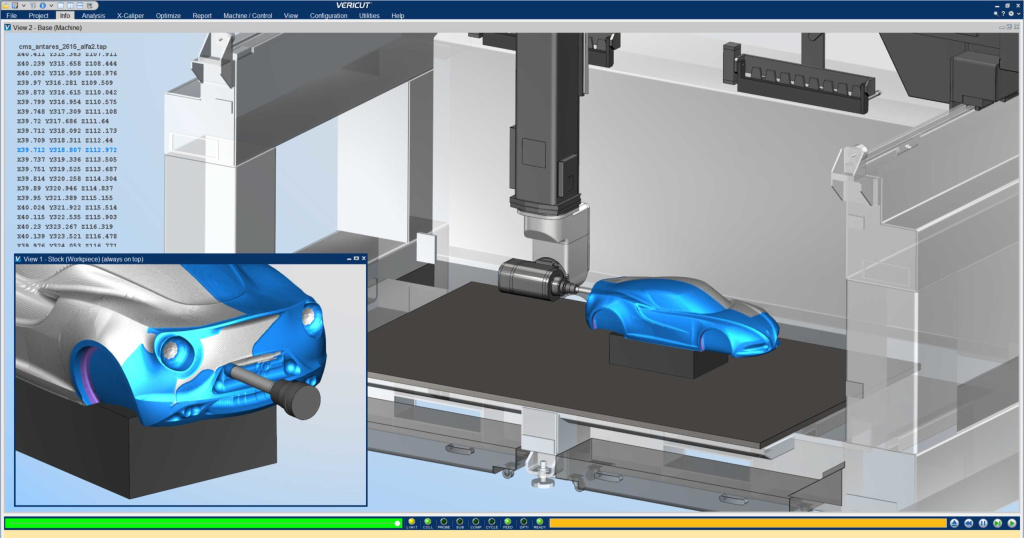
One of VERICUT’s key strengths is its ability to simulate not just the cutting tool and workpiece, but the entire CNC machine tool. The software comes with an extensive library of machine models and also allows users to build custom machine configurations, reproducing the kinematics of mills, lathes, multi-axis machining centers, and more. As a result, VERICUT can mimic complex machining scenarios, including 3-axis to 5-axis milling, multi-spindle mill-turn operations, and even synchronized machining on multiple axes. During simulation, VERICUT continuously checks for collisions or near-misses between all moving parts (the tool, spindle, tables, fixtures, etc.). Users can define “near-miss zones” around components to ensure ample clearance, and the software will alert them if those safety margins are breached.
This level of machine-level simulation is invaluable for validating programs on high-end CNC equipment where the margin for error is small. For instance, a programmer running an intricate 5-axis routine on an expensive aerospace component can use VERICUT to ensure that awkward tool orientations won’t cause the tool holder to smack into the part or machine. As one manufacturing consultant noted, VERICUT “protects our machines from damage due to collisions and gives both the programmer and the machine operator a feeling of safety in their daily work”, while also reducing strain on resources through shorter run times and less downtime. In essence, VERICUT acts as a final safeguard – a virtual proving ground – before the real machine is ever turned on.
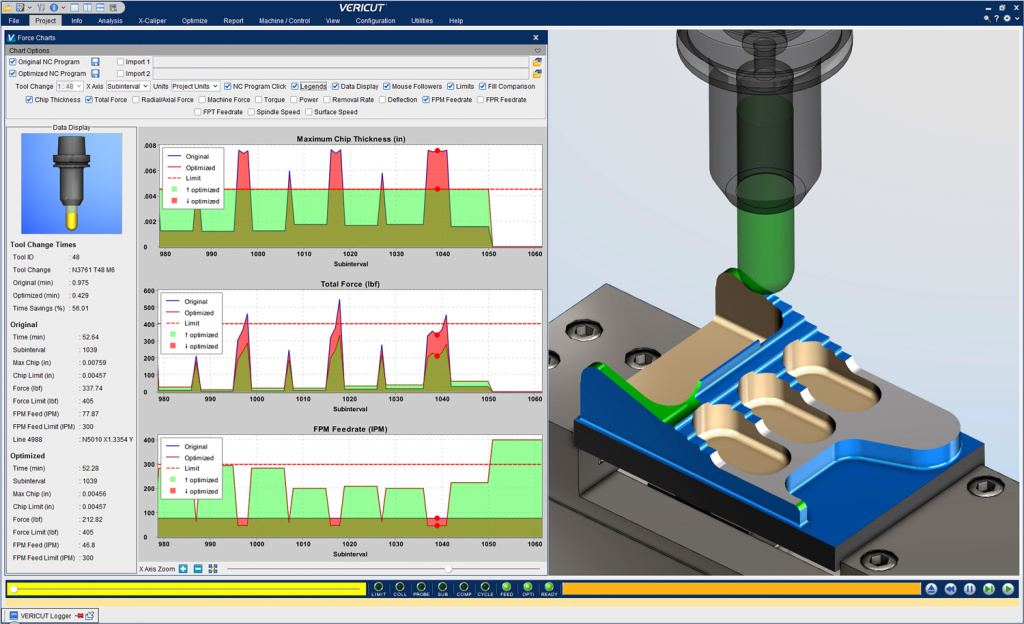
Beyond error detection, VERICUT includes powerful features for analysis and optimization of NC programs. The software can measure and display detailed information about the machining process, such as cutting forces, material removal rates, chip thickness, and tool deflection. Building on this analysis capability, CGTech introduced modules to automatically fine-tune the NC code for greater efficiency. The older OptiPath module and the newer Force module serve this purpose. VERICUT Force, in particular, is a physics-based optimization engine that adjusts the feed rate of the cutting tool depending on the cutting conditions encountered. By analyzing factors like the material type, cutter geometry, spindle power, and engagement volume at each line of code, Force can determine the maximum safe feed rate for each segment of the tool path. The result is often a smoother-running program that maintains more consistent cutting forces.
According to CGTech, Force optimization can reduce machining cycle times by 20–50% in many cases, while also extending cutting tool life because it avoids excessive loads on the tool. These improvements do not require changing the part geometry or the machining process itself – they are achieved purely by optimizing the NC code output from CAM (Computer-Aided Manufacturing) systems. This kind of optimization is particularly valuable in production environments where even small time savings per part can translate into major efficiency gains over large production runs.
Another area where VERICUT has innovated is in composite material manufacturing. Aerospace companies in particular have increasingly used automated machines to lay up composite fibers or tapes for aircraft components. To serve this niche, CGTech developed specialized modules: VERICUT Composite Programming (VCP) and VERICUT Composite Simulation (VCS). These tools enable users to program and simulate automated fiber placement (AFP) and tape-laying machines in a virtual space. The software can model the deposition of composite tapes on complex molds, ensuring that the fiber paths are correct and collision-free. It can also simulate automated drilling and fastening machines, which are used to drill holes and install fasteners in large airframe assemblies. By extending VERICUT’s simulation prowess to composites and assembly automation, CGTech tapped into new applications beyond traditional metal cutting. Additionally, as hybrid manufacturing (combined additive and subtractive machining) emerged, VERICUT expanded to simulate additive manufacturing processes. Users can simulate processes like laser metal deposition or Wire-Arc Additive Manufacturing, then simulate subsequent CNC machining of the deposited material – all within the same VERICUT environment. This capability to handle both additive and subtractive sequences gives manufacturers confidence when working with cutting-edge hybrid machines and ensures that errors can be caught in the virtual model before they cause real-world problems.
Importantly, VERICUT is designed to work within the broader ecosystem of CAD/CAM and PLM (Product Lifecycle Management) software. It operates as a standalone application, but also interfaces with all major CAM systems, including CATIA, Siemens NX, Mastercam, HyperMill, Edgecam, PowerMILL and others.Many CAM software platforms have direct VERICUT integration, allowing NC programmers to export their tool paths to VERICUT with a click for verification. This seamless integration into existing workflows has been crucial to VERICUT’s adoption.
The software is neutral regarding CAD/CAM providers, machine tool builders, or cutting tool brands – a point emphasized during the Sandvik acquisition. Sandvik noted that VERICUT “works stand-alone or in conjunction with all major CAM suppliers” and is machine-tool-neutral as well as cutting-tool-neutral. That neutrality means VERICUT can be used in virtually any manufacturing environment, regardless of which machines or software the company is using to program parts. It also means CGTech has often partnered with other industry players to provide accurate simulation models and data. For example, CGTech has longstanding collaborations with machine tool builders (such as Okuma, DMG Mori, and others) to ensure VERICUT includes up-to-date models and control emulators for their machines, and with cutting tool manufacturers to include tool geometry libraries.
In one notable collaboration, CGTech joined Okuma’s Partners in THINC program – a consortium of technology companies working with Okuma CNC machines. “By partnering with Okuma and Partners in THINC, CGTech can provide users with accurate machine simulations of Okuma machine tools to ensure that their tool paths are right the first time, every time,” Jon Prun said when announcing the partnership. This illustrates how VERICUT’s role often extends into being a hub that brings together various elements of the manufacturing process (machines, tools, and CAM systems) in a common virtual modeling space.
Application Areas and Industry Adoption
VERICUT’s applicability spans a broad range of manufacturing industries, essentially anywhere CNC machines are used to cut or shape material. Over the decades, it has been adopted by companies of all sizes – from small machine shops to multinational corporations – and across sectors including aerospace, automotive, energy, heavy industry, medical devices, consumer products, and motorsports. The aerospace sector, in particular, has a deep historical connection with VERICUT. The software became an integral part of NC programming workflows at major aircraft manufacturers and their suppliers. For instance, both Boeing and Airbus use VERICUT to verify the myriad of machining operations required for airframe and engine components. Aerospace parts often involve complex 5-axis milling of hard alloys or composite layup processes, where mistakes can be extremely costly. VERICUT’s ability to prevent catastrophic errors and optimize cutting made it a standard tool in that industry’s CAD/CAM toolchain. In fact, CGTech’s solutions “are deeply entrenched in the aerospace industry’s history,” notes company president Margaret Schmitt. This is evidenced by the fact that by the 2010s, virtually every major aerospace company was on VERICUT’s client list.
The automotive industry likewise has widely embraced VERICUT, from big OEMs like General Motors and Ford to tier-one suppliers and racing teams. Automotive machining involves high volumes and tight cycle time requirements, especially in production of engine and transmission components. By using VERICUT, automotive manufacturers can fine-tune NC programs to shave off seconds in machining cycles (which can add up significantly in mass production) and ensure that new product launches don’t stumble on manufacturing bugs. In addition, the motorsports world (such as Formula 1 racing teams) relies on rapid iteration of complex components. Those teams use advanced 5-axis CNC machines to make parts under extreme time pressure, and VERICUT helps them avoid wasted time and materials by getting the program right the first time. CGTech has highlighted that VERICUT is adopted “across industries ranging from oil and gas to Formula 1 racing” today. In the oil and gas and energy sectors, large CNC lathes and mills produce parts like valves, pipes, and turbines, often from tough materials. Simulation ensures these big-ticket parts aren’t ruined mid-process. Even smaller precision engineering sectors – from medical implants to electronics – use VERICUT to verify fine milling and micromachining operations where precision is paramount.
One measure of VERICUT’s broad adoption is the sheer number of users and user organizations. As noted earlier, by the end of the 2000s, over 2,000 companies had VERICUT installed. A few years later, that number was in the “thousands of companies in virtually every manufacturing industry”. It’s not just large corporations; many small and mid-sized machine shops also use VERICUT, especially those that do contract work for aerospace or defense where simulation is often a customer requirement. CGTech itself hosts an annual series of events called VUE (VERICUT Users’ Exchange) meetings, held in dozens of locations worldwide, where users come together to learn about the latest features and share feedback. These user groups – nearly 40 meetings per year according to the company – indicate an active and engaged community of VERICUT users. The software’s longevity has also led to a skilled workforce familiar with its use; CNC programmers with VERICUT experience are in demand at companies that have made it an essential step in their manufacturing process.
Another telling sign of VERICUT’s impact is that competing solutions in the CNC verification space are often compared against it. Over the years, a few other simulation software products (like Siemens’ NX Vericut, which is actually a VERICUT integration, or smaller competitors and machine tool makers’ own simulation tools) have emerged, but VERICUT has maintained a reputation as the benchmark. The phrase “verify it in VERICUT” became a common mantra in machine shops – a final quality check before a program is released to the shop floor. For many companies, especially in high-stakes industries, running a new NC program through VERICUT is a standard operating procedure. This level of trust was built up through consistent performance; as CGTech often points out, some customers have been using VERICUT since its very first version and continue to upgrade with each release decades later. Such customer loyalty stems from the software delivering tangible benefits: preventing expensive mistakes, shortening production cycles, improving surface finish and part accuracy (by enabling smoother tool motions), and even facilitating better training. In some cases, VERICUT’s simulation serves as a training tool for new machinists or programmers, allowing them to visualize machining without risking actual equipment.
Crucially, VERICUT’s use is not confined to any single geography. With CGTech’s global expansion, the software saw adoption in North America, Europe, and across Asia. European aerospace companies (Airbus, Rolls-Royce, etc.) have long used it, as have automotive giants in Germany and Japan. In Asia, Japanese and Korean manufacturers integrated VERICUT, and it has been used by firms in China and India as those countries built up their aerospace and automotive industries. Having local CGTech offices and support in those regions (from Bangalore to Beijing) helped drive its worldwide use. Today, VERICUT truly has a global footprint in the manufacturing world, reflecting the universal need for robust CNC simulation.
Business and Market Impact
From a business perspective, CGTech and its flagship product VERICUT present a notable success story in the niche of industrial software. The company remained privately held for over 30 years, self-funded and consistently profitable according to its own accounts, before eventually being acquired by a major industrial group. This stable growth allowed CGTech to focus on long-term development of VERICUT without outside investor pressures. As a result, by the 2010s, CGTech had grown into the leading independent vendor in its category. In 2011, industry analysts ranked CGTech as the top NC simulation and verification software supplier worldwide by revenue. While the company did not publicly disclose its finances (being private), Sandvik’s acquisition press release provides a snapshot: CGTech had revenues of about SEK 470 million in 2019 (roughly $50 million USD). This indicates a healthy business built almost entirely on one product family. That revenue came from software licenses, maintenance contracts, and services centered on VERICUT. Notably, CGTech achieved this scale without branching far beyond its core specialization—its major products all revolved around CNC verification and related simulation (with composites and optimization as adjacent fields). The strategy proved successful: by focusing on being the best at CNC simulation, CGTech captured a substantial share of the market in advanced manufacturing sectors.
In terms of workforce and operations, CGTech remained relatively lean. With under 200 employees globally as of 2020, the company managed a worldwide presence through its subsidiaries and resellers. Its headcount included software developers (many with manufacturing engineering backgrounds), technical support teams, and technical sales engineers who worked closely with customers. CGTech’s Irvine, California headquarters not only housed management and development, but also a machining lab where VERICUT’s results could be tested on real CNC machines – ensuring the simulation matched reality. This close tie between software development and practical machining know-how has been cited as a strength of the company. “VERICUT is 100% developed in-house by software engineers and leaders experienced in manufacturing and the CAD/CAM space,” CGTech emphasizes, underscoring that the team understands the end-use of their product. Each new software release comes with improvements targeting user needs like handling more complex machine kinematics, reducing cycle time further, extending tool life, and adding new capabilities (recent examples include live connection to CNC machines for monitoring, and expanded tool performance analytics).
Another facet of CGTech’s business strategy was forging partnerships and collaborations across the industry. We’ve mentioned the partnership with Okuma’s Partners in THINC as one example, which was aimed at providing better simulation support for Okuma machine users. CGTech cultivated relationships with numerous machine tool OEMs and cutting tool manufacturers. By doing so, they ensured early access to specifications that allowed VERICUT to simulate new machines or tooling accurately from day one. They also interfaced with all major CAD/CAM software vendors, keeping VERICUT compatibility up-to-date as those systems evolved. This collaborative approach not only benefited users but also positioned VERICUT as a neutral platform respected by various players – a Switzerland of CNC software, so to speak. It is telling that even after being acquired by Sandvik (which itself sells cutting tools), VERICUT continues to support and work with cutting tools from all manufacturers, and CAM software from every vendor, without bias. In fact, Sandvik has expanded on CGTech’s partnerships: through Sandvik-owned channels, VERICUT is sometimes bundled or recommended alongside tooling solutions to ensure customers get a complete machining optimization package.
The 2020 acquisition by Sandvik was the first major M&A event in CGTech’s history, and it underscores the importance of VERICUT in the broader landscape of manufacturing technology. By bringing CGTech under its wing, Sandvik aimed to integrate the simulation and verification expertise of VERICUT with Sandvik’s vast experience in cutting tools and machining processes. Nadine Crauwels, President of Sandvik Machining Solutions, noted that combining Sandvik Coromant’s machining expertise with CGTech’s software would “enable us to take a big step forward in offering full machining solutions to our customers, which will reduce waste significantly in their broader value chain”. This highlights how VERICUT contributes to efficiency and waste reduction – not just by preventing crashes, but by optimizing cutting processes (less trial-and-error, fewer broken tools, less machine idle time). Moreover, under Sandvik, CGTech has an opportunity to further extend its reach. Sandvik has been investing in digital manufacturing companies; for instance, it also acquired CAM developer Mastercam in 2021 (via its purchase of CNC Software Inc.) and the post-processor company ICAM in 2022. These moves suggest a future where VERICUT might be more tightly integrated with tooling selection (Sandvik’s core business), CAM programming (Mastercam), and post-processing (ICAM), forming a more seamless end-to-end solution. Indeed, CGTech hinted at this when it mentioned extending upstream to post-processing and downstream to connectivity using real machining data. For the average VERICUT user, the immediate software and support remain of the same high quality, but the backing of a larger corporate parent provides stability and potential new innovations accelerated by shared expertise.
Finally, the decision in 2024 for CGTech to rebrand itself entirely as “Vericut” is a reflection of how powerful the product’s name has become in the manufacturing world. After 35 years, the software’s identity effectively is the company’s identity. The official website (cgtech.com) and marketing materials have begun shifting to the Vericut name, unifying branding under one banner. “The name Vericut has long been associated with cutting-edge technology and industry leadership,” the company stated in its rebranding announcement. While the corporate structure (as a unit of Sandvik) remains the same, the branding change is symbolic of the legacy: an acknowledgment that VERICUT’s success and reputation were the driving force behind CGTech’s growth. As president Shin Voeks put it, the change “represents our vision for the future” while “building on our legacy of excellence”. Going forward, the VERICUT name will not only refer to a product, but to the entire organization dedicated to that product’s development and support. It’s an evolution that speaks to the software’s prominence.
Conclusion
Over its three-and-a-half decades, VERICUT has evolved from a pioneering idea into an indispensable tool across modern manufacturing. What began in 1988 as a solution to prevent CNC machining “surprises” has become, by 2025, a comprehensive platform that ensures CNC programs are executed “right the first time, every time,” to quote founder Jon Prun’s motto.
The software’s journey – driven by technological innovation, close attention to user needs, and a commitment to accuracy and efficiency – mirrors the broader advancement of CNC manufacturing itself. Today, with high-precision machining and complex automation at the heart of making everything from jet engines to medical implants, VERICUT provides a virtual assurance that those manufacturing processes will be safe, optimized, and reliable.
Backed by the resources of Sandvik and re-energized under its unified Vericut brand, the system continues to push the boundaries of what’s possible in digital machining simulation. As manufacturing enters an era of smart factories and Industry 4.0 connectivity, VERICUT’s role as a guardian and enhancer of CNC operations looks set to remain as vital as ever, carrying its legacy of innovation forward for years to come.
Vendor: Sandvik