
Surfcam: Evolution of a Pioneering CAD/CAM Software
The information is currently being reviewed and updated. If you notice any errors or inaccuracies, please let us know.
Overview and Vendor Background
Surfcam is a computer-aided design and manufacturing (CAD/CAM) software platform used for programming CNC machine tools. It enables manufacturers to create efficient toolpaths for a variety of processes, from basic two-dimensional milling to complex five-axis machining. Renowned for balancing a rich feature set with user-friendly operation, Surfcam has long been favored by machinists and engineers seeking productivity without steep learning curves.
The software today is part of the product portfolio of Hexagon AB’s Manufacturing Intelligence division, following a series of acquisitions that brought Surfcam under the umbrella of the Swedish technology giant. Hexagon markets Surfcam alongside its other production software solutions, and provides global support and development resources for the system. According to the official Surfcam website, the system is capable of generating reliable toolpaths for CNC milling across 2D, 3D, and multi-axis operations, as well as controlling lathes and electrical discharge machines. Surfcam’s current custodian, Hexagon, positions it as an integral offering in its suite of manufacturing software, targeting small and mid-sized manufacturers as well as larger industrial operations that require efficient NC (numerical control) programming.
Areas of Application
From its inception, Surfcam was designed to be a versatile CAM solution applicable to a broad range of manufacturing tasks. Users of Surfcam include CNC programmers, design engineers, and machinists working in industries such as aerospace, automotive, medical device manufacturing, consumer products, and general machining. The software’s core function is to translate digital designs into instructions that drive machine tools with precision and efficiency. In practice, Surfcam is employed to program milling centers (from simple 2-axis mills to advanced 5-axis machining centers), turning centers (lathes), and other machine tool types used to cut and shape materials.
Typical application areas for Surfcam include mold and die manufacturing, complex 3D surface machining, prototype development, and production manufacturing of components. For example, a mold-making shop might use Surfcam to generate toolpaths for electrode machining or cavity milling with intricate surfaces, whereas an aerospace machine shop could rely on Surfcam to program multi-axis milling of airframe components or engine parts from tough materials. The software supports high-speed machining strategies needed for efficient roughing and fine finishing, making it suitable for both heavy material removal and precision contouring.
Notably, Surfcam has been marketed as a CAD-neutral or CAD-friendly CAM system. This means it is often used in conjunction with various CAD modeling packages. The developers historically emphasized an open integration strategy so that users could import design data from all major CAD systems. Surfcam can directly read or interface with popular design file formats and maintains associativity with the design in certain workflows. For instance, Surfcam offers direct integration with SOLIDWORKS: users can open native SOLIDWORKS part and assembly files in Surfcam without conversion, and any design changes made in SOLIDWORKS can be recognized and updated in the Surfcam toolpaths. This interoperability streamlines the process from design through manufacturing, allowing design engineers and NC programmers to work in parallel and adapt quickly to design iterations.
Beyond traditional milling and turning, Surfcam’s capabilities extend to other manufacturing processes. The software includes modules or add-ons for programming wire EDM (Electrical Discharge Machining) and has been used to generate toolpaths for laser cutting, plasma cutting, and water-jet cutting machines. This breadth means that Surfcam finds application in shops that do sheet-metal profile cutting or in job shops that need one CAM system to handle diverse types of machines. In summary, Surfcam’s application scope spans from 2D profiling and hole drilling, up through complex 3D surfacing and multi-axis simultaneous machining, making it a flexible tool in many manufacturing environments.
History and Product Evolution
Founding and Early Development: Surfcam’s story begins with a family machine shop and a vision for better machining software. The software was created by Surfware, Inc., a company founded in 1988 in Southern California by Alan Diehl along with his son Larry Diehl and nephew Bryan Diehl. The Diehl family had deep roots in machining: Alan’s father, Victor Diehl, had run a precision mold-making shop since the 1950s, and by the 1960s the family was experimenting with early numerical control (NC) machinery. This hands-on experience with manufacturing technology set the stage for the Diehls to become pioneers in CAD/CAM. In the 1980s, as personal computers started gaining power, the younger generation of the family developed a UNIX-based program for surface modeling and NC toolpath generation. This project laid the groundwork for what would become Surfcam.
When Surfware officially launched Surfcam in 1988, it was entering a CAM software market that was only just transitioning from expensive minicomputer systems to the emerging PC platform. Surfcam distinguished itself as one of the first PC-based CAD/CAM systems available commercially. At a time when many machine shops still used paper tapes and manual programming or were locked into proprietary hardware, Surfcam offered a relatively affordable and accessible software solution that could run on standard personal computers. Early versions of Surfcam provided 3D surface modeling and NC programming capabilities, focusing on making complex machining tasks feasible on a PC.
1990s – Growth and Technical Firsts: Throughout the 1990s, Surfcam evolved rapidly alongside the leaps in PC performance and graphics. Surfware’s development team achieved several industry firsts on the PC platform. They were early adopters of NURBS (Non-Uniform Rational B-Splines) surface modeling in their CAM software, allowing more precise and flexible representation of complex geometries. Surfcam was also among the first PC-based CAM systems to offer true four-axis simultaneous machining, enabling coordinated motion in four axes for more intricate milling jobs. As Microsoft Windows became the dominant operating system, Surfcam transitioned from DOS/UNIX environments to Windows. It was reportedly the first CAM solution to run in 32-bit enhanced mode on Windows, taking advantage of improved memory and multitasking capabilities for better performance and larger toolpath computations. Each release in the 90s brought new functionality — for example, enhancements in “rest machining” (the ability to automatically calculate remaining material and efficiently machine it with subsequent operations), and improved surface blending and rendering which helped users visualize the cutter paths on sculpted surfaces. By the end of the 1990s, Surfcam had established itself as a full-featured 2D/3D CAM system, capable of handling from simple jobs up to complex surface machining, all on a standard PC.
Early 2000s – Introduction of TrueMill Technology: A major leap in Surfcam’s evolution came in the early 2000s with the development of TrueMill. Around 2002, Surfware’s R&D, led by Alan Diehl in collaboration with developer Robert “Pat” Patterson, set out to solve a common problem in CNC machining: how to maintain consistent cutting conditions to improve efficiency. The result was TrueMill, a patented toolpath strategy that intelligently manages tool engagement angle and load. Traditional toolpaths often led to uneven loads on the cutting tool — for instance, a cutter might gouge heavily in corners or full-width cuts, causing vibration or requiring slower speeds. TrueMill’s algorithm dynamically adjusts the path so that the cutter never exceeds a optimal engagement, thereby allowing much higher speeds and deeper cuts without risk of overload. This approach greatly increases material removal rates while also extending tool life, because the cutting is kept in a smoother, less stressful regime. Surfware rolled out this innovation as part of Surfcam Velocity in 2005, branding it as a key competitive feature of their software. Surfcam Velocity, powered by TrueMill, garnered industry attention and even won an IndustryWeek Technology Innovation Award in 2005 for its contribution to manufacturing efficiency. The TrueMill technology was a differentiator that Surfware protected through patents (the concept is sometimes referred to as “engagement milling”). It remains one of Surfcam’s signature capabilities, especially useful for tough materials like titanium and Inconel or any scenario where optimized high-speed machining is desired.
During this period, Surfware remained a family-run business with Alan Diehl at the helm as founder, and later his sons taking on leadership roles. In 2008, Stephen Diehl (Alan’s eldest son) became President and CEO of Surfware, marking a transition to the next generation of leadership. Under Stephen’s tenure, the company celebrated its 20th anniversary and highlighted its decades-long commitment to innovation in CAM. Surfware maintained a strategy of continuous improvement in Surfcam’s core functionality while also nurturing a loyal user base through training and support. By the late 2000s, Surfcam had a global network of value-added resellers and dealers, some of whom had partnered with Surfware since the early days. This community helped spread Surfcam worldwide, even as competition in CAM software intensified.
2010s – Acquisition by Vero Software: The next major chapter in Surfcam’s history came in 2013, not as a technical development but as a corporate change. In February 2013, Surfware agreed to sell the Surfcam software business to Vero Software, a UK-based company. Vero Software was known as one of the world’s largest specialists in CAM software, owning brands like Edgecam, VISI, Alphacam, and others. The acquisition of Surfcam was a strategic move by Vero to broaden its portfolio and strengthen its presence in the North American CAM market (where Surfcam had a strong following). Notably, the deal was structured as an asset purchase – Vero bought the Surfcam product line and related assets, while Surfware, Inc. itself was renamed to TrueMill, Inc. and continued to exist, focusing on developing and licensing the TrueMill technology. For Surfcam users, the change meant that Surfcam became part of a larger family of CAM offerings, though Vero promised to continue developing Surfcam as a distinct product line. Vero even formed a subsidiary called Surfcam, Inc. to handle the product, indicating a commitment to the Surfcam brand and customer base.
2014 and Beyond – Into the Hexagon Portfolio: Just a year after bringing Surfcam into its fold, Vero Software itself was acquired by Hexagon AB in mid-2014. Hexagon, a multinational technology group known for its measurement and industrial software solutions, was expanding aggressively into the manufacturing software sector. With Vero, Hexagon gained a comprehensive CAM software suite – including Surfcam – to complement its existing solutions in metrology (quality inspection systems) and CAD. Following the Hexagon acquisition, Surfcam became one of many CAM/CAD products managed by Hexagon’s Production Software business unit (within the broader Manufacturing Intelligence division). Under Hexagon’s ownership, Surfcam has continued to receive updates and enhancements on a regular release cycle (typically annually or semi-annually). By being under a well-capitalized parent company, Surfcam’s development gained access to greater resources, global marketing, and integration with Hexagon’s smart manufacturing initiatives.
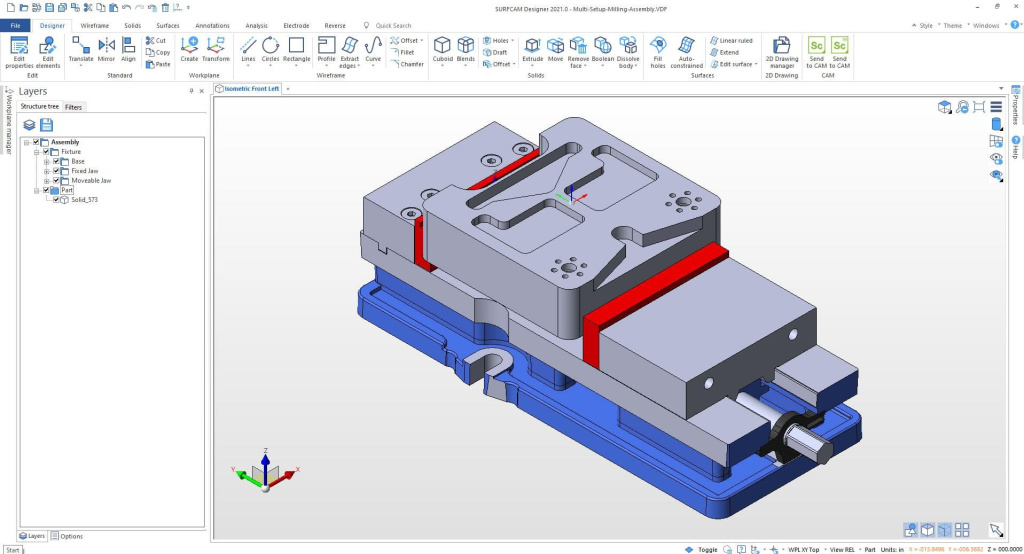
In recent years, Hexagon has introduced new features and modules across its CAM portfolio, and Surfcam is no exception. The software’s evolution in the late 2010s and 2020s has included improvements in five-axis machining strategies, user interface refinements, and support for new cutting tool types (for instance, advanced support for “barrel” milling cutters used in efficient 5-axis machining). Surfcam today also benefits from the inclusion of a companion application called Surfcam Designer, which is a CAD tool for geometry creation and editing, allowing Surfcam users to make design modifications or prepare models for CAM programming without needing a separate CAD system. This addition reflects Hexagon’s goal of providing an integrated design-to-manufacturing solution. More than three decades on from its launch, Surfcam’s journey — from a small family business’s product to a component of a global tech corporation’s lineup — illustrates the dynamic nature of the CAD/CAM industry. Yet throughout, the product has retained its core identity as a practical, efficiency-driven CAM solution for manufacturers.
Business Performance and Market Presence
Surfcam’s market presence grew steadily from its beginnings as a niche PC-based CAM program to a globally recognized manufacturing software solution. While detailed financial figures for Surfcam as a standalone product are not publicly broken out, several indicators shed light on its business performance and reach.
By the late 2000s, Surfware (the original developer of Surfcam) was touting the company as “one of the top ten fastest-growing CAD/CAM software companies in the world.” This claim, made around 2008, coincided with the surge in interest due to the TrueMill technology and the general growth in manufacturing activity. It suggests that Surfcam was gaining new users at an impressive rate during that period. Around the same time, the Surfcam user base had expanded worldwide. Surfcam was reported to be in use for a variety of design and machining purposes across industries, implying a healthy diversity in its customer mix.
One concrete metric of Surfcam’s installed base came to light at the time of the Vero acquisition in 2013. According to statements from Vero Software, Surfcam had been installed on over 26,000 systems worldwide since its introduction. This number reflects cumulative licenses or seats deployed over the product’s life up to that point, highlighting that tens of thousands of programmers and operators had used Surfcam to drive machines. It’s a significant figure that placed Surfcam among the more widely used CAM systems globally. These installations were spread across more than 45 countries, handled through Surfware’s network of distributors and Vero’s international offices, indicating truly global penetration. In fact, Surfcam had been localized into at least 14 different languages, an important factor for adoption in non-English-speaking markets and a testament to its worldwide reach by the 2010s.
The revenue picture of Surfcam itself was intertwined with that of its parent companies over time. In the independent Surfware days, the company was private and family-owned, so revenue figures weren’t publicly disclosed. However, after Surfcam became part of Vero Software, some aggregated figures are known. Vero Software’s turnover in 2013 (which included Surfcam for roughly half that year after the acquisition) was about €80 million. By 2014, Vero’s total revenue had grown to roughly $125 million (about €92 million), as per reports when Hexagon acquired Vero. This growth was driven by a combination of acquisitions (including Surfcam) and organic sales increases. Within Vero’s portfolio, Surfcam contributed to the company’s position as a CAM market leader. Industry analysts noted that by 2014, with Surfcam and other brands combined, Vero was the largest independent CAM software vendor in the world (until Hexagon bought it, making it no longer independent).
In terms of user demographics and geography, Surfcam traditionally had a strong user base in North America, given its California origins and long presence in the US market. Many small and medium-sized machine shops in the United States adopted Surfcam for its balance of capability and cost. Surfcam also gained traction in Europe and Asia-Pacific through reseller partners and trade shows in the 1990s and 2000s. Notably, some of Surfcam’s earliest international distributors in places like Germany, Japan, and the Czech Republic were instrumental in introducing the software to those local markets, often translating the software and providing training. By the time Hexagon took over, Surfcam users were truly global, from automotive suppliers in Detroit, to aerospace contractors in Europe, to electronics tooling shops in Asia.
Another aspect of Surfcam’s market presence is its reputation for support and training. The Surfcam product line built a loyal following partly because Surfware and its partners emphasized customer service. Numerous dealers provided on-site training, and Surfware often highlighted the longevity of its dealer relationships as a strength. This focus on end-user success likely contributed to high customer retention and word-of-mouth referrals, bolstering the business performance over the years.
While Surfcam is part of a larger corporate entity now, it continues to be marketed under its own name and has its own identity in Hexagon’s lineup. Hexagon’s broader reach in the manufacturing sector (which includes metrology equipment and other software) may be helping to introduce Surfcam to new customers who seek an end-to-end solution from design to quality control. As of 2025, Surfcam remains a competitive player in the CAM market, particularly for milling and turning applications. Its competition includes other long-standing CAM systems like Mastercam, Siemens NX CAM, SolidCAM, and HyperMill, among others. The CAM software industry is quite fragmented, but Surfcam’s legacy and continued development under a stable corporate parent have helped maintain its market presence. The exact number of active Surfcam users today is not published, but given the historical figures and ongoing sales, it is likely in the high tens of thousands globally.
Mergers, Acquisitions, and Partnerships
Over its long history, Surfcam has been at the center of a few significant mergers and partnerships that have shaped its trajectory. Understanding these corporate moves provides insight into how the product has been sustained and expanded.
Acquisition by Vero Software (2013): The first major change in ownership came in 2013 when Surfware sold the Surfcam business to Vero Software. For the Surfcam community, this acquisition was a pivotal moment. Vero Software, headquartered in the UK, was known for acquiring and consolidating CAM software brands – prior to Surfcam, Vero had merged with Planit Holdings (which brought along brands like Edgecam and Radan) and had acquired the French CAM developer Sescoi (maker of WorkNC). By acquiring Surfcam, Vero added a well-respected U.S.-based product to its stable. This move was partly about synergy: Vero could share technology components across its products and leverage its larger development team to update Surfcam, while Surfcam offered Vero a strong user base and reseller network in the United States and other markets where perhaps Edgecam or others were less entrenched.
At the time of the acquisition, Vero’s CEO Richard Smith commented that Surfcam was a “robust and well-respected” system with a loyal customer following and knowledgeable resellers. He emphasized that Vero intended to “reinvigorate” the Surfcam product by sharing proven technologies and continuing to invest in its development. For example, Vero had its own toolpath algorithms and interface improvements that could potentially be introduced into Surfcam, and vice versa, Surfcam’s TrueMill technology could be leveraged in other Vero products. The Surfware founders, Alan and Larry Diehl, also expressed confidence that Vero’s global reach and resources would take Surfcam to new levels and continue to serve its customers well. It’s worth noting that after selling Surfcam, the Surfware entity was renamed TrueMill, Inc. This company remained under the Diehl family’s direction and focused on the TrueMill technology (suggesting that TrueMill could be licensed to other CAM vendors or perhaps further developed independently). In practice, Surfcam under Vero continued to feature TrueMill as a differentiator, and likely an arrangement was in place for Vero/Surfcam to use that IP long-term.
Acquisition by Hexagon AB (2014): Barely a year later, the entire Vero Software group was acquired by Hexagon AB. This move was part of a larger trend of big metrology or PLM (Product Lifecycle Management) companies buying CAM software firms to offer more comprehensive manufacturing solutions. Hexagon, which already had strengths in 3D scanning, measurement, and CAD (through previous acquisitions), saw CAM as the next piece of the puzzle. By bringing in Vero, Hexagon instantly gained a portfolio of CAM software brands covering a wide array of industries: Surfcam for general CAM, Edgecam for production machining, WorkNC for high-end mold & die, Alphacam for woodworking, Radan for sheet metal fabrication, and so on. Hexagon’s CEO Ola Rollén noted that Vero’s suite of manufacturing solutions and expertise would enable Hexagon to deliver higher productivity to its customers and to integrate data across the manufacturing lifecycle. The idea was that Hexagon could now connect the dots from design (CAD), to planning and programming (CAM), to execution on the shop floor, and back to inspection (metrology), using software and hardware all under one corporate umbrella.
For Surfcam as a product, being part of Hexagon meant more stability and potentially more cross-pollination of technology. Hexagon kept Vero’s organization largely intact initially, incorporating it as the Production Software business unit. Surfcam continued as one of the distinct brands in that unit. Hexagon did not merge the CAM products into a single software; instead, it maintained each for its market segment but encouraged shared development where possible. Over the ensuing years, Hexagon also acquired other software companies and began building a platform called Hexagon Nexus, aiming to connect various engineering tools. Surfcam, along with its sister CAM products, has started to see some integration with these broader initiatives (for example, being able to interface with Hexagon’s tool library systems or simulation tools).
Partnerships and Collaborations: Apart from corporate ownership changes, Surfcam’s history includes noteworthy partnerships, especially in its early strategy to be CAD-agnostic. In 1999, Surfware announced a “CAM for All CAD” strategy, reflecting a commitment to interoperability. They partnered with several CAD vendors to ensure Surfcam could seamlessly exchange data with those design systems. This included working with companies like SolidWorks (Dassault Systèmes), Baystate Technologies (a CAD interoperability firm), Unigraphics Solutions (now part of Siemens PLM, makers of NX CAD), Visionary Design Systems (then resellers of IronCAD), and Robert McNeel & Associates (developers of Rhino). Through these partnerships, Surfware implemented direct plugins and robust file translators, so that users of those CAD systems could easily bring their models into Surfcam for machining without losing any fidelity or having to redo work. One outcome was an associativity feature: if the design changed in the CAD software, Surfcam could update the toolpaths accordingly. This level of integration was somewhat ahead of its time and showcased Surfware’s collaborative approach.
Surfcam’s partnership with SOLIDWORKS in particular has endured. Surfcam became an official CAM partner product for SOLIDWORKS users, meaning it could be marketed to SOLIDWORKS customers as a complementary CAM solution. The tight link between the two software packages allows Surfcam to serve companies that use SOLIDWORKS for design – a very common scenario in small and medium manufacturers – by providing a nearly seamless transition from 3D modeling to G-code generation.
On the hardware side, Surfcam has generally been neutral, supporting machine tools and controllers from virtually all manufacturers via post-processor files. Over the years, Surfware and its resellers often collaborated with CNC machine tool builders and cutting tool manufacturers to test new machining techniques (for example, demonstrating TrueMill at trade shows in partnership with a machine builder to show dramatically reduced cycle times). These informal collaborations helped validate Surfcam’s innovations in real-world scenarios and gave the software credibility among machinists.
It’s also worth noting the internal collaboration that occurred once Surfcam was within Vero and later Hexagon. Surfcam joined a family of CAM products, and there has been some unification in terms of user interface and shared libraries. For instance, Vero introduced a common CAD platform called “Designer” that could work with multiple CAM brands, which eventually led to Surfcam Designer. Hexagon has also been integrating cloud services and tool data management across its products. So, while these aren’t public “partnerships” in the traditional sense, they are collaborations within the ecosystem that benefit Surfcam’s capabilities.
In summary, Surfcam’s journey has been heavily influenced by strategic acquisitions: first by Vero Software and then by Hexagon. Each transition brought greater resources and reach, helping ensure that Surfcam stayed competitive. Additionally, the company’s philosophy of playing well with others – whether CAD software or CNC hardware – established Surfcam as a flexible choice in a market where compatibility can be as important as raw functionality.
Innovations, Features, and Key Strengths
Surfcam’s longevity in the CAD/CAM industry can be attributed to a combination of continuous innovation and a clear focus on what users need. Over the years, several features and strengths have defined Surfcam and often set it apart in a crowded marketplace.
User-Friendly Interface and Workflow: One of Surfcam’s long-touted strengths is its ease of use. Especially in its earlier years, Surfcam gained a reputation for having an intuitive interface that machinists could learn quickly. The software provides an “out-of-the-box” experience that is relatively straightforward, allowing users to become productive in a short time. This is important in small shops where the CAM programmer might also be the machine operator or where there isn’t time for weeks of training on a complex system. Surfcam’s menus, toolpath strategies, and job management interface were designed to follow a logical machining workflow (set up stock, select tools, choose operations, etc.), and the learning curve was often reported as easier than some high-end CAM systems. Even as the software has added complexity (e.g., support for 5-axis machining), it has tried to maintain simplicity in how those advanced features are presented to the user.
Comprehensive Machining Capability: Feature-wise, Surfcam covers a broad spectrum of CNC programming needs, which is a key strength for shops that do various kinds of work. The platform includes modules for 2-axis milling (profiling, pocketing, drilling), 3-axis and 3+2 positioning milling (for more complex 3D shapes, with the ability to index in multiple orientations), and full 4- and 5-axis simultaneous milling (for intricate continuous contouring in aerospace or medical parts). It also has a dedicated turning module (Surfcam Lathe) that handles everything from basic OD/ID turning and facing to threading and grooving cycles, giving programming control for lathes and mill-turn machines. For wire EDM processes, Surfcam offers specialized strategies to program cutting paths and consider wire cut types and offsets. Additionally, as mentioned earlier, Surfcam can generate toolpaths for laser, plasma, and water-jet cutting, which are essentially 2D profile operations similar in concept to milling but involve different machine physics. This wide coverage means users can rely on Surfcam as a one-stop CAM solution for multiple machine types, rather than needing different software for different jobs.
TrueMill High-Speed Machining: The introduction of the TrueMill toolpath strategy stands out as perhaps Surfcam’s most celebrated innovation. TrueMill (sometimes referred to generically as “engagement-controlled” or “constant chip load” machining) automatically adjusts the cutter’s path to maintain consistent engagement with the material. In practical terms, this lets the user run the machine at higher speeds or feeds because sudden spikes in tool load are eliminated. The impact of TrueMill is twofold: dramatically reduced machining cycle times (Surfware often cited improvements well above 50%, and sometimes over 100% faster in certain tests) and extended tool life (since tools aren’t being pushed beyond their optimal load, they last longer before wearing out or breaking). This was especially revolutionary for tough materials where conventional toolpaths forced very conservative cutting conditions. With TrueMill, even smaller shops could achieve high-speed machining performance without investing in super-expensive machine tools – the software was extracting more performance from existing equipment. Surfcam integrated TrueMill seamlessly into its operation dialogs; for the user, it’s often just choosing a TrueMill option for roughing cycles and then the software handles the rest. Over time, many competitors introduced their own versions of high-speed toolpaths, but Surfware’s early move gave Surfcam a credibility boost in the mid-2000s as an innovator. To this day, the TrueMill approach remains a core strength when marketing Surfcam to new customers who want to improve efficiency.
Interoperability and CAD Integration: As highlighted in earlier sections, Surfcam’s ability to work with various CAD systems is a significant feature. The CAM software includes robust translators for standard formats like IGES, STEP, Parasolid, DXF, and more, ensuring that models from virtually any CAD source can be imported for machining. Beyond that, the associative links with systems like SOLIDWORKS mean that Surfcam can serve as an integrated CAM module in a company’s design-through-manufacturing pipeline. Maintaining associativity (where a design change triggers an update in the CAM project) reduces rework and errors. This integration is a technical feature that many shops find valuable because it keeps design and manufacturing aligned, especially in fast-paced development cycles. It also demonstrates Surfcam’s focus on real-world usability — recognizing that customers use multiple software tools and that the CAM system must fit into that ecosystem smoothly.
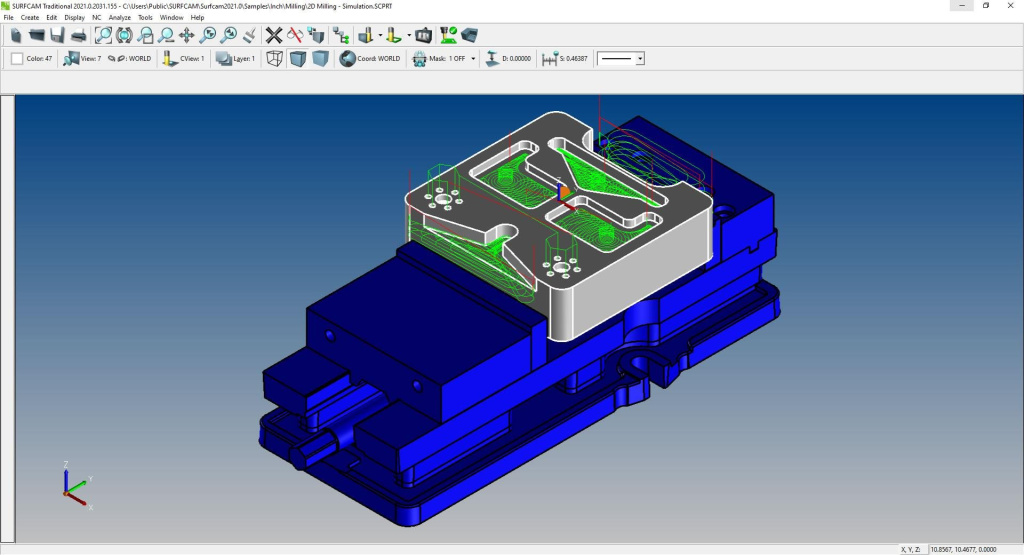
Toolpath Verification and Simulation: Any modern CAM software is expected to offer simulation of the machining process, and Surfcam provides this as part of its feature set. Users can run backplot simulations of the toolpaths to verify the cutter’s movements and ensure there are no collisions or mistakes before sending the program to the machine. Surfcam’s verification module shows the stock being cut away by the virtual tool and can alert the programmer to any problems (like cutting too deep or missing material). This visual verification is critical for avoiding costly errors on real machines. Surfcam has enhanced its simulation graphics over the years, taking advantage of better PC graphics hardware, so that even complex multi-axis motion can be visualized realistically. The simulation also assists in optimizing processes, as users can see inefficiencies or excessive retracts and then adjust the program accordingly. Having an integrated simulation is a key strength because it builds user confidence in the output NC code and saves time in trial-and-error on the shop floor.
Continued Innovation under Hexagon: Under Hexagon’s ownership, Surfcam has benefited from shared advancements in software technology. For example, as Hexagon’s CAM products adopted support for new machining trends like additive manufacturing or hybrid machining, those could potentially filter into Surfcam (though Surfcam itself is primarily focused on subtractive manufacturing). A more concrete recent feature addition is support for advanced cutter types and strategies; the latest releases of Surfcam have introduced support for “barrel cutters” and other specialized milling tools that enable efficient machining of curved surfaces with fewer passes. This is an emerging trend in 5-axis machining (barrel cutters can significantly reduce finishing time on complex surfaces), and Surfcam has kept pace by allowing users to program with these tools. Another example is the introduction of dedicated cycles like a new gun-drilling cycle for deep, straight holes, which was added to improve how Surfcam handles that specific task often found in mold and aerospace work. These enhancements show that Surfcam is not static; it’s continuously updated to include state-of-the-art machining methods.
Key Strength – Customer Loyalty and Community: Though not a software “feature” per se, an intangible strength of Surfcam has been the loyalty of its user community. Many Surfcam users and resellers have stuck with the product for decades. This loyalty stems from the trust that the software will get the job done and the support network behind it. Surfcam’s accessible learning curve means that new generations of programmers can pick it up, and its consistency means that experienced users don’t feel the need to switch to something else. The community often shares tips and best practices (through forums, user group meetings, etc.), which enhances the value one can get from the software. In an industry where switching CAM systems can be disruptive and costly (due to retraining and re-posting all the CNC programs), Surfcam’s ability to keep its users satisfied has been a key part of its longevity.
In summary, Surfcam’s innovations like TrueMill have given it technical edge at times, while its all-around capability and ease-of-use have made it a practical choice for many shops. The software might not always have every high-end feature that some competitors advertise, but it covers the needs of a vast majority of machining tasks with reliability and efficiency. This blend of innovation and practicality is what defines Surfcam’s key strengths as a CAD/CAM system.
Leadership Perspectives and Quotes
Throughout Surfcam’s journey, company leaders and stakeholders have articulated their vision for the product and the company’s direction. Here are a few insights and quotes from key figures associated with Surfcam, reflecting their perspectives on what the software aims to achieve and how the business has evolved:
-
Stephen Diehl – President and CEO of Surfware (2008): On the occasion of Surfcam’s 20th anniversary, Stephen Diehl – son of founder Alan Diehl – highlighted the company’s commitment to innovation and customer success. He stated, “For almost six decades, my family and the Surfware team have focused on creating innovative, high-quality products that enhance the industries we serve. I am constantly amazed by the many beneficial uses that our customers have found for Surfcam and TrueMill.” He emphasized that as the sole provider of the TrueMill technology, Surfware was “committed to helping our customers become more efficient, profitable and successful.” This quote encapsulates the family-driven passion behind Surfcam and the intention to deliver tangible benefits (like efficiency and profitability) to users through technological innovation.
-
Richard Smith – CEO of Vero Software (2013): Upon acquiring Surfcam in 2013, Vero’s chief executive Richard Smith expressed enthusiasm for adding Surfcam to Vero’s lineup and reassured the Surfcam community about continued development. He noted, “Surfcam is a robust and well-respected CAD/CAM system with a large number of loyal customers and knowledgeable resellers. With an emphasis on sharing already proven technologies, we will provide the development platform to reinvigorate the Surfcam product and continue to help its customers become more efficient, profitable and successful.” Smith’s remarks underscored the value Vero saw in Surfcam’s existing strengths (loyal user base and reseller network) and aligned with the same goals Surfware touted – customer efficiency and success. He also alluded to reinvigorating Surfcam, implying investment and technological updates to keep the software competitive.
-
Alan Diehl – Co-founder of Surfware (2013): At the time of the Vero acquisition, Alan Diehl, who was one of Surfcam’s original creators, weighed in on the transition. Reflecting on decades of work, he said, “We have dedicated our lives to developing innovative and productive machining technology. Just as importantly, we enjoy customer and reseller relationships that are the envy of our competitors.” Alan welcomed the move into the Vero fold by adding, “We know we are joining a group with a similar view. We are confident that their additional resources and global distribution will take Surfcam to new levels of efficiency and will continue to provide solutions that boost our customers’ productivity, reduce costs and improve quality.” This quote reveals the pride the founders had in Surfcam’s technology and community, and their optimism that a larger organization (Vero, and subsequently Hexagon) would preserve and amplify Surfcam’s core mission of helping customers improve manufacturing outcomes.
-
Ola Rollén – President and CEO of Hexagon AB (2014): When Hexagon acquired Vero Software (and thus Surfcam) in 2014, Hexagon’s CEO Ola Rollén commented on how the addition fits into a larger strategy. While his remarks covered all of Vero’s portfolio, they are relevant to Surfcam’s future under Hexagon. Rollén said, “Together with its unique suite of manufacturing software solutions, Vero Software has the expertise, knowledge and resources to deliver even higher levels of productivity to our customers. Leveraging our global footprint, the synergies from our combined technologies will advance our strategy, supporting the growing need to integrate all data and processes across the manufacturing lifecycle.” In essence, from the highest level of leadership, the message was that Surfcam (as part of Vero) would contribute to a more integrated and efficient manufacturing process for Hexagon’s customers worldwide. It positioned Surfcam not as an isolated CAM tool, but as a piece of a holistic solution spanning from design to production to inspection.
These statements from different eras of Surfcam’s leadership consistently revolve around a few key themes: innovation in machining technology, improving customer productivity and efficiency, and leveraging partnerships or larger organizations to strengthen the product. The continuity of these themes — whether voiced by the founding family in California or executives in the UK and Sweden — shows that the vision for Surfcam has remained focused on practical manufacturing benefits. The leadership perspectives also acknowledge the importance of the user and reseller community in Surfcam’s success. As Surfcam progressed from a family business to being part of a multinational corporation, the emphasis on helping manufacturers succeed with better technology remained a guiding principle, repeatedly affirmed by those at the helm.
Conclusion
Surfcam’s trajectory over the past several decades paints the picture of a CAD/CAM software that has managed to adapt and thrive amid a fast-evolving industry. From its birth in a humble machine shop environment to its place in a global tech conglomerate, Surfcam has retained a clear identity as a tool that empowers machinists and engineers to program machine tools more effectively. Its general description as a user-friendly but feature-rich CAM system is backed up by the wide areas of application it serves – whether it’s milling an engine component, cutting a mold for a medical device, or turning out precision parts on a lathe, Surfcam has been applied successfully in all these domains.
The history of Surfcam is deeply tied to the innovators who created it, notably the Diehl family, who embedded their practical machining knowledge into the software’s DNA. Over the years, the product kept in step with technological advancements: embracing Windows computing early, pioneering multi-axis PC-based machining, and introducing the acclaimed TrueMill technology that set new benchmarks for toolpath efficiency. Each of these evolutionary steps was aimed at solving real-world manufacturing challenges, helping Surfcam build credibility and a loyal following.
Business-wise, Surfcam’s journey through mergers and acquisitions reflects a microcosm of the CAM software industry’s consolidation. By joining forces with Vero Software and later Hexagon, Surfcam gained a lifeline to greater development resources and a pathway to a broader market. These changes have ensured that Surfcam remains relevant in a competitive landscape, even as it competes and coexists with numerous other CAM solutions. The partnerships forged along the way, especially those focusing on interoperability with CAD systems, show that Surfcam’s value is not only in what it does itself, but also in how well it plays with other tools in the manufacturing workflow.
Today, Surfcam’s key strengths — such as its range of machining capabilities, its high-speed TrueMill option, and its ease of integration — continue to attract users who need dependable CAM software. Under Hexagon’s stewardship, Surfcam is positioned to keep improving and to align with the smart manufacturing trends that demand more automation, connectivity, and data-driven decision-making. Yet, it remains, at its core, a practical solution for generating NC code that runs machines efficiently and accurately.
In the words of Surfcam’s leaders past and present, the ultimate goal has been to make customers more efficient, profitable, and successful in their manufacturing endeavors. Surfcam’s enduring presence in machine shops around the world is a testament that it has delivered on that promise for many, and with continuous innovation, it aims to do so for many years to come.
Vendor: Hexagon