
VISI: A CAD/CAM Software Powerhouse in Mold & Die Manufacturing
VISI and Its Vendor
VISI is a comprehensive computer-aided design and manufacturing (CAD/CAM) software solution specialized for the mold and die industry. Developed originally in the late 1980s, VISI has grown into one of the world’s leading PC-based CAD/CAE/CAM systems for toolmakers. The software provides an integrated environment for 3D tool design, simulation, and multi-axis machining, tailored specifically to the needs of mold makers and die designers.
Today, VISI is part of the product portfolio of Hexagon AB, a global technology company. VISI was created by the British-based firm Vero Software (founded in Italy) and became a flagship offering in Vero’s suite of manufacturing software. In 2014, Hexagon AB acquired Vero Software, bringing VISI under the umbrella of Hexagon’s Manufacturing Intelligence division. Under Hexagon’s ownership, VISI continues to be developed and supported as a key solution within the company’s Production Software business segment. The official VISI product website highlights it as a dedicated solution for mold and die manufacturers with a wide range of capabilities spanning from design to production.
In essence, VISI’s vendor lineage traces back to Vero Software Ltd., a CAD/CAM specialist with decades of industry experience, now operating as part of Hexagon Manufacturing Intelligence. This backing provides VISI users with the security of a large multinational tech company while retaining the focused expertise in tooling that VISI has built up over its long history.
Application Areas and Industry Usage
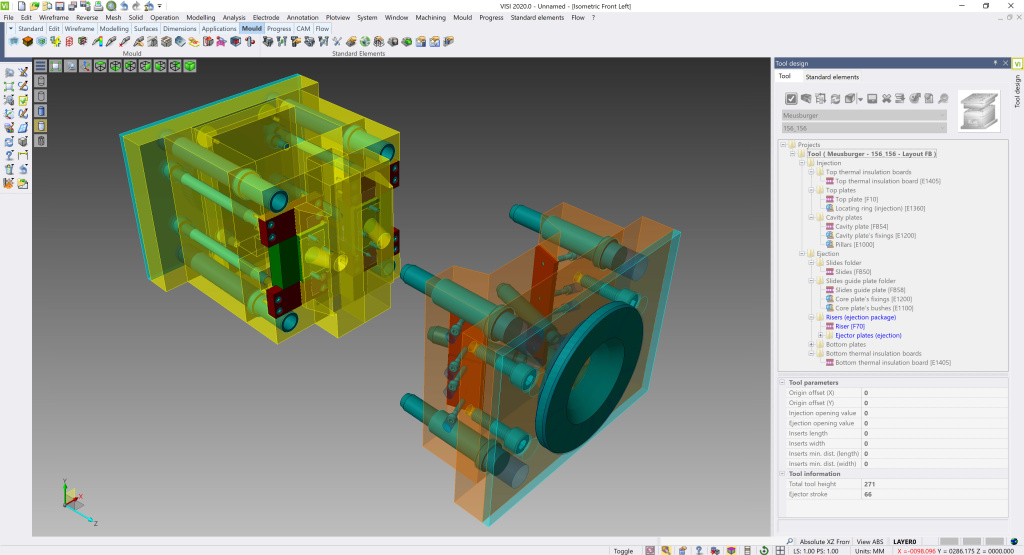
From automotive factories to electronics assembly lines, VISI is employed anywhere precision molds or stamping dies are needed. The software’s functionality covers a broad spectrum of tool design and manufacturing applications, including but not limited to:
-
Plastic Injection Mold Design: VISI offers dedicated modules to design complex injection molds for plastic components. Engineers can model core and cavity inserts, generate mold assemblies (plates, runners, ejectors), and perform mold flow analysis to simulate how molten plastic fills the tool. This ensures that plastic parts (such as automotive interior pieces, consumer electronics housings, medical device components, etc.) can be manufactured with optimal quality and minimal defects.
-
Sheet Metal Stamping Die Design: The system includes specialized tools for designing stamping dies used in sheet metal forming. This covers simple single-stage dies as well as complex progressive dies that form parts through multiple sequential stations. VISI’s die design capabilities help create the punches, die plates, strip layouts, and bending/forming tools required to stamp out metal parts (common in automotive body panels, connectors, appliance components, and more).
-
Tool Path Generation and CNC Machining: As a CAD/CAM package, VISI not only designs the tool geometry but also generates the CAM programs needed to manufacture the tool components. It supports 2-axis through 5-axis CNC milling strategies, enabling users to produce mold cores, cavities, and die components with high precision. The software’s multi-axis machining module can create complex toolpaths for drilling, roughing, finishing, and high-speed machining, all directly from the 3D design data. This integration ensures that the transition from design to machining is seamless and optimized.
-
Electrode Design for EDM: In plastic injection mold making, electrical discharge machining (EDM) electrodes are often needed to form intricate shapes. VISI includes functionality to extract electrode geometry from the mold design, helping toolmakers create the copper or graphite electrodes that will be used to burn delicate details into the steel mold via EDM. This capability streamlines what is traditionally a labor-intensive process and ties it tightly to the overall mold design workflow.
-
Reverse Engineering and Scanning: In recent releases, VISI has expanded into reverse engineering applications. It can import point cloud data or 3D scan data of physical objects (using devices like Hexagon’s Romer arms or Leica scanners) and convert them into usable CAD models. Toolmakers leverage this to digitize existing tooling or parts, create casting models, or inspect components. The integration of scanned geometry with VISI’s modeling environment allows comparison between as-built parts and the original design (gap analysis) and aids in generating toolpaths for refurbishing or reproducing molds and dies.
Across these application areas, VISI’s core strength lies in providing industry-specific tools. For example, a mold designer using VISI can utilize built-in mold component libraries (for standard bolts, ejector pins, cooling channels, etc.) and automated functions that guide the user through the entire mold development process. A die designer can similarly benefit from VISI’s strip layout calculators and spring-back compensation tools tailored to sheet metal forming. By covering everything from initial CAD model to the final machine code for manufacturing, VISI serves as an end-to-end platform for companies in the tooling business.
Industry sectors: The versatility of VISI in mold and die making translates to a wide array of industries served. Prominent sectors include automotive (e.g. molds for headlights, dies for car body parts), aerospace (precision tooling for aircraft components), consumer electronics (molds for device casings and connectors), medical devices (high-precision molds for plastic disposables or equipment housings), industrial machinery, and white goods/appliances. Essentially, any industry that requires custom-tooled manufacturing processes is likely to have VISI in its arsenal. A notable example is in high-volume metal stamping: Brandauer, a 156-year-old precision stamping firm in the UK, uses VISI to design complex press tools that help them produce around 150 billion metal parts per year for connectors and electronics – an indication of the scale and criticality of VISI in real-world production.
History and Evolution of VISI
Founding and Early Years (1980s–1990s): VISI’s origins date back to October 1988 in northern Italy, when two engineers, Don Babbs and Ezio Galardo, left the tech company Olivetti to start a venture focused on CAD/CAM software. They founded what would eventually become Vero Software, with VISI as one of their primary products. In its initial incarnation, the product was often split into VISI-CAD and VISI-CAM, emphasizing its dual focus on design and manufacturing. During the mid-1990s, VISI achieved a significant technical milestone by being one of the first CAD/CAM systems on the PC to incorporate the Parasolid solid modeling kernel (a robust 3D geometry engine also used by high-end CAD platforms). This meant VISI could offer advanced 3D solid and surface modeling capabilities on standard personal computers at a time when many competitors were still confined to expensive workstations or less capable geometry engines.
The early adoption of Parasolid, combined with a user-friendly interface tailored for toolmakers, gave VISI a reputation for power and innovation in the tooling community. By the late 1990s, the company behind VISI had grown and rebranded as VI Group Plc, reflecting the success of the VISI product line. In 1998, VI Group was listed on the London Stock Exchange’s AIM market, raising capital to expand development and global reach. Throughout the late 90s and early 2000s, VISI continued to evolve with enhancements like electrode design modules, improved surface modeling tools, and initial analysis features, all aimed at making life easier for mold and die designers.
Growth, Acquisitions, and Global Expansion (2000s–2010): In the 2000s, the VISI software and its parent company Vero (VI Group) expanded both through organic growth and strategic acquisitions. The company established a presence in key manufacturing markets worldwide, opening offices across Europe, Asia, and North America. By the mid-2000s, VISI had a strong user base in Europe (notably in its birth country Italy, as well as the UK, France, Germany) and was making inroads into the Americas and Asia. Vero also acquired complementary technologies to bolster VISI and its other offerings – for instance, purchasing the Machining Strategist high-speed machining software in 2002, and Camtek (another CAM tool provider) in 2006. These additions enriched the CAM algorithms and capabilities available to VISI users.
By 2007, the company formally adopted the name Vero Software for a unified global brand. Around this time, Vero Software (with VISI as a flagship) earned prestigious recognition, including the Queen’s Award for Enterprise (Innovation) in the UK, highlighting its export success and technological excellence. Indeed, between 2004 and 2010, Vero grew its export revenues by 65% to over £12 million, with more than 90% of its sales coming from outside the UK – clear evidence of VISI’s worldwide adoption. “We are extremely proud and honoured to have won this award which is full recognition of the valuable work of our staff and extensive reseller network,” said Don Babbs, Vero’s Chief Executive, in 2010 upon receiving the Queen’s Award. He attributed the company’s success to heavy investment in R&D and a philosophy of building industry-specific knowledge into the software. According to Babbs, “the company firmly believes that step gains in productivity can be made by building as much knowledge of specific design and machining processes within its software as possible.” This philosophy of productivity through specialization was a driving force behind VISI’s development – the software wasn’t just a general CAD system adapted for tool design; it was deliberately engineered with molds and dies in mind, incorporating the lessons and best practices of that niche.
Despite its technical strengths, by the late 2000s Vero Software faced the challenge of a fragmented CAM software market and the need for greater scale. The global financial crisis era made it difficult for medium-sized software firms to grow, and Vero’s leadership sought ways to strengthen the business. In 2010, an opportunity arose to take the company private and inject new strategic focus. Battery Ventures, a U.S.-based private equity firm, acquired Vero Software in July 2010. With this change, industry veteran Richard Smith was appointed as CEO of Vero. The goal was clear: accelerate growth, improve profitability, and consolidate the CAM market by bringing more products and customers under the Vero umbrella.
The Battery Ventures Era (2010–2014): Backed by Battery Ventures, Vero Software embarked on an aggressive expansion strategy that would greatly broaden VISI’s reach and the company’s overall product portfolio. Richard Smith and his team identified other strong players in the CAD/CAM domain that could complement Vero’s offerings. Over the next few years, a series of mergers and acquisitions reshaped the company:
-
In 2011, Vero Software acquired Planit Solutions, a UK-based CAD/CAM software company known for products like Edgecam (CAM for milling/turning), Alphacam (CAM for woodworking and stone cutting), and Radan (CAD/CAM for sheet metal fabrication). This was a transformative deal – Planit’s products addressed industries beyond Vero’s traditional tooling focus (for example, woodworking and sheet metal fabrication) and had a substantial customer base, particularly in cabinet manufacturing and sheet metal shops. The merger roughly tripled the size of the business and added hundreds of new personnel and thousands of users to the combined entity. It also brought in Planit’s expertise in areas like nesting (for sheet metal cutting) and NC optimization, further enriching the technology pool available to Vero’s development teams.
-
In early 2013, Vero acquired Sescoi International, a French CAM software firm best known for WorkNC, a highly regarded 5-axis CNC machining software used extensively in automotive and aerospace tooling. WorkNC’s automatic toolpath generation and easy-to-use interface for complex machining fit well with Vero’s vision of productivity through specialization – it gave the group a stronger foothold in the high-end machining market and in countries like France, Japan, and the United States where WorkNC had a strong following.
-
Shortly after, Vero also acquired the Surfcam business (Surfware, Inc.) in 2013. Surfcam was a popular CAM system, particularly in North America, known for efficient 3-axis and multi-axis milling strategies. This added yet another brand to Vero’s stable, increasing market share in general manufacturing CAM.
By mid-2014, thanks to these acquisitions and continued organic growth of the core products like VISI, Vero Software had become one of the largest independent CAD/CAM software vendors in the world. In the span of four years, the company’s annual revenue leapt from around $20 million (in 2010) to roughly $120 million by 2014. The employee count grew substantially with development centers and support offices across multiple continents. Importantly, profitability improved as well – under Battery Ventures’ guidance, Vero turned from a barely break-even operation into a healthy business with significant earnings (EBITDA reaching approximately $40 million by 2014). This dramatic growth story made Vero an attractive target for larger industrial technology firms looking to broaden their software offerings.
Acquisition by Hexagon (2014) and Integration: The culmination of Vero Software’s growth spurt came in July 2014, when Hexagon AB, a Swedish technology conglomerate, announced it would acquire Vero for approximately €100 million. Hexagon at that time was well known for its metrology equipment (coordinate measuring machines, laser scanners, etc.) and for design software (having previously acquired CAD developer Intergraph). The addition of Vero’s CAM expertise was strategic: it allowed Hexagon to offer solutions spanning the entire manufacturing process, from design and quality inspection all the way to actual production on the shop floor.
Upon the acquisition, Hexagon’s President and CEO Ola Rollén highlighted the value of VISI and its sister products to Hexagon’s vision of integrated manufacturing: “Together with its unique suite of manufacturing software solutions, Vero Software has the expertise, knowledge and resources to deliver even higher levels of productivity to our customers,” Rollén said, emphasizing that combining Hexagon’s global reach and technologies with Vero’s CAM specializations would help “integrate all data and processes across the manufacturing lifecycle.” In August 2014, Vero Software was fully consolidated into Hexagon’s Manufacturing Intelligence division, operating as an autonomous business unit within it. Richard Smith, the CEO of Vero, expressed confidence that Hexagon’s global scale would “provide stability and support our growth into the future,” noting that all the effort over the years had positioned Vero and its products (like VISI) as leaders in their industries – and now that leadership could extend further under Hexagon’s wing.
Post-acquisition, the VISI development team and product line remained intact, but there were some changes in branding and leadership. Over the next couple of years, the Vero Software name was gradually transitioned into Hexagon Production Software, aligning with Hexagon’s branding conventions. In 2017, long-time Vero/VISI executive Steve Sivitter took on the role of CEO for Hexagon’s Production Software business (succeeding Richard Smith). Under Sivitter’s leadership, the focus expanded beyond traditional CAM into adjacent areas of manufacturing software.
Mergers, Acquisitions and Partnerships
Throughout its history, the company behind VISI has been involved in numerous mergers and collaborative ventures, which have both broadened the software’s capabilities and extended its market reach. Here is an overview of key mergers, acquisitions, and partnerships involving VISI and its parent company:
-
Early Acquisitions: Vero’s initial growth included small acquisitions like Tecnocam (Italy, 2000) and Camtek (UK, 2006), which added local technology and talent. These helped enhance VISI’s modules (for example, incorporating new EDM functionalities and 3-axis machining strategies).
-
Planit (2011): The merger with Planit Software was one of the most significant moves, bringing together two major CAD/CAM portfolios. This not only expanded the user base but also created cross-selling opportunities – VISI could be introduced to customers in industries that Planit served, and vice versa. It was a rare case of two competitors uniting, which ultimately strengthened the combined entity in the global market.
-
Sescoi/WorkNC (2013): Acquiring Sescoi added a well-respected high-end CAM (WorkNC) to the lineup. This also deepened partnerships in automotive manufacturing; many of Sescoi’s automotive clients now became part of Vero’s network, positioning VISI alongside WorkNC in large OEMs and tier-1 suppliers.
-
Surfware/Surfcam (2013): This acquisition further consolidated CAM market share, especially in North America. By integrating Surfcam’s technology, Vero could enhance aspects of VISI’s CAM engine (like advanced 3-axis milling routines) and offer a migration path for Surfcam users to a broader suite of tools.
-
Hexagon Acquisition of Vero (2014): As described, Vero Software (with the VISI product) was acquired by Hexagon AB. Rather than merging with a competitor, this was a case of a larger complementary company absorbing Vero. Hexagon’s interest in VISI was a part of a broader strategy to tie together design, production, and metrology. Post-acquisition, Hexagon maintained VISI’s development momentum and leveraged its sales network to push VISI into new regions. The acquisition also fostered new internal partnerships – for example, VISI began to collaborate more closely with Hexagon’s metrology hardware division to ensure that measurement data (like scanned point clouds of tools or parts) could feed directly into VISI’s modeling and inspection processes.
-
FASys (2017): One noteworthy partnership-turned-acquisition after joining Hexagon was with FASys (a German software firm specializing in tool management and shop-floor automation). Vero had worked alongside FASys for several years, integrating FASys tool management features with VISI’s CAM output to provide a more complete manufacturing execution solution. In 2017, Hexagon acquired FASys and integrated it into the Production Software business. “In looking to expand our technology portfolio beyond CAM, this acquisition is a very important step,” Steve Sivitter, then CEO of Vero (Hexagon Production Software), commented at the time. FASys brought in technology for tool database management, tool presetting, and direct numerical control (DNC) connectivity to machine tools. By incorporating FASys, VISI users could more seamlessly manage cutting tool information and automate the transfer of CNC programs to shop machinery, enhancing productivity on the factory floor.
-
SPRING Technologies (2018): Another acquisition by Hexagon was SPRING Technologies, a French developer of NC simulation and verification software (known for NCSIMUL). SPRING’s solutions allowed realistic 3D simulation of CNC machining processes to detect collisions or optimize cutting conditions. This was highly complementary to VISI’s CAM output. With SPRING onboard, VISI’s ecosystem could offer toolpath verification and simulation capabilities at a new level of sophistication, minimizing errors in machining and integrating virtual validation into the programming stage. Hexagon’s integration of SPRING (and rebranding of NCSIMUL under its umbrella) meant VISI users had access to advanced G-code simulation and machine tool emulation as part of the broader Hexagon Production Software suite.
-
Collaborations and Technology Partnerships: Outside of outright acquisitions, VISI’s history includes collaborations that enhance its functionality. For instance, VISI partnered with CADENAS GmbH to integrate the 3Dfindit parts library into the software (introduced in VISI 2022.0). This partnership gives VISI users direct access to millions of standard component models from manufacturer catalogs (like standard mold bases, bolts, hydraulic cylinders, etc.) from within the CAD interface. As a result, a designer can search and drop in off-the-shelf components without leaving VISI, significantly speeding up the design of tooling assemblies. Another collaboration is with hardware providers: since becoming part of Hexagon, VISI closely works with Hexagon’s metrology and scanning divisions. The synergy project in 2018–2019 connecting Leica/Romer 3D scanners with VISI’s reverse engineering module is a prime example – by aligning software and hardware, Hexagon enabled a smooth workflow for taking scanned physical data into the digital design realm.
-
Reseller and OEM Partnerships: To reach customers globally, Vero Software (and now Hexagon) built an extensive reseller network. One such partner was Vero Solutions srl in Italy, which was an independent distributor for VISI in Italy and Central Europe. Vero Solutions was so successful in promoting VISI that Hexagon eventually acquired this distributor in 2022 to strengthen its direct presence. Similarly, partnerships with CNC machine tool makers and cutting tool manufacturers have occasionally been forged to ensure VISI’s post-processors and machining knowledge are up-to-date. For example, collaborations with tooling companies might provide VISI with ready-made libraries of tool geometries and cutting parameters, benefiting end-users with more reliable CAM outputs.
In summary, mergers and acquisitions have been central to VISI’s story – they transformed a small Italian software project into a component of a global enterprise. Partnerships, whether through technology integrations or reseller arrangements, have further amplified VISI’s reach and kept it aligned with the latest industry needs. Each acquisition or alliance brought new capabilities or markets, making VISI not just a static tool but the core of a continually evolving ecosystem of manufacturing solutions.
Innovations, Features and Strengths of VISI
Over its decades of development, VISI has introduced a number of innovations and distinctive features that distinguish it in the CAD/CAM arena. Its enduring success can be attributed to a combination of technical strengths and a clear focus on the needs of its target users (mold and die makers). Here are some of the notable innovations and strengths of the VISI system:
-
Integrated CAD + CAE + CAM in a Single Platform: One of VISI’s hallmarks is that it provides design (CAD), engineering analysis (CAE), and manufacturing (CAM) capabilities under one roof, specifically optimized for tooling. A mold designer using VISI can progress from creating parting surfaces and mold cores, to running a mold flow simulation, to generating CNC toolpaths for machining the mold, all without exporting data to separate programs. This tight integration reduces data translation errors and streamlines the entire tool development cycle. By comparison, many toolmakers who rely on general-purpose CAD software often need third-party add-ons or separate CAM software. VISI’s all-in-one approach, tailored to the domain, has been a major efficiency booster for its users.
-
Parasolid-Based, Hybrid Modeling Engine: As mentioned earlier, VISI was a pioneer in adopting the Parasolid kernel on PC, which gave it robust solid modeling capabilities from early on. Equally important, VISI excels at surface modeling – critical for creating the complex free-form surfaces of automotive body panels or intricate plastic parts. VISI combines surface and solid modeling into a hybrid modeling environment, meaning designers can work with whichever geometry type suits the task and seamlessly convert or mix them. The system is known for specialized functions like automatic surface healing and fillet repair, which are essential when dealing with imported customer part geometry or scanned data. This modeling strength enables users to manipulate complex shapes (for example, tweaking the curvature of a car fender die or adjusting draft angles on a plastic part) with high precision.
-
Non-Parametric Design Approach (for Flexibility): Unlike some mainstream CAD systems that enforce a strictly parametric, history-based modeling paradigm, VISI offers a more direct modeling approach for tooling design. This can be seen in modules like VISI Progress (for die design) or VISI Mould. Users can make changes to a part of the design without the software automatically recalculating entire model histories. Many tool designers appreciate this flexibility: when handling assemblies with hundreds or thousands of components (as is common in progressive dies or complex molds), a fully parametric model can become unwieldy – small changes might trigger lengthy rebuild times or unintended alterations in dependent parts. VISI’s approach mitigates that. As one manufacturing director at a stamping company observed, parametric CAD models of large press tools often grew into “huge chunks of data” and could cause half-hour-long load times or unexpected cascading changes. VISI, by not being rigidly parametric in those scenarios, allows designers to implement modifications surgically where needed, without waiting for the entire model to update. This translates into time savings and greater control, especially during late-stage design tweaks or troubleshooting.
-
Tooling-Specific Automation and Libraries: A key strength of VISI is the amount of domain knowledge baked into the software. Over years of working with mold makers and die shops, the developers of VISI have incorporated automation for common tasks and standardized components. For instance, VISI Mould will guide the user through mold design steps: selecting mold base sizes from catalogs, positioning ejector pins (with clearance holes auto-generated), adding runners and cooling channels with predefined templates, and so on. VISI Progress does similarly for die sets, helping lay out the strip (the unfolded sequence of stamped part stages) and automatically creating pierce and notch tools. The software comes with extensive libraries of standard parts (like DME or Hasco components for molds, or MISUMI components for dies), which can be dropped into designs. With the recent integration of the 3Dfindit library, this library has expanded massively, ensuring designers have up-to-date access to virtually any standard part they need. The automation extends to CAM as well: VISI’s CAM engine can automate the identification of features to machine (like recognizing all the holes that need drilling, or all the planar faces that can be pocket-milled) and generate toolpaths in bulk, saving programming time. All these specialized features mean that VISI users spend less time doing manual, repetitive CAD/CAM operations and more time focusing on critical design decisions.
-
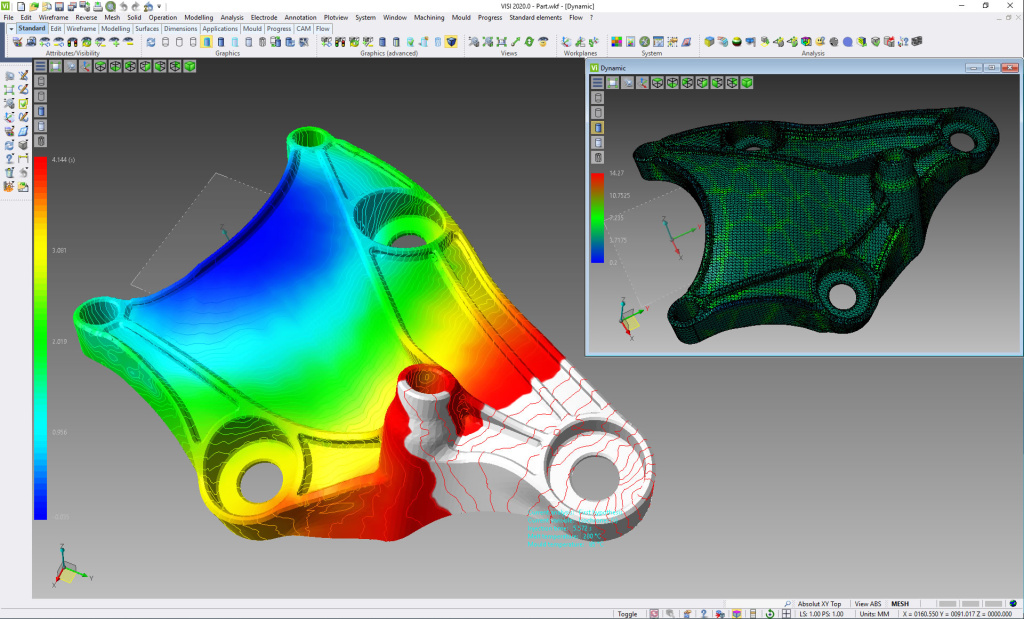
Analysis and Simulation Built In: Unlike most CAD/CAM tools which might require external simulation software, VISI includes analysis modules geared for tooling. VISI Flow is a built-in plastic flow analysis module that simulates how molten plastic will fill a mold cavity. This allows designers to predict issues like air traps, weld lines, or incomplete fills before any steel is cut. By adjusting gate locations or part geometry in VISI based on Flow results, mold designers can optimize for better quality parts. Similarly, VISI’s blank development tools help die designers calculate the starting flat blank of a sheet metal part and foresee potential forming issues such as material thinning or wrinkling. In recent versions, the ability to bring in scan data and perform comparisons adds a quality control aspect – for example, after cutting a die, a user could scan the die and overlay the scan in VISI to check how closely it matches the intended design, or use the scan of a stamped part to see spring-back deviations. This convergence of design, simulation, and verification within VISI exemplifies an innovative approach to all-around CAE (computer-aided engineering) for manufacturing, which traditionally required multiple disparate tools.
-
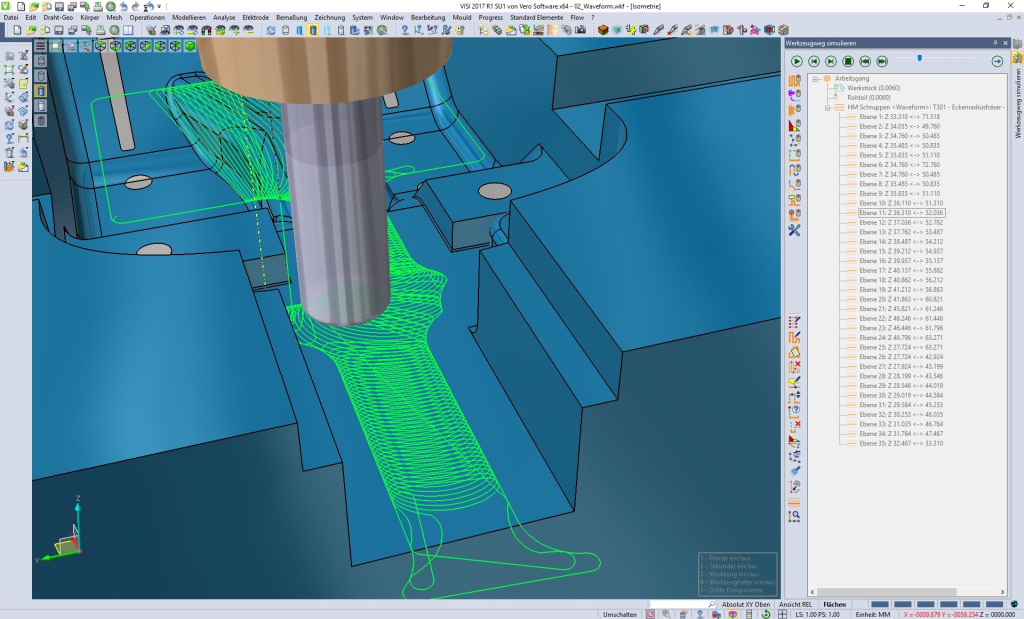
High-Level CAM Capabilities: On the CAM side, VISI benefits from the collective technology of the Vero family. With modules like VISI Machining (2D to 5-axis milling) and the infusion of strategies from WorkNC and Surfcam, VISI offers state-of-the-art toolpath generation. It includes high-speed machining (HSM) routines for efficient roughing (like trochoidal toolpaths to clear large volumes quickly), advanced 5-axis simultaneous milling for complex shapes (such as deep cavity molds or turbine blades), and even support for specialized processes like wire EDM via integrated PEPS technology (one of Vero’s acquired brands). One strength often cited by users is VISI’s post-processor library – support for a wide range of CNC machine controllers and the ability to fine-tune output to specific machines. This is crucial in a toolroom environment where machines can vary from modern 5-axis centers to older 3-axis mills; VISI ensures all can be programmed from one system. Additionally, with the NCSIMUL integration after 2018, users can simulate those toolpaths with machine models to verify there are no collisions or errors, increasing confidence when the code is finally executed on the machine.
-
User-Friendly Interface for Toolmakers: Over the years, VISI’s interface and workflow have been refined with direct input from toolmakers who may not be CAD specialists by training. The software is known for its relatively flat learning curve compared to some high-end CAD systems. Dialogs and terminology in VISI often mirror the language used on the shop floor. For example, VISI’s electrode module asks for parameters in terms that EDM technicians use, and the mold design module uses familiar jargon (core, cavity, sprue, runner, etc.). This attention to the end-user experience, and having a support team that understands manufacturing, has become a selling point. Many small and mid-sized tool shops choose VISI because they can get new designers up to speed quickly and because the software doesn’t feel like a general-purpose CAD overloaded with irrelevant functions – it feels purpose-built for what they do daily.
-
Continuous Innovation and Updates: The development team behind VISI has consistently released new versions (typically two major releases per year in recent times, named by year and release number like “VISI 2021 R2”). Each release usually brings both incremental improvements and occasionally groundbreaking new features. In late 2018, VISI 2019 R1 introduced a major reverse engineering enhancement, directly integrating with new scanning hardware from Hexagon. In the early 2020s, VISI updates focused on improving the user interface, adding even more automation (like auto-insertion of cooling circuits in molds), and leveraging cloud technology for better collaboration (for instance, easier sharing of design data and toolpath results with colleagues or customers). The backing of Hexagon means VISI has access to a wider pool of R&D resources, including algorithms from other Hexagon software and feedback from a global customer base. This assures that VISI will continue to adopt new technologies such as AI-driven design suggestions or improved visualization (perhaps AR/VR for virtual mold try-outs in the future) as those become relevant to manufacturing.
In summary, VISI’s key strength is specialization: it might not be as universally known as some mainstream CAD packages, but in the mold & die community it’s recognized as a powerful, tuned tool that speaks the toolmaker’s language. By innovating within its niche – whether that’s pioneering the use of a robust modeling kernel on PC back in the 90s, or integrating modern scanners and part libraries in recent years – VISI has managed to stay at the forefront of its field. It strikes a balance between embracing new technology and maintaining a practical, applications-driven focus.
Leadership and Vision
One of the reasons VISI has thrived over the years is the strong vision and guidance from its leadership, who often have roots in the manufacturing industry themselves. The company’s leaders have consistently articulated a mission of helping manufacturers be more productive through specialized software.
From the founders onward, there has been an ethos of “for toolmakers, by toolmakers.” Don Babbs (co-founder and long-time CEO) was known for keeping the software grounded in real-world needs. In one interview he emphasized investing in original R&D and the importance of understanding the user’s workflow intimately, rather than just chasing flashy features. This user-centric philosophy was echoed by subsequent CEOs. Under Richard Smith’s tenure (2010–2017), the company’s strategy was to grow the business so it could serve its customers better on a global scale. “All of our efforts over many years have positioned Vero and our products as leaders in the industries we serve,” Smith noted around the time of the Hexagon acquisition, crediting the team’s long-term dedication. That sentiment reflects why Hexagon found VISI valuable: it had authoritative status in its domain.
After joining Hexagon, new voices also shaped VISI’s trajectory. Steve Sivitter, who led the division through the late 2010s, pushed for expanding into adjacent technologies (like the shop-floor tool management from FASys) to offer a more complete solution. “Their company brings great technology and a wealth of manufacturing experience to us,” Sivitter said of partnering with FASys, highlighting a view that VISI’s ecosystem should encompass not just design and CAM, but also the peripherals that surround those processes in a manufacturing environment. This indicates a broader vision of an integrated production software suite, where VISI is a central pillar among many supporting tools.
The leadership also often cites customer feedback and success stories as inspiration. Seeing companies like the aforementioned Brandauer (150 billion parts/year) or innovative mold makers in medical industries achieve results with VISI drives the team to further refine the product. The current stewards at Hexagon MI, such as division presidents, emphasize continuity – ensuring that the knowledgeable VISI development and support teams (many of whom came from Vero Software) keep their close relationships with users. Even as corporate structures change, the core team’s experience remains a valuable asset.
In terms of business performance, Hexagon does not break out VISI’s financials separately, but it’s understood that the Production Software business (which includes VISI and the other former Vero products) has been a steady contributor to Hexagon’s revenue. As of the mid-2020s, Hexagon’s Production Software group serves tens of thousands of customers worldwide, and VISI continues to be a key product especially in the automotive tool & die sector and among precision tooling firms. Hexagon’s global presence – in over 40 countries – means VISI now enjoys truly worldwide distribution and support. There are regional user conferences, training seminars, and technical support centers from Brazil to Japan all catering to VISI users in their local languages, something that smaller standalone companies often struggle to provide. This global support network is a direct result of the company’s leadership decisions to partner, merge, and eventually integrate into a larger organization for the benefit of customers.
Looking ahead, VISI’s roadmap is likely influenced by the industry trends toward digitalization and smart manufacturing. The concept of the “digital twin” – having a virtual replica of the manufacturing process – is something Hexagon actively promotes, and VISI fits into that concept by providing the digital twin of the tooling process. Company leaders have hinted that future developments might involve closer integration of VISI with real-time shop floor data: for example, using sensors on machine tools to feed back information into CAM adjustments, or linking tool design data with enterprise systems for better project management (Hexagon also offers production control software, which could tie in).
Yet, even with these forward-looking ideas, the core directive from leadership remains to keep VISI as the go-to solution for toolmakers. As Stephen Chadwick (Hexagon’s EMEA president) noted in a 2022 announcement, bringing long-time VISI resellers in-house was aimed at “ensuring security for our VISI customers and providing better service now and in the future.” That statement encapsulates the leadership’s commitment: protect what makes VISI successful (its customer base and niche focus) while enhancing it with more resources and technology so it can serve its community for years to come.
Conclusion
From its humble beginnings in Italy through to its position today as a globally deployed software, VISI’s journey reflects the broader evolution of manufacturing technology. It started as an innovative solution born out of a need for better CAD/CAM tools for molds and dies, and over the years it evolved by embracing new technologies (like advanced modeling kernels, simulation, and scanning) and smart business growth (merging with complementary products and eventually joining a larger ecosystem under Hexagon).
For engineers and manufacturers, VISI represents a mature, refined tool that carries decades of industry knowledge. Its strengths in specialized design, ease of use for complex tasks, and integrated approach have made it a staple in tool rooms and design offices around the world. At the same time, being part of Hexagon ensures that VISI users benefit from a broad support network and continued innovation without losing the niche expertise that defined the software.
In the competitive CAD/CAM market, where giants like Autodesk, Dassault Systèmes, and Siemens dominate general-purpose CAD/CAM, VISI has carved out a respected niche. It may not be the software used to design a car’s styling or a plane’s aerodynamics – but when it comes to designing the mold that will shape the car’s dashboard or the die that will stamp out hundreds of thousands of connectors, VISI is often the tool of choice. This laser focus on tooling is both the heritage and future of VISI.
As manufacturing moves further into the era of smart factories and digital integration, VISI’s challenge and opportunity will be to remain the specialist while connecting into broader digital threads. Given its track record and the continued support from company leadership, VISI appears well-positioned to remain a CAD/CAM powerhouse for the mold and die community, combining old-school practical know-how with cutting-edge software innovation.
Vendor: Hexagon