
BobCAD-CAM: Four Decades of Affordable CAD/CAM Innovation
BobCAD-CAM is a computer-aided design and manufacturing (CAD/CAM) software platform that has carved out a niche as an affordable, user-friendly solution for programming CNC machines. Developed by BobCAD-CAM, Inc., a software vendor based in the Tampa Bay area of Florida, the system integrates both CAD and CAM functionality into a single interface. This all-in-one approach allows users to design parts and then seamlessly generate toolpaths, run simulations, and output the G-code needed to drive computer numerical control (CNC) machinery. The software is used to program a wide range of CNC equipment, including milling machines (from 2-axis up to full 5-axis mills), turning centers (lathes and mill-turn machines), routing machines, and even specialized cutting systems like waterjets, laser cutters, plasma cutters, and wire EDMs. By supporting such varied machine types, BobCAD-CAM caters to many manufacturing processes, from precision milling of metal parts to artistic woodworking and engraving.
In terms of industries and use cases, BobCAD-CAM’s versatility has led to its adoption across the manufacturing spectrum. Its user base spans high-end industrial sectors as well as small shops and individual hobbyists. For example, the software is used in aerospace engineering to craft complex components requiring extremely precise toolpaths and simulation (often involving long, multi-axis machining operations). It is also employed in automotive and motorsports for machining custom parts and engine components. Other areas of application include consumer product fabrication, defense and military equipment production, medical device manufacturing, mold and pattern making, jewelry design and engraving, musical instrument fabrication, and general production machining, among others. In each of these sectors, BobCAD-CAM provides the CAD design tools and CAM programming features needed to take a part from concept to finished piece. The company notes that its clientele ranges “from aerospace engineers to home shop machinists,” underlining the broad appeal to both large manufacturers and small-scale users. Educational institutions have also been a focus – technical schools and college CNC programs use BobCAD-CAM as a teaching tool, aided by the company’s outreach to future machinists through initiatives like the “Manufacturers of The Future” program that offers software to schools. No matter the industry, typical use cases involve using BobCAD-CAM to design a 2D or 3D part, then generate CNC toolpaths (such as drilling, milling, turning, or cutting operations) to produce that part efficiently and accurately on the shop floor.
Company Background and History
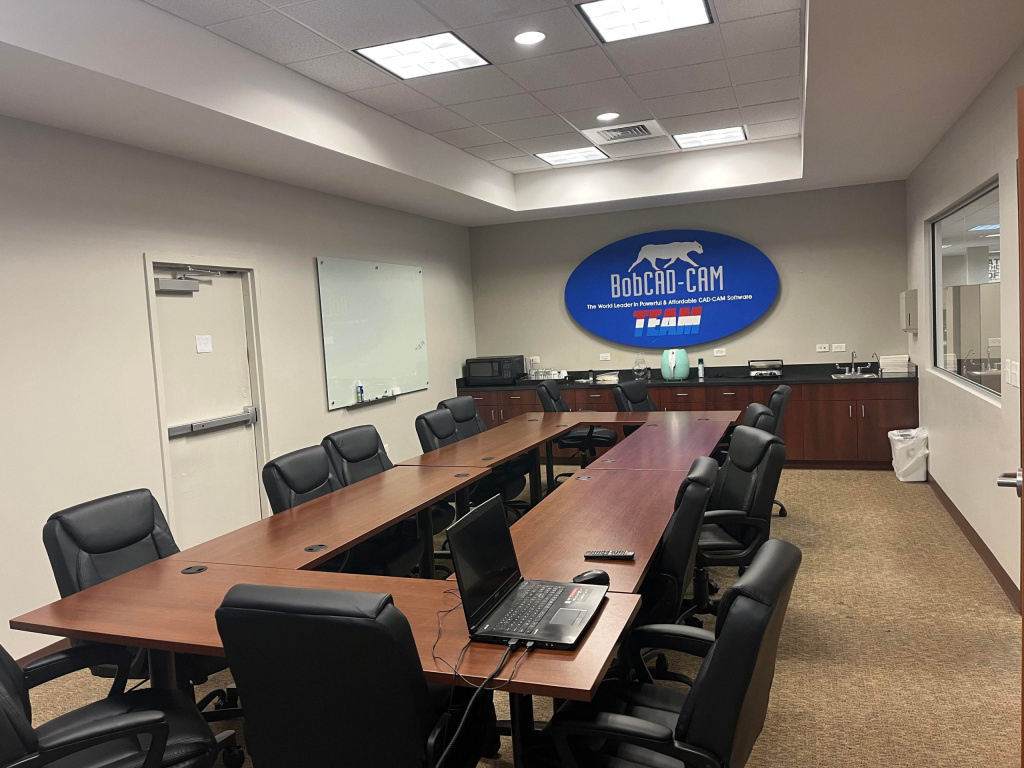
BobCAD-CAM’s origins date back to the mid-1980s, making it one of the longer-running players in the CAD/CAM software arena. The company was founded in 1985 by Robert “Bob” Twaalfhoven, an engineer who graduated from MIT in 1978 and recognized a market need for more accessible CAD/CAM technology. At that time, most CAD/CAM systems were expensive, running on minicomputers or mainframes, and were financially out of reach for many smaller machine shops. Twaalfhoven’s vision was to bring CAD/CAM capabilities to the personal computer and offer an affordable alternative for CNC programming. In the company’s early days, Bob Twaalfhoven literally sold the software out of the trunk of his car, visiting machine shops and demonstrating how it could automate their CNC code generation without the hefty price tag of incumbent systems. This grass-roots approach helped the fledgling software gain its first customers among manufacturers who desperately needed automation but had limited budgets.
The first BobCAD-CAM office opened in Silicon Valley (San Jose, California) to serve the local manufacturing community in the 1980s. As the software’s popularity grew, the company expanded to the East Coast in the early 1990s, establishing a second office in Clearwater, Florida – a region with a strong machining and aerospace industry presence. Eventually, the Florida location became the primary headquarters as the business consolidated its operations there. From the mid-1980s through the 1990s, BobCAD-CAM evolved through a series of version updates that steadily increased its capabilities. Early versions focused on 2D machining and basic 2.5-axis milling toolpaths, but by the late 1990s the software had introduced 3-axis machining for more complex geometries as well as support for CNC lathes (turning). This expansion of features aligned with the growing adoption of CNC equipment across many shops.
A major leap in functionality came around the early 2000s. In 2002, BobCAD-CAM added robust 3D design and modeling tools to complement its CAM engine. This included surface and solid modeling capabilities, allowing users not only to import designs from other CAD systems but also to create and edit complex part geometry directly within BobCAD. Around the same time, the company released its first artistic carving and engraving add-on (an optional module later known as BobART), opening the door to creative applications like custom signs, jewelry, and decorative woodworking. BobCAD-CAM also pioneered the idea of comprehensive training materials for its users – it was among the first CAD/CAM companies to produce extensive training video tutorials (circa 2002), enabling customers to learn the software at their own pace from their shop or home office. These moves helped broaden BobCAD’s appeal, making it more than just a basic G-code generator and transforming it into a fuller-featured CAD/CAM suite.
By 2007, after more than two decades in business, BobCAD-CAM underwent an internal overhaul to modernize and rebuild its product for the future. Bob Twaalfhoven reorganized the development team and spearheaded a ground-up redevelopment of the software’s architecture, resulting in a milestone release: BobCAD-CAM Version 22. This version introduced a range of new modules and enhancements that set the stage for the software’s next generation. Among the notable additions were advanced Lathe (turning) programming capabilities, sheet metal nesting and optimization tools for efficiently laying out parts, and a partnership with Predator Software to integrate a high-end CNC editor and backplot simulator. The integration of Predator’s technology gave users a more powerful environment for editing G-code and visually verifying CNC programs, which was especially useful for avoiding mistakes before running a program on real machinery.
The late 2000s and early 2010s saw BobCAD-CAM continue to mature rapidly. Between 2007 and 2014, the company claims it made some of the “largest strides” in its history in developing and implementing new CNC machining technology. During this period, BobCAD-CAM introduced full 4-axis and 5-axis simultaneous machining support, allowing users to program complex multi-axis CNC mills (an area historically dominated by more expensive CAM systems). It was in this era that BobCAD rolled out its proprietary High Speed Adaptive Roughing strategies – advanced toolpath algorithms for faster and more efficient material removal. In fact, BobCAD-CAM was one of the first CAD/CAM packages to offer multi-axis adaptive toolpaths for full 5-axis machines, bringing high-end machining techniques into a more affordable product tier. Another significant development was the creation of BobCAM for SOLIDWORKS, a plug-in that allowed SolidWorks CAD users to perform CAM programming right inside their familiar design software. BobCAD-CAM became an official SOLIDWORKS Gold Partner as a result, meaning the integration met SolidWorks’ rigorous standards. This was a pivotal move that opened up a new market: engineers and designers using SolidWorks could add on BobCAM to generate toolpaths without leaving their CAD environment. It represented a collaborative approach – instead of competing with established CAD platforms, BobCAD-CAM piggybacked on them to extend CAM functionality to those users. In more recent years, BobCAD-CAM followed up with similar integrations, notably launching BobCAM for Rhino in 2021, which brought its machining capabilities into the Rhino 3D modeling software popular in product design and architecture.
Throughout its history, BobCAD-CAM’s core identity has been tied to affordability and practicality. Larry Pendleton, a long-time executive who joined the company in the 1990s and eventually became its CEO, noted that in the early days CAD/CAM systems from other vendors often cost “$10,000 to $20,000,” which put them out of reach for many smaller shops. BobCAD’s mission was to offer “the same powerful functionality” as those high-end systems but at a drastically lower price point. This positioning created an ongoing challenge: convincing customers that a lower-cost solution could meet their needs as well as the big-name, expensive packages. “We still have to work very hard to justify to the consumer why our CAD/CAM systems are so much less than the others out there,” Pendleton acknowledged in an interview, addressing the common “you get what you pay for” skepticism in the market. Over time, BobCAD-CAM built a reputation as a cost-effective alternative, surviving industry downturns (such as the late-2000s recession) by staying lean and focusing on volume sales. In 2010 and 2011, the company actually saw record revenues in its history, an achievement Larry Pendleton attributed to hitting the necessary sales volume and keeping expenses in check. By 2011, BobCAD-CAM was preparing to introduce its new 5-axis and mill-turn modules and boldly stated that it would offer them for “half the price” of competing systems, “without a drop-off in features and functions” – a strategy Pendleton enthusiastically described as “exciting” because “no longer will shops have to pay $20K for software” to get advanced capabilities. This ethos of democratizing CNC software has been a consistent thread from the 1980s to the present.
Business Performance and Market Presence
Over nearly 40 years, BobCAD-CAM has grown a substantial user base, especially considering its niche in the CNC software market. The company reports that more than 150,000 licenses of BobCAD-CAM have been sold worldwide to date. This figure reflects cumulative users ranging from large corporations to one-person machine shops across over 50 countries. While many CAD/CAM vendors focus primarily on enterprise-level clients, BobCAD-CAM’s blend of affordability and modular product packages has attracted thousands of small and mid-sized manufacturers. Notably, even some well-known industrial names have utilized BobCAD-CAM for certain applications – for instance, the company has mentioned that its software was “powerful enough to accommodate the high-end industry needs of Harley-Davidson” while still being affordable for smaller shops. Such examples illustrate the software’s scalability; a high-profile motorcycle manufacturer might use BobCAD-CAM for specialized jobs or legacy support, at the same time that a garage entrepreneur uses it to program a home CNC router.
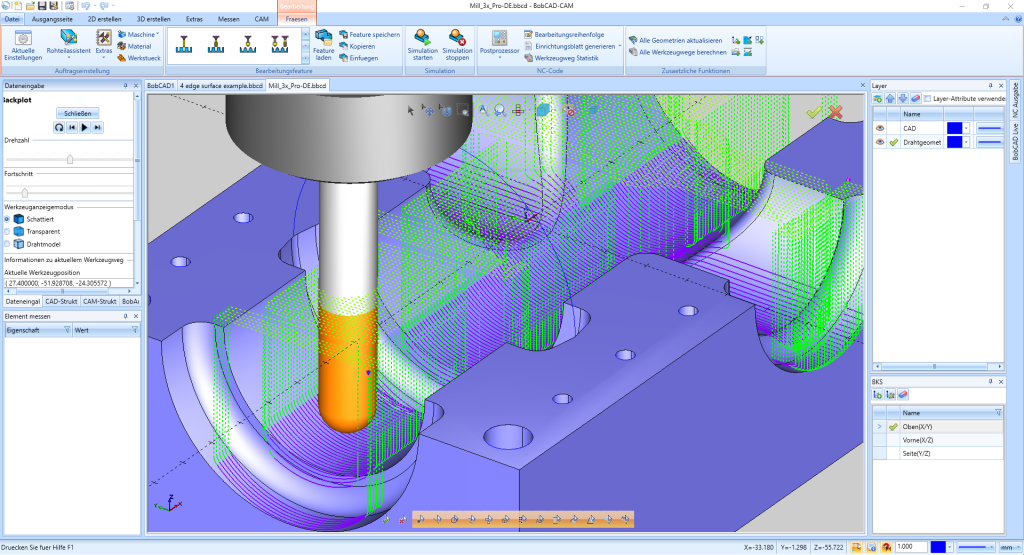
Geographically, BobCAD-CAM’s presence is global, with the bulk of its user community in North America but significant clusters in Europe, Asia, and Latin America. To support international users, the software is offered in multiple languages (including English, German, Spanish, Chinese, among others) and can output CNC programs that adhere to various machine tool standards around the world. BobCAD-CAM, Inc. distributes its products through a network of certified resellers and partners worldwide, ensuring local sales and support in key regions. For example, the company set up a Latin American office in Colombia to handle outreach and support for Central and South American markets. Plans for further international offices were discussed as the company saw growth opportunities in emerging manufacturing hubs. In addition to direct offices, BobCAD has strategic resellers in Europe and Asia and participates in industry trade shows globally to showcase its technology. By focusing on localization and training, the firm works to lower the barrier for non-English-speaking users to adopt the software. This international strategy ties back to the company’s long-term goal of making CAD/CAM technology accessible to “every region and language” that has manufacturing demand.
In terms of business performance, BobCAD-CAM is a privately held company (since 2019 it has been a subsidiary business unit within the Harris Operating Group of Constellation Software, following an acquisition – see next section). As a private entity, it does not publicly release detailed financials. However, industry analysts have made some educated estimates. The tech market research firm Datanyze pegs BobCAD-CAM’s annual revenue at roughly $15–16 million in recent years, with a workforce of on the order of 40–50 employees at its core U.S. operation. Datanyze lists the company’s headquarters in Tampa, Florida and indicates about 44 employees on staff with an estimated $15.5 million in yearly revenue.
Other sources suggest the headcount may be higher when including remote employees or international staff – some estimates put the total number of employees closer to 70 or more. In any case, BobCAD-CAM runs a relatively lean organization, especially when compared to some of its larger competitors in the CAM software space. (By contrast, competitors like Mastercam’s former parent company CNC Software had around 180 employees and $30+ million revenue before it was acquired, and companies like SolidCAM or DP Technology [Esprit] have been in a similar or larger range.) BobCAD’s size belies a broad customer reach achieved through its aggressive pricing and online sales model. The company’s revenue model historically relied on selling software licenses (with optional annual support plans), and it notably eschewed mandatory yearly maintenance fees that many competitors charged. This approach won price-sensitive customers, though it required continually adding new customers and encouraging upgrades to drive growth. Despite its moderate size, BobCAD-CAM has remained consistently profitable over the long term by focusing on niche segments and delivering volume sales – a point of pride for management, which has steered the company through multiple economic cycles in manufacturing.
Ownership, Acquisitions and Partnerships
In late 2019, BobCAD-CAM reached a significant milestone in its corporate history when it was acquired by the Harris Computer Operating Group, a division of Constellation Software Inc. The acquisition, completed on November 1, 2019, made BobCAD-CAM part of a large portfolio of software companies under the Constellation umbrella. Harris (which is based in Ottawa, Canada) typically buys established software firms in specialized markets and operates them as autonomous business units. This deal provided BobCAD-CAM with the backing of a financially strong parent while allowing it to continue focusing on CAD/CAM for CNC machining. BobCAD-CAM’s then-president Larry Pendleton was named an Executive Vice President under Harris to continue leading the unit.
In the press release announcing the deal, Pendleton conveyed optimism about the future, stating, “We are excited to join the Harris family! We look forward to our next steps towards furthering our growth in both products & services to manufacturers globally.” He emphasized that the new ownership would help the company accelerate its growth worldwide. The Harris group also expressed enthusiasm; Senior Executive VP Jim Simak praised BobCAD-CAM as “a leader and innovator in the CAD/CAM software industry” and noted Harris’s aim to provide long-term stability and support further expansion of BobCAD’s success with advanced manufacturers, job shops, and educational partners. The acquisition did not lead to any immediate rebranding – BobCAD-CAM retained its name and product lines, operating independently under Harris. For customers, the most noticeable change was the additional resources and stability behind the scenes. The deal also highlighted the value BobCAD-CAM had built over decades; being acquired by a publicly traded conglomerate validated its status as an important player in the CAM niche.
Before being acquired itself, BobCAD-CAM primarily grew through organic development and partnerships rather than mergers. There are no major acquisitions of other companies by BobCAD-CAM in its history – its growth has been driven internally and by extending the product to new platforms (like SolidWorks and Rhino) instead of buying competitors. However, the company has engaged in numerous strategic partnerships and collaborations over time to enhance its offerings:
- As mentioned, BobCAD-CAM partnered with Dassault Systèmes SolidWorks to become a Gold Partner and develop the BobCAM for SolidWorks plug-in. This deep integration means SolidWorks users can purchase BobCAD’s CAM module to work inside their CAD system, merging the design and manufacturing workflows. The partnership with SolidWorks, formalized in the early 2010s, significantly raised BobCAD’s profile in the CAD community.
- The company similarly partnered with Rhinoceros 3D (McNeel & Associates) to create BobCAM for Rhino, released in 2021. This brought decades of BobCAD’s CAM experience into the Rhino environment, allowing Rhino users (common in product design, architecture, and jewelry design) to generate CNC toolpaths without exporting to a separate CAM program. By aligning with Rhino, BobCAD tapped into another established design ecosystem, showing a strategic pattern of collaboration with CAD software vendors rather than competing with them head-on.
- BobCAD-CAM has long used technology components from ModuleWorks, a specialized provider of CAM toolpath and machine simulation engines. ModuleWorks’ libraries power advanced features in many CAM systems, and BobCAD-CAM leverages them for complex multi-axis machining strategies and 3D simulation. This partnership enables BobCAD to offer high-end features (like 5-axis simultaneous machining and realistic machine simulation) by incorporating proven algorithms, rather than developing all of that code in-house from scratch. ModuleWorks has cited BobCAD-CAM as a partner adopting its latest toolpath strategies and even new standards (for instance, in 2024 BobCAD-CAM joined ModuleWorks in adopting the Manufacturing Data Exchange Specification for better interoperability).
- Recognizing the rise of robotic machining, BobCAD-CAM formed a partnership with RoboDK, a company known for robot programming software. In 2020, the two companies released a joint plugin that allows BobCAD-CAM users to program robotic arms for machining tasks using RoboDK’s technology. This collaboration effectively extends BobCAD-CAM’s reach beyond traditional CNC machines to 6-axis industrial robots, which are increasingly used for milling, trimming, and carving operations. It reflects BobCAD’s willingness to innovate through alliances and address emerging trends in flexible automation.
- The company has also integrated with popular CNC controller software. Notably, BobCAD-CAM offers a link to Mach3, a well-known PC-based machine control program widely used by hobbyist and small-shop CNC operators. The BobCAD-Mach3 connection allows users to send toolpaths directly from BobCAD-CAM to Mach3 to run the machine, streamlining the workflow for those using Mach3-controlled mills or routers. This kind of integration underscores BobCAD’s focus on serving the DIY and budget-conscious segment of the CNC market.
- Beyond technology partnerships, BobCAD-CAM maintains a worldwide reseller and distributor network. The company has authorized resellers across North America, Europe, Asia, and Oceania to sell and support the software. For example, in recent years BobCAD announced strategic reseller agreements such as one with 2SQ Industrial Supply (a tooling distributor in Pennsylvania) to expand reach in certain regions. In India, BobCAD partnered with a local firm (Cube CADTECH) to promote its solutions in the Indian market. These partnerships ensure that customers in different countries have local contacts for purchasing, training, and support. BobCAD supplements this with online direct sales, but having regional partners has been key to its international expansion.
All of these collaborations – whether with CAD companies, component technology providers, or regional resellers – have allowed BobCAD-CAM to punch above its weight and continually improve its product. By focusing on partnerships, BobCAD-CAM has kept its development team relatively small while still offering compatibility with a broad ecosystem of tools and platforms.
Features, Innovations and Competitive Advantages
BobCAD-CAM’s longevity in the market can be attributed to several key strengths and innovative features that distinguish it from other CAD/CAM software. From the beginning, the software’s affordability has been a primary selling point. A hallmark of BobCAD-CAM is that it delivers functionality comparable to many high-end CAM systems but at a fraction of the cost. As discussed by company leadership over the years, BobCAD’s pricing model was intentionally set low to attract small businesses and independent machinists. Even today, obtaining a perpetual license for BobCAD-CAM and a few modules tends to cost significantly less than equivalent packages from competitors. This cost advantage is amplified by the company’s practice of modular product offerings and optional add-ons. Users can purchase just the modules they need – for example, a 3-axis milling package or a 2-axis lathe module – and then upgrade with more advanced 4-axis, 5-axis, art, or nesting modules as their business grows. This modular design lets a customer start with a basic, inexpensive configuration and expand functionality over time without switching platforms. It’s a flexible approach that aligns well with small shop budgets and evolving needs.
Despite its lower price, BobCAD-CAM includes a robust set of features that have kept it competitive. Notably, the software integrates CAD and CAM in one program, whereas some rival solutions split those into separate applications or require using third-party CAD. In BobCAD, users can draw or import a part design (supporting common file formats like DXF, IGES, STEP, STL, SolidWorks files, and more) and then proceed directly to toolpath programming on that geometry. The integration means there is no need for tedious file transfers between design and machining – any changes to the design can instantly be updated in the CAM side. Over the years, the CAD side of BobCAD has matured to include solid modeling, 3D surface modeling, and even artistic vector drawing capabilities, making it a reasonably full-featured CAD tool in its own right for many machining purposes.
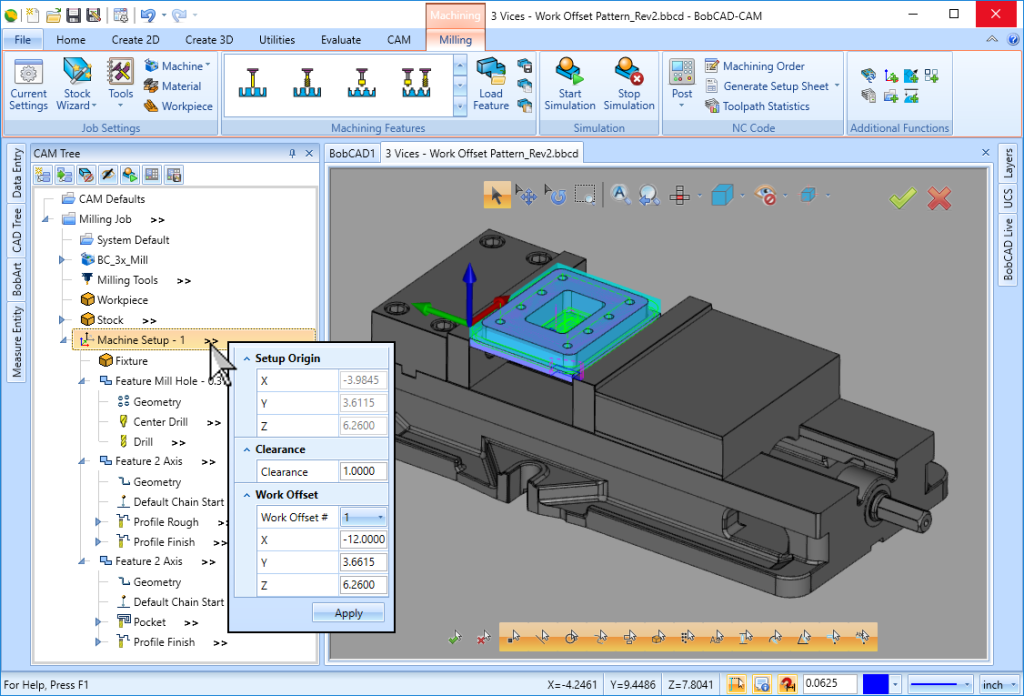
On the CAM side, BobCAD-CAM provides a wide array of machining strategies and an emphasis on ease-of-use. One signature element is its Wizard-driven interface. For each machining operation (whether it’s a simple 2D pocket or a complex 5-axis swarf cut), BobCAD guides the user through the programming steps with a step-by-step wizard. These wizards prompt the user for necessary inputs like tool selection, cutting depths, speeds/feeds, and machining strategies in a logical sequence. This design helps demystify CNC programming for less experienced users. It reduces the learning curve by breaking tasks into guided chunks, rather than confronting the user with dozens of settings on one screen. Another innovation is the concept of Dynamic Machining Strategies™ – a feature BobCAD introduced to let users apply multiple toolpath strategies to the same geometry feature without redundant re-selection. For instance, a user can define a pocket feature and then assign a roughing pass, a semi-finish pass, and a finishing pass all within that single feature’s wizard, instead of programming each step separately. This dynamic approach streamlines programming and is particularly helpful for efficiency. According to the company, advanced features like the dynamic strategies and the wizard interface have “helped countless machinists expand their production power and drive business growth” by saving time and reducing errors.
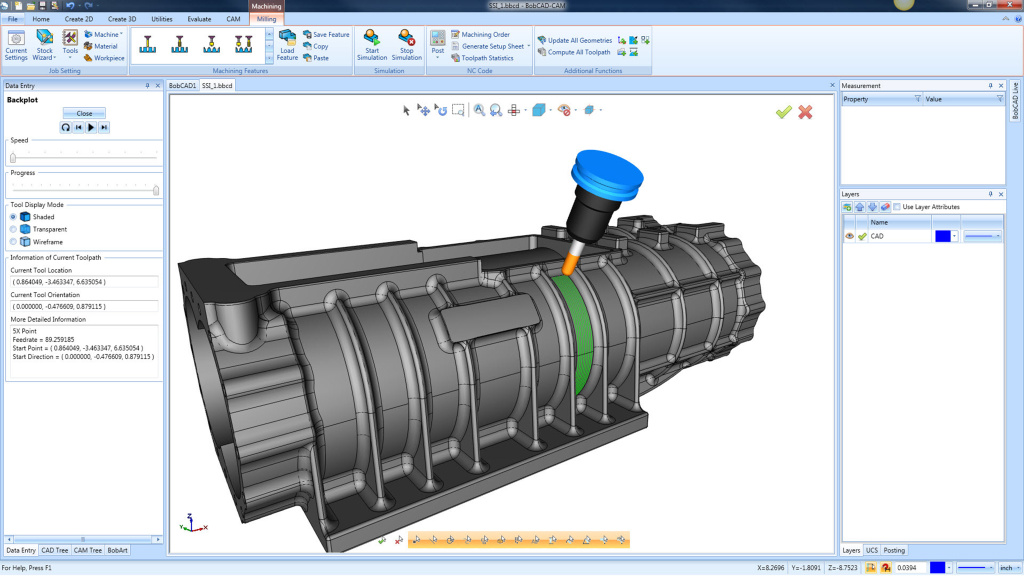
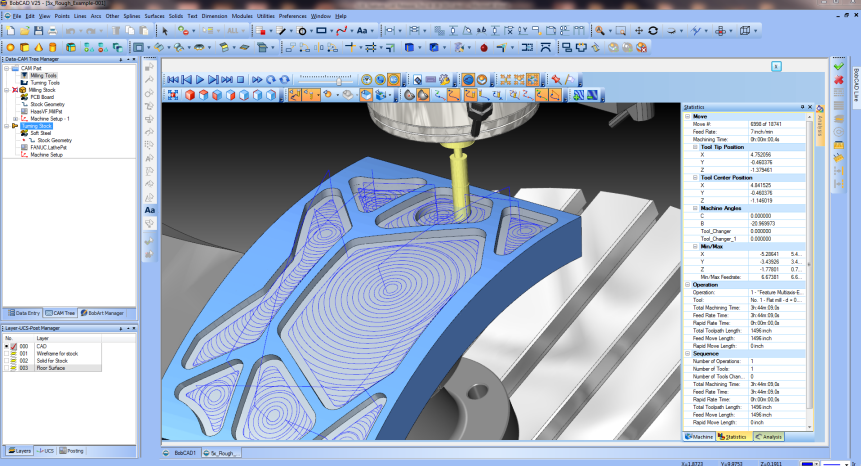
Performance and toolpath quality have also been focal points of development. BobCAD-CAM incorporates high-speed machining algorithms such as adaptive clearing (sometimes called trochoidal or dynamic milling in industry terms) that allow for significantly faster roughing operations. These toolpaths intelligently adjust the cutter’s path to maintain consistent load, enabling higher speeds and extended tool life. BobCAD’s adaptive roughing is available for 2D and 3D operations and extends into multi-axis for sophisticated jobs. The software also offers a variety of finishing strategies like Z-level (waterline) machining, pencil tracing for corners, parallel (lace) cuts, and radial and spiral fills, giving users control over surface finish quality. In recent versions, enhancements like an advanced simulation module (with collision detection and machine kinematics visualization) and a dedicated G-code editor have been included to improve the user’s ability to verify and fine-tune programs before they hit the machine.
One of BobCAD-CAM’s competitive advantages is that many of its developers and support staff have practical machining backgrounds. The company proudly states that the software is designed “by machinists for machinists”. BobCAD’s engineers often have hands-on CNC experience, which has influenced the software’s feature set and usability. For example, recognizing common shop needs, BobCAD added features like canned cycle support, custom drill cycles, and the ability to save and re-use machining features across projects to avoid repetitive setup. “Our customers want easy-to-use features that do not require special programming knowledge to set up and use,” founder Bob Twaalfhoven has explained, underscoring the focus on practical simplicity in the software’s design. This philosophy is reflected in options like the ability to copy and paste machining operations from one part to another, or to load saved machining templates – all aimed at speeding up routine jobs for the average user.
Another strength is the range of post-processors and machine compatibility. BobCAD-CAM outputs standard G-code (and M-code) that can be configured to suit virtually any CNC control. The company provides hundreds of post-processor definitions for popular CNC machines and controllers (such as FANUC, Haas, Mach3, LinuxCNC, and many others), and it offers custom post editing services. This means a user can rely on BobCAD for all their machines in a shop – from a 3D printer-like hobby mill to a full 5-axis machining center – with one software solution. Flexibility is further seen in support for probing cycles, 4th-axis rotary tables, tombstone (fixture) machining, and other specialized machining scenarios that some mid-range CAM packages might not handle. Over the years, BobCAD-CAM even introduced ancillary products like a standalone NC Editor (for G-code tweaking) and a Machine Simulation Promodule for more advanced visualization, showing an effort to round out the ecosystem.
Of course, BobCAD-CAM does not go without competition. The CAM software market is crowded, including industry heavyweights like Mastercam, Fusion 360 (Autodesk), SolidCAM, Inventor CAM, GibbsCAM, and many others each vying for users. BobCAD’s niche has been the budget-conscious segment and those who prefer a one-time purchase model. In recent years, some competitors have moved to subscription licensing or cloud-based systems, whereas BobCAD-CAM has continued to offer perpetual licenses with optional maintenance – a selling point for customers who dislike subscription models. While high-end systems might offer more cutting-edge features or slicker interfaces, BobCAD-CAM’s feature set is robust enough for the majority of everyday CNC work, and its value proposition is hard to beat. A user on a machinist forum once summarized the sentiment: BobCAD “does the brunt of the work that a moderate machine shop could ever need,” especially once the user becomes familiar with its workflow. This capability-to-cost ratio remains one of BobCAD’s strongest competitive advantages.
Leadership and Vision
BobCAD-CAM’s leadership has consistently articulated a vision centered on empowering machinists and lowering the barriers to CNC technology. Bob Twaalfhoven, as the founder and long-time president, imbued the company with an entrepreneurial spirit from the start – literally evangelizing the product from one machine shop to the next in its infancy. Twaalfhoven’s personal story of bootstrapping the business and creating a CAD/CAM program for “the little guy” has become part of the company’s lore. His technical insight (as an MIT-educated engineer) combined with a pragmatic approach (gleaned from listening to machinists on the shop floor) set the tone for BobCAD-CAM’s development. Even as the company grew, Twaalfhoven remained closely involved in product strategy. In an interview reflecting on user needs, he remarked, “Our customers want easy to use features that do not require special programming knowledge to set up and use.” This quote highlights the guiding principle that complexity should be hidden under the hood; the end user should feel in control without needing to be a CAM expert or a programmer to get good results.
Larry Pendleton, who has been the public face of BobCAD-CAM in many ways, joined the company in sales and climbed the ranks to Executive Director and eventually CEO/President. Pendleton helped steer BobCAD through economic ups and downs (like the 2009 recession) and oversaw major initiatives such as the development of multi-axis modules and the foray into international markets. Known for his candid and passionate communication, Pendleton has often spoken about the company’s commitment to value. A decade ago, as BobCAD was preparing to launch its 5-axis module, Pendleton said he was “truly excited” that they would be delivering multi-axis functionality for half the price of the competition, proclaiming “no longer will shops have to pay $20K” for comparable software. Such statements reflect BobCAD’s challenger mentality – the company relishes the idea of undercutting industry giants and giving smaller shops capabilities that were once considered exclusive to big-budget operations.
Since the 2019 acquisition by Harris/Constellation, BobCAD-CAM’s leadership has also emphasized stability and growth. The backing of Constellation provides a long-term home, and management has signaled that it will continue investing in product improvements and customer support infrastructure. The company’s leaders have indicated that being part of a larger software group will not dilute their focus on the CAD/CAM niche but rather enhance resources for development and global reach. BobCAD’s partnership strategy (SolidWorks, Rhino, etc.) is expected to continue under this vision, aligning with complementary technologies to strengthen the ecosystem around its core software.
Internally, the culture at BobCAD-CAM seems to blend software development with real-world manufacturing insight. It’s not uncommon for the team to test new features directly on CNC machines in their training lab or to invite feedback from power users in the community. The company runs an active user forum and produces a weekly “Tech Tuesday” blog and webinar series to engage with users and address common questions. This close-knit interaction with its user base informs leadership decisions on what features to develop next. For instance, if many users request easier 4th-axis indexing workflows or a new post processor for a popular machine, BobCAD’s team tends to prioritize those incremental improvements.
Looking ahead, BobCAD-CAM’s vision remains centered on innovation balanced with accessibility. Areas like additive manufacturing (3D printing) and robotic automation are likely on the radar – BobCAD has already dabbled in these via partnerships and could integrate more capabilities as those technologies converge with traditional machining. Additionally, as CAD/CAM software increasingly incorporates automation (like feature recognition and AI-driven toolpath optimization), BobCAD will aim to include such advanced functionality while keeping the user experience straightforward. The ultimate goal, as consistently voiced by its leaders, is to continue “finding new ways to help shops increase their manufacturing capabilities and overall innovation power” without pricing anyone out of the market.
Vendor: BobCAD-CAM