
PartMaker: Pioneering CAD/CAM for Multi-Axis Machining
The information is currently being reviewed and updated. If you notice any errors or inaccuracies, please let us know.
PartMaker: Pioneering CAD/CAM for Multi-Axis Machining
When multi-axis turning centers and Swiss-type automatic lathes began gaining popularity in the 1990s, manufacturers faced a daunting programming challenge. Traditional CAM software struggled to handle the complexity of machines with multiple spindles and toolposts cutting simultaneously. It was in this niche that PartMaker emerged as a trailblazing solution. PartMaker is a computer-aided design and manufacturing (CAD/CAM) system specifically created to simplify and automate the programming of complex CNC machines – particularly Swiss-type lathes and turn-mill centers.
Over the past few decades, this software has evolved from a small start-up product into an industry-leading tool, now part of Autodesk’s advanced manufacturing portfolio. This article explores PartMaker’s story: its origins and development, the applications it serves, its business journey through acquisitions, and the innovations and expertise that set it apart in the world of precision machining software.
PartMaker and Its Vendor
PartMaker is a CAD/CAM software package that enables manufacturers to program a wide range of CNC equipment, from standard 2-axis lathes and milling machines to multi-axis turn-mill centers and sliding-head Swiss lathes. The software was designed to “divide and conquer” the programming of complex parts – breaking down machining tasks by feature and by machine axis – making it far easier to generate error-free NC code for sophisticated machines. PartMaker’s visual programming interface allows users to program different machining operations (turning, milling on various faces, cross-drilling, etc.) in separate windows or modules, then automatically synchronize those operations across multiple spindles and tool turrets. This patented approach to multi-axis CNC programming revolutionized how machinists handle intricate parts: instead of tediously writing code and manually coordinating simultaneous operations, PartMaker users can rely on an intuitive graphical environment that ensures proper sequencing and collision-free toolpaths.
Originally, PartMaker was developed by a small U.S. company called IMCS, Inc. (International Manufacturing Computer Services), based in Fort Washington, Pennsylvania. IMCS was a startup founded in the mid-1990s by a team led by Hanan Fishman, who left a career in finance in 1998 to help start the venture. Fishman and his colleagues saw a gap in the CAM market for programming multi-tasking machine tools. They launched the first version of PartMaker in 1996. The initial software targeted turn-mill machines (lathes with milling capability), but adoption was slow at first. “The available hardware just wasn’t ready for it,” recalls Hanan Fishman about that early attempt. “In the mid-90s, turn-mills couldn’t do much milling, so they were largely used as two-axis lathes. Many viewed two-axis turning as a simple task to program, so there wasn’t much demand for sophisticated CAM software for turn-mill applications at the time.” Facing this reality, the PartMaker team pivoted to focus on an even more complex class of machine that was becoming popular in precision manufacturing: Swiss-type screw machines.
By leveraging the core ideas from their turn-mill software, the developers expanded PartMaker to support Swiss-style automatic lathes – highly precise machines used for small, intricate parts (common in medical devices, electronics, and firearms). This led to the creation of PartMaker SwissCAM, released in the late 1990s. It was a timely innovation: CNC Swiss machines were increasingly in demand for producing parts like bone screws, dental implants, connectors, and other high-precision components, yet there was virtually no dedicated CAM software for them. PartMaker’s solution was one of the first of its kind. “Nobody had programming software for Swiss-type lathes,” Fishman notes. “Our technology made it easy, and as a result, we experienced meteoric growth.” PartMaker SwissCAM introduced efficient programming methods and synchronization tools tailored to Swiss machines, even earning the company a second U.S. patent for its unique approach. By the early 2000s, PartMaker had established itself as the premier CAM system for Swiss turning, and its reputation (and sales) began to grow rapidly, especially among job shops and manufacturers in the precision machining arena.
Areas of Application
PartMaker’s primary application area is production machining – in other words, programming the tools that mass-produce precision parts. The software’s capabilities cover a broad spectrum of CNC operations:
-
Swiss-Type Lathes: PartMaker became best known for Swiss lathe programming. Swiss-type automatic lathes (sliding headstock machines) can have multiple axes and can perform turning and milling simultaneously on bar stock with extreme precision. PartMaker provides specialized modules to handle guide bushing setup, sub-spindle pick-offs, and multiple toolpost synchronization unique to Swiss machines. This makes it invaluable in industries like medical device manufacturing (for surgical screws, bone pins, etc.), dental technology (implants and abutments), electronics and telecommunications (precision connector pins and components), the firearms industry (small firearm components and casings), and any field requiring tiny, high-tolerance turned parts.
-
Turn-Mill Centers: These CNC machines combine milling and turning in one unit, often with two spindles and tool turrets. PartMaker’s turn-mill module allows programming of complex parts in a single setup. For example, aerospace shops use turn-mill machines to produce engine and fuel system parts that require both lathe and mill work. PartMaker can coordinate milling on a flat or cylindrical face, drilling at angles, and traditional turning, all while managing the interactions between multiple tools cutting at once.
-
Conventional Mills and Lathes: Although its specialty is multi-axis equipment, PartMaker also supports standard 3-axis milling and 2-axis turning. It provides a unified platform so that a machine shop can program all of its CNC equipment using one software solution. This is useful for shops that have a mix of machines – from simple engine lathes to advanced 5-axis turn-mills – ensuring consistency in programming and toolpath strategies across the board.
-
Wire EDM: The software includes modules for programming Wire EDM (electrical discharge machining) machines, which cut precise shapes with a thin wire in industries like toolmaking and die-making. This expanded capability means PartMaker isn’t limited to cutting with traditional tools; it can also generate paths for non-traditional machining processes.
In short, PartMaker can handle virtually every type of CNC machining operation found in a modern precision manufacturing shop. Over time, the company touted that its solution served “eight key industry sectors,” including the five mentioned above (medical, dental, aerospace, telecommunications, firearms) as well as automotive, defense, and general industrial manufacturing. Any industry that relies on high-volume production of complex, tightly-toleranced parts has been within PartMaker’s scope. Notably, the software gained an especially strong foothold in the medical and dental fields – by 2012, the bulk of PartMaker’s user base consisted of medical device manufacturers, who prized the software for its ability to program intricate components reliably.
History and Evolution of the Product
Founding and Early Development: PartMaker’s story began with IMCS, Inc. in the 1990s. The concept was driven by the rapid evolution of machine tool technology. Founder Hanan Fishman recognized that as CNC machines gained multi-axis capabilities, shops would need new programming tools. Together with his co-inventor (and family member) Lena Fishman, he developed a system for visual synchronization of multiple tool paths. The innovation was codified in a U.S. patent granted in 2004 for “a system and method [that] allows visual programming of simultaneous and synchronous machining operations on multi-axis lathes.” This invention became the backbone of PartMaker’s software architecture. In practical terms, it meant PartMaker could graphically represent and coordinate operations on dual spindles (for example, one spindle turning the part while another simultaneously mills a feature on the part’s backside). The software groups related machining steps into synchronization sets and uses an internal post-processor to output NC code compatible with specific machine models. This universality and flexibility was a major leap forward in CAM for lathes.
After the lukewarm market response to its 1996 debut (due to turn-mill machines being underutilized at the time), IMCS refocused on Swiss-type automatics, releasing PartMaker SwissCAM around 1998-1999. SwissCAM proved to be a turning point. Companies running Swiss lathes quickly discovered that PartMaker could save countless hours of manual coding and trial-and-error. The software’s “divide and conquer” strategy – essentially programming sub-operations in separate, simplified 2D contexts (front turning, back turning, cross-milling, etc.) and then letting the system synchronize them – made programming even the most elaborate Swiss part feasible for the average CNC programmer. SwissCAM’s success cemented PartMaker’s reputation and attracted a loyal user base in the precision turned parts community. By the early 2000s, IMCS was thriving, albeit still a relatively small firm with most of its customers in North America. Hanan Fishman, who became the company’s president, often emphasized how PartMaker’s focus on this niche enabled it to outpace larger CAM competitors when it came to features that multi-axis lathe users needed. “CAM software for multi-axis turning and Swiss is a particularly narrow niche that requires a lot of domain knowledge and focus to be successful,” Fishman noted. According to him, PartMaker’s specialized focus – combined with a direct sales and support model – allowed the company to deliver a level of expertise and service that general-purpose CAM vendors (who sold through resellers) could not match. This approach helped PartMaker cultivate strong relationships with its users, ensuring that feedback from machine shops directly informed the software’s development.
Expansion and Acquisition by Delcam: PartMaker’s growing success did not go unnoticed by larger players in the CAD/CAM industry. In 2005, IMCS began talks with Delcam plc, a major UK-based CAD/CAM software company known for products like PowerMILL and FeatureCAM. Delcam was impressed by PartMaker’s strength in the Swiss-turning segment – a domain where Delcam had little presence – and saw an opportunity to round out its own portfolio. The following year, in July 2006, Delcam officially acquired IMCS and the PartMaker product line. IMCS, Inc. was subsequently renamed PartMaker Inc. as a Delcam subsidiary. This acquisition followed Delcam’s strategy of integrating niche CAM solutions (Delcam had bought FeatureCAM a year prior in 2005). Under the terms of the deal, PartMaker’s development team would remain in the United States and continue to focus on the product, while Delcam’s global network of over 150 offices and resellers would take over worldwide marketing and distribution. This was a transformative moment for PartMaker’s business. “Currently, approximately 90 percent of our sales originate from North American accounts,” Hanan Fishman said at the time, underscoring that PartMaker was then very U.S.-centric. “By joining Delcam, we will be able to accelerate our international sales growth. In addition, Delcam’s financial strength will enable us to expand our development and support teams, and provide even better service and product enhancements to the existing PartMaker user community.” In other words, becoming part of Delcam offered PartMaker both a broader reach and deeper resources for R&D.
Delcam’s leadership was equally enthusiastic. Hugh Humphreys, Delcam’s managing director in 2006, stated, “Multi-axis turning equipment is becoming increasingly complex and sophisticated, and so needs dedicated, specialist software. The addition of the PartMaker software to our existing range will allow us to support companies around the world that wish to introduce these advanced machines.” Indeed, with PartMaker in its stable, Delcam could claim one of the industry’s most complete CAM solution sets, covering everything from 5-axis milling and mold making (PowerMILL) to feature-based machining (FeatureCAM) and now Swiss/turn-mill programming (PartMaker). Post-acquisition, PartMaker Inc. continued to operate with a degree of autonomy in development, retaining its Pennsylvania office and core team. However, sales of PartMaker in Europe, Asia, and beyond surged thanks to Delcam’s established channels. By the late 2000s, the software had a truly global user base. Delcam’s annual reports in 2007–2008 attributed part of the company’s record sales growth to the integration of PartMaker and the ability to offer “the widest range of industry-leading CAM software from any supplier.”
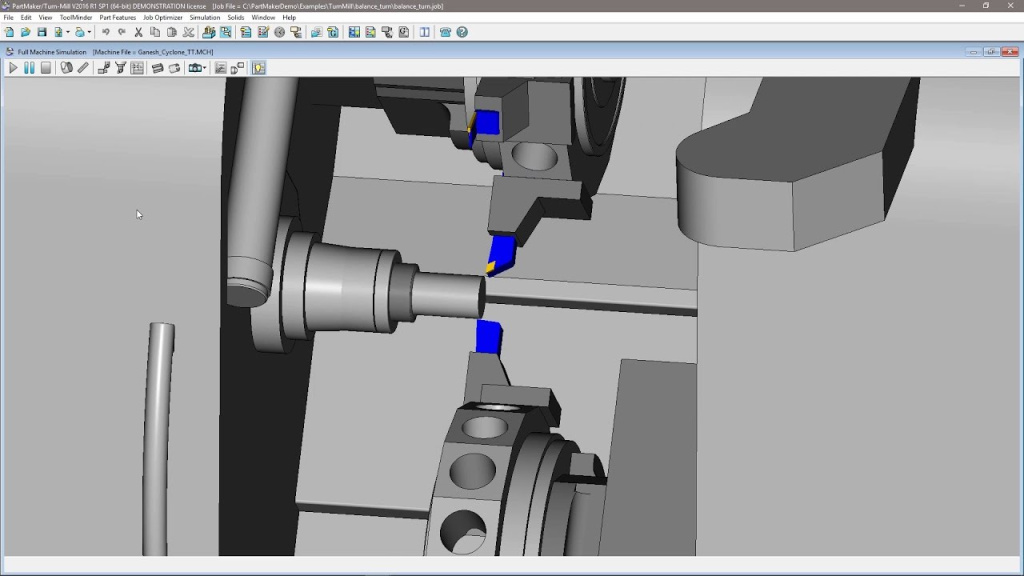
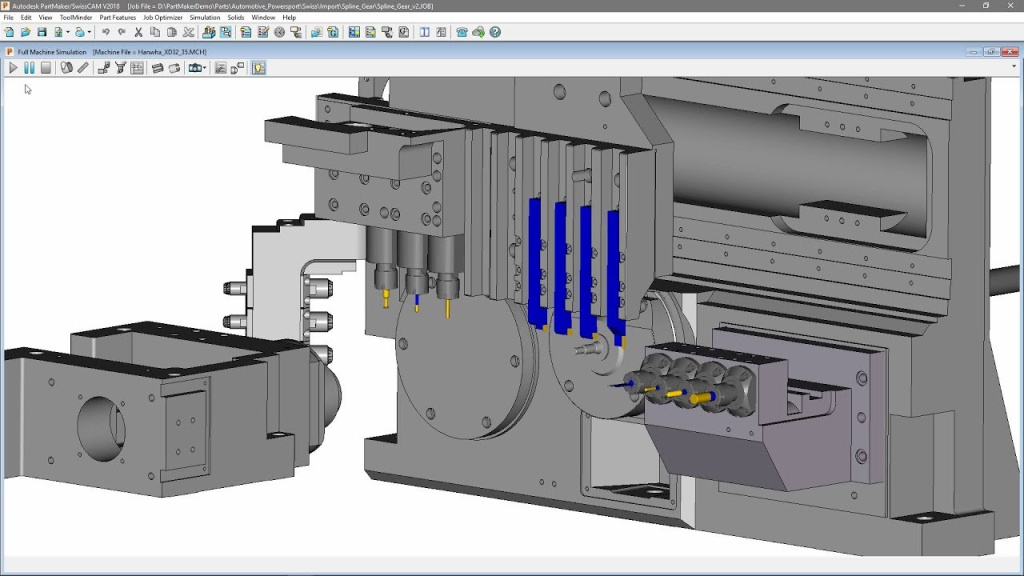
Further Development and Innovations: During the Delcam years, PartMaker kept advancing its technology. Regular version updates were released that added features and supported new machines. For example, PartMaker introduced improvements in surfacing and simulation to keep up with ever-more complex machine tools. A notable milestone was the release of PartMaker Version 8 in the late 2000s, which was described by Fishman as “a seminal release … with so many productivity-enhancing features.” Over time, modules were added for 5-axis milling within turn-mill machines and more sophisticated simulation capabilities. PartMaker’s simulation could create a “digital twin” of complex CNC lathes – including multiple spindles, turrets, and even accessories like programmable steady rests – allowing users to verify the entire machining process and detect collisions or timing issues before anything hit the shop floor.
One of PartMaker’s strengths has always been its rich library of post-processors and machine configurations. The software came pre-loaded with hundreds of tested post-processors for popular machine models from manufacturers like Citizen, Star, Tsugami, Tornos, Mazak, and Okuma, among others. Users could also fine-tune or “teach” the post-processor to accommodate custom macros or specific machine behaviors. This made PartMaker a very flexible choice: a shop could purchase a new Swiss lathe and often find that PartMaker already supported it, or that the vendor had collaborated with PartMaker’s team to ensure compatibility.
Another significant evolution was the introduction of PartMaker Modeling in 2012. While PartMaker always had basic CAD functionality (to allow users to draw or import part geometry), it was initially limited to 2D drafting. Fishman likened the early built-in CAD to “AutoCAD for the machinist” – handy for quick sketches or edits, but not a full 3D design tool. As customers increasingly began working with 3D solid models (often provided by clients or generated upstream by CAD engineers), PartMaker saw a need to give CAM programmers more power to manipulate those models. The PartMaker Modeling module brought true 3D CAD capability into the system, using the industry-standard Parasolid kernel. This allowed users to import solid models (via IGES, STEP, etc.), repair them, and even create or modify geometry in 3D. “This allows people to accept poor-quality data from all sorts of different systems and repair it, turning it into a watertight, machineable solid model,” Fishman explained when describing the benefit. The modeling module included a “Solid Doctor” tool to automatically heal gaps or errors in imported geometry – a common issue when dealing with neutral CAD file formats. By integrating these CAD tools, PartMaker reduced the dependency on separate CAD software, enabling machinists to perform minor design adjustments or fixturing setup within the PartMaker environment itself. This innovation was especially welcomed by medical parts manufacturers, who often have to tweak geometry or create jigs for tiny implants and screws.
Autodesk Acquisition and Integration: The next major chapter came in 2014 when Delcam itself was acquired by Autodesk, Inc. As part of a broader strategy to expand into manufacturing software, Autodesk (famous for AutoCAD and Inventor in the design space) purchased Delcam for roughly $276 million, bringing all of Delcam’s CAM products under its wing – PartMaker included. Autodesk’s acquisition of Delcam was one of the biggest moves in CAM industry history, and it signaled Autodesk’s commitment to providing end-to-end solutions from design to fabrication. “Today we are taking an important step on our path toward delivering a better manufacturing experience,” said Carl Bass, then Autodesk’s CEO, when announcing the deal. “Together Autodesk and Delcam will help further the development and implementation of technology for digital manufacturing.” For PartMaker users at the time, initially, it was business as usual. Delcam was allowed to operate as a semi-independent subsidiary for a while, and PartMaker development and support continued from the same team in Pennsylvania.
However, Autodesk soon began streamlining its CAM offerings. It introduced a product called Fusion 360 for integrated CAD/CAM and also inherited overlapping tools (FeatureCAM and PartMaker had some areas of redundancy, since both could program lathes and mill-turn machines). In 2016, Autodesk made a strategic decision to integrate PartMaker into FeatureCAM, effectively consolidating the two product lines. PartMaker’s specialized Swiss-turning engine was not discarded; instead, it was bundled as an add-on within the FeatureCAM Ultimate tier. Beginning with the 2017 release, “Autodesk FeatureCAM Ultimate” included all of PartMaker’s functionality. In practical terms, a user buying FeatureCAM Ultimate would get access to the PartMaker interface and modules for Swiss and multi-axis turning. Autodesk’s goal was to simplify its product portfolio while still serving PartMaker’s niche user base. For example, PartMaker 2017 was released not as a standalone product but as part of FeatureCAM 2017 Ultimate. This combination allowed shops to have one Autodesk CAM platform for both their milling and turning needs, with Swiss-specific capabilities unlocked through PartMaker’s inclusion. One early adopter of this integration, Bill Karas of Karas Kustoms, noted that programming his Swiss lathe via FeatureCAM (with PartMaker’s Swiss module) “saves our company a ton of time with excellent results,” whereas previously he had been writing Swiss programs by hand.
By folding PartMaker into the FeatureCAM family, Autodesk also aligned it with Fusion 360, the cloud-enabled CAD/CAM platform. Today, Autodesk markets PartMaker within the context of “Fusion 360 with FeatureCAM.” In essence, PartMaker’s technology lives on as a key component of Autodesk’s high-end manufacturing software bundle, even though the PartMaker name is no longer sold as a separate product. As of the mid-2020s, Autodesk continues to support the PartMaker functionality for programming Swiss-type lathes and complex turning centers, and many longtime PartMaker users have transitioned to using FeatureCAM Ultimate (often still referring to the Swiss module informally as “PartMaker”).
Business Footprint and Market Impact
From a business perspective, PartMaker’s journey is a classic example of a niche technology thriving through strategic focus and later benefiting from acquisition by larger enterprises. In its independent days (1990s–mid 2000s), PartMaker Inc. was a relatively small company but one that punched above its weight in terms of innovation. The company operated out of suburban Philadelphia and was even backed early on by local venture initiatives – it is listed as an “alumni” of the Ben Franklin Technology Partners of Southeastern Pennsylvania, a state-sponsored incubator, which suggests PartMaker received seed funding and support to grow its business in the region. By concentrating on the needs of precision turned-parts manufacturers, PartMaker built a loyal following. Users often praised the software’s ability to dramatically reduce programming time for machines that were notoriously complex to program. This translated into tangible productivity gains on the shop floor – shorter setup times, fewer errors, and the ability to take on more complex jobs. Many small and medium job shops credit PartMaker for enabling them to expand into Swiss machining work, which in turn opened doors to lucrative contracts in medical and aerospace markets.
While exact revenue figures for PartMaker Inc. were not publicly disclosed, we know that prior to the 2006 Delcam acquisition about 90% of its sales came from North America, indicating a strong domestic customer base in the United States (especially in regions with many precision machining firms, such as the Midwest and New England). Post-acquisition, with Delcam’s global reach, PartMaker saw increased adoption in Europe and Asia. By piggybacking on Delcam’s reseller network in over 60 countries, PartMaker likely grew its user count significantly. Delcam overall reported having tens of thousands of customers worldwide (over 45,000 by 2013 across all products), and while PartMaker accounted for a subset of that, it became a critical offering in Delcam’s portfolio for markets like Switzerland, Germany, and Japan where Swiss-type lathes are common. After Autodesk’s takeover, existing PartMaker customers were gradually transitioned to Autodesk subscription licensing. Autodesk does not break out PartMaker usage numbers separately, but the company has pointed to its manufacturing solutions (which include FeatureCAM/PartMaker, PowerMill, etc.) as an important growth area. The fact that Autodesk continues to include PartMaker’s capabilities in its flagship Fusion 360 Manufacturing suite suggests that there remains a steady demand for that technology.
Geographically, PartMaker’s influence can be seen in precision manufacturing hubs around the world. In Switzerland (home of Swiss-type machines), in Japan (where many leading Swiss lathe builders are based), and in countries like China and India (where precision component manufacturing has grown), specialized CAM tools like PartMaker have been key to maximizing machine productivity. In the U.S., PartMaker long enjoyed a strong relationship with the Precision Machined Products Association (PMPA) – it was reportedly the first CAM software member of that organization, joining in 2000 to stay connected with the screw machine community. Over the years, PartMaker sponsored numerous training seminars, user group meetings, and industry events to both demonstrate its software and gather input. This close interaction with the user community fostered continuous improvement and also cemented PartMaker’s reputation as “the CAD/CAM choice of many of the world’s leading production machining organizations.”
The PartMaker team also engaged in partnerships with machine tool OEMs to ensure their software kept pace with machine innovations. For instance, they frequently collaborated with Swiss lathe manufacturers like Tornos, Citizen, Star, and Tsugami to obtain early information on new machine models and to develop supporting post-processors and simulation models. Such collaborations were often highlighted in trade press – for example, Tornos (a Swiss machine builder) once published case studies showing how PartMaker SwissCAM was used to optimize programming on its machines, and PartMaker engineers would appear at machine tool open houses or trade show booths to demonstrate programming a part on the actual machine. These relationships were mutually beneficial: PartMaker got exposure to the machine OEM’s customers, and the machine OEM could offer a proven CAM solution to buyers who might otherwise struggle to program their new high-end lathe. Additionally, PartMaker wasn’t shy about partnering with educational institutions and training programs. There are instances of PartMaker donating software seats to community colleges and technical schools to help train the next generation of CNC programmers on state-of-the-art multi-axis CAM. This outreach not only marketed the software but also helped alleviate the skilled labor shortage by ensuring that new machinists were familiar with advanced programming techniques.
In terms of competition, PartMaker’s main rivals over the years have included other CAM systems that target multi-axis lathes, such as GibbsCAM, Esprit, and Mastercam (with specialized modules). Many of these competitors introduced their own Swiss programming features in response to PartMaker’s success. But throughout, PartMaker maintained a reputation for very strong focus on lathe applications. Even competitors might concede that PartMaker’s synchronization interface and knowledge of lathe kinematics were top-tier. This domain expertise turned PartMaker Inc. into an attractive acquisition target – first for Delcam and later indirectly for Autodesk. It’s worth noting that Autodesk’s decision in 2017 to consolidate products was partly to eliminate overlapping offerings, but it also reflected that PartMaker’s functionality was essential enough that it needed to be preserved and incorporated rather than simply discontinued. In effect, Autodesk validated the value of PartMaker’s technology by weaving it into the future of its CAM line.
Features, Innovations and Strengths of PartMaker
Several key innovations and strengths have defined PartMaker and differentiate it from generic CAM software:
-
Visual Synchronization and “Divide-and-Conquer” Programming: At the heart of PartMaker is its visual approach to multi-axis programming. The user programs different tool paths in separate, simplified contexts (e.g., programming the main spindle’s front-side operations in one window, the sub-spindle’s back-side operations in another, milling features in another, etc.). Each of these contexts is two-dimensional, which makes defining tool paths much easier than trying to program in full 3D with multiple moving components. PartMaker then provides a synchronization tool – often depicted as a timeline or set of synchronized icons – where the programmer can graphically line up the sequences from each context, inserting synchronization codes or wait points as needed. This approach allows even a novice Swiss machinist to grasp the parallel operations that will occur. It dramatically reduces the trial-and-error that was historically required when writing Swiss machine code manually. The patented synchronization system, complete with a “sync editor” and color-coded representation of tool paths, is widely regarded as one of PartMaker’s greatest strengths. It essentially encodes expert knowledge of how to optimize cycle times by overlapping cutting processes safely. For example, one tool can be cutting on the main spindle while another tool is already working on the part’s back end in the sub-spindle – PartMaker helps coordinate the hand-off of the part between spindles and ensures that the timing is correct to avoid crashes. This feature not only saves programming time; it also often yields more efficient cycle times because the software can identify opportunities for concurrency that a human programmer might miss.
-
Comprehensive Machine Support and Post-Processing: PartMaker early on committed to supporting a vast array of machine configurations. Whether a shop has a simple 2-axis lathe with a bar feeder or a state-of-the-art 12-axis Swiss machine with twin spindles and three turrets, PartMaker could be configured to model it. The software includes a machine configuration utility and an editor called ConfigPost that allows customization of post-processor output. Out-of-the-box, PartMaker came with hundreds of posts tailored to specific machine models – for instance, a post for a Citizen Cincom A20 or a Star SR-20, etc., each optimized for the controller’s dialect and special functions like guide bushing adjustment or thread whirling. This meant users could generate ready-to-run CNC code without heavy manual editing. PartMaker’s commitment to accurate post-processing built trust among machinists, since nothing is more frustrating than CAM software producing faulty code. PartMaker would work closely with end-users and machine builders to refine these posts. As a result, over years of field use, the library became very mature. Additionally, because PartMaker also handled milling and wire EDM, a manufacturer could program all processes of a part (turning, milling, even secondary EDM operations) within one software environment and output code for different machines as needed. This holistic capability made it easier to coordinate multi-step manufacturing (for example, rough-turn a part on a lathe, then transfer to a mill for detail work, all programmed within one PartMaker project).
-
Advanced Simulation and Verification: The complexity of multi-axis lathes makes simulation vital – a small mistake in a program could lead to a collision between tools, or a crash of a sub-spindle into the main spindle, causing costly damage. PartMaker excelled in providing realistic machine simulation for the machines it supported. Users can load a 3D model of their specific machine (either provided by PartMaker or created from machine dimensions) and then watch a virtual machining process step-by-step. The simulation reflects the actual kinematics – for example, showing turrets moving, the part being passed from one spindle to another, tools entering and retracting, etc. Collision checking algorithms would warn if any move would result in interference. This gave programmers confidence to run complex programs on expensive equipment. Some of PartMaker’s simulation features even allowed measuring clearances and distances in the virtual model, so one could fine-tune the program to ensure, say, a tool retracts just enough to clear a rotating guide bushing. At a time when not all CAM systems offered full machine simulation, PartMaker was ahead of the curve, recognizing that Swiss and turn-mill users needed this assurance due to the high stakes of errors.
-
Feature Recognition and CAD Integration: Although not a feature-based CAM system per se, PartMaker did incorporate some feature recognition for holes and milled pockets, which helped speed up programming of repetitive features. More significant was its integration of CAD (with PartMaker Modeling). By embedding Parasolid-based solid modeling, PartMaker allowed users to do things like extract cross-sectional geometry from a solid, project a toolpath on a 3D surface, or create fixtures and collets within the same program. This tight coupling of CAD and CAM meant fewer back-and-forth steps between separate software when preparing a job. For instance, if an engineer sends a 3D model of a new orthopedic bone screw, the CNC programmer can load that model in PartMaker, slice it to get turning profiles, add any necessary chamfers or undercuts directly via modeling, and then proceed to create the machining sequences. If the model has tiny gaps or overlaps (as sometimes happen in complex imported geometry), the software can auto-heal them, ensuring the CAM calculations proceed on a clean solid. These capabilities improved the robustness of the programming process.
-
User-Friendly Interface for Complex Tasks: PartMaker’s interface, while dense with options, was always designed with the shop-floor programmer in mind. From the beginning, the developers emphasized minimizing keystrokes and using graphical icons to represent machining functions. The software uses the concept of “Process Tables” – essentially spreadsheets of operations – which many users find convenient to visualize tool sequences. It also provides context-sensitive help and visuals; for example, when defining a grooving operation, the relevant part of the profile is highlighted and the user is prompted only for pertinent parameters. Such design choices made it possible for a machinist (not just an engineer) to program highly complex parts after a reasonable amount of training. Longtime users often comment that PartMaker “thinks like a machinist,” meaning that its workflow follows the logical order a person would use if cutting the part manually in stages.
-
Continuous Innovation in Niche Capabilities: Over the years, PartMaker introduced numerous specialized functions that addressed niche requirements. A few examples: support for thread whirling, a manufacturing technique used on Swiss machines to cut threads (like those on bone screws) with a dedicated attachment – PartMaker added this and allowed users to define custom thread whirling inserts. Support for off-center Y-axis rotary milling on lathes – as multi-tasking lathes evolved to include Y-axis movement, PartMaker incorporated toolpath strategies to mill features off the part’s centerline without manual calculations. Another example is backturning and simultaneous front/back machining on twin-spindle machines: PartMaker’s synchronization could coordinate front and back cuts so that they don’t interfere, maximizing concurrency. Many of these capabilities were not available in general CAM packages or required cumbersome workarounds, but PartMaker delivered them elegantly, often working closely with early adopters of new machine tool technology to develop the feature. This agility in adopting new techniques became a hallmark of PartMaker’s development ethos.
-
Strong Support and Training Services: Though not a software feature, an important strength of PartMaker as a product was the support infrastructure behind it. PartMaker Inc. built a reputation for excellent customer support, typically handled by engineers who deeply understood both the software and machining. The company offered on-site training, comprehensive manuals, and later an annual user group conference where new features were showcased and best practices taught. Even after becoming part of Delcam and Autodesk, the original PartMaker support team largely stayed intact for years, continuing to assist legacy users. This mattered because shops relied on that expertise when they encountered a tricky programming scenario or a machine behavior that needed a post tweak. The direct sales model that Fishman championed also meant customers had a direct line to the creators of the software; this not only solved issues faster but often led to new features being added in subsequent releases as common requests emerged. In essence, PartMaker sold not just a piece of software, but a specialized solution backed by humans who knew the ins and outs of multi-axis machining challenges.
Leadership Insights and Legacy
Throughout its evolution, PartMaker benefited from consistent leadership that truly understood the manufacturing domain. Hanan Fishman helmed the company from its inception through 2016, navigating both its technical direction and its business strategy. His voice, along with other company leaders, provides insight into PartMaker’s philosophy. As mentioned, Fishman emphasized focus and expertise as keys to success, and that ethos permeated the organization. Under Delcam, PartMaker was led by a “PartMaker Division” within the larger company, ensuring that it didn’t get lost among bigger products. Even as part of Autodesk, for a time PartMaker’s team remained a distinct unit within the Advanced Manufacturing Group.
The result of this continuity is that PartMaker’s core mission – to make complex machining easier – stayed front and center. In interviews over the years, Fishman often used real-world analogies to explain PartMaker’s value. For example, describing the software’s CAD enhancements, he pointed out the pain of dealing with “dumb” CAD files and how crucial it is for machinists to be able to fix models without waiting on a design engineer. By solving those pain points, PartMaker built goodwill with its users. Another telling comment from Fishman came when PartMaker joined Autodesk via Delcam: he expressed optimism that being part of a larger entity known for design software would create a more seamless workflow from design to manufacturing. Indeed, that trend is what we see now with Fusion 360 integrating CAD and CAM (including PartMaker’s CAM).
From the perspective of Delcam and Autodesk leadership, the acquisition of PartMaker was about completing the puzzle of digital fabrication. Delcam’s CEO in 2006 and Autodesk’s CEO in 2014 both essentially said: to address modern manufacturing, we need solutions for every specialized process – and PartMaker was the acknowledged specialist for Swiss and turning. Their stewardship ensured that PartMaker’s technology found a permanent home rather than becoming obsolete. While the PartMaker brand name as an independent product was sunset after 2016, its legacyendures through integration. Longtime users who open FeatureCAM today will still find the familiar PartMaker dialogs and modules, now enhanced by links to Autodesk’s ecosystem (for instance, the ability to manage tool libraries via cloud or to simulate Swiss machining within a Fusion 360 interface).
The story of PartMaker is often cited in the manufacturing software community as an example of how a small, focused team can innovate in a niche and eventually influence the entire industry. By concentrating on the specific problems of multi-axis lathe programming, PartMaker drove the state of the art forward. This ultimately forced larger CAM products to evolve and also provided a valuable building block for Autodesk’s push into smart manufacturing solutions.
Conclusion and Outlook
Today, PartMaker’s influence can be felt every time a complex turned part is programmed efficiently. The software turned what was once considered an art – the almost esoteric skill of Swiss lathe programming – into a more predictable, manageable engineering process. As manufacturing moves further into automation and digitalization, the kind of capabilities PartMaker introduced are more important than ever. Multi-axis machines are only growing in complexity, with some modern CNC lathes featuring hybrid functions (like laser cutting or additive manufacturing in the same machine). The need for advanced CAM software to drive these is critical. Autodesk’s decision to embed PartMaker into its offerings indicates that the PartMaker approach will continue to evolve under the Fusion 360/FeatureCAM umbrella.
The vendor behind PartMaker is now Autodesk, one of the largest CAD/CAM software providers in the world. This backing means continuous development and integration with other cutting-edge technologies (for example, linking CAM with cloud-based process optimization or using AI to assist programming – areas Autodesk is exploring). For end-users, the practical support for PartMaker’s functions remains strong; Autodesk regularly updates the FeatureCAM Ultimate package, and Swiss machine builders still coordinate with Autodesk to ensure new machine models are supported.
In retrospect, PartMaker’s journey from a humble start-up solution to part of a multinational software suite is a reflection of its value to industry. It addressed a critical bottleneck in precision manufacturing and did so in a way that combined innovative software engineering with practical shop-floor wisdom. Company leadership consistently highlighted that combination. As Hanan Fishman once summed up PartMaker’s role: it helped companies produce more complex parts in less time, enabling them to stay competitive as tolerances tightened and lead times shortened.
PartMaker also exemplifies the trend of consolidation in the CAD/CAM software market – where niche tools often become integrated into larger platforms. Yet, users often remember the niche tool fondly because it catered exactly to their needs. It’s not uncommon to still hear manufacturing engineers say, “I’m using Autodesk FeatureCAM, which has PartMaker inside it – I’ve been a PartMaker user for years.” This speaks to brand loyalty born from a quality product.
Looking ahead, the spirit of PartMaker continues as part of Autodesk’s vision of a unified digital manufacturing solution. New users learning to program a Swiss lathe with Autodesk Fusion 360/FeatureCAM may not always know the history behind the interface they’re using. But they are benefiting from decades of accumulated expertise encoded in the software. As long as tiny, high-precision parts remain vital to modern life – whether in medical implants, aerospace instruments, or next-generation electronics – the legacy of PartMaker will remain highly relevant. It stands as a success story of CAD/CAM innovation: proof that even the most complex manufacturing challenges can be surmounted with the right mix of technology and insight.
Vendor: Autodesk