
RoboDK: A Decade of Democratizing CAD/CAM Robot Programming
The information is currently being reviewed and updated. If you notice any errors or inaccuracies, please let us know.
Introduction
In the world of industrial automation, RoboDK has emerged over the past decade as a leading CAD/CAM robotic simulation and offline programming platform. Founded in 2015 as a spin-off from a university robotics lab in Montreal, Canada, RoboDK set out to make advanced robot programming tools accessible and affordable. Today, this powerful software is used to program and simulate over a thousand different robot models, helping companies of all sizes streamline automation tasks without the hefty price tag traditionally associated with robotic simulation software. As RoboDK celebrates its tenth anniversary, the company stands as a global player in robotic programming software – a small, innovative firm whose mission is to “democratize robotics and empower industries with innovative, brand-independent tools,” in the words of its marketing manager.
Overview of the RoboDK Software and Company
RoboDK is a software platform for simulation and offline programming of industrial robots. In practical terms, it allows users to create robotic programs on a computer – complete with 3D modeling of cells and processes – and then deploy those programs to real robot hardware with minimal tweaking. The software supports an extensive library of robot arms (over 1,000 models from approximately 90 different manufacturers) and is brand-agnostic, meaning a single RoboDK interface can program robots from virtually any major vendor. This brand independence is a core philosophy of the company. From the beginning, RoboDK dedicated itself to breaking down vendor lock-in barriers: rather than relying on each robot maker’s proprietary programming tools, users have a one-stop platform to work with robots from ABB, Fanuc, KUKA, Yaskawa, Universal Robots, Stäubli, and many others.
The vendor behind RoboDK is the privately-held company RoboDK Inc., headquartered in Montreal with an additional office in Barcelona, Spain. It remains a fairly small enterprise (around 25–30 employees) but with an outsized global reach. The company was founded by Albert Nubiola, who serves as CEO, and co-founded by Lauren Ierullo, who led early marketing efforts. Nubiola developed RoboDK as an outgrowth of his Ph.D. research at the CoRo robotics laboratory of ÉTS Montreal. The core idea was to create a “powerful robotics simulation and programming [tool] to bring state-of-the-art technology to companies large and small, and to coders and non-coders alike”, as the company’s founders have described.
RoboDK’s approach emphasizes a user-friendly interface that does not require deep programming skills, combined with advanced capabilities under the hood (like kinematic solvers, collision checking, and code generation for any robot controller). The result is a cost-effective simulator that significantly lowers the barrier to entry for automating with robots. “In 2015, traditional simulation software cost almost as much as an industrial robot. RoboDK was founded to bring affordable, state-of-the-art simulation and robot programming software to all,” recalls CEO Albert Nubiola of the motivation behind the product.
Areas of Application
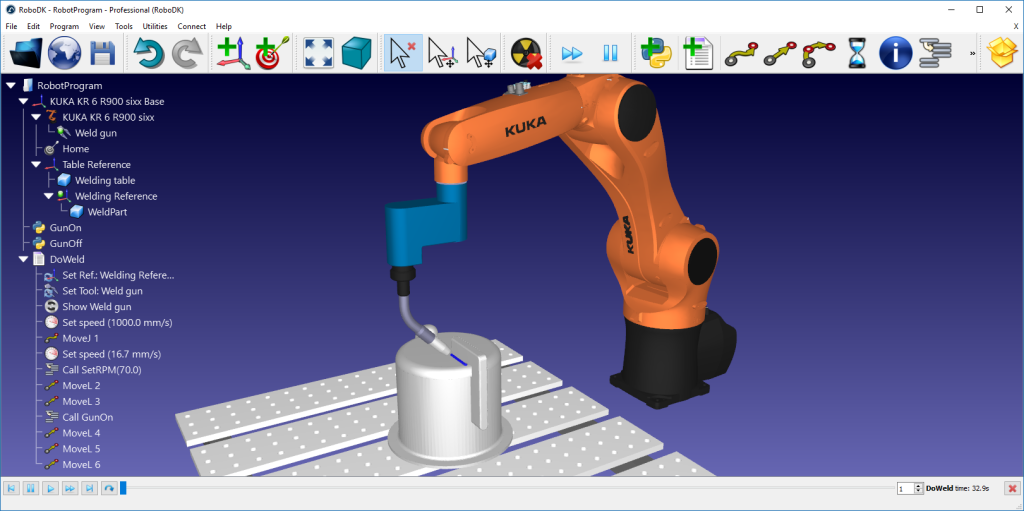
One of RoboDK’s strengths is its versatility – the software is applied in a wide range of industries and robotic applications. Essentially, any task that an industrial robotic arm can perform can be simulated and programmed using RoboDK’s CAD/CAM environment. Common application areas include:
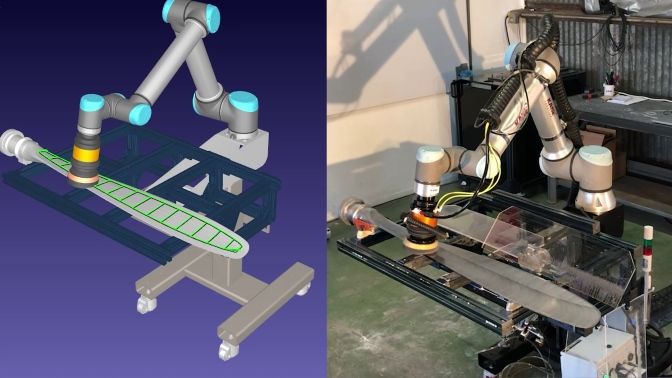
- Machining and Material Removal: RoboDK is frequently used for robot milling, drilling, and trimming processes. Users can generate complex toolpaths (e.g. sculpting or CNC-like operations) and then use RoboDK to convert those paths into robot motion programs. This has enabled projects like artistic sculpture carving – for example, a New York design studio used RoboDK to program robots that carved large statues for Spotify’s RapCaviar Pantheon art installation. In manufacturing, companies use RoboDK to mill patterns, polish molds, and even carve wood or stone with robotic arms instead of traditional CNC machines.
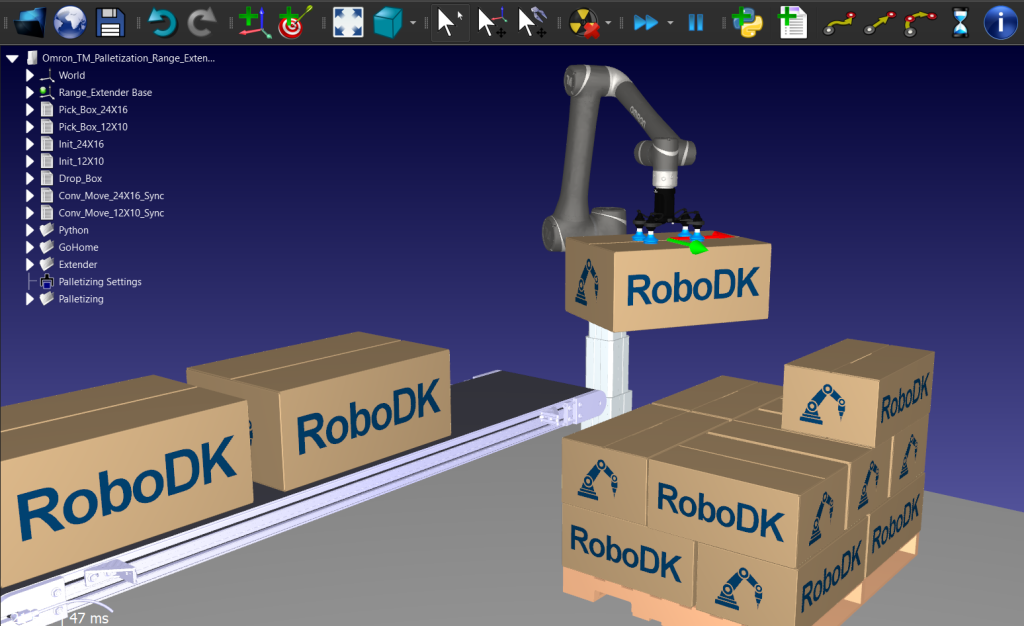
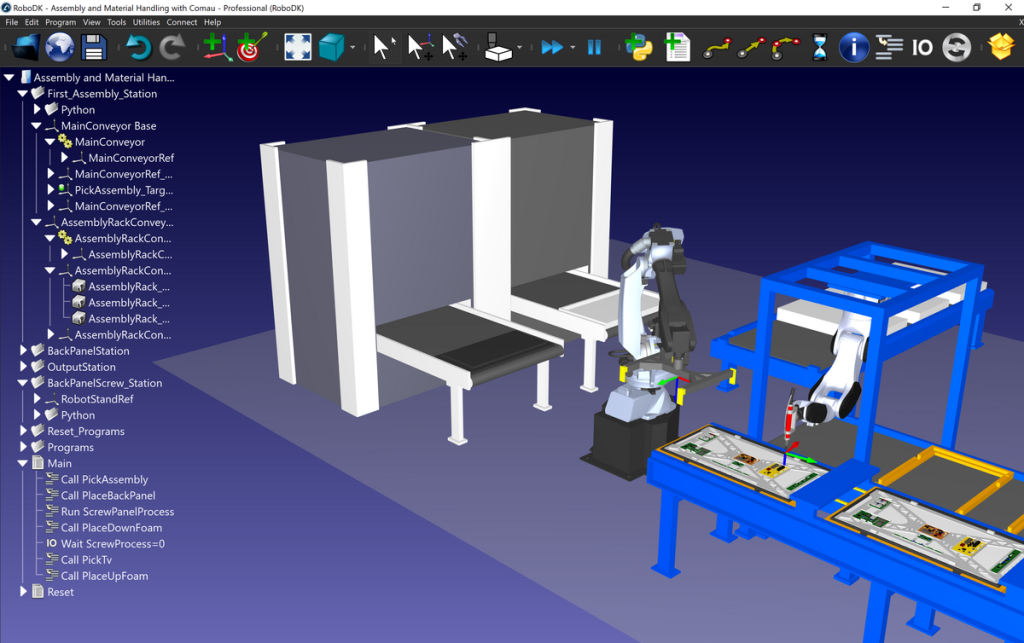
- Welding, Painting, and Assembly: Traditional robotic tasks in factories, such as arc welding or spray painting, are fully supported by RoboDK’s simulation toolkit. The software allows engineers to optimize robot paths for painting complex surfaces or welding along intricate joints, all in a virtual cell that can include conveyors, positioners, and other peripherals. Assembly and pick-and-place applications are also configured and tested in RoboDK, which helps integrators verify reach and cycle times before installing equipment on a production line. A notable automotive project involved RoboDK in simulating assembly line robots for a Mercedes-Benz manufacturing scenario, where an integration partner (RobCo S.W.A.T.) combined RoboDK with CAD tools to plan robot stations for car assembly and painting tasks.
- 3D Printing and Additive Manufacturing: As robots are increasingly used as motion platforms for 3D printing, RoboDK has found a role in generating deposition paths and controlling robots for additive manufacturing. Its CAD-to-path features enable slicing a CAD model and converting it to robotic extrusion or welding paths for printing large structures.
- Inspection and Quality Control: RoboDK can simulate inspection processes, using robots equipped with cameras or sensors. A high-profile example is its use by NASA – in 2017, a team at NASA Langley Research Center developed an automated system for aircraft fuselage inspection using a Universal Robots arm programmed offline with RoboDK. RoboDK’s simulation was crucial for planning the optimal scan patterns. By 2019, NASA expanded this to a dual-robot system for more advanced non-destructive testing of airplane parts, again leveraging RoboDK to coordinate multiple robots and external axes in sync.
- Calibration and Metrology: The software includes calibration tools that help users improve a robot’s accuracy by calibrating joint parameters and tool center points. RoboDK’s Robot Calibration module (introduced in 2015) uses external measurement devices to achieve up to 10× better accuracy in robot positioning. This is valuable for applications like machining and inspection where precision is critical. Many companies have used RoboDK to calibrate robots – indeed, RoboDK’s very first customer back in 2015 used it to calibrate an ABB robot for a milling operation.
- Research and Education: Universities, training centers, and R&D labs are also key users of RoboDK. Because of its affordable licensing and support for many robot types, it has become a popular teaching tool for robotics courses. Students can learn robot programming in a safe virtual environment. The company offers a free trial and educational licenses, making it accessible to academia. As of 2025, RoboDK reports thousands of educational users worldwide, contributing to its mission of making robotics knowledge widespread. Even robotics hobbyists and smaller startups have leveraged the software to prototype automation concepts before investing in physical robots.
Beyond these, RoboDK has powered some unusual and innovative uses of robots. In the art world, it enabled the “Dark Factory Portraits” project, where artists Rob and Nick Carter programmed a robot (using RoboDK) to paint fine art portraits without any vision system – a creative exploration of robotic art. In aerospace maintenance, Texas-based company Wilder Systems built the world’s first robotic airplane “drive-through” wash station with the help of RoboDK’s programming; two Fanuc robots on rails were programmed to wash an aircraft fuselage autonomously, cutting a tedious 16-person-hour manual task down to under an hour.
Such examples underscore how flexible the software is, enabling robotics in domains that might not have used industrial robots before.
History and Product Evolution
RoboDK’s journey began at the ÉTS CoRo (Control and Robotics) Laboratory in Montreal. Albert Nubiola, while working on his doctorate, was the lead developer of a research project called RoKiSim – a multi-platform tool for 3D robot simulation. Seeing the potential to turn this into a commercial product, Nubiola launched RoboDK as a company in January 2015 with support from the lab. The young startup received its first validation when a manufacturer in New Zealand adopted RoboDK in 2015 to solve a complex robot milling calibration problem. From that point, RoboDK steadily evolved its software and expanded its user base around the globe.
In its early years, the company focused on covering the rapidly growing variety of industrial robots on the market. At launch in 2015, RoboDK’s robot library included about 200 models from 20 manufacturers; by 2020 it had grown to 500+ models from 50 manufacturers, and today it exceeds 1,000 models from 80–90 brands.
This aggressive expansion of supported robots has been key to its brand-independent appeal. “RoboDK is designed to enable companies to simulate and program any robot with one piece of software at an affordable price. Keeping that promise means we regularly update our library to incorporate the latest industrial robots,” explained co-founder Lauren Ierullo during the company’s 5-year anniversary. To manage this growth, RoboDK built a team and partner network to continually add new robot definitions and post-processors (the code that translates generic paths into brand-specific robot code).
Alongside broadening robot support, RoboDK introduced new features and modules at a rapid pace. Here is a timeline of notable milestones in RoboDK’s product evolution over the decade:
- 2015: Company founded in Montreal; first version of RoboDK released. Secured initial customers and proved the concept of affordable offline programming. Started with core features like robot kinematics, basic simulation, and code generation for major robot brands.
- 2016–2017: Focus on improving simulation fidelity and working closely with early adopters. By 2017, RoboDK’s software was robust enough to be used in a NASA project for automated inspection. The company began collaborating on advanced use-cases, validating features like multi-robot synchronization.
- 2018: Introduced dedicated CAD/CAM plugins. RoboDK rolled out add-ins for popular CAD/CAM software such as SolidWorks, Mastercam, Autodesk Inventor, and Fusion 360. These plugins allow engineers to export toolpaths from their CAD/CAM environment directly into RoboDK with a click, facilitating robot machining applications. The same year, RoboDK added an automated robot drilling solution to its feature set, expanding into complex manufacturing processes.
- 2019: Enhanced simulation realism. New capabilities included automatic collision detection (helping users avoid robot crashes in simulation) and even virtual reality (VR) support to visualize robot cells with VR headsets. Around this time, NASA unveiled a dual-robot tomography inspection system programmed with RoboDK, demonstrating the software’s ability to handle coordinated robots and custom kinematics.
- 2020: Expanded platform availability. Notably, RoboDK launched versions for mobile and embedded systems – becoming the only mainstream robot simulation software to run on Android and iOS devices (as well as single-board computers like Raspberry Pi). While mobile versions are lightweight, they showcased RoboDK’s commitment to accessibility and innovation, allowing students or engineers to carry a robot simulator in their pocket. Also in 2020, as the company marked five years, it reported having over 30,000 active users across 15 countries, a testament to the global demand for its solution.
- 2021: Launch of TwinTrack, a novel programming-by-demonstration tool. TwinTrack uses an off-the-shelf laser tracker device to record an operator’s hand movements and convert them into robot paths. This “teach by guiding” approach lets users program a robot by simply moving a pointer along a desired trajectory in space – RoboDK records the motion and generates the corresponding robot program. TwinTrack was a significant innovation for intuitive robot programming and creating digital twins of manual operations.
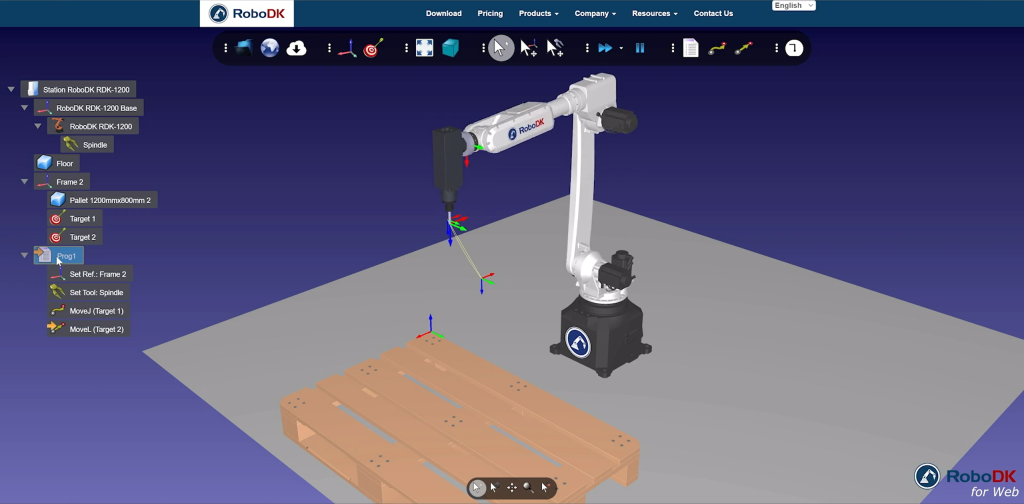
- 2022: Introduction of RoboDK for Web. To further lower barriers, RoboDK released a web-based version of its simulator. This cloud application runs in a browser with no installation needed, offering a lighter-weight option for sharing projects or giving demonstrations remotely. Although not as full-featured as the desktop app, RoboDK for Web embodied the company’s push toward flexibility and ease of access.
- 2023: Establishment of the RoboDK Add-In Marketplace. In 2023, RoboDK opened an online marketplace for user-contributed plugins and extensions to the software. This allowed the growing community of RoboDK users and developers to create custom add-ins (for example, integrations for specific hardware, specialized programming tools, or new UI features) and share them. By 2025, the marketplace features over 50 add-ins, expanding RoboDK’s ecosystem and tailoring it to niche applications. Also in late 2023, RoboDK released TwinBox – a compact industrial PC pre-loaded with RoboDK, designed to serve as a dedicated controller or edge device for running robot programs on the shop floor. TwinBox helps integrate RoboDK into production environments for real-time monitoring and control.
- 2024: Reached the milestone of supporting 1,000+ robot models in the library, reflecting the explosion of new robot types (including collaborative robots and emerging manufacturers) in the market. In early 2024, RoboDK announced a prominent partnership with Italian robot maker Comau, integrating RoboDK’s simulation engine into Comau’s own programming software. This marked the first time RoboDK became an embedded solution for an original robot manufacturer’s platform, underscoring its maturity as a technology provider.
- 2025: Celebrating 10 years, RoboDK continues to innovate with an eye towards artificial intelligence features. The company has hinted at developing AI-driven capabilities for automatic path optimization, smarter collision avoidance, and even autonomous robot programming suggestions in future releases. The team also remains focused on expanding hardware support (both new robots and peripherals like grippers or external axes) and enriching its marketplace ecosystem.
Throughout this evolution, RoboDK has stayed true to its founding vision. Every new feature or product has been aligned with making robotics easier to adopt. “As industrial robotics evolves, so does RoboDK,” Nubiola said in 2020. “We want to empower our customers with the latest post processors, calibration tools and essential plugins – all at a cost that’s several times lower than that of our competitors.”
Those competitors traditionally include large proprietary software suites often tied to specific robot brands or very expensive standalone simulation packages. By contrast, RoboDK from the start offered flexible licensing (including a free trial and affordable professional licenses) and a modular approach, attracting a loyal user base particularly among small and medium enterprises and integrators.
Business Growth and Metrics
From a two-person startup in 2015, RoboDK has grown into a globally recognized provider of robot programming software. Over the years, the company’s footprint has expanded significantly in terms of users and geographic reach, even while remaining relatively small in headcount. As of 2025, RoboDK is used by over 50,000 people in more than 50 countries worldwide. These users range from engineers at Fortune 500 manufacturers to students in university robotics clubs. Notably, the software has been downloaded and employed by both industrial end-users and system integrators on every inhabited continent, reflecting a truly global adoption.
In addition to its broad user community, RoboDK has established a network of partners and distributors around the world. The company counts over 90 partners spanning various countries – these include local resellers that provide sales and support in specific regions, as well as technology partners who collaborate on integrating RoboDK with other solutions. For example, RoboDK has partnerships with metrology companies like API and Creaform (to enhance its calibration offerings) and automation component suppliers. This partner network has helped RoboDK reach customers in regions where it doesn’t have a physical office, from Asia to South America. By working closely with distributors and OEM partners, RoboDK ensures that users in different countries have access to training and support in their local language, which has aided its international growth.
Despite its worldwide presence, RoboDK remains a lean organization. The company’s Montreal headquarters leads development and support, while a European office in Spain helps with EU customers. In total, RoboDK has on the order of 25 employees in 2025 – a testament to how a small, agile team can maintain a complex software relied on by tens of thousands. The company has largely bootstrapped its growth; according to business databases, RoboDK has not raised any institutional fundingto date, growing through reinvestment of its revenues. The firm’s annual revenue is modest but healthy for its size – on the order of $2 million USD per year as of the mid-2020s. This revenue comes from software license sales, maintenance and support contracts, and related services. RoboDK’s CEO has indicated that keeping the company independent and customer-funded has allowed them to focus on long-term product quality rather than external investor demands.
In terms of customer segments and geographical distribution, RoboDK’s user base is quite diverse. The industries most represented among RoboDK users include automotive manufacturing, aerospace, electronics, academic research, and robotics system integration services. Geographically, strong user communities exist in North America and Europe (especially in countries known for manufacturing or robotics, like the United States, Germany, France, Spain, and Italy). RoboDK has also seen growing adoption in Asia-Pacific, with users in countries such as China, Japan, India, and Australia, often via its distributor partners. The company’s outreach and tutorials have been translated into multiple languages, further fueling uptake in non-English-speaking markets.
Another metric highlighting RoboDK’s impact is its online following and community activity. The company’s forum and YouTube channel host thousands of discussions and tutorial videos, showing an engaged community of robot enthusiasts and professionals exchanging tips. On LinkedIn, RoboDK’s page has over 60,000 followers, reflecting significant interest in its updates and content. This community-driven growth has been a key part of RoboDK’s strategy – many improvements to the software have been spurred by user feedback and open dialogue with robotics engineers using the tool in the field.
Partnerships, Collaborations, and Industry Relationships
Rather than expanding through mergers or acquisitions, RoboDK has grown via strategic partnerships and collaborative projects. The company has no known mergers or acquisitions in its history – it has remained an independent software vendor. Instead, it actively seeks partnerships that enhance its platform’s capabilities or reach. These partnerships fall into a few categories:
- Robot Manufacturers (OEMs): A landmark partnership was formed with Comau, an Italian robot manufacturer, in 2024. This collaboration integrated RoboDK’s simulation and offline programming features into Comau’s own RoboShop Next Gen software. For RoboDK, working closely with a major OEM not only validated its technology but also “solidified [the] presence in the OEM market” as an embedded solution. Comau robot users can now seamlessly use RoboDK’s engine for tasks like importing CAD models, planning paths, and simulating cells with multiple robots and external axes – directly within Comau’s environment. RoboDK’s CEO Albert Nubiola praised the partnership as “a pivotal moment for us… working together, we made advanced simulation more affordable”. The success with Comau may pave the way for similar collaborations with other robot makers in the future. Indeed, RoboDK’s brand-agnostic stance positions it as an attractive partner for any OEM that doesn’t have its own robust simulation software. (It’s worth noting RoboDK is also officially certified in programs like Universal Robots’ UR+ ecosystem, indicating a good relationship with leading cobot manufacturers.)
- CAD/CAM and Software Companies: RoboDK has partnered with makers of CAD/CAM software to streamline the workflow from design to robotic execution. For instance, in 2020 MecSoft Corporation (developer of VisualCAM and RhinoCAM) announced a partnership with RoboDK to let MecSoft’s CAM users easily export toolpaths for robotic milling. Similarly, RoboDK has worked with BobCAD-CAM on a plugin for robotic machining, and provides integrations for SolidWorks and Autodesk products. These collaborations essentially turn RoboDK into a bridge between the digital design world and physical robots on the shop floor. By teaming up with CAD/CAM vendors, RoboDK extends its reach to their customer bases and adds value by offering an end-to-end solution (design in CAD, simulate in RoboDK, execute on a robot).
- Automation Solution Providers: RoboDK often joins forces with specialized automation companies to deliver turnkey solutions. A good example is its collaboration with DIY-Robotics (a provider of pre-engineered robotic cells) and ATI Industrial Automation (a maker of robotic tool changers and sensors) to develop an easy-to-use robotic deburring cell. In that project, RoboDK’s software was the programming backbone that allowed clients to simulate and program the entire cell (robot + spindle + tool changer) for automated deburring and finishing tasks. This and similar joint efforts underscore RoboDK’s role as a component in larger automation systems. The software’s flexibility means it can be the “brain” behind various robotic workcells assembled by partner firms.
- Academic and Research Collaborations: Given its origin in academia, RoboDK has maintained ties to the research community. It is often involved in research projects where a robust, customizable robot simulator is needed. For instance, RoboDK’s API (which allows programming the software via scripting in Python, C#, etc.) has been used in projects exploring human-robot interaction and optimal task scheduling in manufacturing. The company’s staff have published technical guides and even academic-style articles on advanced features like realistic robot dynamics or integrating external sensor feedback. While not a formal partnership, RoboDK’s relationship with ÉTS Montreal’s CoRo lab continues in the form of knowledge exchange and recruiting talent – many RoboDK employees, including Nubiola, hail from that lab.
- Notable Customer Collaborations: Some of RoboDK’s most publicized collaborations are with its end-users on unique projects. We’ve already mentioned NASA’s and Wilder Systems’ work. Another interesting case was a project with a Spotify marketing team, where RoboDK was used to program robots that carved sculptures of musical artists. RoboDK also aided a collaboration with Mercedes-Benz via an integrator (RobCo S.W.A.T.) to validate robotic painting and assembly processes virtually before implementation. These case studies often turn into partnership-like relationships, as RoboDK’s engineers sometimes assist or tailor features for the customer’s needs, and in return gain insight into new use cases. The company proudly highlights such success stories to demonstrate the software’s capabilities and the collaborative ethos of its team. As Samuel Bertrand, RoboDK’s General Manager, put it: “Our focus is on working with our customers and our community to deliver practical solutions that fit their needs. RoboDK is making robotics a viable option for more people and industries with tools that are affordable and easy to use.”
In summary, partnerships have been vital to RoboDK’s strategy – they extend the software’s integration with hardware, enhance its functionality, and expand its market presence without large marketing spend. By collaborating with established industry players (whether a robot manufacturer or a software firm), RoboDK multiplies its reach. The company’s ability to remain neutral (not tied to one brand) and its technical adaptability make it a sought-after partner in many robotics initiatives.
Innovations and Unique Features of RoboDK
RoboDK has distinguished itself in the competitive arena of robot simulation software through continuous innovation and a clear focus on user needs. Here are some of the unique features and strengths that define the RoboDK system:
- Brand-Independence and Extensive Robot Library: Perhaps RoboDK’s most noteworthy feature is its vast and ever-growing library of robot models. It supports robots from over 50 manufacturers, encompassing more than 50,000 different robot configurations when you consider various models and controller versions. This manufacturer-agnostic approach is unrivaled – the company proudly notes that it supports more robot brands and models than any other publicly available robotics software library. The practical benefit is that a user can invest time learning RoboDK and then apply those skills to virtually any robot they encounter. Integrators especially appreciate this, as they can use one software platform for programming different clients’ robots regardless of brand. The library includes everything from tiny 4-axis SCARA robots to large 6-axis manipulators and even collaborative robots and parallel (delta) robots. Each robot definition comes with a kinematic model and a post-processor for generating native code. This universal compatibility fulfills RoboDK’s vision of being a “single, unified platform” for all robots.
- Offline Programming and CAD-to-Path Workflow: RoboDK excels at Offline Programming (OLP) – creating and validating robot programs without needing the physical robot online. By simulating robot movements on a virtual model of the cell, RoboDK helps users fine-tune programs and ensure there are no crashes or reach issues, all before any real robot moves. This greatly reduces production downtime since new programs can be tested virtually. The software includes tools to import CAD models (of parts, fixtures, tooling) and then program the robot relative to those models. For example, a user can import a 3D model of a workpiece and generate a path along its surface (such as a trim cut or a painting stroke) using RoboDK’s CAD-to-Path utility. This integration with CAD data is very powerful – it means even complex curved paths can be translated into robot motion accurately. And thanks to its plugin ecosystem, RoboDK can pull toolpaths directly from CAD/CAM environments, blending into existing design workflows at manufacturers. All of this makes for a smoother digital thread from design to robotic fabrication.
- Advanced Simulation Capabilities: Over the years, RoboDK has added high-end simulation features that were once found only in more expensive systems. It can simulate multiple robots working together, complete with coordinated motion (useful for applications like dual-arm assembly or multi-robot machining). It also supports simulation of robots with external axes (like a robot on a linear track or using a rotating indexing table), expanding the range of processes users can model. Features like collision detection automatically highlight any interference between robot, tool, workpiece, or cell components, so that users can adjust paths and avoid downtime or damage. RoboDK even integrated Realistic Robot Simulation (RRS) modules for certain brands (e.g., through the Comau partnership) to get highly accurate cycle time and joint-level motion estimates. In addition, the inclusion of VR and connectivity to PLCs/sensors means users can create digital twins of their robotic cells and interact with them in real-time for testing. Despite packing these capabilities, RoboDK maintains a relatively lightweight and user-friendly interface – it runs on a standard PC without requiring specialized hardware, and its UI is generally regarded as intuitive even for those without programming backgrounds.
- Robot Calibration and Accuracy Tools: A standout offering from RoboDK is its focus on robot calibration and accuracy enhancement. Through its RoboDK Calibration module and the hardware kits it supports, users can measure their robot’s actual parameters and update the digital twin for more precise programming. This is crucial for high-precision tasks like machining or drilling, where a robot’s inherent positioning error could cause defects. RoboDK provides routines to calibrate a robot’s joint lengths, tool center point (TCP), and even cell reference frames using measurement devices (such as laser trackers or portable CMM arms). The result is a calibrated model that improves the absolute accuracy of robotic motions by an order of magnitude in some cases. Few affordable simulation packages offer this kind of integrated calibration solution – it has been a differentiator for RoboDK, especially in markets like aerospace manufacturing where precision is key. The company also introduced TwinTool, a simple tool calibration system using a laser distance sensor, which allows users to automatically find a tool’s exact length and orientation in minutes. This attention to accuracy helps bridge the gap between simulation and reality, making sure what’s simulated in RoboDK matches what the robot does on the floor.
- Programming by Demonstration (TwinTrack): Another unique innovation is RoboDK’s TwinTrack feature. Launched in 2021, TwinTrack leverages an off-the-shelf laser tracking device to record human motion and translate it into robot instructions. In practice, a person can use a handheld probe or even just move the robot’s tool flange by hand, and the system captures the trajectory with high precision. RoboDK then generates a smooth robot program that follows that taught path. This approach, often called “programming by demonstration,” lowers the skill required to program complex paths – a skilled craftsman could guide the robot along a desired path (like welding a custom seam or painting a unique pattern), and RoboDK would convert it into an automated routine that the robot can repeat. It’s an elegant merging of human expertise and robotic consistency. TwinTrack showcases RoboDK’s willingness to incorporate emerging technologies (in this case, metrology hardware) into its ecosystem for the benefit of users.
- Extensibility and Community Add-Ins: With the introduction of the Add-In Marketplace, RoboDK opened its platform for external developers. The software has a well-documented API, and many users have created custom scripts or plugins for specific needs. Now those extensions can be shared easily, from simple tools like user-interface tweaks to integrations with other enterprise software. This community-driven extensibility means RoboDK can adapt faster and serve niche applications without everything being developed in-house. It also fosters a community of robotics developers around the product. In interviews, RoboDK team members have expressed excitement about this, noting that allowing users to create and share their own add-ons “opens the door for… in-demand tools that benefit everyone, fostering collaboration and innovation within our user base.” In essence, RoboDK is not just a static tool, but a growing platform that others can build upon, which is a strategic strength in the evolving landscape of Industry 4.0 software.
- Cost and Accessibility: A practical but important strength of RoboDK is its pricing model. Traditional robotic simulation software from big industrial vendors has a reputation of being extremely expensive – often costing tens of thousands of dollars per license annually. RoboDK dramatically undercuts those costs (its exact pricing varies, but it is on the order of a few thousand dollars for a professional license, with options for time-limited or feature-limited versions). For what it offers, this is seen as highly cost-effective. The availability of a free trial and even a free version for small projects allows companies to test out and see returns before committing budget. This affordability has been a conscious part of RoboDK’s strategy to “make the return on investment of robots more attractive to users”, as CEO Albert Nubiola noted. The company also doesn’t charge extra per robot brand or application – one license covers all features and all brands, which is not always the case with competitor tools. By lowering software costs, RoboDK makes deploying a robot cell more economically feasible, especially for small businesses or new automation adopters. In line with this, RoboDK aims to be easy to learn, providing extensive documentation and tutorial videos freely on their website and YouTube channel. Users have access to manuals, example projects, and a responsive forum without additional cost, building good will and user self-sufficiency.
With these strengths combined, RoboDK has carved out a unique position in the market. A software developer from the RoboDK team summed it up: “RoboDK stands out by supporting a vast number of robots with the ability to simulate, program, and control them — offering unparalleled capabilities in the industry.”
This broad capability, paired with a nimble, customer-centric development approach, explains why RoboDK has achieved wide adoption in just ten years, going from an academic project to a go-to solution for robot simulation across industries.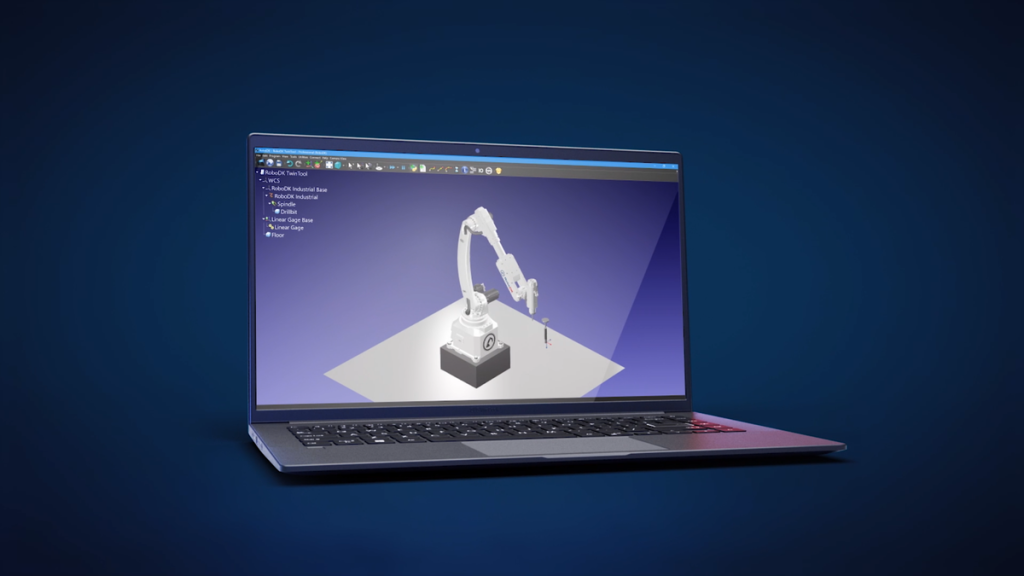
Leadership, Culture, and Vision
The trajectory of RoboDK is also a story of the leadership behind it and the company culture that has fueled its innovation. CEO Albert Nubiola has been a driving force with a clear vision: to “build a software platform where users can program any robot arm using the same software, democratizing robot simulation and programming”.
By all accounts, Nubiola’s hands-on expertise in robotics (he holds a PhD in the field) and entrepreneurial spirit set the tone for RoboDK’s product-first philosophy. He is often directly engaged with customers and the community, listening to feedback and even answering technical questions on forums. This close contact with end users has helped RoboDK stay aligned with what the robotics market is looking for.
Within the company, a culture of collaboration and continuous learning prevails. RoboDK prides itself on being a Canadian startup with a very international team – hiring specialists from around the world to bring diverse knowledge. Employees have highlighted the trust and flexibility at RoboDK. “Everyone’s ideas are valued, and [the] atmosphere not only enhances productivity but also encourages us to innovate and grow together,” one RoboDK software developer, Yann Mack-Veilleux, shared on the occasion of the 10-year anniversary. This kind of open culture has likely contributed to the company punching above its weight in terms of creativity and output. The small team operates more like a tight-knit lab pushing boundaries than a corporate machine, which makes sense given its lab spin-off roots.
The leadership also extends to how RoboDK interacts with the robotics industry at large. The company often publishes blog posts, webinars, and how-to guides that educate about robotics in general, not just promoting its own product. For example, Nubiola has written about the differences between robot arms and CNC machines, dispelling myths about programming robots for machining. By acting as thought leaders, RoboDK’s team members build credibility and trust in the community. They frequently attend and present at industry trade shows (such as Automate, Automatica, and FABTECH) to demonstrate new features and share knowledge on offline programming best practices.
Looking ahead, RoboDK’s leadership is focused on emerging trends that could shape the next decade of robot software. One clear direction is leveraging artificial intelligence and machine learning to automate more of the robot programming process. This could mean RoboDK eventually offering AI-driven suggestions for optimal robot movements or automatic error correction. They are also watching the rise of collaborative robots and ensuring RoboDK remains the go-to platform for programming cobots safely and efficiently. Another aspect of the vision is to keep lowering the barrier to entry – possibly via more cloud-based offerings or simplified user interfaces for non-experts. In a recent reflection, CEO Albert Nubiola advised companies, “Automating manufacturing applications is far easier and cheaper if you combine the right tools and involve the right people. With RoboDK, even the trial version, it is easy to perform feasibility studies to understand what you can do with your robot or choose the right robot for your application. We aim to keep adding new software products and integrations to make automation even easier and enable advanced manufacturing applications.” This statement encapsulates RoboDK’s mission-oriented approach: it’s not just selling software, but trying to empower more people to successfully use robots.
As for the company’s business vision, RoboDK seems content to remain independent and grow organically, focusing on customer satisfaction. There is still ample room in the global market for growth – many potential users in developing markets have yet to adopt offline programming tools. RoboDK’s affordable model positions it well to capture those new adopters as industrial robotics continues to spread worldwide. At the same time, the company will face competition from both established automation giants (who are making their software more user-friendly) and new startups leveraging cloud and AI. Staying ahead will likely require the same formula that got RoboDK this far: relentless improvement, responsiveness to users, and maintaining the agility of a startup even as its reputation soars.
Conclusion
From its humble beginnings as a university project to its current status as a globally used CAD/CAM robot programming system, RoboDK exemplifies how innovation and a clear mission can transform an industry niche. In the span of ten years, the company has helped democratize robotic simulation, putting powerful automation tools into the hands of engineers, students, and creators who might otherwise be kept out by high costs or technical complexity. RoboDK’s software has enabled manufacturers to prototype and deploy robot solutions faster and cheaper – often making the difference in achieving a positive ROI on automation. Its impact is visible in factory floors where downtime for programming has been slashed, in research labs where new robotic applications are being invented, and even in art studios where robots perform feats of creativity.
As of 2025, RoboDK stands at a crossroads of opportunity. The robotics sector is booming with no sign of slowing: more companies are seeking flexible automation, and skills shortages are driving demand for easier programming methods. RoboDK is well-positioned to address these needs with its brand-agnostic platform and growing ecosystem. The next chapters for RoboDK will likely involve deeper integration of intelligence into the software, wider industry partnerships, and perhaps branching into related domains (such as robot fleet management or augmented reality for robot teaching). If the past is any guide, the team behind RoboDK will approach these opportunities with the same ethos they started with – focusing on practical, user-driven innovation to keep robotics accessible.
For those in the manufacturing and tech community, RoboDK’s journey offers an inspiring case study of a startup making a global impact in a specialized field through dedication to its mission. It shows that even in a space dominated by large industrial vendors, a small company with the right vision and execution can rise to prominence by solving real problems for users. As RoboDK’s story continues to unfold, one can expect it to remain a key contributor in shaping the future of robotic automation, living up to its goal of enabling anyone, anywhere to leverage the power of robots.
Vendor: RoboDK