
Robotmaster CAD/CAM: A Comprehensive Overview of a Robotic Programming Innovator
The information is currently being reviewed and updated. If you notice any errors or inaccuracies, please let us know.
General Overview
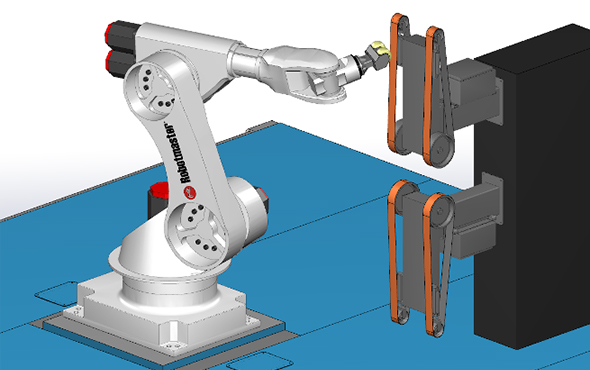
Robotmaster is an advanced CAD/CAM-based offline programming software for industrial robots, designed to make robot programming faster and easier. Instead of manually teaching robots every point of a motion (a traditionally time-consuming process), Robotmaster enables users to program robotic tasks on a computer using familiar CAD/CAM tools. The software automatically converts CAD designs and toolpaths into robot control code, while optimizing the robot’s movements and detecting issues like collisions or reach limits. This significantly streamlines the process of programming complex jobs.
Robotmaster’s vendor is Hypertherm Associates, a U.S.-based manufacturing technology company. Robotmaster originally emerged from a Canadian software firm but today is one of Hypertherm’s key software offerings, reflecting Hypertherm’s broader portfolio of industrial cutting and automation solutions. As a Hypertherm brand, Robotmaster benefits from the company’s global resources and reputation in the industrial manufacturing arena. In summary, Robotmaster provides a powerful yet user-friendly platform that bridges the gap between design and robotic execution, allowing even non-experts to program robotic systems efficiently.
Application Areas and Industries
Robotmaster is used across a wide range of application areas, essentially any task that an industrial robot can perform with a tool. Common processes programmed with Robotmaster include welding, cutting, trimming, milling, grinding, sanding, deburring (edge smoothing), polishing, painting and spray coating, dispensing of materials (such as sealants or adhesives), and even additive manufacturing (robotic 3D printing). The software’s strength lies in its versatility: a single programming environment can handle multiple types of robotic operations. For example, a manufacturer can use Robotmaster to program a robot for precision cutting one day and for welding assembly the next, all within the same interface. By automatically optimizing paths and tool orientations, Robotmaster helps ensure each of these processes is executed with high accuracy and efficiency.
Because of this flexibility, Robotmaster has been adopted in numerous industries. In the automotive industry, integrators use it to program robotic welding of car bodies, laser cutting of metal components, and trimming of plastic or composite parts. The aerospace sector employs Robotmaster to program robots for tasks like machining and drilling composite airframe parts, precision trimming of jet engine components, and painting of aircraft panels. Metal fabrication and machinery companies use Robotmaster for cutting, grinding, and finishing metal parts, while furniture and timber manufacturers have used it for robotic sanding and carving of wood. In medical and prosthetics production, the software helps program robots to mill custom prosthetic devices and to trim orthopedic implants accurately. The energy sector and transportation manufacturers use Robotmaster for tasks such as cutting and welding large structures (e.g. wind turbine components or railcar parts). Even niche areas like stone cutting (using robots to sculpt or cut stone) and orthotics have seen Robotmaster in action.
Essentially, any industry that relies on robots to perform precise, multi-axis operations can benefit from Robotmaster. The software’s broad support for different robot brands and applications means it is not tied to a single niche – it is equally at home in an automotive factory or a small job shop making custom art pieces. This wide applicability has made Robotmaster a go-to solution for companies seeking to expand automation beyond simple pick-and-place into more complex, value-added processes.
History and Evolution
Robotmaster’s story begins with a vision in the mid-1990s. Jabez Technologies, a Montreal-based company, was founded in 1996 by mechanical engineer Chahe Bakmazjian with the goal of simplifying robotics programming. By 2001, Jabez was experimenting with the idea of using CAD/CAM software – which was traditionally used for programming CNC machine tools – to program robotic arms. At that time, the prevailing method for programming industrial robots was to manually “teach” points to the robot or use very basic vendor-specific tools, which was laborious. Jabez developed a prototype that could take tool paths from a CAM system and translate them into robot motions. In 2002, the first version of Robotmaster was unveiled as a revolutionary product: it could convert Mastercam’s CAD/CAM toolpaths into robot programs automatically. This effectively allowed a programmer to use a familiar CAM interface (like one used for CNC milling) and apply it to a 6-axis robot, a leap forward for the industry.
The early success of Robotmaster confirmed that there was strong demand for easier robot programming. Over the next few years, Jabez Technologies continued to refine and expand the software. By 2003, Robotmaster was applied to program robots from major manufacturers such as FANUC, Motoman (Yaskawa), and Stäubli, demonstrating its brand-agnostic approach. In 2004, the software’s capabilities grew to better handle trimming and milling applications, which are common in industries like automotive plastics and aerospace components. New features were added yearly: in 2005, the team introduced advanced robot kinematics capabilities, allowing Robotmaster to intelligently handle the robot’s joint movements and avoid issues like singularities. Around this time, Jabez began using the term “CAD/CAM for Robots” to describe their solution – an idea that was novel enough that some in the industry initially claimed that integrating CAD/CAM with robotics was impossible. By proving it was not only possible but highly effective, Jabez and Robotmaster started to change minds about offline programming.
In 2008, Robotmaster introduced powerful optimization tools that could automatically refine a robot’s motion path to be more efficient and error-free. These optimization features, which let users visualize and tweak robot trajectories before running them, “put Robotmaster on the map” in the robotics community. The software could identify and fix errors (like collisions or joint limits being exceeded) in the virtual environment, saving a tremendous amount of trial-and-error on the factory floor. As a result, even as robots tackled more complex tasks, programming them did not require tedious manual adjustments at each step – Robotmaster handled much of that complexity behind the scenes.
Throughout the early 2010s, Robotmaster’s capabilities and recognition continued to grow. An interactive simulation environment called RISE (Robotmaster Interactive Simulation Environment) was released in 2013, giving users a more visual and intuitive way to program and validate robot paths. That same year, Robotmaster’s impact was acknowledged with the Game Changer Award for Motion Control at the RoboBusiness conference – a sign that the product was considered a breakthrough in robotics software. By 2014, CIO Review magazine named Robotmaster as one of the “Top 10 Engineering Design Solutions” and in 2015, as one of the “20 Most Promising Robotics Solution Providers,” highlighting the company’s influence in the field of robotic automation.
A pivotal moment in Robotmaster’s history came in 2015 when Hypertherm, Inc., an industrial cutting systems manufacturer based in New Hampshire, acquired Jabez Technologies. This acquisition marked Robotmaster’s transition from a small independent software product to part of a larger corporate family. Hypertherm, known for its plasma cutting equipment and industrial software, was expanding into robotics, and Robotmaster became the cornerstone of its new Robotic Software group. After joining Hypertherm, the Robotmaster team remained largely intact in Montreal (where development continued) while gaining access to Hypertherm’s global network and resources. The integration was smooth, with Jabez’s leadership and engineers continuing their work under Hypertherm’s umbrella.
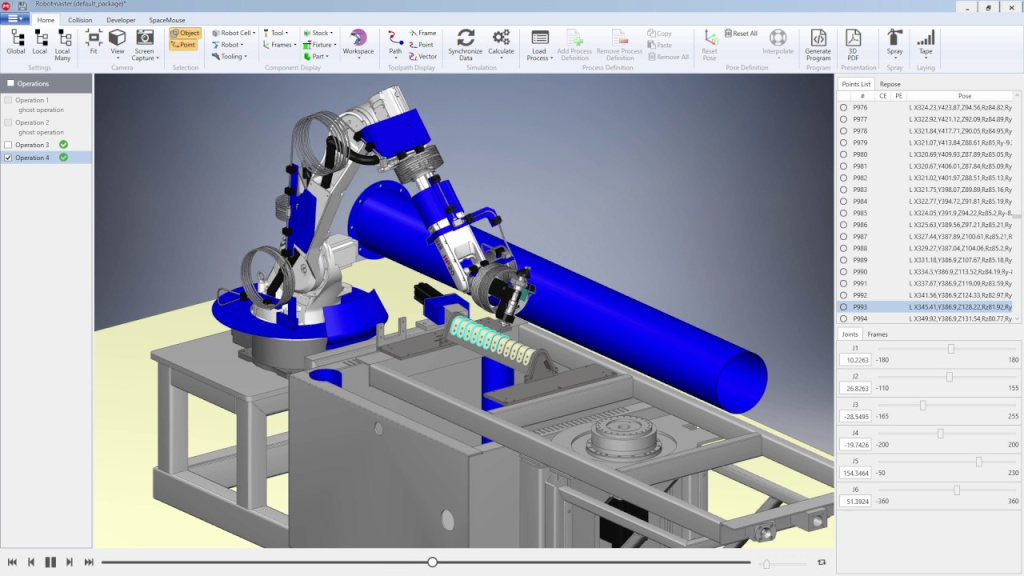
Post-acquisition, development of Robotmaster did not slow down – in fact, it accelerated. The latter half of the 2010s saw a major evolution of the product. By 2018, Hypertherm released Robotmaster Version 7 (V7), which was a completely redesigned platform built from scratch. This was a significant technological leap: whereas earlier versions of Robotmaster functioned partially as an add-on to existing CAM software (relying on Mastercam in its very early iterations), Robotmaster V7 was a standalone, fully independent system. It featured a modern, task-oriented user interface and architecture that did not require users to have separate CAD/CAM software knowledge. This new architecture was developed by expanding the Robotmaster engineering team – they brought in specialists in fields like mathematical optimization, simulation, and even gaming UX to make the software both powerful and easy to use. The result was a more intuitive, flexible Robotmaster capable of handling even multi-robot workcells in a user-friendly way.
Since the launch of V7, Robotmaster has continued to improve with regular updates. Hypertherm (which rebranded its corporate structure as Hypertherm Associates to encompass its various brands) has released new features such as enhanced material removal simulation, easier programming workflows, and tools to simplify multi-robot coordination. By the mid-2020s, Robotmaster is at the forefront of offline robot programming technology. It has evolved from a pioneering concept in 2002 into a mature, robust system used by companies worldwide. Its journey – from a startup’s bold experiment to an industry-leading solution under a major corporation – underscores the growing importance of software in unlocking the full potential of industrial robots.
Business Performance and Market Presence
As a privately held product line within Hypertherm Associates, specific revenue figures for Robotmaster are not publicly disclosed. However, several indicators show that Robotmaster has a strong and growing market presence. The software has been on the market for over two decades (since 2002) and during that time it has accumulated a global user base. Robotmaster is used by manufacturers, robot integrators, and automation specialists across North America, Europe, and Asia. The company built a network of distributors and integrator partners to reach customers worldwide. For example, as early as 2015 Robotmaster established a distributor partnership in Japan to support the NACHI brand of robots, reflecting its expansion into the Asian market. Today, it supports clients through partners in many regions, including Europe (where dedicated distributors market the software) and the Americas.
In terms of user adoption, Robotmaster’s appeal is broad: it has been implemented in small job shops with a single robot as well as large manufacturing enterprises running entire fleets of robots. The ease-of-use and time-saving benefits often translate into measurable productivity gains for users, which helps drive word-of-mouth and repeat business. One robotic systems integrator noted that using Robotmaster cut programming time by 50% or more for certain projects – such efficiencies are crucial in high-mix, low-volume manufacturing environments. While exact numbers of installations aren’t published, Robotmaster’s longevity and recognition in industry rankings suggest a significant install base. The inclusion of Robotmaster in CIO Review’s prominent provider lists, for instance, indicates it was among the top software choices for many companies in the robotics domain by the mid-2010s.
The backing of Hypertherm Associates further boosts Robotmaster’s business performance. Hypertherm is a sizable company in the industrial technology space, known for its cutting systems, with operations and customers around the globe. As of the 2020s, Hypertherm Associates employs roughly 1,800–2,000 people worldwide and has distribution in dozens of countries. Being part of this organization means Robotmaster can leverage Hypertherm’s global sales force, technical support infrastructure, and established relationships with industrial customers. This has likely increased Robotmaster’s geographic reach and the speed of acquiring new users. In addition, Hypertherm’s financial strength allows continued investment in Robotmaster’s R&D, ensuring the product stays competitive.
Robotmaster’s success can also be gauged by its longevity and continuous improvement. The software has sustained itself in the market for over 20 years – a notable achievement in the fast-evolving tech world – and it continues to receive major upgrades. This suggests a steady demand and a viable revenue stream backing the development. Moreover, its presence in high-profile industry trade shows (like Automatica in Germany, where new versions have been debuted) and frequent updates in press releases signal an active and engaged user community. While we lack exact revenue or number-of-user figures, it’s clear that Robotmaster has established itself as a leading solution in the niche of robot offline programming. Its combination of an expanded feature set and Hypertherm’s support positions it for ongoing growth as more manufacturers seek flexible automation solutions.
Mergers, Acquisitions, and Partnerships
Robotmaster’s corporate journey has been shaped by one major acquisition and numerous strategic partnerships. The most significant event was the acquisition of Jabez Technologies (the original creator of Robotmaster) by Hypertherm in August 2015. Hypertherm’s purchase of Jabez was motivated by the recognition that simple offline programming is a key enabler for wider use of robotics in manufacturing. By bringing Robotmaster in-house, Hypertherm aimed to marry its expertise in industrial cutting hardware with Jabez’s software innovation. The transaction was structured as an asset purchase (financial terms were not disclosed) and it resulted in the formation of Hypertherm’s Robotic Software group. Post-acquisition, Hypertherm kept Jabez’s Montreal office and team intact, indicating confidence in the existing leadership and talent. Chahe Bakmazjian, the founder of Jabez, continued to lead the Robotmaster team as part of Hypertherm, ensuring continuity. For Robotmaster, joining the Hypertherm familymeant access to greater resources and a global platform, while for Hypertherm it meant an entry into the broader robotics market beyond its traditional focus on cutting machines. This acquisition has proven beneficial on both sides, strengthening Robotmaster’s development and support, and expanding Hypertherm’s solutions portfolio.
Beyond that merger, Robotmaster has engaged in various partnerships and collaborations to extend its reach. One category of partnerships is with robot manufacturers themselves. From its early days, the Robotmaster team worked closely with major robot makers to ensure the software would support their models. As a result, Robotmaster today is compatible with most leading industrial robot brands (including ABB, KUKA, FANUC, Yaskawa Motoman, Universal Robots, Nachi, and others). While not formal mergers, these collaborations with OEMs involve sharing robot kinematic data, testing new robot models for compatibility, and sometimes co-marketing solutions. Such alliances are crucial for Robotmaster to remain a universal programming tool; for instance, when a new robot model or a new brand enters the market, Robotmaster often updates its software to include support, sometimes in partnership with that robot’s manufacturer or distributor. A notable collaboration was with Japan’s Nachi-Fujikoshi Corp: in 2015, Robotmaster announced support for Nachi robots, facilitated by a partnership with its Japanese distributor (Genetec Corp). By including Nachi, Robotmaster reached the milestone of supporting essentially all major robot manufacturers in the market, enhancing its appeal to integrators who may deal with multiple robot brands.
Another key form of partnership for Robotmaster is through authorized integrators and resellers. The company has built a global network of partners who are trained on Robotmaster and promote it as part of their automation solutions. For example, in Europe, firms like Intercam SA have been distributors of Robotmaster, bringing the software to customers in countries like Spain, France, and others. In North America, integrators such as Minnesota-based Sofos Robotics have become authorized partners; Sofos includes Robotmaster in the robotic systems they deliver to clients who need an easy programming solution. These partnerships are mutually beneficial: Robotmaster extends its market presence and gets real-world feedback, while the partners can offer a more complete package (robot hardware plus top-tier programming software) to end-users. In 2023, Hypertherm Associates highlighted the importance of such collaborations by officially announcing new partnerships, indicating that finding integration experts who can marry robotics hardware with Robotmaster software expertise is like “hitting the jackpot” for expanding their customer reach.
Robotmaster also collaborates through industry associations and events. It has been a member of the Association for Advancing Automation (previously the Robotic Industries Association) since 2007, engaging with the broader robotics community. This involvement helps in staying ahead of industry trends and forging connections with both technology partners and potential clients. At trade shows and automation expos, Robotmaster often appears alongside robot manufacturers in joint demonstrations – another form of informal partnership where the synergy of hardware and software is showcased.
In summary, apart from the major acquisition by Hypertherm, Robotmaster’s strategy for growth heavily relies on partnerships: integration with virtually all robot brands, and a network of distributors and integrators worldwide. These collaborations ensure that Robotmaster remains compatible with the latest robotic technologies and is accessible to customers in various regions through trusted local partners. They have been essential in solidifying Robotmaster’s position in the market as a hardware-neutral, widely supported solution for offline robot programming.
Innovations, Unique Features, and Strengths
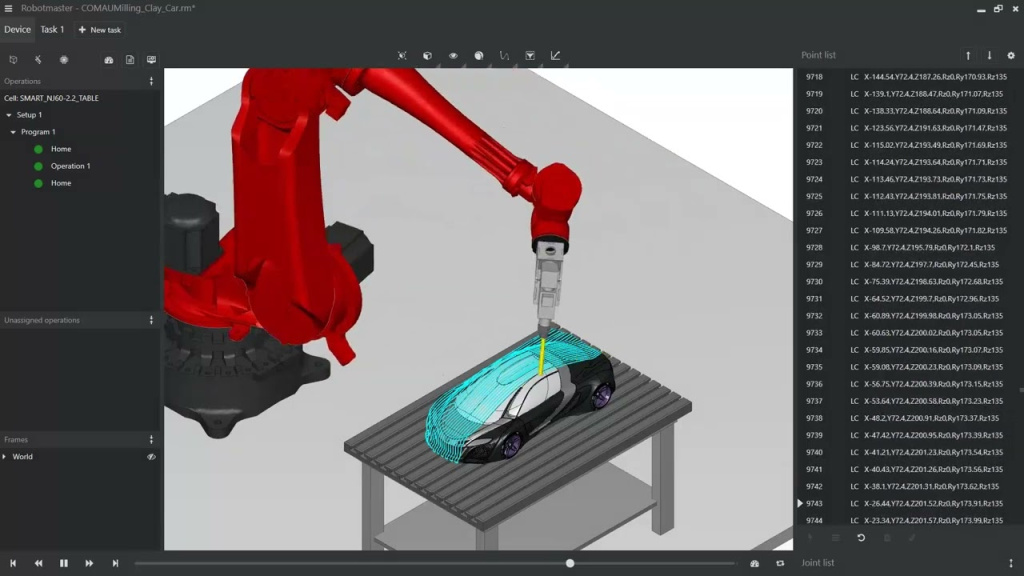
Robotmaster’s rise to prominence has been driven by a series of innovations and unique strengths that distinguish it from traditional robot programming methods and competing software. One of its fundamental innovations was being one of the first CAD/CAM-integrated robot programming systems. In the early 2000s, this was a radical idea – leveraging the mature technology of CAD/CAM (Computer-Aided Design and Manufacturing) and bringing it into the robotics world. This integration meant that a user could program a robotic arm in much the same way they would program a 5-axis CNC machine, using a graphical interface to create toolpaths on a 3D model of the part or workpiece. Robotmaster would then automatically translate those paths into the precise joint movements the robot needed to perform. The benefit of this approach is that it eliminated the need for point-by-point manual teaching of robots. Instead of jogging a robot to dozens or hundreds of points and recording each position (the old teach pendant method), a task expert could simply draw or import the desired path and let Robotmaster calculate the robot’s motions. This not only saved time but also opened robot programming to people who weren’t robotics experts – for example, a CAD/CAM programmer or machinist could now program a robot with relatively little additional training.
Another key strength of Robotmaster is its emphasis on automation and error avoidance in the programming process. The software is built to automatically detect common robot motion problems and resolve them. For instance, Robotmaster can identify if a certain movement would cause a robot to reach a joint limit or enter a singularity (a problematic configuration), and it can adjust the path or arm posture to avoid those issues. It can also flag potential collisions (such as the robot arm hitting a fixture or the part it’s working on) in simulation, so the user can correct them before sending the program to the real robot. This intelligent automation drastically reduces the trial-and-error that would otherwise be required. By 2008, when Robotmaster introduced enhanced optimization tools, it became possible for users to optimize an entire robotic job at the click of a button – the software would fine-tune the path for the best cycle time and fluid motion. These capabilities were far ahead of many competitors at the time and remain a strong selling point: Robotmaster produces error-free, optimized robot paths automatically, where other systems might require manual tweaking.
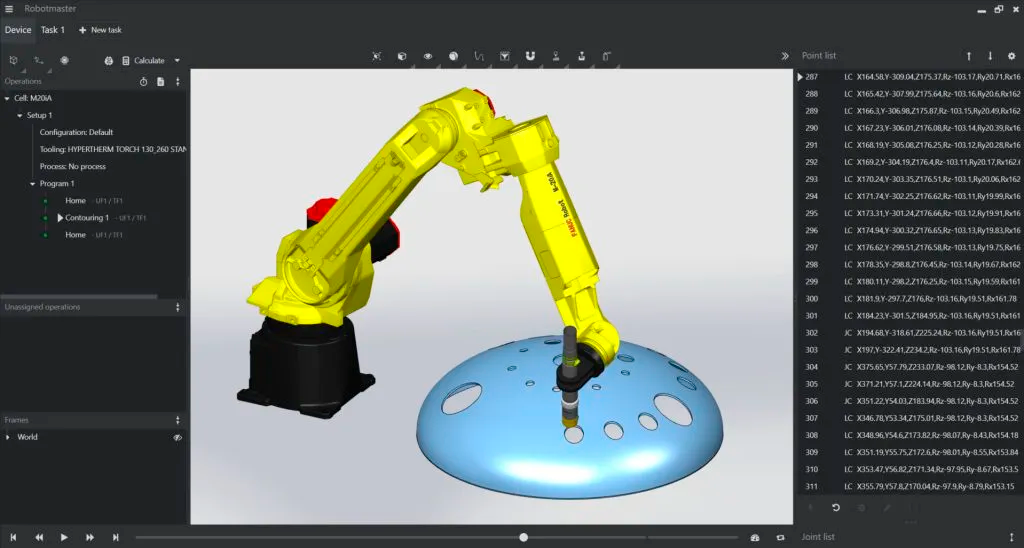
User experience and accessibility have also been areas of continuous innovation. Robotmaster’s developers have strived to create a system that can be used by novices without sacrificing the advanced options needed by experts. Over various versions, the interface was refined with features like an interactive 3D simulation environment (allowing users to play through the robot’s motion in a virtual cell and adjust on the fly) and context-sensitive guidance (to help users choose the right operations or parameters). The modern Robotmaster (Version 7 and onwards) introduced a slick, modern UI with an operation-focused workflow – meaning the software guides the user step-by-step through setting up a robotic operation, from defining the part and tool to generating the path and verifying it. One standout feature in recent releases is the orientation helper, which interactively shows whether a planned motion is feasible as the user adjusts the orientation, thus preventing errors in real time. Robotmaster also added a material removal simulator, which is especially useful for machining or trimming tasks: users can actually see a simulation of material being cut away by the robot’s tool, verifying that the end result matches the design intent.
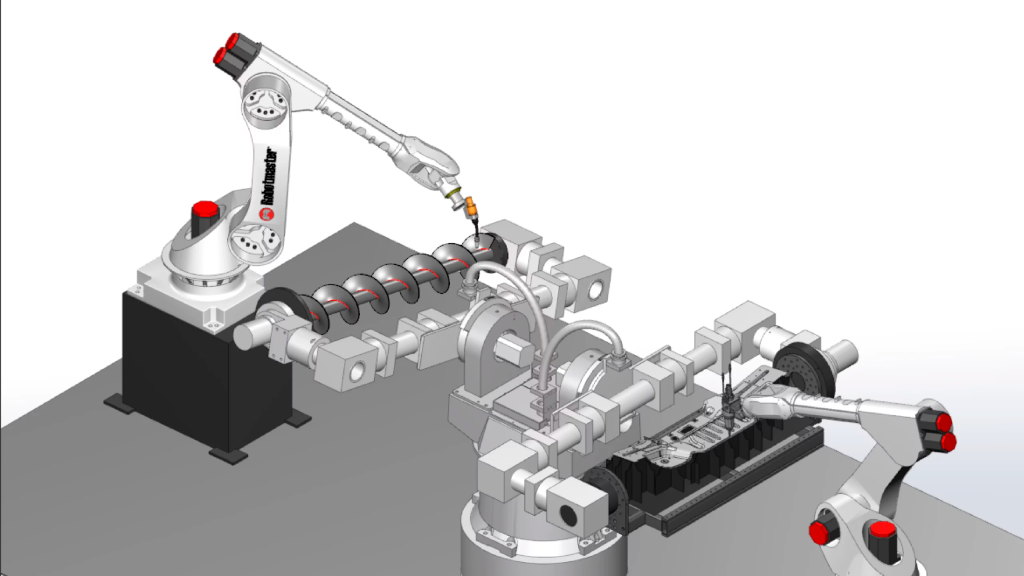
Perhaps the most significant innovation in Robotmaster’s newer generation is its support for multi-robot and multi-process workcells. As manufacturing cells grow more complex, a single cell might have two, three or more robots working in coordination, along with external axes or positioners. Historically, programming multiple robots to work together (without collision and with synchronized timing) is an expert-level challenge. Robotmaster’s new architecture tackled this by allowing multiple robots to be programmed within one project, with tools to coordinate their tasks. The software can, for example, allocate different portions of a job to different robots or manage tool hand-offs. Its “task-based” paradigm means you define the tasks and the system figures out how to distribute and schedule them among the available robots. Moreover, Robotmaster allows transferring a given job from one robot model to another with minimal reprogramming – an impressive flexibility in an industry where programs often had to be rewritten from scratch if you changed robot brands or models. This flexibility is an “industry first” that Robotmaster touts: it future-proofs a user’s programming effort by not locking it to a specific robot hardware.
Robotmaster’s strengths are also evident in its broad compatibility and integration capabilities. It can interface with numerous CAD file formats and CAM packages, allowing users to import toolpaths or designs from their preferred design software. It also supports output to a wide range of robot controllers, effectively speaking the “language” of each robot brand (post-processors for ABB Rapid code, FANUC LS code, etc.). This means a user can use Robotmaster as a one-stop platform for many different projects and robots, rather than using one software for one brand and a different one for another. The convenience and efficiency gains from this “single solution” approach are significant for integrators who might deal with many robot types.
In terms of innovation recognition, Robotmaster’s unique approach and features have garnered industry accolades, as mentioned earlier (Game Changer awards, etc.). But perhaps the best testament to its strengths is its user adoption – many companies that adopted Robotmaster have reported drastic reductions in programming time and a capability to take on more customized or complex jobs than they could before. By lowering the expertise barrier, Robotmaster lets manufacturers repurpose robots for new tasks quickly, which is crucial for high-mix production where changeovers are frequent.
In summary, Robotmaster’s innovations can be summed up in a few key points: automation of complex programming tasks, integration with CAD/CAM, ease of use for non-experts, and hardware-agnostic flexibility. These strengths make it a powerful tool in implementing flexible automation. Competitors exist in the offline programming space (some robot makers offer their own software, and there are other third-party tools), but Robotmaster’s long history of focusing on CAD/CAM integration and optimization has given it a reputation as a cutting-edge solution. For any company looking to maximize what their industrial robots can do, Robotmaster offers a combination of sophisticated algorithms and user-friendly design that is hard to match.
Leadership Perspectives
Company leaders have often spoken about Robotmaster’s mission and the evolving role of robotics in manufacturing. From the very beginning, the philosophy was clear that software would be key to unlocking robotics. “But an advanced robotic machine is only as good as the program it runs on,” observed Chahe Bakmazjian, Robotmaster’s founder and president. This early insight drove the company to focus on making robot programming as robust and capable as the hardware itself. Bakmazjian, who started Jabez Technologies in the 1990s, had a vision to expand what robots could do for industry. “The goal was clear; we wanted robots to interact with all kinds of applications that were once not served adequately, and we have been successful in achieving it,” he explained, reflecting on Robotmaster’s mission to extend robotics into new domains through better software. This vision of flexibility and ease-of-use guided Robotmaster’s development over the years.
The leadership at Hypertherm, the parent company, has echoed similar themes about the importance of robotics and how Robotmaster fits into a larger strategy. In 2015, when Hypertherm acquired the Robotmaster team, Hypertherm’s CEO highlighted the broader manufacturing trends that underscored the deal. “A growing trend toward lean and flexible manufacturing is resulting in the expanded use of robotics in our served industries. Manufacturers realize that robots are increasingly critical to producing higher quality products at a lower cost, and to achieving the speed and flexibility needed to remain competitive,” said Evan Smith, Hypertherm’s President and CEO, in a press statement at the time. He went on to affirm the strategic fit of Robotmaster, saying “Adding Jabez to the Hypertherm team will enable Hypertherm to bring even greater value to our robotic customers, and at the same time provide Jabez with the support and resources to achieve its wider vision, which we share.” This quote encapsulates the shared vision between Robotmaster’s originators and Hypertherm’s leadership: both saw that the future of manufacturing would involve more robots, and critically, that those robots would need advanced programming solutions to reach their full potential.
Together, these leadership perspectives underline a consistent narrative. The founders emphasized empowering robots with better software so they could tackle more tasks, and the corporate leadership emphasized integrating that software into a global strategy to help manufacturers be more productive and competitive. Whether spoken by the entrepreneurial engineer who created Robotmaster or the executive steering a large industrial company, the message converges on the same point: simplifying and improving robot programming is vital for the next wave of manufacturing innovation. This vision from the top has clearly influenced Robotmaster’s direction, keeping it focused on innovation that matters to industry.
Vendor: Hypertherm