
DCAMCUT: Pioneering CAD/CAM Software for Wire EDM
Introduction
In the world of precision manufacturing, wire-cut Electrical Discharge Machining (EDM) is a crucial but highly specialized process. Wire EDM machines can cut metal with extreme accuracy—often within a few thousandths of a millimeter—while producing excellent surface finishes and allowing long periods of unattended operation. These advantages, however, come with the challenge of longer machining cycles and the need for sophisticated programming. Enter DCAMCUT, a CAD/CAM software system dedicated exclusively to wire EDM. Developed by the Berlin-based company DCAM GmbH (official website: dcam.de), DCAMCUT has spent over three decades carving out a unique niche in the CAM software market. It provides an advanced toolset for programming 2-axis to 4-axis wire EDM machines directly from 3D CAD data, enabling manufacturers to fully exploit the capabilities of their EDM hardware. The software is used worldwide across industries – from tool-and-die shops and mold makers to aerospace and medical device manufacturers – wherever intricate, high-precision parts must be produced with wire EDM.
Despite its low profile compared to mainstream CAD/CAM packages, DCAMCUT is regarded as a leader in this domain. DCAM GmbH touts itself as the “leading developer and manufacturer of programming systems for wire EDM,” having evolved into a highly specialized firm with an international customer base. Managing Director Jens Franke emphasizes that basic CAM software bundled with EDM machines can suffice for simple jobs, but more complex tasks demand a dedicated solution: “The more complex the task, the more difficult it becomes to operate profitably with bottom‑of‑the‑range CAM solutions,” Franke notes. This ethos underpins DCAMCUT’s development: it is a premium standalone system designed to handle the most challenging EDM programming scenarios with efficiency, accuracy, and reliability.
Fields of Application
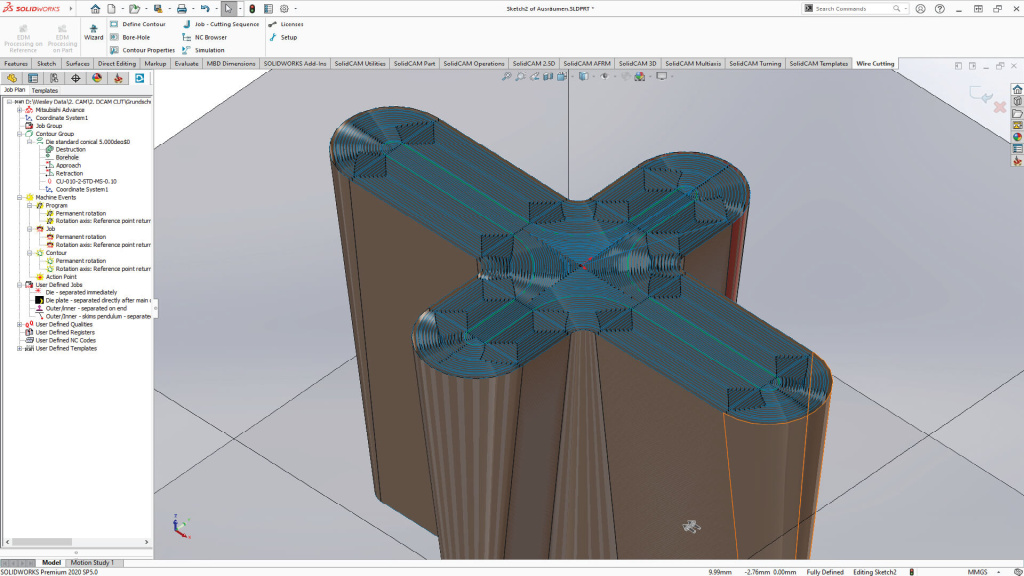
Because DCAMCUT focuses solely on wire EDM, its application area is naturally centered on industries and tasks where this machining process is indispensable. The software’s users span tool and mold making, where wire EDM cuts hardened steel dies with intricate profiles; machine and plant construction, which often requires precision-cut components; extrusion die manufacturing, where EDM creates complex extrusion tooling; prototype production, enabling one-off parts with fine details; and even high-tech fields like medical technology and aerospace. In medical device fabrication, for example, wire EDM is used for surgical instruments and implants with tight tolerances, and DCAMCUT helps program those cuts accurately. In aerospace, companies rely on the software to produce engine components, fuel system parts, and other precision pieces from tough alloys. By catering to these specialized sectors, DCAMCUT has built a loyal user base. The company’s profile indicates that leading firms worldwide rely on DCAMCUT for wire EDM programming, benefiting from its ability to handle anything from straightforward 2D cuts to complex 3D contours on exotic materials. In short, wherever wire EDM is employed as a manufacturing method, DCAM’s software is likely to be considered as a go-to solution to maximize the process’s potential.
Origins and Evolution
DCAMCUT’s story traces back to an unlikely beginning in the aftermath of the Cold War. DCAM GmbH, the company behind the software, was officially founded in Berlin in May 1990, just months after the reunification of Germany. Its roots lie in the former East German enterprise VEB Steremat, which had been the state-run developer of numerical control (NC) software for EDM and other machining processes. When the state-owned industry dissolved, a group of entrepreneurial engineers saw an opportunity. DCAM’s founders – including Falk Berthold, Jürgen Ludwig and Eckehard Müller – pooled their resources to acquire Steremat’s NC software rights for various machining disciplines (drilling, milling, turning, grinding, EDM, etc.) for a modest sum of 116,000 Deutsche Marks. This purchase laid the foundation for the new company’s technology. In its early days, DCAM GmbH had four principal stakeholders, each holding 25% equity: three of the founders (Berthold, Ludwig, Müller) and a software specialist named Oswald Wagner. Wagner was not only a co-owner but also the chief developer of a firm called NC-Soft Wagner, and he brought with him a crucial piece of the puzzle – the initial CAD system that would work in tandem with DCAM’s CAM solution for EDM. This partnership gave birth to the first version of DCAMCUT in the early 1990s, combining DCAM’s NC programming expertise with Wagner’s CAD interface.
However, the company’s focus sharpened after a pivotal moment in 1994. After several years of collaboration, DCAM GmbH and NC-Soft Wagner decided to part ways. In the split, Wagner’s company took back the rights for the non-EDM software (covering drilling/milling, turning, grinding, etc.), while DCAM GmbH retained the EDM programming technology. From that point onward, DCAM exclusively concentrated on wire EDM. This decision to specialize would define the company’s identity and its flagship product’s trajectory. Freed from the need to support multiple machining processes, the DCAM team zeroed in on becoming the best in the niche of wire erosion software.
Throughout the late 1990s and 2000s, DCAMCUT underwent continuous evolution. By the early 2000s, DCAM GmbH was integrating more advanced 3D modeling kernels into the software. Notably, around 2001 the system’s 3D core was overhauled, and in 2003 a new version was released based on the think3 CAD kernel, giving users improved 3D design and visualization capabilities. By 2006, DCAMCUT had achieved full 3D functionality in its programming environment, meaning users could import complex 3D models and generate wire EDM toolpaths with a high degree of automation and accuracy. This was a significant leap from older 2D-based methods and allowed the software to eliminate many manual steps and potential errors. In 2009, another important technological step occurred: DCAMCUT adopted SOLIDWORKS as a platform for its user interface and CAD engine. Essentially, the company built a version of DCAMCUT on the SOLIDWORKS OEM foundation, which brought a modern, well-known CAD environment to its users. Around the same time, DCAM also developed a variant integrated with Autodesk Inventor. From then on, the product was offered in multiple flavors – a standalone DCAMCUT Solo (with its own CAD module) and plugin-style integrations DCAMCUT for SOLIDWORKS and DCAMCUT for Inventor. This flexibility meant customers could either use DCAM’s built-in CAD capabilities or work within the familiar interface of their preferred CAD system, with DCAMCUT seamlessly embedded. By leveraging the popularity of SOLIDWORKS and Inventor, DCAMCUT positioned itself as a complementary add-on for those major CAD platforms, which helped expand its appeal to new users who wanted to program wire EDM directly from within their design software.
As DCAMCUT’s capabilities grew, so did its reputation in the industry. By the late 2000s, the company had a mature product and a clear leadership position in the wire EDM software niche. To secure its future growth, DCAM GmbH began seeking a strategic partner. In 2007, talks began with Tebis AG, a larger German CAD/CAM company known for its CAD/CAM solutions in toolmaking and manufacturing. The two companies started a cooperation that year, recognizing the complementary nature of their offerings – Tebis had broad CAD/CAM software for milling and other processes, while DCAM specialized in EDM. This partnership proved fruitful, and within a couple of years Tebis moved to acquire DCAM outright. By 2009, DCAM GmbH became a fully owned subsidiary of Tebis AG. Under Tebis’s ownership, DCAM remained a distinct unit focused on wire EDM, but gained access to Tebis’s global sales and support network and resources for development. The partnership also fostered technical collaboration: for example, integrating DCAMCUT’s wire EDM capabilities into the broader Tebis product suite for customers who wanted a one-stop CAM solution. Despite the new ownership, DCAMCUT continued to be marketed under its own name and maintained its integration with third-party CAD systems, preserving the qualities that made it unique.
The leadership of DCAM GmbH also saw a transition in the subsequent years. On January 1, 2012, Jens Franke took over as Managing Director, assuming day-to-day operational leadership of the subsidiary. Franke, an experienced figure in the CAM software field, became the public face of DCAMCUT and was charged with steering its next phase of growth, while an executive from Tebis (Adrian Fritsche) joined DCAM’s management to represent the parent company’s interests. By all accounts, the arrangement worked well – DCAM GmbH reported that it was “flourishing”under the new structure, seeing more success than ever and selling its software internationally through Tebis’s channels and other distributors. In 2017, the company relocated its headquarters from central Berlin to Teltow, a technology park area on the outskirts of the city. At the new Teltow office, DCAM opened a modern training center and showroom, complete with EDM machines (such as a Mitsubishi wire EDM unit) for practical demonstrations. This move provided more space and better facilities for training customers on DCAMCUT, underscoring the company’s commitment to customer support and education. By the end of the 2010s, DCAM GmbH remained a relatively small enterprise in terms of staff – on the order of only a few dozen employees – but it commanded outsized influence in its specialized domain. As of that time, DCAMCUT was on version 8.x and approaching a new major release (version 9.0 would arrive around 2021), continuing a steady cadence of improvements and refinements.
Business Growth and Partnerships
Over its lifespan, DCAM GmbH transitioned from an East German start-up to an international player, albeit a niche one. Today, as part of Tebis AG, the company benefits from a global footprint that belies its modest size. Tebis’s worldwide presence (with numerous regional offices and distribution partners across Europe, Asia, and North America) has helped DCAMCUT reach customers far beyond its home base. DCAM’s own materials highlight that they have an “international sales network”, and the software is now used in countless manufacturing companies around the world. While exact user numbers and financial figures are not publicly disclosed, DCAMCUT’s enduring market presence for 30+ years suggests a stable and possibly growing install base. In its core market of the German-speaking countries, DCAMCUT is well-known among toolmakers and EDM specialists; through Tebis and other resellers, it has also been adopted by users in other European markets, North America, and Asia where high-end wire EDM is in demand. The company’s business model includes not just software licenses but also training, support, and consulting services. Together with its parent Tebis, DCAM provides process-oriented consulting to help clients optimize their EDM operations, indicating an emphasis on building long-term partnerships with customers rather than one-off software sales.
One of DCAM’s key strategies for growth has been forming partnerships and integrations. The software’s ability to integrate into SOLIDWORKS and Autodesk Inventor is a prime example – DCAM GmbH worked closely with Dassault Systèmes and Autodesk (or their third-party developer programs) to ensure DCAMCUT could function as a plugin within those CAD environments. This allowed DCAMCUT to tap into the large user communities of those CAD systems. Many toolmakers who already used SOLIDWORKS for design could add DCAMCUT as their EDM programming module, rather than having to learn a completely separate stand-alone CAM system. This tight integration remains a selling point and was achieved through official collaboration; DCAMCUT for SOLIDWORKS, for instance, leverages SOLIDWORKS’ interface and was built on the SOLIDWORKS OEM platform, indicating a formal arrangement with Dassault. Likewise, the Inventor integration implies cooperation with Autodesk’s developer network. These partnerships lowered the barrier to entry for new users and embedded DCAM’s technology into established CAD/CAM workflows at many companies.
Another important set of partnerships is with the EDM machine manufacturers themselves. DCAMCUT is designed as a vendor-neutral programming solution – it supports wire EDM machines from virtually all major manufacturers (such as Mitsubishi Electric, GF AgieCharmilles, Makino, FANUC, Sodick, and others). To achieve this, DCAM GmbH maintains updated post-processor support and technology databases for a wide range of machine models. The company works closely with machine builders to ensure that new machine capabilities (for example, improved automatic wire threading systems or new generator settings) are supported in the software. A notable collaboration highlighted by DCAM’s leadership is with Mitsubishi Electric. Mitsubishi, a leading maker of wire EDM machines, has cooperated with DCAM in training and development efforts. At DCAM’s Teltow training center, for example, a Mitsubishi EDM machine is installed for customer demos and testing. Jens Franke has praised this relationship, stating: “Our cooperation with Mitsubishi Electric is going very smoothly… Mitsubishi Electric involves its cooperation partners very early on in reporting improvements in the control and programming. This way we can respond in good time and always modify our solutions appropriately.” Such close ties mean that when Mitsubishi (or other machine OEMs) introduce a new feature or model, DCAMCUT can quickly adapt to support it, giving end-users a seamless experience. It’s a symbiotic relationship: the machine manufacturers can point their customers to DCAMCUT for advanced programming needs, and DCAM can optimize its software for those machines, ensuring top performance.
Beyond OEMs, DCAM GmbH has built a network of distributors and resellers to extend its reach. For instance, in the UK market, the company SolidCAM UK (better known for milling CAM software) has acted as a distributor for DCAMCUT, offering it to their customers who need EDM solutions. Similar arrangements exist in other countries, leveraging partners who understand local markets. All these collaborations have amplified DCAMCUT’s presence without the company itself having to dramatically increase in size. In terms of corporate development, the most significant partnership was, of course, the merger with Tebis AG. Becoming part of Tebis has provided DCAM with greater financial stability and access to a wider customer pool (Tebis serves many automotive and aerospace clients, for example). While DCAMCUT remains a distinct product, some of its technology has also been incorporated into Tebis’s flagship CAD/CAM software. Tebis can offer its own customers an integrated wire EDM module powered by DCAMCUT’s algorithms, showing how the acquisition created a win-win integration of technologies.
As of today, DCAM GmbH’s business appears strong within its focused domain. The company operates in a relatively competition-sparse niche: few software companies concentrate solely on wire EDM programming. Most competitors are either the basic software that comes with EDM machines or modules within larger CAM suites. DCAMCUT’s longevity and continued updates suggest that it has a solid customer retention and steady new adoption where high-end EDM work is needed. By continuously innovating (as detailed in the next section) and leveraging its partnerships, the system has maintained a technical edge. The leadership at DCAM emphasizes customer feedback and industry collaboration as key factors in its success. Franke and his team frequently engage with users through training seminars, user group meetings, and by working on-site with companies to tailor solutions. This close relationship with the user community not only helps clients get the most out of the software but also informs DCAM’s development priorities for future releases. In summary, through strategic partnerships and a clear focus, DCAMCUT transformed from a small German start-up product into a globally deployed solution, all while staying true to its wire EDM specialization.
Innovations and Key Features
DCAMCUT’s longevity in the market is a direct result of continuous innovation and a reputation for solving the specific challenges of wire EDM programming. Over the years, the system has introduced features that set it apart from both simpler tools and generalist CAM software. Here are some of the distinctive strengths and innovations that DCAMCUT offers:
-
Exclusive Focus on Wire EDM: DCAMCUT is developed by a company that deals only in wire EDM software. This singular focus, sustained since 1994, means every feature in the product is designed with EDM in mind. Unlike generic CAM programs that treat EDM as an add-on, DCAMCUT covers the nuances of the process end-to-end. For users, this translates into a highly refined tool. For example, the software includes an extensive technology database for wire EDM, containing optimal cutting parameters for different machine brands, wire types, materials, and thicknesses. It can automatically apply the correct discharge settings and offsets for a given machine and material – something a generic CAM system might leave to the user to configure. Being a specialist for decades has also allowed DCAMCUT to incorporate industry best practices and respond quickly to any new EDM techniques or trends. DCAM GmbH proudly points out that it is likely the only IT company of its kind focusing exclusively on wire erosion technology for such a long period, which has yielded a “highly efficient software solution” tailored to the needs of toolmakers and precision engineers.
-
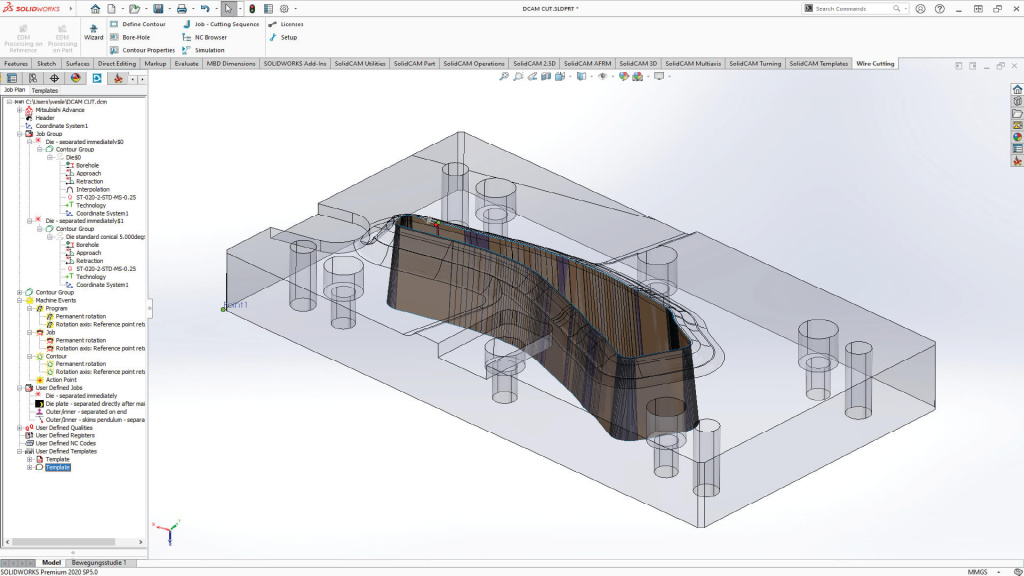
Working Directly from 3D CAD Models: One of the hallmark capabilities of DCAMCUT is its ability to generate EDM programs directly on the surfaces of 3D models. In traditional wire EDM programming, especially in older systems, a common approach was the so-called “2D/2-axis” method: programmers would extract upper and lower profile curves from a 3D part and use those as the basis for a wire path, essentially working in two separate 2D planes. This could lead to approximation errors and a lot of manual effort to ensure the two profiles sync up. DCAMCUT eliminated that outdated workflow. Jens Franke explains this advantage succinctly: “DCAMCUT works directly with the data of the 3D model, in other words on the original faces of the design.”By reading the exact geometry of the part, DCAMCUT ensures that the wire path follows the intended shape precisely, even for complex tapered or 4-axis cuts. The software can automatically detect if a given 3D part is feasible to wire-cut (for instance, checking for features like reverse tapers or undercuts that might cause issues) and alert the user early in the programming stage if adjustments are needed. This direct-model approach improves accuracy and reduces programming time because engineers no longer need to manually derive and adjust 2D cross-sections – the full 3D information is used from the start. It also improves process reliability: as Franke has noted, many errors that show up on an EDM machine are actually programming errors from working with incomplete data, and by using the full 3D model, “workpieces programmed with DCAMCUT are produced without any deviations” from the design intent.
-
Template-Based Automation: DCAMCUT introduced a powerful template technology that significantly cuts down on repetitive programming work. In many workshops, the types of EDM jobs often repeat with variations – for example, cutting punches and dies, or multiple similar components with slight design differences. With DCAMCUT, users can program a job once and save the entire sequence as a template (including geometry selections, cutting strategies, offsets, etc.). The next time a similar part needs to be cut, the programmer can simply apply the saved template to the new geometry. According to user reports, this feature can reduce programming effort by 60–70% and also reduce the chance of errors, because proven methods are reused rather than reprogrammed from scratch. Templates can be catalogued for an organization’s common tasks, enabling even less experienced programmers to follow an established process with confidence. This level of automation is crucial in improving efficiency on the shop floor – it frees up the programmer’s time and ensures consistency in how jobs are set up, which in turn leads to more reliable machining outcomes.
-
Advanced 4-Axis and Unattended Cutting Strategies: As wire EDM technology progressed, more machines became capable of complex 4-axis movements (where the wire’s upper and lower guides can be independently controlled to cut tapering or changing profiles through a part). DCAMCUT has robust support for such 4-axis wire EDM operations. Beyond just programming a shaped taper, the software introduced intelligent strategies to handle practical challenges, such as preventing cut-out pieces from causing machine interruptions. One innovation is a specialized 4-axis “clearing” cycle for pocketing out material with the wire. In traditional EDM, if you cut a closed shape completely free, the slug of material can fall and potentially damage the machine or cause a short circuit. DCAMCUT’s clearing strategy instead “chews up” the material into small bits by clever wire pathing, or leaves strategic tabs, so that nothing drops out unexpectedly. Franke has explained that sometimes it’s more efficient to essentially destroy the inner material (turning it into small segments that can be flushed away) than to cut a slug that must be manually removed. This feature is particularly useful for machining delicate geometries and deep pockets where constant supervision would otherwise be required. By enabling safer unattended cutting, DCAMCUT lets shops take full advantage of the wire EDM’s ability to run overnight or over weekends, thus improving overall productivity. Additionally, DCAMCUT supports multi-axis indexing and rotary tables, allowing extremely intricate parts to be cut from multiple sides or orientations in one setup – a capability useful for aerospace and medical components that might have features around a circumference.
-
Integrated Simulation and Error Checking: DCAMCUT includes a comprehensive simulation environment and an NC code browser for verification. Before ever moving to the machine, programmers can simulate the wire path on a virtual model of the workpiece, even including the machine’s geometry if needed, to check for any potential collisions or gouges. The software graphically highlights any problematic areas – for example, if a contour might cause a wire over-burn or if there’s a small leftover piece that wasn’t machined due to an offset. The NC browser feature lets users inspect the actual G-code (NC program) alongside the 3D graphics, with the software indicating which line of code corresponds to which segment of the cut. Any gaps or omissions (like a section that didn’t get cut due to geometry issues) are clearly marked. These error-checking measures act as a quality assurance step, ensuring the program is correct and optimized before it’s loaded onto the actual EDM machine. By catching mistakes upfront, DCAMCUT helps avoid costly machine crashes or wasted workpieces. Experienced EDM operators often remark that the software’s simulation gives them confidence to run jobs “lights-out” (unattended), knowing that the toolpaths have been thoroughly vetted virtually. This is a significant benefit in an industry where machine downtime and trial-and-error prove expensive.
-
User-Friendly Interface and CAD Integration: Over the years, DCAMCUT’s interface has evolved with feedback from toolmakers and machinists. The latest versions feature a modern, ribbon-style UI (especially in the versions integrated with SOLIDWORKS/Inventor) and a logically organized workflow that guides the user through job setup, toolpath creation, simulation, and output. In version 9.0, DCAM introduced a redesigned job browser panel that keeps all the steps of setting up an EDM job in one docked sidebar, making it easier to navigate through the sequence without flipping through multiple dialogs. Icons and visual cues have been updated to be more intuitive, and error messages are clearer about what needs to be fixed if something is amiss. For those using DCAMCUT within a CAD system, the experience is even more seamless – one can go from designing a part to programming its EDM cuts in the same session and software environment. This tight CAD/CAM integration eliminates the hassle of data translation (since the model doesn’t have to be exported and re-imported) and ensures that if the design changes, the EDM program can update associatively. DCAMCUT’s parametric associativity means if a designer modifies a part’s geometry slightly, the EDM toolpaths will flag that change and allow the programmer to quickly regenerate the program to suit the updated model, saving time on engineering change orders.
-
Commitment to Customer Support and Continuous Improvement: While not a software feature per se, DCAM GmbH’s approach to support and development deserves mention as part of its strengths. The company provides extensive training courses (both in-person and online) for new users, ensuring that even those new to wire EDM can climb the learning curve. It also offers a 30-day trial version of DCAMCUT with limited features (or a full-feature trial on request) so that potential customers can evaluate the system on their parts. Existing users benefit from regular updates – the company has steadily released new versions and incremental improvements, often incorporating user suggestions. For example, the introduction of features like automatic feature recognition (where the software can detect all possible EDM-able features in a 3D model automatically) was driven by user requests to speed up job setup for complex parts. DCAM’s close relationships with key customers (some of whom, like the German firm Lüntech, even acted as pilot testers and co-developers for new capabilities in the 2000s) means the software is very much tuned to real-world needs. This customer-centric development cycle ensures DCAMCUT stays relevant even as manufacturing techniques evolve. In a quote reflecting the company’s philosophy, the DCAM team stated: “We provide our customers with cutting-edge software of the highest level.”This is indicative of their commitment to keeping the software technically advanced and industry-leading in its specialized field.
Through these innovations and features, DCAMCUT has built a strong reputation as an “ingenious CAM solution that offers a multitude of benefits” specifically for wire EDM users. It strikes a balance between automation and control – automating the tedious and error-prone aspects of EDM programming while still giving expert users fine control over the process when needed. The result for businesses using DCAMCUT is often faster programming times, more right-first-time results on the machine, and ultimately higher productivity and precision in manufacturing.
Conclusion
From its unique origin in post-reunification Berlin to its status today as a globally used niche software, DCAMCUT exemplifies how focus and expertise can create lasting value in the technology world. The software’s journey – driven by a small team committed to wire EDM excellence – has mirrored the evolution of manufacturing itself, as industries demand ever greater accuracy and efficiency. Now backed by Tebis and collaborating with giants in both the CAD and machine-tool industries, DCAMCUT continues to thrive by doing what it does best: enabling companies to program wire EDM machines with confidence and sophistication. In an era where digital fabrication is paramount, DCAMCUT remains the specialist that many turn to for the precise art of cutting with electrified wire.
As manufacturing moves toward smarter and more automated processes (Industry 4.0, lights-out factories, etc.), DCAM GmbH’s decades of know-how in wire EDM software position it well to remain a leader in its corner of the CAM software landscape. The company’s leadership, typified by Jens Franke’s hands-on approach and vision, maintains a clear direction: to keep innovating in wire EDM and to ensure that this once “underestimated” aspect of production keeps pace with the rest of the industry. After thirty-five years, DCAMCUT stands as a testament to the value of specialization, and its story is a fascinating chapter in the broader history of CAD/CAM technology and modern manufacturing.
Vendor: Tebis