
PTC’s Integrated CAD/CAM Solution Transforming Product Design
Overview – Creo CAM and PTC
Creo is a comprehensive computer-aided design and manufacturing (CAD/CAM) software suite developed by PTC (Parametric Technology Corporation). As a fully integrated 3D CAD/CAM/CAE platform, Creo enables engineers to design products in 3D, simulate their behavior, and directly generate manufacturing instructions within one environment. In practical terms, Creo allows a company to take a product from initial concept and detailed design all the way to toolpath generation for CNC machines and even 3D printing, without needing to transfer data between different applications. This tight integration between design and manufacturing (the “CAD-to-CAM” workflow) helps reduce errors and development time.
PTC, the vendor behind Creo, is a Massachusetts-based software company known for pioneering parametric CAD technology. Founded in 1985, PTC introduced the industry’s first parametric, feature-based solid modeling software (Pro/ENGINEER) in 1988, revolutionizing how engineers develop products. Today, PTC is a global provider of solutions for product design, lifecycle management, and industrial digital transformation. Headquartered in Boston, the company employs over 7,000 people and supports more than 30,000 customers worldwide. Its product portfolio spans not only CAD/CAM (with Creo) but also product lifecycle management (Windchill), industrial Internet of Things (ThingWorx), augmented reality (Vuforia), engineering calculations (Mathcad), and more. This broad suite of technologies positions PTC as a key player helping industrial firms digitize their engineering and manufacturing processes.
Application Across Industries
One of the strengths of Creo is its broad applicability across various industries. Companies in multiple sectors rely on Creo for designing complex products and bringing them to market:
-
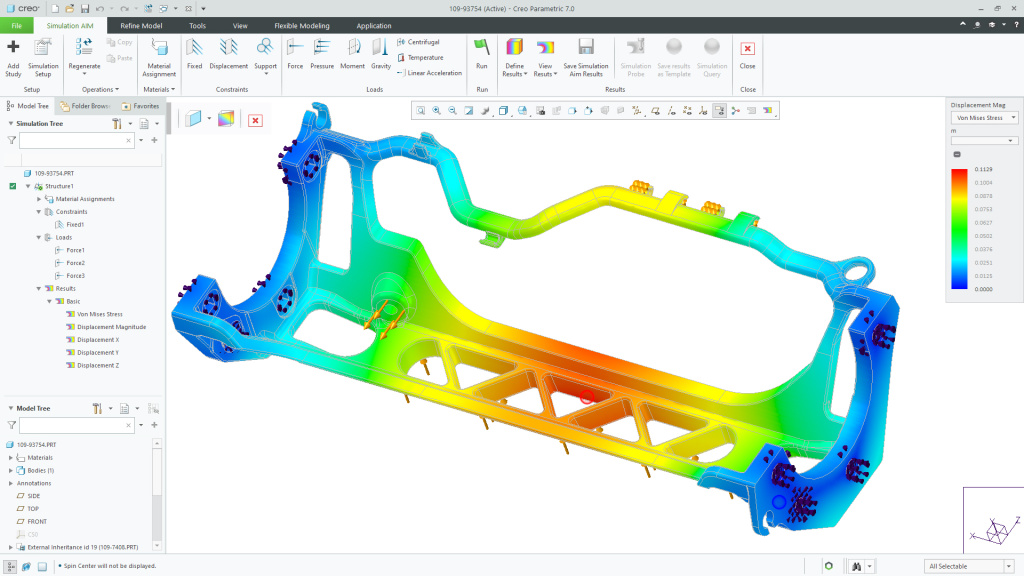
Aerospace & Defense: In the aerospace industry, Creo is used to design aircraft structures, engines, and components that must meet strict performance and safety criteria. Its simulation tools help engineers analyze stresses on airplane parts or spacecraft assemblies, while its CAM capabilities enable precise machining of high-performance materials often used in jets and satellites. Major defense contractors and aerospace firms have long adopted Creo for its robust handling of large assemblies and intricate part geometries.
-
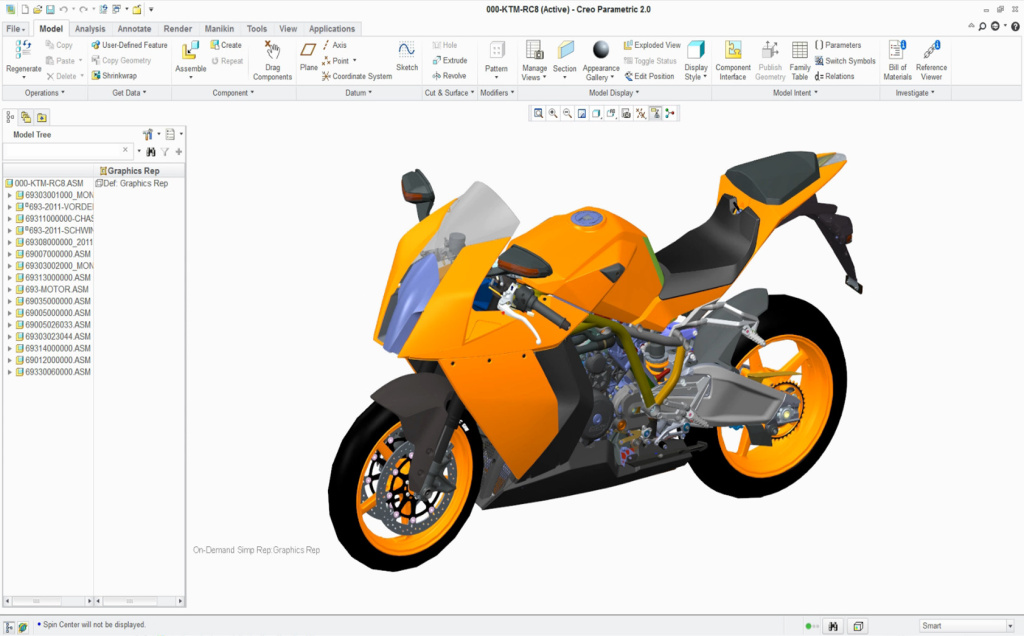
Automotive: Automakers and suppliers use Creo to develop everything from powertrain components (like engines and transmissions) to exterior body panels and interior systems. The software’s parametric approach allows automotive engineers to quickly iterate vehicle designs and manage changes – for instance, adjusting the dimensions of an engine part and automatically updating all related components. Creo’s CAM module also generates the CNC toolpaths for machining molds, dies, and parts, streamlining the transition from vehicle design to manufacturing.
-
Industrial Machinery & Equipment: Manufacturers of heavy machinery, industrial equipment, and appliances leverage Creo for its ability to handle complex mechanical assemblies. In industries like industrial pumps, agricultural machinery, and construction equipment, engineers use Creo to model large mechanical systems with thousands of parts. The software’s simulation extensions allow checking for interferences or stress points, and its advanced manufacturing features support multi-axis milling and turning needed to fabricate big, complex components.
-
Electronics & Consumer Products: Creo is also employed in high-tech and consumer product design, where aesthetics meet engineering. Electronics companies use it to design housings for devices, circuit board layouts, and even wire routing via dedicated cabling and schematics extensions. Consumer product designers appreciate Creo’s surfacing and freeform modeling tools for styling ergonomic shapes (for example, in power tools or kitchen appliances), while ensuring the product can be manufactured. The ability to integrate plastic injection mold design and toolpath generation helps companies go from a 3D gadget model to the molds that will produce its plastic parts.
-
Medical Devices & Others: In medical technology, Creo helps design equipment such as imaging machines, surgical tools, and wearable health devices, which require precision and often compliance with regulatory standards. Its model-based definition capabilities (embedding dimensions and annotations directly in 3D models) can improve communication in regulated design processes. Other sectors where Creo is used include energy (e.g. designing wind turbine components), transportation, and even racing – for instance, motorsports teams have used Creo to design car parts and then CNC-machine lightweight, optimized components for performance gains.
Across these industries, the common thread is that Creo provides an end-to-end solution: engineers can design innovative products, validate their performance with simulations, and then output manufacturing instructions, all using the same software. This integrated workflow is a major advantage for companies aiming to shorten development cycles and maintain a seamless “digital thread” from design through production.
Origins and Development History
PTC’s founding and Pro/ENGINEER: The history of Creo traces back to the mid-1980s with the founding of PTC. The company was established in 1985 by Sam Peisakhovich Geisberg, a Russian-born mathematician and CAD software visionary who set out to fundamentally improve the design process through parametric modeling. Geisberg’s vision materialized in 1988 when PTC launched Pro/ENGINEER, the first commercial CAD software to fully utilize parametric, feature-based solid modeling. This was a game-changer in the industry – unlike previous CAD tools that required manual re-drawing of changes, Pro/ENGINEER allowed designers to define relationships and constraints in their models. If an engineer modified one dimension or feature, all related parts and drawings would update automatically. This parametric approach introduced unprecedented flexibility: design iterations that once took hours or days could be done in minutes, and it reduced errors by keeping the design intent consistent. Pro/ENGINEER rapidly gained adoption through the late 1980s and 1990s, propelling PTC’s growth as a CAD leader. By the early 1990s, the software’s capabilities expanded beyond 3D modeling to include associated applications like drafting (2D drawings), surface modeling, sheet metal design, and even product data management. Notably, PTC also made an early foray into CAM during this period – responding to customer demand, PTC introduced Pro/Manufacturing, an NC (numerical control) toolpath module that worked directly with Pro/ENGINEER models. This meant a design change in the CAD model could instantly ripple through to updated milling or turning instructions for manufacturing. It took a few iterations for PTC’s integrated CAM to mature, but by integrating CAD and CAM data from the start, PTC set itself apart by offering a single database for design and manufacturing. Engineers could ensure that the CAD model, engineering drawings, and CNC machining paths all stayed in sync – a significant productivity boost for its users.
Growth, competition and evolution: Throughout the 1990s, PTC rode the success of Pro/ENGINEER as the CAD market grew. By combining mechanical design, analysis, and manufacturing tools, PTC appealed to large manufacturing companies eager to streamline product development. PTC’s success also spurred competition: other CAD vendors like Dassault Systèmes (with CATIA and SolidWorks), Siemens PLM (with Unigraphics/NX and later Solid Edge), and Autodesk (with AutoCAD and Inventor) all advanced their own offerings, leading to a highly competitive CAD industry. PTC continuously updated Pro/ENGINEER (often called “Pro/E”) with new features and improvements. By the late 1990s, the company was also expanding into product lifecycle management (PLM) software with Windchill (introduced in 1998 as one of the first web-based PLM systems), indicating PTC’s ambition to manage not just design but the entire lifecycle of products.
Rebranding to Creo: In 2010, after over two decades of Pro/ENGINEER’s presence, PTC announced a major change: it would rebrand and unify its suite of design software under the name Creo. This move, implemented with the launch of Creo 1.0 in 2011, was more than just a name change – it represented PTC’s strategy to create a more cohesive, user-friendly platform that combined technologies from several PTC acquisitions and legacy products. By this time, PTC had acquired companies like CoCreate (a developer of direct modeling CAD software) and Mathsoft (maker of Mathcad engineering calculation software), and it also had visualization tools (ProductView) and others. The Creo brand allowed PTC to bring these together. For example, what had been known as Pro/ENGINEER became Creo Parametric, retaining the parametric modeling core. CoCreate’s capabilities were repackaged as Creo Direct for direct modeling (allowing users to manipulate geometry freely without a history tree). Other functions were split into modules like Creo Simulate (for CAE analysis), Creo Illustrate (technical illustrations), Creo Schematics, and so on – all under one family name. The goal was to enable users to move between parametric and direct modeling, or design and analysis, more seamlessly than the old separate products allowed. The introduction of Creo as a unified platform was also aimed at addressing growing product development complexity; by ensuring all these tools shared a common data model and interface, PTC hoped to make the user experience more intuitive and the software more scalable for large projects. Creo 1.0 was released in 2011, effectively superseding Pro/E and CoCreate, and over the next decade PTC continued to refine Creo with annual releases (Creo 2, 3, … up to the current versions) that introduced new capabilities and user experience improvements.
Throughout its development history, Creo (and PTC as its developer) has been characterized by continuous innovation in response to industry needs. For instance, as 3D printing emerged, PTC added additive manufacturing tools to Creo. As model-based definition (MBD) gained traction (using 3D models with embedded annotations instead of traditional 2D drawings), Creo added support for rich 3D annotations and PMI (product manufacturing information) to enable drawing-less workflows. And when real-time simulation technology became available, PTC integrated it (in partnership with Ansys – more on that later). In essence, the evolution from Pro/ENGINEER to Creo reflects PTC’s broader journey from a pioneering CAD start-up to a diversified provider of software for every stage of product development.
Business Performance and Market Presence
PTC’s Creo is not just an engineering tool; it’s also a significant business line in a competitive market. As of the mid-2020s, PTC Inc. is a multi-billion dollar company – in its 2024 fiscal year, PTC reported annual revenues on the order of $2.3 billion. The company’s revenues are divided across its various product segments (CAD, PLM, IoT, AR, etc.), with Creo and other CAD offerings constituting a substantial portion of that total. The CAD segment has shown healthy growth in recent years, aided by recurring subscription revenues and new customer wins, including growth in Asia and Europe. PTC’s overall strategy has shifted toward subscription and Software-as-a-Service (SaaS) offerings, which provides a steady recurring revenue base. This strategy includes Creo (which is now offered via subscription licenses and as a cloud-hosted version called Creo+), ensuring a stable user base and continuous updates.
In terms of user base and global reach, PTC claims a wide adoption of Creo worldwide. The company serves more than 30,000 customer companies globally – ranging from Fortune 500 manufacturers to small and mid-sized design firms. This includes thousands of organizations in North America, Europe, and Asia that use Creo for daily engineering work. The software’s user population likely numbers in the hundreds of thousands of engineers. PTC also actively engages with this community through training, certification programs, and user conferences (such as the annual PTC/User conference and LiveWorx event) to support and educate its customers. The ubiquity of Creo in industries like automotive and aerospace means it has become part of the required skill set for many mechanical engineers; universities and technical institutes often include Creo (or its predecessor Pro/E) in their engineering curricula, which helps feed new talent into the Creo user community each year.
Market position: In the broader CAD/CAM market, Creo is regarded as one of the leading high-end solutions. PTC is frequently mentioned alongside a handful of major CAD vendors that dominate the market for professional mechanical design software. Its primary competitors include Dassault Systèmes (with CATIA and SolidWorks), Siemens Digital Industries (with NX and Solid Edge), and Autodesk (with Inventor and Fusion 360, among others). Each of these companies has a slightly different focus – for instance, Dassault and Siemens also offer comprehensive PLM systems and tend to serve many of the same large enterprises as PTC, while Autodesk often targets a broad range from high-end to hobbyist. In this landscape, PTC’s Creo is known for excelling in parametric design and complex assembly handling, as well as its tight integration with PTC’s PLM (Windchill) for enterprise data management. Creo’s footprint is especially strong in industries like industrial equipment and heavy machinery (where PTC historically had many clients), while its rivals SolidWorks or Inventor might be more common in smaller design firms or CATIA in aerospace styling, for example. Overall, PTC holds a significant share of the CAD market and has the financial performance to show continued investment in the platform. The company’s emphasis on “digital thread” connectivity – tying Creo design data into manufacturing, service, and IoT systems – is part of its pitch that it can deliver value beyond just the CAD seat, allowing businesses to transform how they bring products to market. PTC’s leadership has highlighted that synergy as a competitive advantage of their portfolio.
From a business metrics standpoint, PTC has also shown robust profitability and growth in recurring revenue. The company has over 7,000 employees worldwide, with development centers and offices in many countries (the core Creo development historically was based in the northeastern US, with significant R&D also in India and Europe over time). The sustained success of Creo is critical to PTC’s financial health – it’s a mature product in a mature market, but PTC’s ability to keep Creo relevant through new features and integrations has helped retain existing customers and attract new ones. This is evidenced by the fact that Creo’s annual revenue and bookings have continued to grow modestly despite stiff competition and the availability of lower-cost alternatives; many long-time Pro/E users remain loyal due to the depth of features and trust in PTC’s support. Additionally, PTC’s newer strategy of offering both Creo and Onshape (its cloud CAD acquisition) means it can cover different market segments, which potentially boosts its overall CAD market share. In summary, Creo is both a technological cornerstone of PTC’s product suite and a major contributor to PTC’s business performance, anchoring a revenue stream that has allowed PTC to invest in new technologies and acquisitions over the years.
Major Acquisitions, Mergers, and Partnerships
Throughout its history, PTC has grown not only organically via product development like Creo, but also through strategic acquisitions and partnerships that have expanded its capabilities. Below are some of the most notable corporate moves involving Creo or PTC as a whole, and how they have influenced the Creo CAM ecosystem and PTC’s position in the market:
-
Expansion through acquisitions: PTC has a long track record of acquiring companies to broaden its technology portfolio. Early on, a significant move was the 1998 acquisition of Computervision, a older CAD company, which brought PTC additional CAD technology and customer base (Computervision’s CADDS system) as well as expertise in areas like manufacturing and plant design. Moving into the mid-2000s, PTC made a series of acquisitions directly relevant to Creo: In 2005–2007 PTC acquired Arbortext (technical publishing software), Mathsoft (Mathcad engineering calculation software), and CoCreate in 2007. The CoCreate acquisition (for approximately $250 million) was especially significant for Creo – CoCreate was a leader in direct modeling CAD, an approach different from PTC’s parametric heritage. By buying CoCreate, PTC obtained technology for explicit modeling (later incorporated as Creo Direct) and also gained CoCreate’s customer base (which included companies like Canon and HP). This allowed PTC to offer “a full range of modeling approaches – parametric, explicit, 2D – to its customers,” complementing Creo’s capabilities with flexibility for concept design or late-stage edits without constraints. Subsequent acquisitions bolstered other parts of PTC’s product development suite: for example, in 2013 PTC acquired ThingWorx, an Industrial IoT platform provider, signaling PTC’s move beyond traditional CAD/PLM into the emerging IoT space. While ThingWorx is separate from Creo, in the long run it enables integration where a Creo-designed product can be connected to IoT data (e.g., feeding real-world sensor information back into design improvements). In 2014, PTC added Axeda (for IoT device management) and in 2015 it bought the Vuforia augmented reality platform from Qualcomm – again, not directly part of Creo, but AR has since been linked to Creo by allowing users to publish AR experiences of their CAD models for visualization.
-
Recent acquisitions – SaaS and more: In the last several years, PTC’s acquisitions have aimed at transitioning the company into cloud-based offerings and expanding its reach in later lifecycle stages. A headline deal was PTC’s acquisition of Onshape in October 2019 for about $470 million. Onshape is a cloud-native CAD and data management platform (accessible entirely via web browser) that was founded by the original creators of SolidWorks. By acquiring Onshape, PTC signaled a commitment to the future of CAD in the cloud and gained a second CAD product in its stable. Onshape operates as a separate product from Creo (with its own development team and user base), but it complements PTC’s portfolio by targeting new customers who prefer a SaaS (Software as a Service) model and collaborative, lightweight CAD tool. PTC’s CEO at the time, Jim Heppelmann, noted that the Onshape deal positioned PTC to capitalize on an industry shift toward SaaS – essentially giving PTC a foothold in both traditional on-premise CAD (Creo) and cloud CAD (Onshape). In 2021, PTC acquired Arena Solutions, a cloud-based PLM provider, further reinforcing its SaaS lineup on the PLM side (Arena is complementary to Windchill, focusing on mid-market, cloud PLM needs). Another major recent move was in late 2022, when PTC announced the acquisition of ServiceMax for $1.46 billion. ServiceMax is a field service management software company; by adding it, PTC sought to offer manufacturing customers a more complete view of a product’s lifecycle – from design (Creo) to service and maintenance (ServiceMax) – under one umbrella. While ServiceMax doesn’t integrate with Creo directly, the strategy here is about PTC covering all digital aspects of a product’s life (design, manufacture, operate, service). These acquisitions indicate PTC’s evolution from a pure CAD company into a broader industrial software firm, but they all tie back into making the Creo-centric ecosystem more valuable (for instance, a Creo model managed in Windchill can now also feed into an Arena cloud PLM workspace or connect to IoT via ThingWorx, etc., creating an interconnected suite).
-
Strategic partnerships and collaborations: PTC has also engaged in high-profile partnerships to advance its technology and market reach. One landmark partnership was forged in 2018 with Rockwell Automation, a leading industrial automation company. Rockwell invested $1.0 billion in PTC for an ~8% equity stake, and the two companies formed a strategic alliance to combine PTC’s IoT and AR solutions with Rockwell’s factory automation expertise. This partnership, which resulted in a joint offering called FactoryTalk InnovationSuite (combining ThingWorx IoT, Vuforia AR, and Rockwell’s software), doesn’t directly change Creo, but it strengthens PTC’s overall value proposition in digital manufacturing – and implicitly benefits Creo by ensuring the designs from Creo can be part of a connected smart factory ecosystem. Another key collaboration impacting Creo users is PTC’s partnership with Ansys, a leader in engineering simulation. In 2018, PTC and Ansys announced a partnership to integrate Ansys’s high-fidelity simulation technology into Creo. This led to the product Creo Simulation Live and later Creo Ansys Simulation, bringing real-time FEA (finite element analysis) and other simulation capabilities directly into the CAD interface. As a result, a design engineer working in Creo can instantly see simulation feedback (powered by Ansys solvers) on their model without switching to a separate application. This is a powerful differentiator for Creo, essentially “democratizing” advanced simulation for designers. The partnership with Ansys is ongoing and has grown – Ansys is considered a strategic partner, and both companies share a vision of integrating CAD and CAE more tightly. In addition to these, PTC maintains partnerships with other technology providers and services firms: for instance, alliances with cloud providers (Microsoft Azure for hosting some of its cloud products), with consulting firms that implement PTC solutions, and with academic institutions for research and training. All these collaborations help ensure that Creo and related tools stay compatible with the latest technologies and industry practices.
In summary, PTC’s mergers and acquisitions over the years have dramatically expanded the context in which Creo operates – from adding direct modeling (CoCreate) and calculations (Mathcad) in the 2000s, to embracing cloud CAD (Onshape) and field service (ServiceMax) more recently. Its strategic partnerships, notably with Rockwell and Ansys, have extended Creo’s reach into smart manufacturing and integrated simulation. For users of Creo CAM, these moves mean that the software is not an isolated design tool, but part of a much larger ecosystem. Designers using Creo can benefit from technology that was originally acquired or partnered – for example, generative design capabilities from a 2018 acquisition (Frustum) or real-time simulation from the Ansys deal – all now embedded in their CAD/CAM software. PTC’s corporate strategy clearly positions Creo as central to a platform that connects design with manufacturing, product analytics, and service in ways that few competitors can match with a single-vendor solution.
Innovations, Key Features, and Unique Advantages
From its inception to its latest release, Creo has been associated with innovation in how products are designed and manufactured. Below are some of the key features and unique advantages that Creo (and specifically its CAD/CAM capabilities) offers to engineers and businesses:
-
Parametric and feature-based modeling: The cornerstone of Creo’s innovation is parametric modeling. Every model in Creo is built with an internal history tree capturing the features (extrudes, cuts, holes, rounds, etc.) and their relationships. This means designs are intent-driven – you specify the design intent (e.g. this hole’s position is 100 mm from that edge) and Creo enforces those rules. The advantage is robust designs that can be quickly updated: if requirements change, a few parameter edits will regenerate the model to the new specs, saving immense time over redesigning from scratch. This parametric approach, pioneered by PTC, has become an industry standard in high-end CAD, but Creo continues to refine it with each version for usability and power. For instance, Creo supports advanced feature types like helical sweeps, surface merges, and patterning tools that let users build very complex geometry while preserving the parametric control. For assemblies, Creo’s parametric ethos extends to allowing associative relationships between parts – so an assembly can drive component geometry (top-down design), useful in scenarios like ensuring multiple parts fit together exactly. The parametric engine is also the foundation for optimization features: designers can run sensitivity or feasibility studies by letting Creo vary certain dimensions to meet goals (integrating with analysis tools).
-
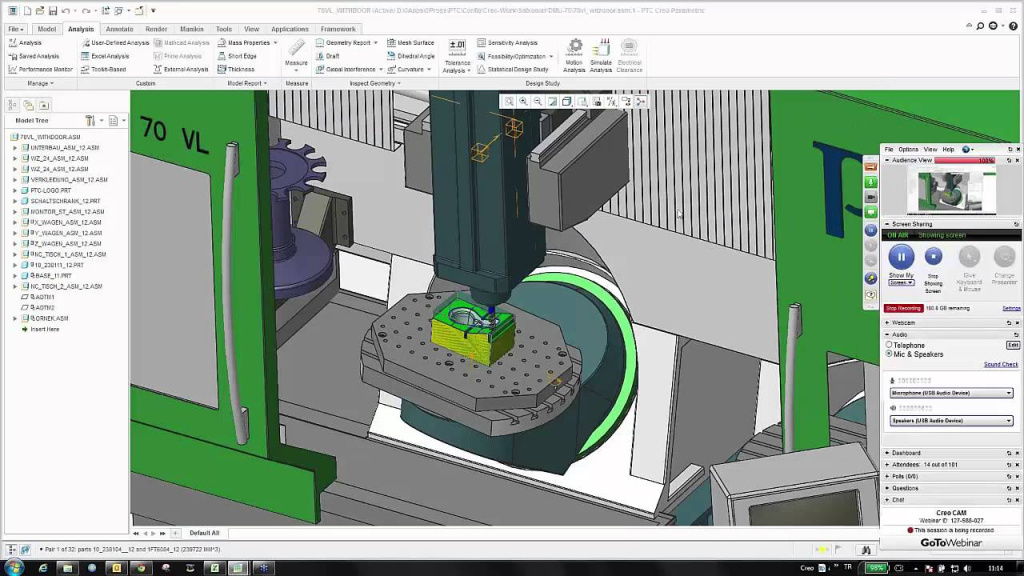
Integrated CAD, CAM, and CAE in one platform: Creo offers a broad array of modules under one umbrella, which is a huge benefit for companies that want a unified solution. On the CAM side, Creo includes a full suite of manufacturing tools often referred to as Creo NC or Creo Machining Extensions. These tools allow users to generate toolpaths for CNC machining directly from the 3D model. For example, an engineer can take a finished 3D part and use Creo’s machining module to create milling operations (2.5-axis up to 5-axis milling), turning (lathe operations), drilling, and even wire EDM processes. The software will generate the corresponding G-code or CL data for CNC machines. Since the CAM is associative to the model, if the design changes, the toolpaths can update accordingly – reducing the need to re-program machines from scratch after design modifications. Creo’s CAM capabilities have kept pace with industry needs: they support high-speed machining strategies, multi-axis simultaneous toolpaths for complex surfaces, and even machine tool simulation (so you can check for collisions in a virtual environment before cutting metal). Likewise, on the analysis (CAE) front, Creo provides simulation modules (like Creo Simulate) for structural, thermal, and modal analysis, and through its partnership with Ansys, provides real-time simulation feedback and high-fidelity simulations without leaving Creo. This means that rather than exporting a model to a separate FEA program, a designer can apply loads and constraints in Creo and get immediate stress results, and iterate the design accordingly. The tight coupling of CAD with CAE and CAM in Creo’s environment encapsulates the dream of concurrent engineering – design, analyze, and manufacture in parallel on the same dataset, enabling faster and more iterative product development.
-
Interoperability of modeling approaches: One standout feature of Creo is that it supports both parametric modeling and direct modeling. Through Creo Parametric and Creo Direct apps (or modes within the interface), users can choose the approach that suits their task. Parametric is ideal for controlled, production-ready designs, while direct modeling is useful for rapid concept development or editing imported geometry (like a STEP file from a client) where you might not have a history tree. PTC’s integration of these modes means you can switch to a direct modeling approach to push/pull geometry freely and then go back to parametric for detailed features, all on the same model. This flexibility is a competitive edge because it blends the best of both worlds (history-based and history-free modeling). It’s particularly beneficial when working with legacy data or multi-CAD environments – Creo can import models from other CAD systems and allow the user to edit them without needing to recreate them, thanks to the direct editing tools.
-
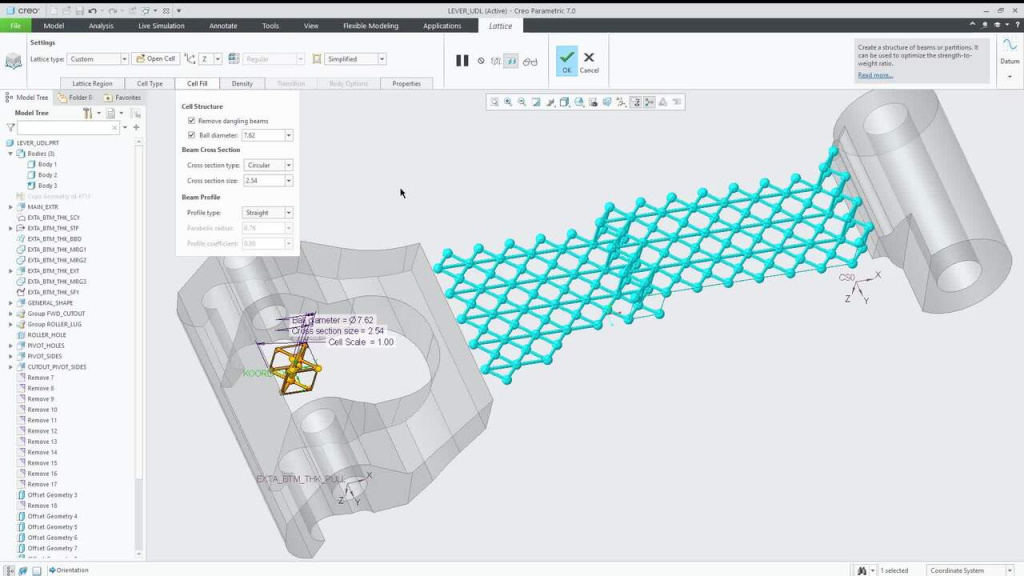
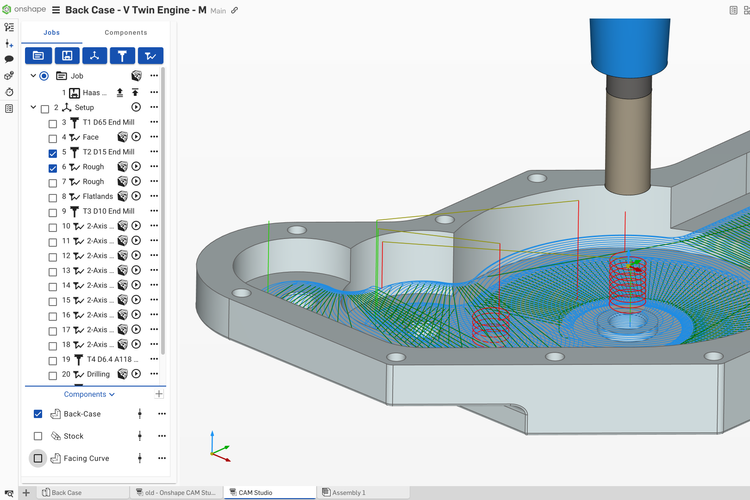
Advanced manufacturing and generative design: In recent versions, Creo has introduced generative designand additive manufacturing features that set it apart as an innovative CAD/CAM solution. Generative design, powered by technology from PTC’s Frustum acquisition, allows users to specify design objectives and constraints (like desired performance, material, and the space a part can occupy), and then the software algorithmically generates optimal geometry. This often leads to organic, lattice-like structures that a human designer might not conceive on their own. Creo’s Generative Design extension can produce these lightweight, optimized shapes automatically, which are especially useful for 3D printing or multi-axis machining of complex forms. Speaking of additive manufacturing, Creo includes dedicated tools for designing with 3D printing in mind. Users can create lattice structures within solid geometry (to reduce weight), validate that a shape is printable without support (checking overhang angles, etc.), and directly connect to 3D printers. Creo even allows for printing in full-color or multi-material if the hardware supports it, and can generate the sliced layers (via integration with Materialise software) needed for additive manufacturing. On the subtractive side, Creo’s High-Speed Milling capabilities help program CNC machines to produce those generatively designed forms efficiently, using specialized 3-axis and 5-axis toolpaths. All these features illustrate PTC’s push to keep Creo at the cutting edge of manufacturing technology – whether subtractive or additive.
-
IoT and AR integration (Digital Twin concepts): Because PTC also develops IoT and AR platforms, Creo has unique integrations that allow leveraging those technologies in design. For example, Creo can publish an AR experience of a CAD model with a few clicks – using PTC’s Vuforia, an engineer can place a virtual 3D model at scale in a real-world context (viewable through a phone or AR headset), which is a powerful way to communicate designs to stakeholders who aren’t CAD users. This can be used for design reviews or marketing before a physical prototype exists. In terms of IoT, PTC promotes the concept of a “digital twin”, where a Creo CAD model of a product can be linked with live data coming from its real-world counterpart via ThingWorx. While this is more of an enterprise solution than a feature inside Creo itself, it means Creo is part of a larger loop: designs made in Creo can be improved continuously using field data from connected products, enabling designers to see how their products perform and perhaps adjust the next iteration accordingly. These capabilities underscore an advantage of being in PTC’s ecosystem – Creo isn’t an isolated design tool but can be a node in an Internet-connected, augmented reality-enabled workflow that few other CAD packages can natively match.
-
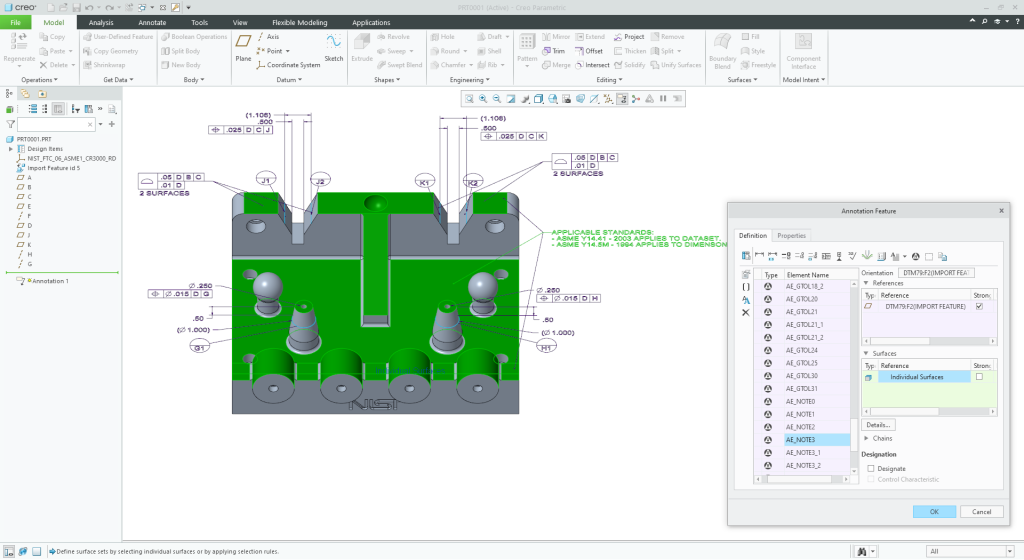
Model-Based Definition (MBD) and documentation: Creo has strong support for model-based definition, meaning it allows the 3D model to serve as the source of manufacturing information without needing separate 2D drawings. Users can fully annotate 3D models with dimensions, GD&T (geometric dimensioning and tolerancing symbols), surface finish notes, material specifications, and other notes. These annotations follow industry standards (like ASME Y14.41) for digital product definition. The advantage here is a single source of truth – the annotated 3D model can be used by manufacturing and quality teams directly, reducing the chances of discrepancies that sometimes occur between 2D drawings and 3D models. Creo’s tools for creating 3D drawings (Combined States, annotation planes, etc.) are well developed, and it also outputs standard formats like 3D PDFs or STEP AP242 with PMI, so downstream software or suppliers can read the data. This capability is increasingly important as companies attempt to go paperless in their processes. Additionally, for those who still need drawings, Creo maintains powerful 2D drawing creation tools (Creo Drawing module) which are associative with the model – ensuring drawings update with model changes. This was one of the original strengths from the Pro/E days and continues to be essential for many industries that require detailed engineering drawings alongside models.
-
Scalability and performance on complex projects: Creo is known for handling large, complex assemblies with relative ease. Industries like aerospace or automotive, where an entire vehicle or aircraft might be assembled digitally, push CAD tools to their limits with thousands of parts. Creo’s Lightweight Representations and data management links with Windchill allow users to load big assemblies in a manageable way, often using simplified geometry until detailed info is needed. PTC has put effort into keeping the software efficient, using techniques like graphics acceleration, selective retrieval of sub-assemblies, and simplified representations. This means Creo can be used not just for small components but for designing entire systems (for example, an entire production line layout, or a full tractor model with all its bolts). The software’s stability and capacity in those scenarios are a key advantage for large enterprises. It’s also worth noting that Creo is extensible – PTC offers many extensions (add-on modules) that cater to specific needs: e.g., Creo Mold Design for injection mold development, Creo Piping for routed systems (tubes, pipes, hoses), Creo Cabling for electrical harness design, and so on. This modular approach means a company can use Creo as a one-stop solution, tailoring it with the modules relevant to its products.
-
Continuous innovation and user-driven improvements: PTC regularly updates Creo (typically annually with major releases and periodic maintenance builds) and often introduces headline innovations. In recent releases, for example, PTC added Artificial Intelligence/Machine Learning features in the form of generative design and design guidance, as well as improved user interface and user experience enhancements (the interface has evolved to be more modern and customizable, with context-sensitive ribbons, etc.). Many improvements are driven by user feedback from the large Creo community – PTC hosts an ideas forum and has a community of practice where users suggest and vote on enhancements. This has led to refinements like better sketching tools, more intuitive drag handles for model edits, and more robust import/export support for other CAD formats. In addition, PTC’s integration of acquired technologies often brings leaps in functionality – a clear example being the integration of Frustum’s generative algorithms or Ansys’s simulation solvers shortly after those partnerships were formed. These kinds of integrations often give Creo users new capabilities ahead of competitors (for instance, PTC was among the first to have a true real-time FEA inside CAD when Creo Simulation Live was introduced).
Collectively, these innovations and features make Creo a comprehensive and future-forward CAD/CAM platform. Companies that adopt Creo can leverage not just traditional CAD functionality but also cutting-edge practices like generative design and augmented reality. For engineers, Creo’s unique advantage is that it acts as a single environment where one can design a part, optimize its shape algorithmically, validate its performance, and then generate the code to manufacture it – all without translations or losing associativity. That level of integration, combined with the backing of PTC’s ongoing R&D, gives Creo a reputation as a toolset that can tackle the most demanding design challenges of today’s industry.
Leadership Perspectives on Creo
PTC’s leadership has often emphasized the importance of Creo within the company’s strategy and the value it delivers to customers. Over the years, executives at PTC have provided insight into how they view Creo’s role in the market and its future direction. Here are a couple of notable quotes from PTC leadership that shed light on Creo and its impact:
-
Jim Heppelmann – PTC’s CEO on Creo’s strategic role: Jim Heppelmann, who served as PTC’s CEO from 2010 through 2023, has frequently spoken about Creo as a linchpin in PTC’s portfolio. When PTC acquired the generative design company Frustum in 2018, Heppelmann highlighted how adding new technology into Creo aligns with PTC’s mission. “PTC is pushing the boundaries of innovation with this acquisition,” Heppelmann said, referring to integrating Frustum’s generative design into the Creo suite. “Creo is core to PTC’s overall strategy, and the embedded capabilities from Ansys and, later, Frustum will elevate Creo to a leading position in the world of design and simulation,” he stated. This quote underscores that PTC sees Creo as more than just a CAD tool – it’s the centerpiece of a strategy to lead in both design and analysis by incorporating best-in-class technologies (Ansys for simulation, Frustum for generative design). Heppelmann also spoke broadly about the industry undergoing transformation: with technologies like augmented reality, virtual reality, high-performance cloud computing, IoT, artificial intelligence, and additive manufacturing all converging, he described the CAD industry as “going through a renaissance” and affirmed “PTC is committed to leading the way.” This reflects PTC’s intent to ensure Creo remains at the forefront as these technologies reshape how products are developed. Under Heppelmann’s tenure, PTC invested heavily in modernizing Creo and integrating it with emerging tech, reinforcing his viewpoint that keeping Creo innovative is crucial for the company’s leadership in the market.
-
Brian Thompson – on the introduction of Creo+: In 2023, PTC made headlines by bringing Creo to the cloud with Creo+, the SaaS-based version of the software. Brian Thompson, PTC’s General Manager for Creo, introduced Creo+ to customers as a major step forward for collaboration in design. At PTC’s LiveWorx event, Thompson said, “With this latest development, our customers will be able to design faster, easier, and more collaboratively than ever before.” He explained that Creo+ combines Creo’s proven design capabilities with new cloud-based tools, enabling design teams – including those distributed across different locations – to work together on the same model in real time. In Thompson’s view, this was a significant milestone not just for PTC and its users but for the CAD industry as a whole, marking the evolution of a traditionally desktop, file-based application into a connected, cloud-enhanced platform. This quote highlights PTC leadership’s focus on collaboration and user productivity. By saying “design faster, easier, and more collaboratively than ever before,”Thompson encapsulated the key customer benefits PTC hopes to deliver with Creo+: speed (through cloud computation and instant updates), ease of use (through simplified deployment and an updated UI), and collaboration (through multi-user co-design and data management in the cloud). Such messaging from PTC’s leadership reveals that they are acutely aware of the changing expectations of CAD users – who now demand the convenience and connectivity of cloud solutions – and that they intend to keep Creo evolving to meet those expectations.
These leadership perspectives illustrate PTC’s commitment to Creo as a strategic product. The executives consistently convey that Creo is central to PTC’s vision of the “digital thread” – connecting design, simulation, manufacturing, and service – and they reinforce that PTC will continue to innovate Creo with cutting-edge technology integrations and modern platforms. For users and customers, these statements from PTC’s top brass provide reassurance that Creo will not stagnate; rather, it will be continuously enhanced to tackle new challenges (like incorporating AI or enabling global collaboration). In the fast-moving world of engineering software, having this clear vision and vocal support from company leadership often translates into a strong roadmap and steady improvements, which seems to be the case with Creo’s development under PTC’s guidance.
Vendor: PTC