
PowerMILL: From CAM Pioneer to Autodesk’s Manufacturing Powerhouse
The information is currently being reviewed and updated. If you notice any errors or inaccuracies, please let us know.
PowerMILL is a high-end computer-aided manufacturing (CAM) software application used to program complex machining operations on CNC machines. Originally developed by the UK-based firm Delcam in the 1990s, PowerMILL is now produced and sold by Autodesk, Inc. following Autodesk’s acquisition of Delcam. The software specializes in generating optimized toolpaths for 3-axis to 5-axis milling machines, enabling manufacturers to machine intricate 3D shapes with high efficiency and precision. By calculating the most efficient cutting paths, PowerMILL helps reduce machining time, minimize tool wear, and achieve smooth surface finishes on finished parts. It is a key part of Autodesk’s portfolio of digital manufacturing tools, offered to industry professionals worldwide.
In essence, PowerMILL serves as the bridge between digital designs and real-world manufacturing. Engineers import a 3D design model into PowerMILL and use the software to plan how a CNC machine will cut and shape the material. PowerMILL offers an array of advanced strategies for roughing, finishing, and drilling, along with detailed simulation and verification tools to ensure that toolpaths are collision-free and optimized. Over decades of development, it has become known as one of the most powerful CAM solutions for complex machining tasks, trusted in industries ranging from aerospace to jewelry making. Autodesk’s stewardship in recent years has further integrated PowerMILL into broader workflows, combining it with design and simulation systems to support end-to-end digital manufacturing.
Key Application Areas
PowerMILL is used across a broad spectrum of industries that require sophisticated machining of complex parts. Its flexibility and advanced multi-axis capabilities make it suitable for everything from large industrial components to small detailed pieces. Some of the key application areas include:
-
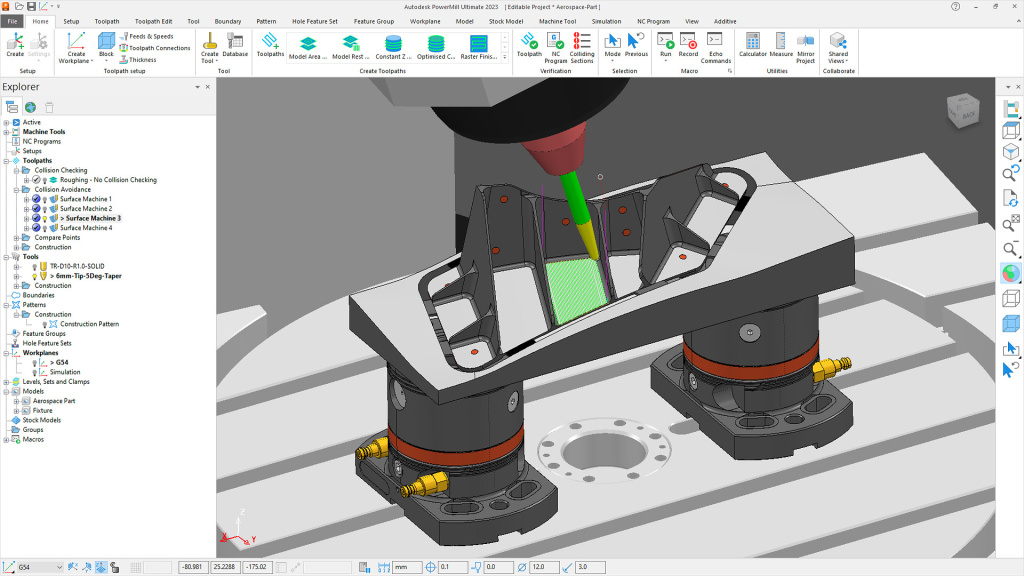
Aerospace: Programming the machining of critical aerospace components such as turbine blades, impellers, and structural aircraft parts. The software can handle the intricate shapes and tight tolerances required in aerospace manufacturing.
-
Automotive & Motorsport: Creating molds, dies, engine parts, and prototype models for cars and racing vehicles. Automotive suppliers use PowerMILL to machine tooling and custom components with high precision.
-
Industrial Machinery: Supporting the production of heavy machinery parts, injection molds, casting patterns, and other equipment used in manufacturing. PowerMILL’s toolpath strategies are ideal for mold & die work, reducing cycle times in tooling production.
-
Healthcare & Prosthetics: Crafting orthopedic implants, prosthetic devices, and orthotic molds. For example, custom prosthetic limb sockets or dental restorations can be milled from raw material using CAM programs generated in PowerMILL.
-
Footwear & Consumer Products: Designing and machining molds for shoe soles and other consumer goods. (Delcam had a specialized footwear solution, and PowerMILL has been applied to create complex patterns and molds in the footwear industry.)
-
Jewelry & Artisanal Manufacturing: Producing fine jewelry molds, engraving, and sculptures. Jewelers and artists employ PowerMILL to mill wax or metal pieces with intricate detail that would be difficult to achieve by hand.
-
Toys & Sports Equipment: Crafting detailed forms such as action figure molds or equipment prototypes. The software’s versatility even extends to programming machines for toys and sports gear, as noted by the company’s coverage of industries “from aerospace to toys and sports equipment.”
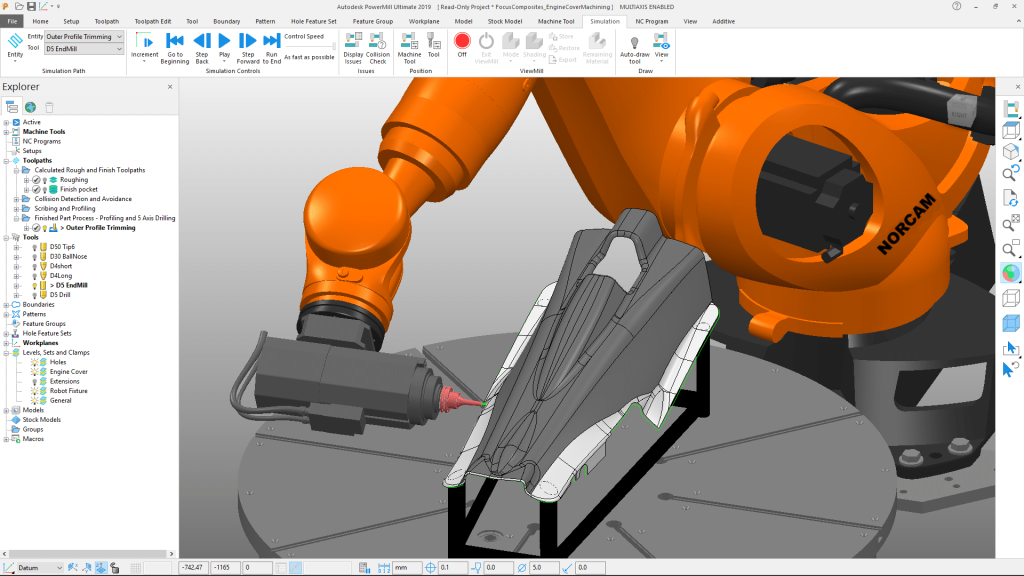
Across these diverse sectors, what the applications have in common is the need to accurately manufacture complex 3D shapes. PowerMILL is particularly valued for high-precision, high-value manufacturing scenarios—for example, aerospace engineers trust it to meet strict safety and quality standards, while mold makers rely on it to carve out tooling with fine detail and smooth finishes. The software supports not just traditional milling machines but also emerging applications; for instance, it has a Robot Interface option that allows programming of 6- or 7-axis robotic arms for machining, expanding its use into robotic manufacturing cells. This broad applicability has made PowerMILL a go-to CAM solution in any situation where advanced multi-axis machining is required.
Origins and Early Development
The origins of PowerMILL trace back to academic research in the 1960s and 1970s, long before the software itself was launched. In 1965, Dr. Donald Welbourn at Cambridge University in England recognized the potential of using computers to help pattern makers and engineers design complex 3D shapes for manufacturing. Backed by the UK Science Research Council and early sponsorship from companies like Ford Motor Company, Welbourn’s team began developing a software system for computer-aided manufacturing. By 1973, this research effort led to a pioneering CAM program called DUCT. Co-developed by Donald Welbourn and engineer Ed Lambourne (who was seconded from industry), DUCT was one of the earliest interactive CAM software systems. It enabled users to design and manipulate 3D models and generate toolpath instructions for machining—capabilities quite cutting-edge for the era of punch-card computing. The project was supported by the Cambridge University Engineering Department and received funding and technical resources from industry partners (for example, Control Data Corporation in Germany provided computing time on its mainframes). These industry collaborations ensured that the CAM software evolved with practical manufacturing needs in mind.
By the late 1970s, development of DUCT had moved from academia into the commercial realm. The Delta Metal Group, a British industrial company that had been involved in supporting the project, established a dedicated development center for the software in Birmingham, UK in 1977. This marked the formal founding of the company that would become Delcam. Initially operating as a subsidiary of Delta, the team in Birmingham continued improving the DUCT software and began selling CAM solutions to industry clients in the 1980s. As computer hardware advanced (particularly the advent of affordable mini-computers in the early 1980s), it became economically viable for even mid-sized manufacturers to use CAD/CAM technology for complex 3D design and machining. This environment allowed DUCT to gain a foothold in industries that needed computer-driven machining of complex parts, and the user base grew steadily.
In 1989, a management buyout led by Delcam’s then-managing director Hugh Humphreys and technical director Ed Lambourne bought the company from Delta Metal. The newly independent company was renamed Delcam International in 1991. This change ushered in a period of expansion and modernization for the company’s software. Delcam moved its headquarters into a purpose-built facility in Small Heath, Birmingham, and ramped up development efforts to create a new generation of CAM products. By the early 1990s, personal computers and workstations had become powerful enough to handle sophisticated 3D CAM calculations, and Delcam seized this opportunity to re-write and improve its software offerings.
PowerMILL as a product was born out of this early lineage and transition. Delcam took the accumulated expertise from DUCT and began developing a more advanced, Windows-based CAM system with a modern user interface and enhanced capabilities. The result was PowerMILL 1.0, first introduced in the mid-1990s (Delcam internally began rolling it out around 1995). This was part of what Delcam marketed as the “Power Solution” range – a suite of software that covered the full manufacturing cycle from design to machining. Alongside PowerMILL (for machining toolpaths), Delcam also introduced complementary products like PowerSHAPE (for 3D CAD modeling) and PowerINSPECT(for inspection and metrology). Together, these tools replaced the older DUCT system with a more modular and user-friendly set of applications. PowerMILL quickly became the flagship CAM offering, focusing on toolpath programming for CNC milling up to 5 axes. The early versions of PowerMILL in the late 1990s were adopted by manufacturing companies who needed to generate complex cutter paths efficiently. Users found that even at its first release, PowerMILL could handle complicated 3D sculpted surfaces with relative ease, making it especially popular in mold making and aerospace component machining.
Throughout the late 1990s and early 2000s, Delcam continuously improved PowerMILL with new features and enhancements in regular releases. By 2002, PowerMILL had robust 5-axis machining support, which was becoming increasingly important as 5-axis CNC machines gained wider use. Delcam’s developers – many of whom had deep expertise in CAM mathematics and algorithms – implemented advanced strategies for high-speed machining, rest machining (to remove remaining material after roughing), and automated collision checking to prevent the cutting tool or holder from gouging the part. This focus on technology and performance kept PowerMILL at the forefront of CAM innovation. In 2006, for example, Delcam introduced a PowerMILL Robot Interface, allowing the software’s toolpaths to drive multi-axis industrial robots, opening new possibilities for machining large or complex shapes using robotic arms instead of traditional machine tools. As personal computing power grew, PowerMILL also benefited from faster processing, enabling it to calculate toolpaths for large, complex models more quickly than earlier generations.
Growth, Acquisitions, and Autodesk’s Takeover
During the 2000s, Delcam experienced significant growth as a company, and PowerMILL played a central role in that success. To broaden its product offerings and enter new market segments, Delcam embarked on a strategy of acquisitions and partnerships. In the early 2000s, the company acquired several other CAM software firms, integrating their tools and technologies under the Delcam umbrella. Notably, Delcam purchased FeatureCAM (from Engineering Geometry Systems) in 2005 and PartMaker (a specialist in CNC programming for Swiss-type lathes and turn-mill machines) in 2006. These products complemented PowerMILL by addressing different niches: FeatureCAM focused on feature-based automation for milling and turning, while PartMaker catered to precision turned parts. Earlier, Delcam had also acquired smaller companies like Alcami (2001) and Crispin (2007, a footwear CAD/CAM specialist). Through these acquisitions, Delcam grew its customer base and its expertise, becoming a one-stop shop for a variety of CAD/CAM needs in manufacturing. By 2010, the company had one of the broadest portfolios in the CAM software industry, including solutions for design (PowerSHAPE), machining (PowerMILL, FeatureCAM, PartMaker), inspection (PowerINSPECT), and even artistic modeling (ArtCAM for engraving and decorative work).
In addition to acquisitions, Delcam forged strategic partnerships to enhance its market reach. For example, the company entered into a partnership with machine tool builder Doosan in 2008 to promote the use of PowerMILL and FeatureCAM on Doosan CNC machines. Through this collaboration, Delcam and Doosan worked together on optimized post-processors (the machine-specific instructions) and provided virtual machine tool models to ensure that customers could seamlessly program Doosan equipment. Similar cooperative efforts with other machinery and tooling companies helped Delcam tailor its software to real-world manufacturing environments and gave it an edge in delivering complete solutions to clients. These partnerships not only improved the product (through better machine integration and tested workflows) but also expanded Delcam’s sales channels in global markets via the partners’ networks.
By the early 2010s, Delcam’s growth was evident in its numbers and its global presence. The company was listed on the London Stock Exchange’s Alternative Investment Market (AIM) since 1997, and it reported steady financial growth year after year. According to company reports, Delcam reached milestones of 25,000 customers by 2008 and kept climbing – surpassing 40,000 by 2012 and about 45,000 by 2013. By 2013, Delcam had direct offices or joint ventures in over 30 countries and a network of more than 300 resellers and agents worldwide, providing local support to users in all major industrial regions. Its workforce had grown to around 700 employees globally (with an additional 100 or so in affiliated joint-venture companies). Notably, industry analysts at CIMdata identified Delcam in 2014 as the world’s largest specialist CAM software vendor by revenue and staff size. At that time, Delcam’s development team of over 200 software engineers was the largest focused on CAM R&D in the world – a fact that Delcam touted as a competitive advantage in pushing out new features and technology.
This success culminated in a major corporate development: in late 2013, Autodesk, Inc. announced its intent to acquire Delcam. Autodesk is a U.S.-based software giant known for AutoCAD and a broad portfolio of design, engineering, and media software. For Autodesk, which had been looking to expand into the manufacturing software space, Delcam’s CAM products were a perfect fit. The deal was substantial – Autodesk offered £20.75 per share, valuing Delcam at approximately £172.5 million (roughly $286–$300 million USD at the time). Industry observers noted that this price made it the largest acquisition ever in the CAM software market. Clive Martell, Delcam’s CEO at the time, underscored why Delcam commanded such value. “It’s because of the team at Delcam,” Martell said, emphasizing that the company’s highly skilled development team and “absolute world-class products” were its core strengths. He proudly described Delcam as having “the largest CAM team in the world” with deep expertise in advanced manufacturing – which in turn had built an “amazingly strong brand” with a loyal customer base. Those qualities made Delcam attractive not only to Autodesk but also made the acquisition somewhat “industry-disrupting,” as Martell put it, given the scale. Indeed, Autodesk’s move was seen as a game-changer in the CAM industry, dwarfing previous CAM mergers (Martell pointed out that prior combinations like Vero’s merger with Planit or 3D Systems’ acquisition of Cimatron were much smaller by comparison).
Autodesk officially completed the acquisition of Delcam in February 2014. Delcam then became a wholly-owned subsidiary of Autodesk, but interestingly Autodesk chose to allow it to continue operating with a degree of independence. At least in the immediate years after the deal, Delcam was run as an “independently operated subsidiary,” maintaining its development centers in Birmingham and its product lines under the same brand names (though co-branded with Autodesk later). This strategy was intended to ensure continuity for Delcam’s customers. “For the customer, it will feel like the same relationship,” commented Autodesk’s manufacturing solutions executive Buzz Kross at a post-acquisition briefing, reinforcing that Autodesk would keep Delcam’s structure and support in place. Autodesk’s CEO at the time, Carl Bass, also expressed enthusiasm for the deal. “Today we are taking an important step on our path toward delivering a better manufacturing experience,” Bass said in a statement, explaining that together Autodesk and Delcam would “help further the development and implementation of technology for digital manufacturing.” This reflected Autodesk’s vision of connecting design and manufacturing in a seamless digital workflow – essentially, Autodesk had great design tools (CAD, simulation, etc.), and by acquiring Delcam’s CAM and metrology tools, it aimed to provide a full spectrum solution from concept to fabrication. Clive Martell, for his part, noted he was “very excited by the opportunities” that would come from combining Delcam’s CAM expertise with Autodesk’s scale and design software prowess, envisioning a compelling platform to serve both companies’ customers.
Under Autodesk, the PowerMILL name was retained, now often referred to as Autodesk PowerMill. In the years following the acquisition, Autodesk gradually integrated Delcam’s products into its overall product ecosystem. Delcam’s leadership saw some changes: Clive Martell transitioned out of the CEO role a year or so after the acquisition, and Autodesk appointed new managers (for instance, a former Autodesk UK executive, Pete Baxter, took on a leadership role in the Delcam unit). Despite these changes, development of PowerMILL continued in Birmingham and the software roadmap remained aggressive. Autodesk invested in further R&D for PowerMILL and its sister products, leveraging the larger resources at its disposal. The user community benefited from Autodesk’s support in terms of more training resources, integration with Autodesk’s cloud services, and bundling options (such as offering PowerMILL alongside Autodesk’s Fusion 360 or Inventor software for companies that wanted both design and manufacturing solutions from one vendor).
Market Presence and Performance
By becoming part of Autodesk, PowerMILL gained an even wider distribution network and deeper financial backing. However, even prior to the acquisition, the software had achieved a strong market presence. Delcam’s revenues in its last full year as an independent company (2012) were reported at £47.1 million, and they continued to grow into 2013. The company’s steady growth was remarkable given the global economic turbulence around 2008–2009. Martell noted that although Delcam saw a brief slowdown during the 2008 financial crisis, the business rebounded quickly – by 2010, sales had surpassed their pre-recession peak. This resilience was attributed to Delcam’s broad international reach and diversified customer base. The Americas (North and South) became a major growth region for PowerMILL and other Delcam products in the early 2010s, alongside the software’s traditional stronghold in Europe. Asia was another critical market: Delcam had a particularly robust presence in countries like China, Korea, and Japan through subsidiaries and joint ventures (for example, Hankook Delcam in South Korea was a joint venture that grew to a 50-person team on its own). By spreading its business across automotive, aerospace, consumer goods, medical, and other sectors, Delcam managed to mitigate the impact of downturns in any single industry or region.
One metric illustrating PowerMILL’s popularity is the number of companies using it worldwide. As mentioned, Delcam celebrated its 40,000th customer in 2012 and 45,000th in 2013. After joining Autodesk, the momentum continued – the company marked over 50,000 customers by 2015. (These figures include all Delcam product customers, but PowerMILL was the flagship product for many of them.) In terms of individual users or seats of software, a Delcam fact sheet around that time cited approximately 90,000 active licenses/users globally. This extensive user base is geographically diverse: Europe (especially the UK, Germany, Italy) and North America are key markets, but a significant portion of users hail from East Asia (China in particular had many manufacturing companies adopting Delcam software). PowerMILL also had penetration in emerging manufacturing hubs around the world, supported by Delcam’s strategy of establishing local offices and training centers so that customers could get support in their local language and time zone.
After the Autodesk acquisition, exact user numbers are not publicly broken out for PowerMILL alone, since Autodesk reports broader business segments. However, Autodesk did indicate that the addition of Delcam brought tens of thousands of manufacturing software customers into its fold, contributing to Autodesk’s Manufacturing Solutions division growth. Autodesk’s manufacturing software revenue (which includes PowerMILL along with other CAM tools like FeatureCAM and Autodesk’s own Fusion 360 platform) became an important component of the company’s portfolio in the latter half of the 2010s. Autodesk’s strategy has been to offer PowerMILL as part of its “Make” portfolio (digital fabrication tools), often targeting enterprise customers who need advanced CAM capabilities beyond what the more general-purpose Autodesk Fusion 360 CAM can provide. As of the mid-2020s, PowerMILL remains a cornerstone product for high-end CAM within Autodesk’s lineup, indicating sustained demand. The software is typically licensed on a subscription basis under Autodesk, and it continues to be used by large automotive and aerospace companies, small specialized machine shops, and everything in between.
In terms of competition and market position, PowerMILL competes with other CAM software such as Mastercam, Siemens NX CAM, HyperMill (by Open Mind), and CATIA Machining (by Dassault Systèmes), among others. Industry surveys by CIMdata around 2013–2014 showed Delcam with roughly 8% of the global CAM software market (by direct revenue), making it one of the top CAM vendors worldwide. PowerMILL, as Delcam’s top-selling product by revenue, was a major contributor to that share. This placed PowerMILL among the leading CAM solutions globally. Its closest competitors vary by region and industry – for example, Mastercam has been strong in North America particularly for job-shop environments, while PowerMILL carved out a strong reputation in automotive and aerospace circles for very complex machining jobs. The Autodesk acquisition arguably further solidified PowerMILL’s market position by assuring customers of long-term support and integration. Rather than being a niche CAM-only company, Delcam became part of a $2 billion software corporation, which gave large enterprise customers confidence that their investment in PowerMILL would be supported for years to come.
Features and Innovations
PowerMILL’s enduring popularity is largely due to its rich set of features and the continuous innovations added over time. From the beginning, PowerMILL was engineered to tackle the most challenging CNC machining tasks – particularly the machining of complex free-form surfaces and curves often found in molds, dies, aerospace components, and sculpted products. Several key features and strengths distinguish PowerMILL in the CAM software landscape:
-
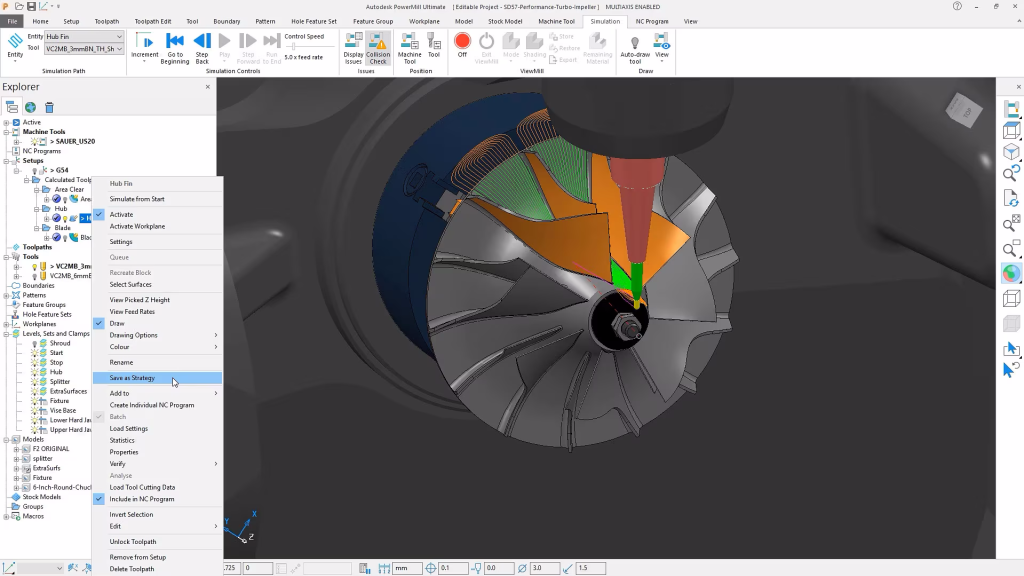
Advanced Multi-Axis Machining: PowerMILL excels at 3-axis, 4-axis, and 5-axis milling strategies. The software allows programmers to easily define toolpaths on complex geometry, including full five-axis simultaneous motions needed to machine intricate undercuts or deep cavities. It provides intuitive control over tool axis orientation, pivot points, and machine head rotations, which is crucial for avoiding collisions and tool holder interference in multi-axis setups. Early on, PowerMILL was among the leaders in making 5-axis toolpath generation more accessible; it offered specialized strategies for common 5-axis tasks like blade and impeller machining, engine porting, and trimming.
-
High-Speed Machining Strategies: Delcam was a pioneer in integrating high-speed machining (HSM) techniques into CAM software. PowerMILL offers numerous HSM toolpath styles that produce smooth, flowing motions ideal for high spindle speeds and fast feed rates. For example, its trochoidal milling and spiral finishingstrategies help avoid sharp corners in tool motion, thereby maintaining consistent cutting forces and reducing stress on the machine tool. Using these strategies, machinists can significantly cut down machining time while prolonging tool life – making the overall manufacturing process more efficient. The ability to helically mill holes or use adaptive clearing (a method of constant tool load roughing) are other HSM features that have been part of PowerMILL’s repertoire, allowing users to machine harder materials or complex pockets with less risk of tool breakage.
-
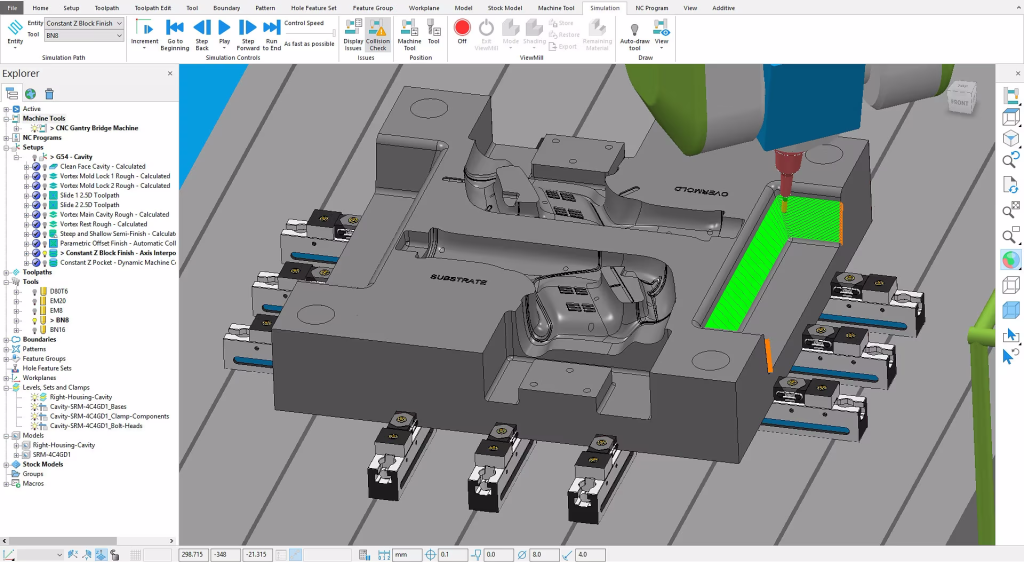
Toolpath Optimization and Editing: PowerMILL provides a high level of control to the CAM programmer to optimize toolpaths. Users can visualize the cutting tool’s trajectory and make detailed edits – for instance, removing small redundant moves, smoothing link motions between cut passes, or adjusting stepovers in localized areas. The software automatically checks for gouges (where the tool might cut too deeply into the part) and allows fine-tuning to avoid them. One of PowerMILL’s renowned strengths is its collision avoidance and simulation capabilities: it can simulate the entire machining process with the actual tool, holder, and machine kinematics model, flagging any potential collisions or near-misses. This gives programmers confidence that the program will run safely on the real machine. If issues are detected, PowerMILL can automatically adjust tool tilt angles or retract moves in 5-axis to dodge collisions – a feature highly valued in complex jobs. An experienced user described PowerMILL as “unmatched” for complex 3D contouring and praised its “amazing gouge protection and collision checking” – attributes that have set it apart when dealing with complicated geometries.
-
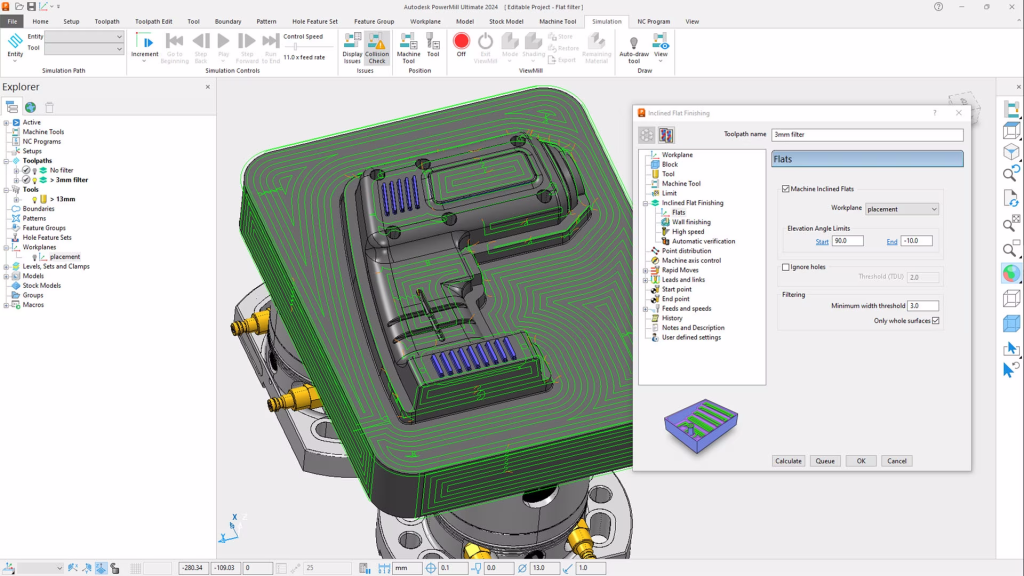
Surface Finish Quality: PowerMILL has always placed emphasis on generating toolpaths that result in excellent surface quality. It offers many finishing strategies (such as z-level slicing, raster passes, pencil milling for corners, and new flowline techniques) that can be applied based on the shape of the part. The software allows very fine control of stepovers and cusp height – the residual scallop left on a surface after machining – enabling users to achieve mirror-like finishes when required (for example, in mold tooling where polishing time needs to be minimized). In recent releases, Autodesk continued to enhance these finishing algorithms. A notable addition has been flowline finishing, which automatically follows the natural curvature of a surface, yielding an even finer finish with fewer tool marks. PowerMILL’s developers have also worked on optimizing tool entry/exit moves and linking moves so that the machine runs as smoothly as possible, reducing any dwell marks or sudden accelerations that could blemish the part surface.
-
Automation and Templates: For efficiency, PowerMILL includes features to automate repetitive tasks. Users can save machining strategies as templates and reapply them to similar parts or family-of-parts, saving programming time. The software’s scripting and macro capabilities allow power users to customize routines—for instance, automatically programming a series of drill holes or simplifying the programming of symmetrical parts. In addition, the integration of FeatureCAM technology into Autodesk’s offerings means some of its feature-based automation can complement PowerMILL for certain tasks (though they remain separate products, some cross-pollination of ideas occurs within Autodesk’s CAM tools).
-
Integration and Interoperability: PowerMILL is CAD-neutral, meaning it can import 3D models from virtually any CAD system (common formats include IGES, STEP, STL, CATIA, NX, SOLIDWORKS, etc.). Once inside PowerMILL, the user can prepare the model for machining by defining stock material, fixtures, and work coordinate systems. For design changes, PowerMILL works well in tandem with Delcam’s own PowerSHAPE or Autodesk’s CAD tools; for example, an engineer might tweak a design in Autodesk Inventor or Fusion 360 and update the machining toolpaths in PowerMILL accordingly. Under Autodesk, efforts have been made to improve data exchange between PowerMILL and other Autodesk software. There have also been moves to connect PowerMILL to cloud services—for instance, for sharing manufacturing process data or leveraging cloud computing to simulate multiple toolpath scenarios in parallel – though the core CAM computation remains a desktop application due to the heavy calculations involved.
Over the years, Delcam and Autodesk have ensured that PowerMILL keeps up with technological trends. One area of innovation has been combining additive and subtractive processes: while PowerMILL is mainly a subtractive (machining) tool, Autodesk has experimented with hybrid manufacturing strategies, and having a robust CAM engine like PowerMILL’s is beneficial for any integrated additive/subtractive system developments. Another area is metrology integration – with PowerINSPECT under the same roof, there have been initiatives to allow using the same geometric data for both machining and inspection, tightening the feedback loop for precision manufacturing.
In comparison to its competitors, PowerMILL’s distinguishing strength is often cited as its capability to handle extremely complex projects with reliability and flexibility. While other CAM packages also offer multi-axis machining, users often praise PowerMILL for giving expert programmers more direct control when they want it, and for its robust calculations that can manage large files (with millions of lines of code) without choking. Its heritage as a product born from intensive R&D and real-world feedback since the 1970s means that many corner cases in machining have been addressed over time. The software’s interface, while very powerful, is geared toward experienced CAM programmers who appreciate the depth of options available. This is in slight contrast to some newer CAM tools which focus on ease-of-use for simpler jobs; however, Autodesk has tried to make PowerMILL more approachable to new users by updating the UI and providing extensive learning materials post-acquisition.
Another noteworthy strength is the support and documentation accumulated around PowerMILL. Delcam built a strong user community, and that has continued under Autodesk. Users have access to extensive toolpath strategy libraries, example projects, and technical support from Autodesk’s advanced manufacturing team (many of whom came from Delcam). This knowledge base is crucial when tackling unusual machining tasks – chances are that someone has done something similar with PowerMILL and shared advice about it.
Leadership Perspectives and Vision
Throughout its journey from a research project to a commercial product and eventually an Autodesk offering, PowerMILL has been guided by a vision of innovation in manufacturing. The leadership at both Delcam and Autodesk have often articulated how this software fits into the future of making things. Delcam’s long-time technical gurus like Ed Lambourne and development director Steve Hobbs were known for pushing the envelope in CAM algorithms, always aiming to shorten computation times and improve the efficiency of generated toolpaths. This technical focus was balanced by business leaders like Hugh Humphreys and Clive Martell, who emphasized building a global presence and serving customers in varied industries. Martell, who became CEO in 2009, often highlighted the importance of investing in R&D and talent. Under his tenure, Delcam consistently put around 20% of its revenue back into research and development. “We have been investing heavily in research and development and are supporting new talent by employing skilled graduates,” Martell said in one interview, pointing out that a long-term view was necessary to stay ahead in the CAM market. This commitment to innovation kept PowerMILL’s development team releasing new features annually, and even exploring emerging manufacturing trends like additive manufacturing support (Delcam had begun projects in additive and was an official sponsor of the Bloodhound supersonic car project, reflecting a forward-looking culture).
From Autodesk’s perspective, the acquisition of PowerMILL (and Delcam’s technology at large) was part of a broader vision to unite the digital pipeline from design to production. Autodesk executives like Carl Bass and Buzz Kross envisioned that designers could model a part in CAD, simulate its behavior, and then directly generate the machining instructions – all using Autodesk software. The phrase “digital manufacturing” encapsulates this idea of a seamless flow. In line with this, Autodesk also developed Fusion 360 (a cloud-based CAD/CAM platform) for more integrated workflows. However, they recognized that for the most demanding machining work, PowerMILL’s advanced capabilities were unparalleled. As Buzz Kross humorously noted at a press event, Autodesk now had both the design tools that “all the big car brands use” and, with Delcam, the manufacturing tools that “all the beautiful cars use a lot more.” The synergy promised to “complete the circle” for customers who wanted a single ecosystem for design and manufacturing data.
In recent statements, Autodesk has reaffirmed its commitment to PowerMILL and the advanced manufacturing segment. The company has created an Autodesk Advanced Manufacturing Facility in Birmingham (essentially expanding Delcam’s site) to serve as a hub for developing PowerMILL, PowerSHAPE, FeatureCAM, and related products. This facility acts as both a R&D center and a demonstration lab where Autodesk can showcase the latest CAM techniques to industry partners. Current Autodesk leadership in digital manufacturing often speaks about the importance of high-end CAM in modern production, especially as trends like mass customization, generative design (where computer algorithms create optimized shapes), and automated factories become more prevalent. In these contexts, having a robust CAM engine like PowerMILL ensures that even the most complex generative-designed form can be manufactured efficiently.
Looking forward, PowerMILL is expected to continue evolving under Autodesk’s umbrella. The integration with cloud technology is one area to watch – for instance, storing machining knowledge in the cloud or using cloud-based AI to suggest optimal machining strategies could become part of the software’s future enhancements. Another area is the continued refinement of user experience: Autodesk might streamline certain workflows or combine elements of PowerMILL with other software (though as of today, it remains a distinct application due to its specialized nature). What remains constant is the software’s core mission: enabling manufacturers to cut complex parts accurately and efficiently. As manufacturing enters the era of smart factories and Industry 4.0, PowerMILL’s precise toolpath generation is likely to be a key component in automated CNC machining cells and digital fabrication processes worldwide.
Vendor: Autodesk