
RADAN CAD/CAM: From University Project to Sheet Metal Industry Staple
In a bustling sheet metal workshop, sparks fly as CNC machines cut and punch through metal with precision. Behind the scenes, software plays a pivotal role in orchestrating these operations. One such software is RADAN, a CAD/CAM system that has become a staple of the sheet metal fabrication industry. Celebrating nearly half a century in use, RADAN is widely acknowledged as one of the world’s leading PC-based solutions for sheet metal design and manufacturing. It offers a comprehensive suite of applications covering everything from part design and nesting, to CNC machine programming for cutting and bending, and even production management tasks like cost estimation and workflow planning.
Today, RADAN is part of Hexagon AB’s manufacturing software portfolio, but its origins trace back to a humble university project that revolutionized how sheet metal machinery is programmed.
A Focus on Sheet Metal Fabrication Applications
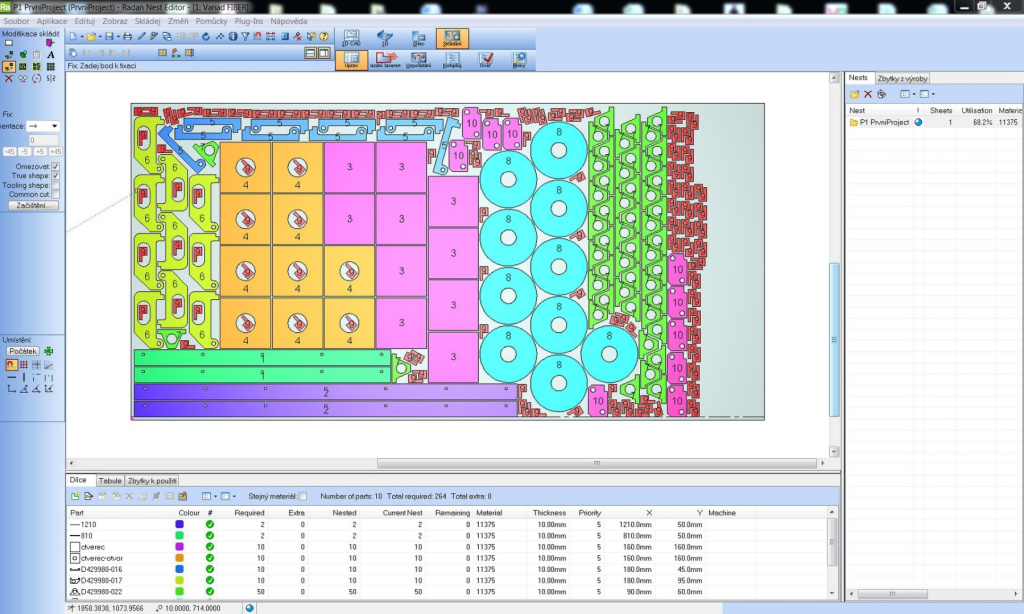
RADAN’s Core Purpose: RADAN is specialized CAD/CAM software developed exclusively for sheet metal fabrication. Its primary role is to help engineers and programmers design sheet metal parts and generate the NC (numerical control) code to drive cutting machines (such as laser cutters, plasma cutters, and turret punch presses) and bending equipment (press brakes). In practical terms, RADAN allows a user to draw or import a part, lay it out optimally on metal sheets (a process called nesting), and then produce the machine instructions for cutting out the shape and bending it to final form. The software supports a variety of sheet metal processes under one umbrella – a user can program precise punch patterns for a CNC turret press, toolpaths for laser or waterjet cutting, and even the bending sequences for a press brake, all using RADAN’s modules.
Industry Use Cases: The capabilities of RADAN are tailored to the needs of sheet metal manufacturers across many sectors. Job shops and OEMs in industries such as automotive, aerospace, electronics, HVAC, and furniture rely on RADAN to produce parts ranging from small brackets and clips to large enclosures and panels. For example, an engineering subcontractor might use RADAN to program a turret punch press equipped with special multi-bend tooling, allowing small bends to be formed during the punching process instead of a separate bending station. This integration saves time and streamlines production.
Fabricators use RADAN to maximize material usage by nesting many part shapes onto each metal sheet with minimal waste, and to switch between cutting technologies as needed – one part might be more efficiently produced on a laser cutter versus a punch press, and RADAN helps evaluate and program both options. Thanks to its broad functionality, RADAN often becomes the all-in-one software backbone of sheet metal shops. Some companies run their entire fabrication programming through RADAN, using it not only to generate cutting paths but also to simulate bend sequences, estimate job costs, and output production reports. In essence, if a product is made of sheet metal, RADAN is the kind of software that can take it from a CAD drawing to a finished cut and formed component on the shop floor.
Origins at Bath University and Early Development
RADAN’s story begins in 1976 in Bath, England – long before personal computers and CAD software were commonplace in manufacturing. At that time, programming a sheet metal punch press was a laborious task: engineers wrote coordinate commands by hand, and the instructions were fed into the machine via punched paper tape. That year, two senior lecturers at Bath University, Tony Billett and Martin Swainston, were approached by a machine tool manufacturer with a forward-thinking request: could the process be improved by simulating it on a computer first? Billett and Swainston developed a software program to read the punch press’s paper tape and simulate the machine’s movements offline. This was a breakthrough – for the first time, a factory could test and verify a sheet metal NC program on a computer before committing metal to the machine. “It was very primitive compared to RADAN today, but far in advance of anything else available in 1976,” one early team member later recalled of that initial program. The ability to catch errors or optimize tool paths virtually, rather than on the shop floor, saved time and material, heralding a new era of computer-aided manufacturing for sheet metal.
Encouraged by this success, the university project spun off into a commercial endeavor. The resulting company, Radan Computational Ltd, was founded in 1976 (the name “RADAN” itself likely derived from “RAymund DANiel” or another moniker, according to company lore, though the exact naming story is less documented than the software’s technical evolution). From the late 1970s into the 1980s, Radan Computational grew as a small engineering software firm, focusing solely on sheet metal applications – a niche largely ignored by the mainstream CAD/CAM vendors of the time. The early products, branded Radraft (for computer-aided drafting of sheet metal parts) and Radpunch (for generating punch press programs), ran on Tektronix 4050-series graphical workstations. These systems were among the first to bring interactive computer graphics to manufacturing engineers, allowing users to draw parts on-screen and output NC code. As computing hardware advanced, the Radan software was ported to UNIX systems in the mid-1980s, expanding its performance and capability. By 1990, Radan released its first 3D module, enabling the modeling and unfolding of 3D sheet metal components – critical for designing parts with bends and then flattening them for cutting patterns. The mid-1990s saw another pivotal transition: the entire RADAN product suite was re-engineered for the Windows PC platform by 1995, aligning with the broader migration of CAD/CAM tools to personal computers.
Throughout the 1990s, Radan gained traction internationally. The company appointed distributors in multiple countries, which led to rapid export growth. Many sheet metal fabricators around the world adopted RADAN as they modernized their operations, impressed by the software’s ability to handle complex punching routines and later, laser cutting as that technology became prevalent. By the early 2000s, RADAN had established itself as a leading solution in its domain. In 2002, a new generation of RADAN for Windows was introduced, bringing a refreshed interface and enhanced features to keep up with evolving user needs.
Growth, Acquisitions, and Global Expansion
While Radan Computational started as a two-person venture, by 2006 it had grown into a 75-employee international business headquartered in Bath with subsidiaries in France and the United States. An informal ceremony in 2006 marked RADAN’s 30th anniversary, where managing director Chris Aston recounted the journey from that “two-man operation in 1976” to a company with thousands of users worldwide. Around this time, RADAN reached an impressive milestone: over 15,000 software licenses were in use around the world, testament to its widespread adoption. “We are currently enjoying the most successful period in our history,” Chris Aston said in 2006, attributing the success to the product’s comprehensive approach. By providing a “one-stop shop” of software for all of a sheet metal company’s needs – from design through to cutting, bending, and even quoting – Radan had secured “an enviable position as the dominant supplier within the UK sheet metal sector.” In its home market of Britain, RADAN was arguably the number one CAD/CAM system for sheet metal, and its footprint internationally was steadily expanding.
A major turning point for the business came in 2003, when Radan Computational was acquired by Planit Holdings, a UK-based CAD/CAM conglomerate. Planit Holdings plc was known for assembling various manufacturing software brands; at the time it also owned solutions like Alphacam (for woodworking/CNC routing), Cabinet Vision (for cabinet/furniture design), and an ERP/MRP system for workshops. Bringing Radan into the fold gave Planit a strong position in sheet metal fabrication software. Under Planit’s ownership, RADAN’s development remained centered in Bath and the product strategy was sharpened to focus exclusively on sheet metal (dropping any peripheral products that Radan had experimented with, in order to deepen its specialization). The mid-2000s also saw Planit acquire the Edgecam metal cutting CAM software, among others, making Planit one of the largest CAD/CAM vendors in the UK.
In 2011, a significant industry consolidation occurred: Planit Holdings merged with Vero Software, another UK-based CAM software company. Vero Software was the developer of solutions like VISI (for mold and die design), and it had a strong presence in general machining CAM. The merger, backed by the private equity firm Battery Ventures, combined Planit’s portfolio (including RADAN) with Vero’s, creating one of the world’s largest CAM software groups. Industry analysts noted that the new combined company became the third-largest CAD/CAM software vendor globally, trailing only the much larger general CAD companies Dassault Systèmes and Siemens PLM. Importantly for RADAN users, the new parent company (which continued under the name Vero Software) made it clear that all product lines would continue to be developed and supported. “We fully recognize the importance of product branding and customer loyalty, and therefore it is important to emphasize that we will continue to invest in all of the products,” said Richard Smith, then CEO of Vero, underscoring that RADAN’s future was secure in the merged entity. This period brought RADAN a broader global reach as well, since Vero had direct offices and resellers in dozens of countries.
The next chapter in RADAN’s corporate story came in 2014. In July of that year, the Swedish technology firm Hexagon AB announced the acquisition of Vero Software. Hexagon is a multinational known for its high-end measurement, industrial design, and simulation technologies, and the move signaled Hexagon’s expansion into the manufacturing software arena. Through this acquisition, RADAN (as part of Vero) joined a family of software brands under Hexagon’s Manufacturing Intelligence division. Hexagon’s interest in RADAN and its sister products was driven by a vision of offering end-to-end solutions for smart factories – integrating design, production, and quality control. “Together with its unique suite of manufacturing software solutions, Vero Software has the expertise, knowledge and resources to deliver even higher levels of productivity to our customers,” Hexagon President and CEO Ola Rollén said at the time, highlighting the value of adding CAM solutions like RADAN to Hexagon’s portfolio. He noted that leveraging Hexagon’s global footprint and combining technologies would support the growing need to integrate all data and processes across the manufacturing lifecycle.
The deal was accompanied by information that Vero Software’s turnover in 2013 was approximately €80 million, giving a sense of the business scale RADAN was part of by that point. Under Hexagon, RADAN’s development team has continued to release new versions annually, and the product now benefits from the stability and R&D resources of a large parent corporation. The RADAN brand remains intact (often marketed as “Hexagon RADAN” or under the banner of Hexagon Production Software), and the software continues to be sold worldwide through Hexagon’s channels. With Hexagon’s backing, RADAN has further extended its global reach – today it is used in over 50 countries, supported by a network of Hexagon offices and authorized resellers across Europe, Asia, the Americas, and beyond.
Features, Modules, and Innovations
One of RADAN’s greatest strengths is its breadth of functionality tailored to sheet metal fabrication, all integrated into a single platform. Over decades of development, the software has evolved a modular structure, with each module focusing on a specific aspect of the sheet metal process while sharing a common interface and data. Key modules and features include:
-
Design & Drafting: RADAN offers 2D and 3D design tools for sheet metal. The legacy Radraft module provides 2D CAD drafting for flat patterns, and more recently Hexagon introduced a 3D CAD module (often referred to as RADAN Designer) which allows users to create or import solid models. These models can be unfolded automatically into flat shapes for cutting. This capability to take a 3D part (for example, a chassis or bracket designed in SolidWorks or another CAD system) and generate the flat cut layout is essential in sheet metal work. RADAN reads common CAD files and can integrate via direct interfaces or import routines, ensuring that it fits into various CAD workflows.
-
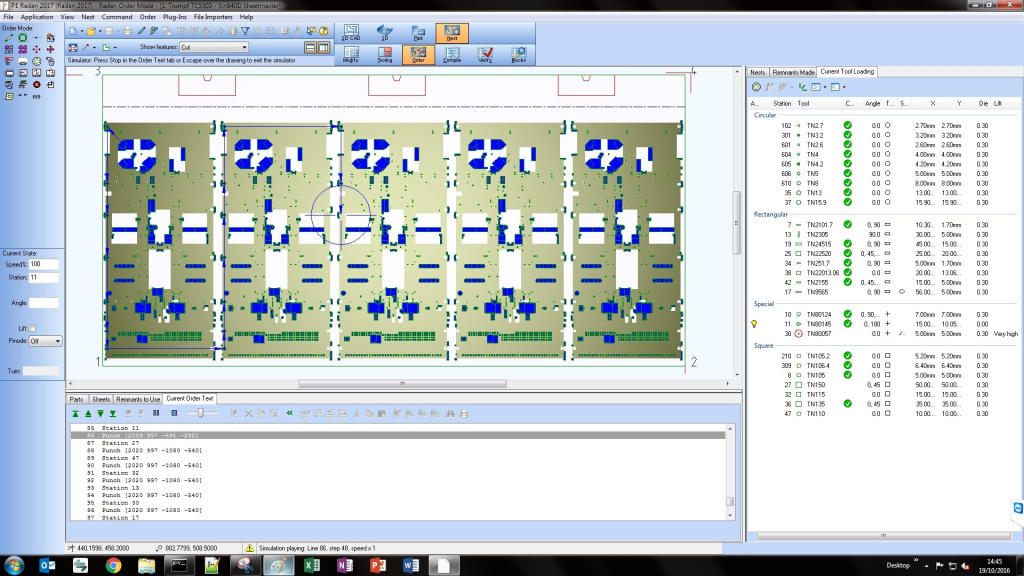
Punching (Radpunch): For CNC punch press programming, RADAN’s Radpunch module provides comprehensive tools to assign punches to part geometry, optimize tool paths, and minimize machine hits. It supports turret punch presses from a wide range of machine manufacturers, handling tasks like auto-selection of appropriate tooling, repositioning for sheets larger than the machine’s throat, and use of special tools (such as cluster punches or forming tools). Radpunch aims to reduce programming time and increase the efficiency of punching operations through automation, while still allowing the programmer fine control over tooling decisions if needed.
-
Profiling (Radprofile): The Radprofile module addresses laser cutting, plasma cutting, waterjet, and other profiling processes. Users can program precise contour cuts for these CNC machines, with RADAN automatically determining lead-ins, lead-outs, cutting order, and piercing points. It includes technology tables to adjust cutting speeds and parameters based on material type and thickness. For profile cutting machines that also have punching capability (combination machines), RADAN can handle both in a coordinated way (through a Radcombi module), deciding which features to punch and which to laser cut for optimal efficiency.
-
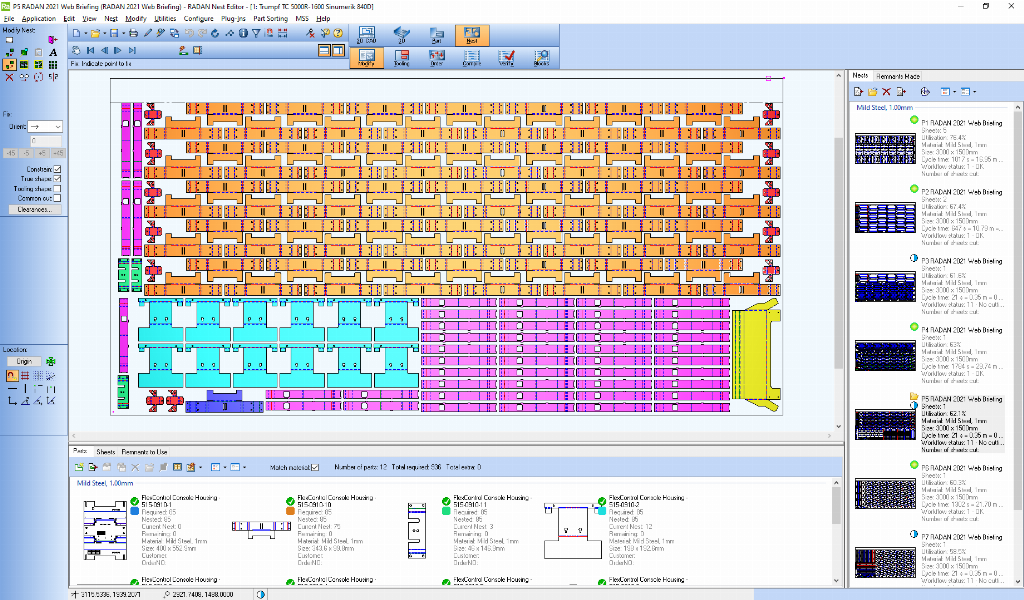
Nesting (Radnest): Material utilization is critical in sheet metal fabrication, and Radnest provides advanced true-shape nesting functionality. This means it can take a batch of part geometries and compute the best arrangement of those shapes on standard sheet sizes, allowing parts to nest inside cutouts of other parts when possible. Radnest factors in grain direction, part rotation constraints, and quantity requirements. The goal is to minimize waste scrap and maximize the number of parts per sheet, which directly saves material cost. RADAN’s nesting can be run in automatic mode for a quick layout, or manually adjusted with interactive tools for the programmer to tweak layouts. Recent versions of RADAN have introduced features like common-line cutting(sharing cut paths between adjacent parts) and better management of sheet remnants, improving material yield further.
-
Bending (Radbend): RADAN extends into press brake programming with its Radbend module. After parts are cut out flat, they often need bending on a press brake to form flanges and brackets. Radbend imports the 3D model (or uses the one from RADAN Designer) and allows the user to simulate the bending sequence. It will determine the optimal bend order, tool selections (press brake tooling like punches and dies), and back-gauge positions, while checking for collisions or feasibility issues. This offline programming for press brakes means setup and trial-and-error on the actual machine can be minimized. Radbend generates the NC code for modern CNC press brakes and also provides setup information to operators. By having cutting and bending software linked, any design changes can be reflected all the way through to bending without reprogramming from scratch – a big advantage over separate systems.
-
Tube Cutting and 5-Axis Laser (Radtube & Radm-ax): For specialized applications, RADAN offers Radtube(for CNC tube cutting machines) and Radm-ax (for 5-axis laser cutting systems). These modules handle the CNC programming of complex cuts on cylindrical or rectangular tubing and can drive 5-axis laser heads that cut at angles or cut intricate shapes on formed parts. By extending its core algorithms to these niches, RADAN appeals to manufacturers in sectors like automotive exhaust fabrication or structural steel work, who need to program tube laser machines or multi-axis laser cells. These modules were added as RADAN identified growing needs in those areas, and they allow companies to use a single software environment for both flat sheet and tube cutting programming.
-
Logistics and Production Management: Beyond pure CAD/CAM, RADAN has developed production management add-ons that address the upstream and downstream parts of the workflow. For instance, Radimport automates the import of parts and job information from external systems (useful when handling dozens of customer DXF files or a BOM of parts to be made). Radmanager helps manage the scheduling of nests and the organization of parts by customer or work order. Radquote, as the name suggests, is a module to quickly generate accurate quotes for sheet metal jobs – it uses the part geometry and material data to estimate cutting time, punching time, bending time, and material cost, giving sales teams a reliable cost in minutes. These tools emerged from direct customer feedback. As RADAN’s Sales Manager Kevin O’Connor observed, sheet metal shops increasingly “want something to run the whole of their production process, which may include punch, laser, press brake, costing, and production control.” In response, RADAN’s team developed this broader logistics suite so that managers can go from customer inquiry to finished part within one software ecosystem. For example, an estimator can import a customer’s CAD file into Radquote, get a price and lead time, and once the order is confirmed, seamlessly use that same data to generate nests and NC code in Radpunch/Radprofile – avoiding duplicate data entry.
Innovation and Competitive Strengths: Several factors have kept RADAN at the forefront of its field. First is its deep specialization – by dedicating itself to sheet metal from the very beginning, RADAN built up features that generalist CAM systems lacked. It was an early pioneer in automating CNC programming for punching and profile cutting, introducing capabilities like feature recognition (automatically detecting part features like holes or slots and assigning the appropriate tools) and fully automatic toolpath generation well ahead of many competitors. Users often praise the balance RADAN strikes between automation and control: the software can automatically generate an entire nest of parts with toolpaths in seconds, but it also allows skilled programmers to intervene, edit tool selections, or adjust cutting sequences easily where needed. This flexibility has been crucial in winning over job shops who need to fine-tune jobs for custom requirements.
Another strength is the all-in-one nature of the RADAN suite. Especially after the addition of quoting and management modules, RADAN positioned itself not just as a programming tool but as a comprehensive manufacturing solution. A fabricator can rely on RADAN for virtually every digital aspect of their operation, which simplifies training and IT integration. By comparison, some competitors might offer excellent nesting or cutting software, but not have an integrated bending module or quoting system, forcing companies to use multiple software packages. RADAN’s “single solution” approach thus became a selling point – less hassle, more consistency. It’s often marketed as a “total solution for sheet metal manufacturing”, promising greater material utilization (through superior nesting reducing scrap) and improved workflow efficiency (through data integration from quote to production).
RADAN has also maintained a close relationship with machine tool manufacturers and its user community, which drives its ongoing innovation. The development team works with major sheet metal machine OEMs (like Trumpf, Amada, Bystronic, Salvagnini, and others) to ensure new machines and features are supported in RADAN as soon as they hit the market. When fiber lasers became popular, RADAN quickly incorporated cutting strategies tailored to them; when new punching machines with higher hit rates or special tools come out, RADAN updates its post-processors and tool libraries accordingly. The company also hosts regular user group meetings and solicits feedback. “We talk to the machine tool companies to ensure that all our new functionality fits in with their technology, and we hold regular user group meetings where customers tell us what they’d like to see in future releases,” says Kevin O’Connor, emphasizing the collaborative development philosophy. This user-driven approach has led to practical enhancements in each annual release of RADAN. For example, recent versions introduced automatic part marking (to label parts with IDs during nesting), improved handling of residual sheet remnants, and refined algorithms for things like “end-burn” lead-outs to improve cut quality on thick materials – features often requested by fabricators tackling very specific production challenges.
Business Footprint and Outlook
From its modest start in the UK, RADAN today has a truly global footprint. The software is used by thousands of manufacturing companies on every continent. Under Hexagon’s ownership, RADAN is sold and supported through Hexagon Manufacturing Intelligence’s worldwide network, which means customers can get local training and support in their own language and time zone – an important factor for global companies. The user base spans small 2-3 person job shops as well as large multinational enterprises with multiple fabrication facilities. While exact user numbers aren’t publicly updated, the figure of 15,000 licenses in 2006 has surely grown substantially with the boom in manufacturing over the last two decades and Hexagon’s expanded reach.
In terms of business performance, RADAN contributes to Hexagon’s software segment revenues. Although financial data specific to RADAN isn’t broken out (as it’s bundled within a larger division), the success of the product can be inferred from the continued investment in its development and the expansion of its module offerings. Even after nearly 50 years, RADAN keeps adding new functionality annually, indicating a solid and ongoing return on investment for the company. This longevity and continuous improvement are relatively rare in the software world – many niche products from the 1980s have long since disappeared or been replaced, but RADAN has managed to stay relevant and competitive. Part of this stems from the strategic mergers and acquisitions that brought it under the umbrella of larger organizations, providing financial stability and a broader market reach. But equally, it stems from the software’s adaptability. RADAN evolved with technological shifts (for instance, moving to Windows, embracing 3D CAD integration, supporting new machine innovations) and adapted to changing customer demands (like providing faster quoting tools and hooks into ERP systems for Industry 4.0 integration).
Looking ahead, RADAN appears poised to remain a key player in its niche. The push toward smart manufacturing and fully digital fabrication workflows plays to RADAN’s strengths, since it already ties together design, manufacturing, and management data in one system. The backing of Hexagon – which is investing heavily in digital factory solutions – means RADAN could see integration with other high-tech systems, such as feedback loops from machine tool monitoring or links with metrology (quality inspection) data to adjust cutting processes. In interviews, RADAN’s team has highlighted two focus areas for the future: continuously delivering state-of-the-art functionality in each release, and further developing the logistics/management side of the software to support end-to-end production control. In essence, the goal is to keep giving sheet metal fabricators new tools to improve productivity in cutting and bending, while also empowering them with better information flow and automation for their entire operation.
After nearly five decades, RADAN’s core mission hasn’t changed: helping sheet metal companies cut parts more efficiently and profitably. Its longevity is a testament to how well it has fulfilled that mission. From a university lab concept in the 1970s to an industry-standard software in the 2020s, RADAN has navigated the tides of technology and market competition through innovation, focus, and a close connection to its users’ needs. As manufacturing moves further into the digital age, RADAN is well-positioned to remain an indispensable tool in sheet metal fabrication, continuing to evolve just as it has done since the days of paper tape and mainframe computers.
Vendor: Hexagon