
ESPRIT CAM: Four Decades of Innovation in Manufacturing Software
ESPRIT is a high-performance computer-aided manufacturing (CAM) software system used for programming CNC (computer numerical control) machine tools. Developed as the flagship product of DP Technology Corp., ESPRIT has grown into one of the world’s leading CAM solutions for manufacturers. The software enables users to create, optimize, and simulate CNC machining programs for a wide range of equipment – from simple milling machines and lathes to complex multi-axis, multitasking machining centers. ESPRIT’s core strength lies in its adaptability: it provides a single, universal CAM platform capable of driving almost any type of CNC machine through a common interface. This means a machinist can program milling, turning, drilling, wire EDM, or even hybrid additive manufacturing operations all within one software environment. The result is a streamlined workflow that helps companies reduce programming time, avoid costly errors, and maximize the utilization of advanced machine tools.
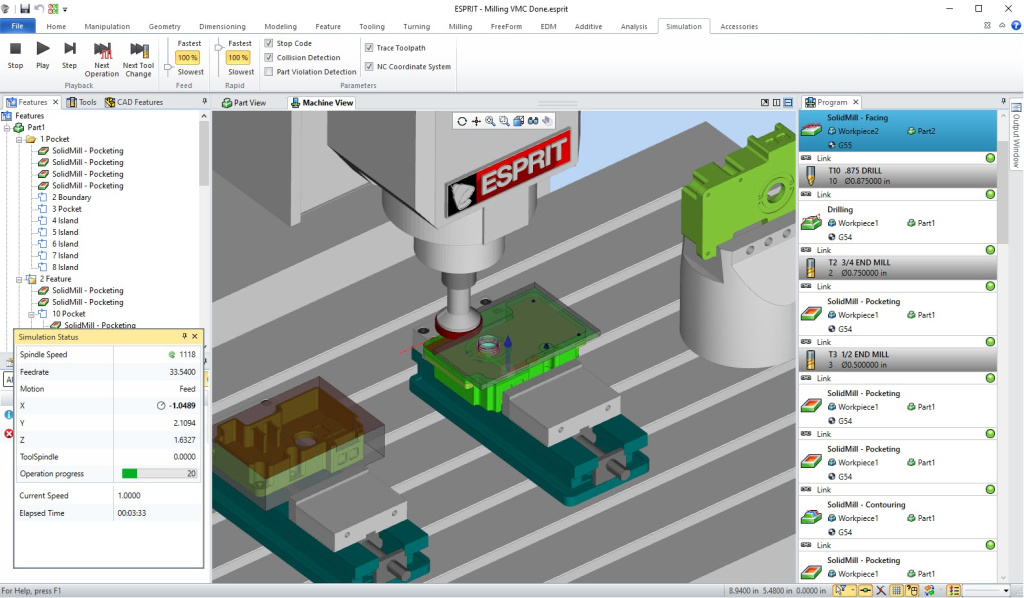
A key element that differentiates ESPRIT is its emphasis on “digital twin” simulation and optimization. The software builds a virtual model of the real machining environment – including the CNC machine, workpiece, cutting tools, and fixtures – to simulate cutting processes exactly as they would occur on the shop floor. By leveraging this digital twin, ESPRIT can generate machine-optimized G-code toolpaths that often require no manual editing. In other words, the code that ESPRIT outputs is ready to run on the machine (“edit-free”), which is a significant advantage in an industry where post-program tweaking is common. This capability is supported by factory-certified post-processors (software translators for specific machine models) that DP Technology developed in collaboration with machine tool builders. Combined with intelligent automation features, ESPRIT helps ensure that the CNC program will execute smoothly, improving tool life, cycle times, and overall productivity for the end user.
The vendor behind ESPRIT also plays an important role in the system’s identity. ESPRIT was originally created and sold by DP Technology Corp., a California-based CAM software company. In late 2020, DP Technology was acquired by Hexagon AB, a Swedish technology conglomerate, and became part of Hexagon’s Manufacturing Intelligence (MI) division. Hexagon MI is a major provider of industrial solutions, known for its metrology equipment and production software portfolio. Under Hexagon, ESPRIT continues to be developed and marketed globally, now backed by the resources of a large multinational. The product is often referred to as “Hexagon’s ESPRIT” in recent years, reflecting its new ownership. Despite the corporate change, the ESPRIT brand and team remain focused on CAM innovation and customer support, operating as a business unit within Hexagon’s extensive manufacturing technology lineup. (Official information and downloads can be found on the ESPRIT website, which is now part of Hexagon’s online presence.
Application Areas and Industries
ESPRIT CAM software is used across a broad spectrum of industries and manufacturing applications. Because it is a general-purpose yet highly adaptable CAM system, its user base ranges from small job shops to large industrial enterprises. Aerospace and defense companies employ ESPRIT to program the machining of complex aircraft components, engine parts, and high-precision defense equipment. The software’s ability to handle multi-axis milling and turning makes it well-suited for the intricate geometries and tight tolerances often found in aerospace work. Automotive and transportation manufacturers also use ESPRIT for various parts – from engine blocks and transmission components to tooling and molds – taking advantage of its fast programming and optimization to improve production efficiency.
In the medical and dental field, where one-off custom parts and fine detail are common (such as orthopedic implants or surgical instruments), ESPRIT’s simulation and accuracy help ensure first-part correctness and reduce material waste. Energy and power generation companies (oil & gas, renewable energy, etc.) utilize the software to machine large-scale components like valves, pump parts, and turbine blades, relying on its support for both heavy 3-axis milling and complex 5-axis cutting strategies. The die and mold industry is another key sector: mold makers benefit from ESPRIT’s advanced 3D surface machining and high-speed milling strategies to achieve smooth finishes on molds and dies used for plastics, glass, and metal casting.
Beyond these high-tech industries, ESPRIT is a popular choice for general industrial machinery, construction equipment, and consumer products manufacturing. It is often found in job shops and contract manufacturing firms, which serve a variety of customers and thus need a versatile CAM system. For example, a small precision machining shop might use ESPRIT to program anything from simple brackets to complex multi-operation parts for different clients. Because ESPRIT supports programming for multitasking machine tools (machines that combine milling and turning in one, for instance), it’s especially valued in shops that have invested in advanced CNC equipment to consolidate operations.
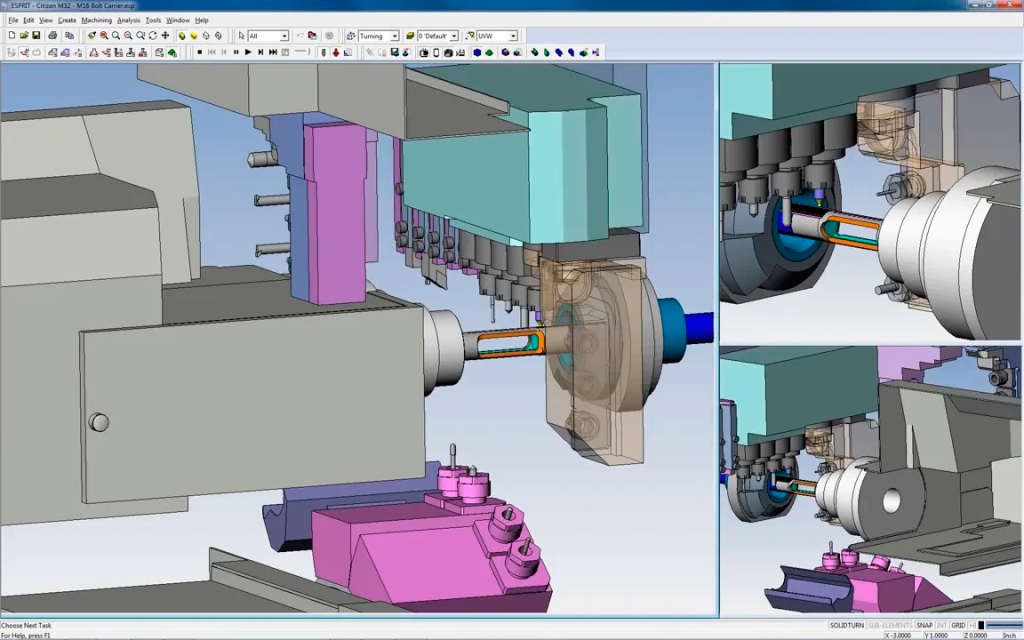
Notably, ESPRIT has strong capabilities in programming Swiss-type lathes (sliding-headstock automatic lathes used for very small, precise parts, common in medical and electronics industries) and multi-spindle, multi-turret mill-turn centers. These types of machines are notoriously complex to program due to multiple simultaneous cutting operations. ESPRIT provides synchronized programming and simulation for such equipment, which is a major reason industries like medical device manufacturing and electronic connector production (where Swiss machines are prevalent) turn to ESPRIT. The software’s algorithms manage the coordination of multiple toolpaths and spindles, helping users avoid collisions and optimize cycle times on these sophisticated machines.
In summary, the application areas of ESPRIT span virtually all sectors of discrete manufacturing. The software is used “in thousands of shops all over the world,” as the company often notes, from small family-owned machine shops to multinational corporations. Its users make parts that drive industries such as aerospace, automotive, energy, medical, consumer goods, industrial equipment, and more. This broad adoption is a testament to ESPRIT’s flexibility: whether it’s a one-off custom part or high-volume production, simple 2-axis turning or 5-axis simultaneous milling, ESPRIT can be configured to handle the job. This wide industry reach has also been enabled by DP Technology’s strategy of partnering with machine vendors and toolmakers (more on that later), ensuring that ESPRIT stays current with the latest manufacturing techniques and machinery in each field.
History and Evolution of ESPRIT
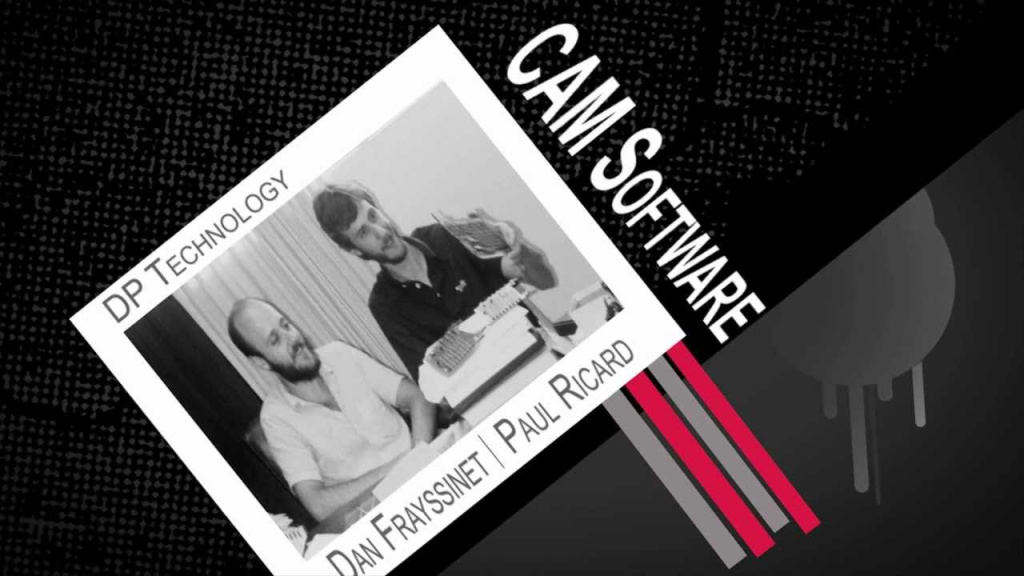
The story of ESPRIT CAM began in the early 1980s, amid the rise of computer-aided manufacturing software. DP Technology Corp., the original developer of ESPRIT, was founded in 1982 by two French-born engineers, Dan Frayssinet and Paul Ricard. The duo met in Chicago in 1980 while working on software projects, and they soon decided to start their own company to pursue their vision of improving manufacturing through software. By 1982 they had moved to Camarillo, California (just north of Los Angeles), and officially launched DP Technology. The name “DP” was simply taken from the first letters of “Data Processing” or could even stand for the first names of the founders (Dan and Paul), as anecdote has it – either way, the fledgling company was focused on developing cutting-edge CAM software for the emerging CNC machining industry.
In its early days, DP Technology carved out a niche by focusing on software for wire EDM (Electrical Discharge Machining). Wire EDM is a specialized process used to cut hard metals with a thin electrified wire, and in the 1980s it was a relatively small market. By providing a dedicated solution for this niche, DP Technology was able to gain a toehold in the CAM market. ESPRIT (which had been chosen as the product name) quickly earned a reputation among EDM shops for its effectiveness in programming complex EDM geometries. This initial success with EDM gave the company a stable base from which to expand. As CNC machine tool technology advanced through the late 1980s and 1990s, DP Technology broadened ESPRIT’s capabilities to cover more common machining processes: milling and turning. The company’s vision was to create a full-spectrum CAM system that could handle “the entire manufacturing process” for machine shops. By the mid-1990s, ESPRIT was supporting 3-axis milling and 2-4 axis turning on lathes, and had introduced features for multi-axis interpolation and basic 5-axis machining – keeping pace with the increasing complexity of machine tools.
Throughout the 1990s and into the 2000s, DP Technology remained a relatively small but growing player in the CAM software industry, competing with other established CAM packages. A major turning point came in the early 2000s when the company anticipated the rise of multitasking CNC machines. Machines that could perform milling and turning in one (often called mill-turn centers) and those with multiple spindles and turrets were becoming more popular as manufacturers sought to complete parts in one setup. However, programming these machines was challenging with existing software. DP Technology invested in developing ESPRIT’s ability to program such multi-channel machineswith synchronized toolpaths and comprehensive simulation. This forward-looking development paid off handsomely.
In 2008, DP Technology secured a landmark partnership with Japanese machine tool builder Mori Seiki Co. (which later merged into DMG MORI). Mori Seiki agreed to bundle a license of ESPRIT with every one of its mid-range and high-end machine tools sold worldwide for a period of five years. This was a huge endorsement of ESPRIT’s capabilities on complex machines, essentially making ESPRIT the CAM solution of choice for Mori Seiki’s advanced lathes and mill-turn centers. The deal massively increased ESPRIT’s exposure: as Mori Seiki shipped machines globally, many end-users were introduced to ESPRIT as part of their new equipment. According to co-founder Paul Ricard, name and brand recognition of ESPRIT “increased exponentially” after this point. The Mori Seiki partnership opened doors to collaborations with other top machine manufacturers as well – soon Mazak, Okuma, and Citizen (all renowned makers of multitasking or Swiss-type machines) worked with DP Technology to ensure ESPRIT could drive their latest CNC models. This era, around 2008-2010, marked rapid growth for DP Technology as the company’s software became embedded in the workflows of many high-end machine tool users.
As DP Technology grew, it also expanded its global footprint. The company established offices and subsidiaries in Europe and Asia to support its international customers, eventually operating more than 20 offices across three continents. ESPRIT’s user community spread worldwide, supported by a network of resellers and technical support centers. During the 2010s, DP Technology reportedly made several strategic acquisitions to complement its technology portfolio and accelerate growth (though specific acquisitions were not always publicly detailed). These likely involved acquiring smaller software tools or talent to enhance features like knowledge-based machining, additive manufacturing, or cloud connectivity as the industry evolved.
DP Technology continually improved ESPRIT with new releases – often named by year (ESPRIT 2010, 2012, 2015, etc.). By the late 2010s, the company embarked on a major overhaul of the platform, internally dubbed “ESPRIT TNG” (The Next Generation). This next-gen initiative sought to refactor the software architecture for modern computing environments and incorporate advanced capabilities like artificial intelligence and hybrid manufacturing (additive plus subtractive). Beta versions of ESPRIT TNG were introduced around 2019, demonstrating features such as AI-driven toolpath planning and integrated additive manufacturing cycles. This development coincided with growing industry trends toward automation and digitalization – areas that DP Technology was keen to embrace to keep ESPRIT at the forefront of CAM technology.
After nearly four decades as an independent company, DP Technology’s journey entered a new chapter in 2020. In that year, the company was acquired by Hexagon AB, a global technology firm with a significant presence in manufacturing solutions. The acquisition, finalized in late 2020, brought ESPRIT under the umbrella of Hexagon Manufacturing Intelligence. This was a significant milestone in ESPRIT’s history: from two entrepreneurs in 1982 starting in a small office, to becoming part of a multi-billion-dollar corporation by 2020. Co-founders Paul Ricard and Dan Frayssinet, who had led the company for 40 years, viewed the acquisition as a chance to further expand ESPRIT’s reach and innovation. “This is a natural fit, because manufacturing intelligence is exactly what ESPRIT is all about,” said Paul Ricard at the time of the Hexagon deal, noting that joining Hexagon would ultimately allow DP Technology “to better serve our customers.” Fellow co-founder Dan Frayssinet echoed the optimism, stating that “the global reach of Hexagon will allow us to expand our brand and to accelerate the evolution of our products based on the needs of manufacturers around the world.” After the acquisition, DP Technology’s leadership and core team were integrated into Hexagon’s MI division, and they continue to develop ESPRIT, leveraging Hexagon’s broader resources in research, development, and global customer support.
From its origins in 1982 to the present day, ESPRIT’s evolution reflects the broader trends in manufacturing technology. The software grew from handling basic NC programming to supporting some of the most advanced manufacturing processes available. Throughout that journey, DP Technology maintained a focus on technical excellence. “We’ve always focused on developing products that provide better solutions than anything else on the market,” co-founder Paul Ricard once remarked, explaining the engineering-driven approach that guided ESPRIT’s development. That philosophy of relentless improvement has helped ESPRIT remain a relevant and competitive CAM system as the manufacturing landscape has changed over four decades.
Business Footprint and Metrics
Over the years, ESPRIT and its parent company DP Technology achieved a solid position in the CAM software market, with notable business metrics demonstrating their footprint:
-
Revenue and Growth: Just prior to the Hexagon acquisition, DP Technology was a healthy mid-sized software business. In 2019, the company’s annual sales were approximately €35 million (about $40 million USD). This revenue came from software licenses, maintenance contracts, and services worldwide. The growth trajectory had accelerated after major OEM partnerships (like the Mori Seiki deal) and as ESPRIT entered new domains such as additive manufacturing.
-
User Base: ESPRIT is used by thousands of manufacturers globally. While exact license counts are proprietary, the company has indicated that “thousands of shops” across more than 40 countries rely on ESPRIT. Industry sources and DP Technology’s own statements have at times suggested that tens of thousands of end-usersprogram CNC machines with ESPRIT. These users range from individual CNC programmers in small machine shops to large corporate manufacturing teams in Fortune 500 companies. The broad user base attests to ESPRIT’s versatility across different sizes of business and types of manufacturing.
-
Global Presence: By 2020, DP Technology had around 250–260 employees worldwide, spread across 21+ offices on three continents (North America, Europe, and Asia). The company’s headquarters has long been in Camarillo, California, but it established regional offices in strategic locations such as France (reflecting the founders’ roots and a strong European customer base), Japan and China (to support the Asian market), and other manufacturing hubs. In addition to direct offices, DP Technology built an extensive reseller network – about 130 reselling partners in 44 countries – to distribute and support ESPRIT in locales where they didn’t have a physical office. This network has been crucial for global customer service and training, especially for smaller markets.
-
Market Position: ESPRIT is recognized as one of the leading independent CAM systems, often mentioned alongside other top CAM software like Mastercam, Siemens NX CAM, CATIA CAM, and so on. While not the very largest in terms of number of seats (some competitors focus on more entry-level niches with larger volume), ESPRIT carved out a reputation in high-end, complex machining applications. By becoming part of Hexagon, ESPRIT joined a larger family of manufacturing software products, which collectively have a significant market share. Hexagon’s Manufacturing Intelligence division, which ESPRIT is now under, is a $1.5+ billion business (with thousands of employees and multiple product lines including metrology equipment, CAD/CAM, and simulation software). This context means ESPRIT now contributes to – and benefits from – a much larger business ecosystem than it did as a standalone company.
-
Community and Support: DP Technology has historically invested in strong customer support and community programs, which is a qualitative metric of note. The company offered direct technical support, online user forums, and regular training events (like the ESPRIT World Conference that DP Technology used to host, and now webinars and the ESPRIT Learning Center for on-demand training). Additionally, DP Technology ran an education program to get ESPRIT into technical schools and universities, helping train the next generation of machinists on their software. By cultivating this community and knowledge base, the company improved user retention and satisfaction – an important factor that doesn’t show up on balance sheets but certainly impacts business success.
In summary, by the time of its integration into Hexagon, ESPRIT was a firmly established CAM solution with a global footprint. It had a multi-decade track record, a broad international user community, and a steady flow of business that made it an attractive acquisition. Under Hexagon, these metrics are expected to grow further as ESPRIT taps into Hexagon’s larger sales channels and customer base around the world.
Mergers, Acquisitions, and Partnerships
Mergers & Acquisitions (M&A): The most significant M&A event in ESPRIT’s history is undoubtedly its acquisition by Hexagon AB in 2020. Hexagon, a publicly traded Swedish technology group, purchased DP Technology Corp. (and with it ESPRIT) in a private transaction announced in October 2020. The terms of the deal (such as purchase price) were not publicly disclosed, but it was clear that Hexagon aimed to strengthen its smart manufacturing portfolio with this move. Hexagon AB’s President and CEO, Ola Rollén, highlighted that “DP Technology is an innovator with a strong focus on building smarter, data-driven manufacturing solutions.” By bringing ESPRIT into Hexagon’s lineup – which already included other production software and metrology solutions – Hexagon sought to “cement [its] market-leading position in CAM” and accelerate the development of an integrated smart factory offering. The acquisition was completed after regulatory approvals in late 2020, and DP Technology was fully absorbed into the Hexagon Manufacturing Intelligence division. Since then, the ESPRIT product has been marketed under the Hexagon brand, but it remains a distinct offering within a broader suite that Hexagon provides to manufacturers (a suite that also includes CAD/CAM software from previous Hexagon acquisitions, such as Vero Software’s products for toolmaking and production machining).
From DP Technology’s perspective, being acquired by Hexagon was a strategic milestone and an opportunity for expansion. The leadership team at DP (which included the founders and several long-time executives) remained on through the transition. They publicly expressed enthusiasm about the partnership. “The acquisition by Hexagon will only strengthen our offerings for our resellers, partners, and customers,” said Don Davies, a vice president at DP Technology, noting that ESPRIT would continue to provide “the best product, the best post-processors, and the best support and service in CAM” but now with the backing of a much larger organization. Indeed, Hexagon’s resources in R&D and its global sales network promised to take ESPRIT into new markets and to new levels of technical sophistication. One of DP’s executives, Chuck Mathews, observed that by leveraging “the strengths of a multinational company, we will achieve greater velocity in the expansion of our products and services on the global CAM marketplace.” In practical terms, since 2021 we have seen ESPRIT become more tightly integrated with other Hexagon offerings and participate in Hexagon’s vision of smart manufacturing (for example, connecting CAM with metrology data and factory automation platforms).
Prior to being acquired itself, DP Technology was rarely involved in large M&A as a buyer, but it did make some small acquisitions over the years to enhance ESPRIT. These were usually targeted at adding new capabilities. For instance, industry insiders have noted that DP Technology acquired certain specialized technologies or development teams – such as a small company working on additive manufacturing toolpath algorithms – which were then incorporated into ESPRIT’s product development. Additionally, DP Technology often formed joint-development partnerships rather than outright acquisitions. One example was its close collaboration with a French firm years ago to integrate sophisticated 5-axis toolpath strategies into ESPRIT. While these specific deals were not highly publicized, they contributed to ESPRIT’s growing feature set (e.g., the addition of advanced 5-axis composites machining cycles, better simulation kernels, etc.). So, while Hexagon’s takeover is the headline merger in ESPRIT’s narrative, behind the scenes DP Technology did leverage acquisitions and partnerships to keep its technology on the cutting edge.
Strategic Partnerships and Collaborations: If one word characterizes ESPRIT’s go-to-market strategy over the years, it is “partnership.” DP Technology understood early on that, to succeed in the CAM world, their software needed to work seamlessly with the machines, tools, and platforms that manufacturers use. Thus, the company actively forged partnerships on multiple fronts:
-
Machine Tool OEM Partnerships: Perhaps the most influential partnerships were with CNC machine tool manufacturers. As discussed, the 2008 Mori Seiki partnership was transformative – ESPRIT was effectively endorsed by a top machine builder and bundled with their machines. Following that, DP Technology cemented relationships with other OEMs. For example, Mazak, a world-leading machine tool maker, worked closely with DP Technology to integrate ESPRIT with Mazak’s new machine models. In recent years, ESPRIT became one of the first CAM systems to integrate with Mazak’s “Smooth Ai” CNC controls, enabling users to import ESPRIT’s digital twin simulations directly into the machine’s control interface for verification. This kind of deep integration is the result of collaborative R&D between DP and the machine builder. Similar efforts were undertaken with Okuma (for their multitasking machines and turn-mill centers) and Citizen (for Swiss-style automatic lathes). The benefit of these partnerships is twofold: ESPRIT can boast “factory-certified” support for those brands (giving confidence to end-users of those machines), and the machine OEMs can offer their customers a proven CAM solution tailored to their equipment. It’s a symbiotic relationship – machine sales drive ESPRIT licenses, and ESPRIT’s capabilities can sometimes influence a customer’s choice of machine if they know programming will be easier. Even today as part of Hexagon, the ESPRIT team continues to partner with leading machine builders; the official ESPRIT website highlights “Enduring Partnerships” with top industry names to ensure mutual customers get the most out of their CNC investments.
-
CAD and Software Integrations: ESPRIT is often used alongside CAD (computer-aided design) systems, so DP Technology formed partnerships in the CAD world as well. The software has direct integration with popular CAD programs like SOLIDWORKS and Autodesk Inventor. In fact, ESPRIT has been a Certified Gold Partnerproduct for SOLIDWORKS for many years, meaning users can launch ESPRIT directly within the SOLIDWORKS interface and machine the models they design without data translation. This tight CAD-CAM integration was achieved through collaboration with the CAD vendors to ensure compatibility and smooth data exchange. Additionally, DP Technology developed plugins and APIs to let ESPRIT work within PLM (Product Lifecycle Management) systems and other manufacturing software ecosystems, recognizing that many large customers needed ESPRIT to fit into their digital workflow. These software partnerships broadened ESPRIT’s appeal to companies standardizing on certain CAD systems or looking for a connected digital thread from design to manufacturing.
-
Tooling and Accessory Partnerships: Another area of collaboration was with cutting tool manufacturers and other accessory suppliers. For example, DP Technology worked with companies like Sandvik Coromant (a major cutting tool maker) to incorporate optimal tool usage strategies into ESPRIT. In one case, ESPRIT added a specialized “roll-in” entry strategy for face milling that Sandvik recommended to improve tool life – a direct result of partnering with the tool maker to embed best practices. The software also includes extensive libraries of inserts, drills, and end mills from various tool manufacturers, made possible by data sharing partnerships. Similarly, as on-machine probing became common (using touch probes to measure parts on the CNC machine), ESPRIT partnered with probe makers like Renishaw to support programming of probing cycles in the CAM system. These collaborations ensure that when a user programs a part in ESPRIT, they have the latest tool data and can simulate using these real-world accessories accurately.
-
Educational and Community Collaborations: DP Technology also partnered with educational institutions and industry associations. It launched the “ESPRIT in Education” program (circa 2000) offering discounted licenses and curriculum support to technical schools and universities. By collaborating with professors and trainers, DP aimed to make ESPRIT a staple in CNC training programs, thus creating a pipeline of young machinists already familiar with the software. The company also engaged with associations like AMT (Association for Manufacturing Technology) and events like IMTS (International Manufacturing Technology Show) to stay involved in industry discussions and standards (DP was an early supporter of the MTConnect standard for machine data, for instance). These efforts helped shape ESPRIT’s image as a contributor to the manufacturing community, not just a vendor.
One notable recent collaboration in the additive manufacturing realm came after joining Hexagon: ESPRIT partnered with Meltio, a developer of hybrid manufacturing technology. In 2021, Hexagon announced that ESPRIT became the first official software partner for Meltio’s additive manufacturing “Engine” – a module that can be integrated into CNC machines to perform metal 3D printing (directed energy deposition) and machining in one setup. This partnership has ESPRIT providing the CAM brains behind hybrid metal printing and cutting, showing the continued spirit of collaboration into new technological frontiers.
In conclusion, partnerships have been integral to ESPRIT’s strategy. By working closely with machine builders, software companies, and other industry players, ESPRIT ensured compatibility and often gained a first-mover advantage in supporting new machines or processes. These alliances have helped differentiate ESPRIT in a crowded market – when a machine tool company itself recommends ESPRIT, that carries weight with end-users. As part of Hexagon, ESPRIT is expected to continue this collaborative approach, now also interoperating with sister products (for example, linking Hexagon’s metrology systems data back into the CAM cycle for closed-loop manufacturing, a collaboration inside the Hexagon family).
Innovations and Key Features
Over its long history, ESPRIT has introduced numerous innovations and developed a rich set of features. The company’s focus has always been on pushing the envelope of what CAM software can do, especially in the realm of automation, accuracy, and versatility. Here are some of the key features and innovations that define ESPRIT and often set it apart from other CAD/CAM systems:
-
Full-Spectrum CAM Capabilities: ESPRIT is designed as an all-in-one CAM solution. It supports programming for virtually every machining process: 2½-axis and 3-axis milling, 4-axis and 5-axis simultaneous milling, 2-axis turning (basic lathes) up through complex multi-axis turning (multi-turret, multi-spindle lathes), mill-turn and multitasking machines (combining milling and turning in one), Swiss-type automatic lathes, wire EDM, and even additive manufacturing processes (more on that below). This breadth means a manufacturer can standardize on one CAM system for many different machine tools and operations, which is not always the case with competitors (some of which specialize more narrowly). ESPRIT’s architecture allows users to program combinations of these processes in a single part program – for example, a part that needs milling, then turning, then a wire EDM cut can all be handled within one ESPRIT project. This “single source” approach improves consistency and reduces training needs since programmers don’t have to switch software when dealing with different machines.
-
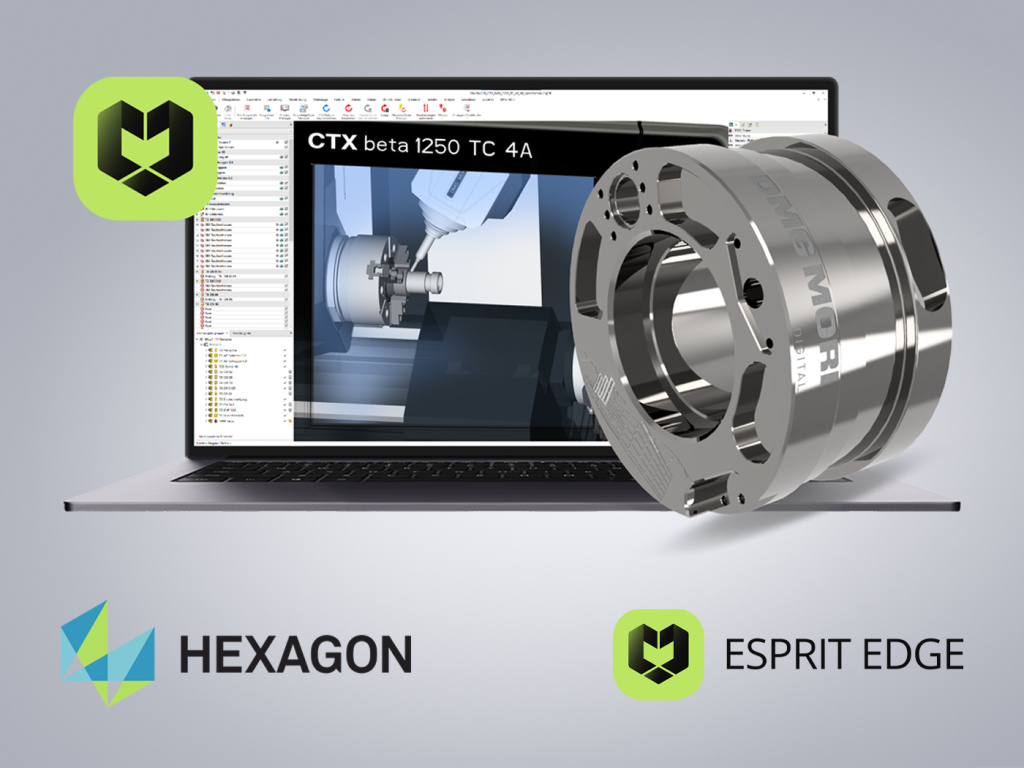
Digital Twin Simulation and Verification: A standout feature of ESPRIT is its robust simulation environment. The software creates a highly accurate digital twin of the CNC machine and setup. Users can import 3D models of their specific machine tool (including spindles, turrets, tool holders, tailstocks, chucks, etc.) and then watch as ESPRIT simulates the entire machining process with that exact configuration. Collisions, over-travel errors, or any mis-coordination between multiple elements are detected in this virtual stage, before any real cutting occurs. This saves expensive mistakes on the shop floor – especially important for costly machines or when machining pricey materials (like exotic alloys where a single scrapped part can cost tens of thousands of dollars). The fidelity of ESPRIT’s simulation has been honed through those partnerships with machine builders, giving it the ability to accurately emulate even very complex kinematics (like 5-axis mills or Swiss machines with dozens of moving components). The digital twin extends to stock materials and cutting tools as well, so users can see material removal in real time and verify the final part geometry. Many users credit this simulation with boosting their confidence to take on difficult jobs, knowing that “if it works in ESPRIT, it will work on the machine.”
-
Edit-Free, Optimized G-Code: Generating reliable NC code (G-code) without manual intervention has been a mantra for ESPRIT. The software’s post-processor system is particularly strong – DP Technology invested heavily in creating factory-certified post-processors for hundreds of machine/control combinations. These post-processors translate the CAM toolpaths into the exact commands needed for each specific CNC machine model and controller (Fanuc, Siemens, Heidenhain, Mazak’s Mazatrol, etc.), respecting all the nuances and best practices of each. The result is that programmers can hit “post” and get machine-ready code that doesn’t require them to hand-edit little fixes (a common need in other CAM systems when the post isn’t dialed in perfectly). This concept of “edit-free code” improves efficiency and reduces the chance of human error being introduced at the last minute. Additionally, ESPRIT’s toolpath engine itself includes optimization algorithms – for example, it can automatically modify feeds and speeds for toolpaths to maximize tool life (avoiding excessive cutting forces in corners, etc.), and it can optimize the sequence of operations to minimize tool changes or repositioning. Collectively, these features mean the programs generated by ESPRIT tend to run smoothly and efficiently, often achieving shorter cycle times and longer tool longevity than baseline programs.
-
Artificial Intelligence and Automation: In recent versions (especially with the rollout of the “New ESPRIT” or TNG platform), the software has incorporated AI-driven features to make programming faster and more automated. This includes things like automatic feature recognition – ESPRIT can analyze a 3D CAD model of a part and identify machinable features (pockets, holes, profiles) on its own. It then can suggest or automatically apply appropriate machining processes to those features based on a knowledge database. The company developed what it calls the KnowledgeBase™: a system where proven machining processes and strategies can be saved and reused. For instance, a shop can record the optimal way they machine a particular type of feature/material combination; later, whenever ESPRIT encounters a similar feature, it can automatically retrieve and apply that process. This turns years of machining experience into tangible software intelligence. Over time, as the KnowledgeBase grows, ESPRIT can essentially program parts semi-autonomously by leveraging past knowledge and AI pattern-matching. The AI also helps in multi-axis toolpath planning – for example, ESPRIT uses intelligent algorithms to decide the best approach angle for 5-axis cuts or to determine how to split operations between multiple turrets on a multitasking lathe for optimal balance. All of these automated decisions reduce the manual burden on the CNC programmer and help even less experienced users produce high-quality programs. “Automation is in our DNA,” one might say about DP Technology’s philosophy – they have consistently looked for ways to let the software handle repetitive or complex calculations so that the human can focus on higher-level decisions.
-
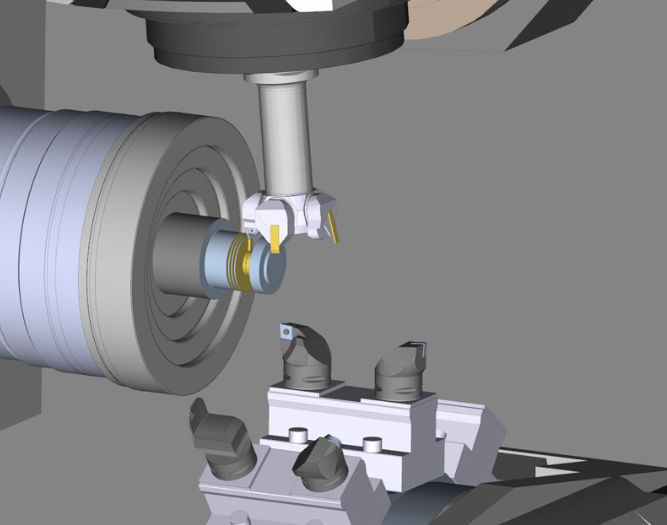
Advanced Multitasking & Swiss Machining Support: ESPRIT has long been an innovator in supporting the most complex machine tools. Its multitasking (mill-turn) module allows programming of simultaneous multi-tool operations, synchronization of milling and turning passes, and specialized cycles like pinch turning or balanced milling (where two tools cut the same part feature from opposite sides). Programmers can insert synchronization codes in an easy timeline view, coordinating two spindles or turrets with drag-and-drop simplicity. The software also tackles the challenges of Swiss-type lathe programming: these machines feed bar stock through a guide bushing and can have a dozen or more axes including multiple tool posts and sub-spindles. ESPRIT provides a dedicated interface for Swiss machines, managing the sliding headstock movements and the tiny, precise cuts typical in that domain. Innovations like automatic barstock feeding (stock pull) and cutoff synchronization, gang vs. turret tool scheduling, and overlap of operations were pioneered in ESPRIT’s Swiss module. These capabilities set ESPRIT apart as one of only a few CAM systems truly adept at high-end Swiss machining (a domain where some competitors falter or require separate specialized software). Continuous updates are made to support new model launches from Swiss machine builders (e.g., ESPRIT swiftly added support when Citizen or Tsugami release a new machine). For users, this means they can confidently invest in advanced machine tools knowing their CAM software will fully utilize the machine’s potential.
-
Hybrid Additive Manufacturing: An exciting innovation in recent years has been ESPRIT’s move into additive manufacturing programming. DP Technology integrated additive processes (specifically Directed Energy Deposition (DED), a form of metal 3D printing) into ESPRIT, making it a hybrid CAM system. This allows users to program both the building (printing) and machining of a part in one unified sequence. For example, a user could program a machine to deposit metal in a certain shape and then machine it to final tolerances, alternating between additive and subtractive steps. ESPRIT’s additive module includes support for laser metal deposition with either powder or wire feedstock, and it uses the same intuitive interface, so existing CAM users can adapt quickly. The partnership with Meltio (mentioned earlier) is a case in point: Meltio’s technology lets a standard 3-axis CNC machine do metal 3D printing by adding a special print head; ESPRIT serves as the tool to create the toolpaths for that print head, as well as any cutting passes needed after printing. This development makes ESPRIT one of the first established CAM systems to offer true hybrid manufacturing capabilities. Additionally, ESPRIT has introduced an additive module for powder bed fusion (the kind of 3D printing used in standalone metal 3D printers), which can assist in preparing and optimizing build files for those machines. While additive manufacturing is a relatively new field for CAM, ESPRIT’s early adoption demonstrates innovation and provides a differentiator at a time when many competitors are still focused purely on cutting operations.
-
Integration with Industry 4.0 and Beyond: As manufacturing enters the age of Industry 4.0 – emphasizing connectivity, data, and automation – ESPRIT has been evolving to fit that paradigm. It is able to communicate with shop floor management systems and IoT platforms to some extent (for example, it can take feedback from machine tool monitors about cutting performance and use that to adjust future programs). Under Hexagon, there is ongoing work to integrate ESPRIT with Hexagon’s metrology software so that measurement data can loop back to adjust machining strategies automatically (closed-loop machining). ESPRIT also launched an online Learning Center and moved some of its computational engines to cloud-based services for collaboration. These steps indicate a commitment to keeping the software modern and in line with the digital factory concept.
In terms of what differentiates ESPRIT from other CAD/CAM systems, several points emerge from the above features. ESPRIT is often praised for its strength in driving complex lathes and mill-turn centers – a niche where it arguably outperforms many rivals. Its legacy in those partnerships means an ESPRIT user can get a post-processor and machine model from the software vendor or OEM that works out-of-the-box for, say, a DMG MORI 5-axis turn-mill, whereas with some other CAM tools, the user might struggle to piece together a solution. Users also note that ESPRIT’s user interface and workflow remain consistent across different machine types, which isn’t always the case for competitors that acquired different modules over time. That consistency lowers the learning curve to expand into new machining methods.
Another differentiator is the emphasis on support and training – DP Technology built a reputation for attentive customer support and having engineers who deeply understand both software and machining. This human touch complements the software’s technical prowess. In a competitive sense, ESPRIT often goes up against Mastercam (a very widely used CAM, especially for milling) and Siemens NX (often used in enterprise environments), among others. Mastercam might have a larger user base in general, but ESPRIT often wins out in evaluations for multi-axis turn-mill or Swiss applications due to its specialized features. Siemens NX is very powerful but part of a larger CAD/PLM suite and typically much more expensive; ESPRIT can offer comparable high-end capabilities as a focused CAM solution that’s machine-agnostic. In fact, being independent of any single machine or CAD vendor (until Hexagon ownership) was an advantage – ESPRIT positioned itself as a neutral CAM that will work in almost any environment. Now under Hexagon, it still largely maintains that neutrality in terms of machine support, even as it integrates within Hexagon’s solution ecosystem.
To sum up, ESPRIT’s key innovations – from digital twin simulations to AI-powered programming and hybrid manufacturing – underscore its role as a technology leader in CAM. The continuous addition of new capabilities has kept it relevant as manufacturing technology has advanced. As the manufacturing world heads into an era of smart, connected, and automated production, ESPRIT’s combination of rich features and Hexagon’s backing positions it well to remain a go-to solution for complex machining challenges.
Leadership and Vision: Voices from the Company
Throughout ESPRIT’s journey, the leadership of DP Technology (and now Hexagon) has been vocal about the company’s vision and values. Here are a few quotes from key figures that shed light on ESPRIT’s philosophy and direction.
“Starting the company let me combine my passion for software development, my engineering background, and my desire to be in business for myself. It was the perfect combination.” – Paul Ricard, Co-founder of DP Technology, reflecting on the company’s origins in the 1980s.
This quote from Paul Ricard illustrates the entrepreneurial spirit that launched ESPRIT. Both Ricard and Dan Frayssinet were engineers who saw an opportunity to build something of their own in the CAM software market. That personal passion drove the company in its formative years, allowing it to take risks and innovate in niche areas like wire EDM without fear. As Ricard recalled, they viewed it as a “no-loss proposition” – if it failed, they’d simply return to France, but if it succeeded (which it did), they’d have created something truly impactful. “We’ve always focused on developing products that provide better solutions than anything else on the market.” – Paul Ricard, Co-founder of DP Technology, on the engineering-driven approach to building ESPRIT.
This comment, made by Ricard in an interview after nearly 40 years in business, highlights the company’s commitment to technical excellence. It underscores that DP Technology’s leadership prioritized the quality and capability of the ESPRIT product above all. Rather than chasing quick sales or marketing hype, they invested in solving hard problems in manufacturing (like simplifying multitasking machine programming). This engineering mindset became a core part of ESPRIT’s identity and reputation among users.When Hexagon announced the acquisition of DP Technology, CEO Ola Rollén’s statement positioned ESPRIT as a perfect fit for Hexagon’s strategy. Calling DP Technology “an innovator” with focus on smart, data-driven solutions validated that ESPRIT was seen as forward-looking (aligning with trends like Industry 4.0). Rollén’s emphasis that ESPRIT would strengthen Hexagon’s CAM market leadership also acknowledges ESPRIT’s standing in the industry. For Hexagon, bringing ESPRIT on board was a way to enhance its offerings for customers who need advanced CNC programming as part of a larger digital manufacturing suite. The quote reflects a confidence that the ESPRIT team’s expertise and their relationships (with machine tool providers, etc.) would be invaluable in Hexagon’s open, interoperable approach to manufacturing tech.
“The global reach of Hexagon will allow us to expand our brand and to accelerate the evolution of our products based on the needs of manufacturers around the world.” – Dan Frayssinet, Co-founder and CEO of DP Technology, on joining Hexagon (2020).
Co-founder Dan Frayssinet’s words at the time of the acquisition convey optimism about the future of ESPRIT under Hexagon. Frayssinet, who had been CEO of DP Technology, saw Hexagon’s worldwide presence as a means to amplify what ESPRIT could do. This quote shows the alignment in vision: DP Technology’s leaders believed that Hexagon’s resources (from global sales channels to R&D muscle) would help them serve customers better and develop the software further. There is an implicit recognition that, even after decades of success, there were more “evolutions” to be done for ESPRIT – and Hexagon would speed that up.
“ESPRIT will continue to offer the best product, the best post processors, and the best support and service in CAM… the acquisition by Hexagon will only strengthen our offerings for our resellers, partners, and customers.” – Don Davies, VP at DP Technology (Americas), reassuring stakeholders post-acquisition.
Don Davies, a long-time executive at DP Technology, provided this assurance that the company’s core values won’t change with the new ownership. It encapsulates the pride in ESPRIT’s quality (“best product, best post processors”) and the company’s famed support, while also pointing out that Hexagon’s backing is a positive force. Such quotes were likely aimed at both customers and the network of resellers/partners, to let them know that ESPRIT was in good hands and that continuity plus improvement could be expected.
In discussing what the Hexagon acquisition meant for customers, Paul Ricard emphasized synergy. By integrating ESPRIT with Hexagon’s suite (which includes metrology, simulation, and other production software), customers could eventually leverage a more connected manufacturing solution. Ricard pointed out that ESPRIT users would gain access to Hexagon’s broader portfolio, while Hexagon would benefit from ESPRIT’s specialized CAM expertise – a win-win that ultimately should manifest in enhanced technology on the shop floor.
These voices from ESPRIT’s leadership convey a few consistent themes: a dedication to innovation and technical excellence, a commitment to customer success and support, and an enthusiastic outlook on growth through strategic partnership (be it the Hexagon merger or earlier collaborations). The tone from the founders shows a blend of pride in what they built and pragmatism in joining forces with a larger entity to take it further. Even after stepping under the umbrella of Hexagon, the ESPRIT team’s statements indicate they are still focused on what they have always valued – empowering manufacturers to be more efficient and productive through great software.
Vendor: Hexagon