
ENCY: A Next-Generation CAD/CAM System Transforming Manufacturing
In the world of computer-aided manufacturing, a bold newcomer is aiming to redefine the standards of how we design and program machines. ENCY is a comprehensive CAD/CAM/OLP (Computer-Aided Design / Computer-Aided Manufacturing / Offline Programming) software ecosystem developed by ENCY Software Ltd., a company based in Limassol, Cyprus.
Launched globally in late 2024, ENCY is described by its creators as a next-generation platform that blends user-friendly simplicity with cutting-edge technology. The system goes beyond traditional CAD/CAM by providing a unified environment to program both CNC machines and industrial robots, all while enabling cloud-based collaboration and AI-driven assistance. ENCY’s vendor, ENCY Software, positions the product as a solution to modern manufacturing challenges – a single connected system that can take a part from concept to finished product faster and more intuitively than legacy tools.
General Description of ENCY and Its Vendor
At its core, ENCY is an advanced software bundle for manufacturing engineering. It encompasses design import, toolpath generation for CNC machining, robotic motion programming, simulation, and post-processing – essentially covering the entire digital workflow needed to go from a CAD model to a machined or 3D-printed part. The system’s key strength is the integration of capabilities that are traditionally spread across multiple software packages. ENCY allows users to perform multi-axis CAM programming and industrial robot programming within the same application. This unified approach means a company’s CNC programmers and robotics engineers can work on one platform, share data seamlessly, and follow a coherent workflow.
The vendor behind ENCY, ENCY Software Ltd., is a relatively new company with deep roots in the CAD/CAM industry. Founded in 2024, the firm is headquartered in Cyprus but has a global outlook. The ENCY team has emphasized building an ecosystem (“ENCY X”) that is technologically independent and extensible – delivering what they call “unmatched CAD/CAM power, security, rich digital manufacturing content, powerful API tools and collaboration capabilities” in one platform. In practice, this means ENCY is not only a stand-alone software but also includes cloud services and integration tools to fit into various enterprise environments. ENCY Software provides several modules under the ENCY umbrella (described further below), and it backs the product with resources such as an online component library, user manuals, an API for custom extensions, and a network of support partners.
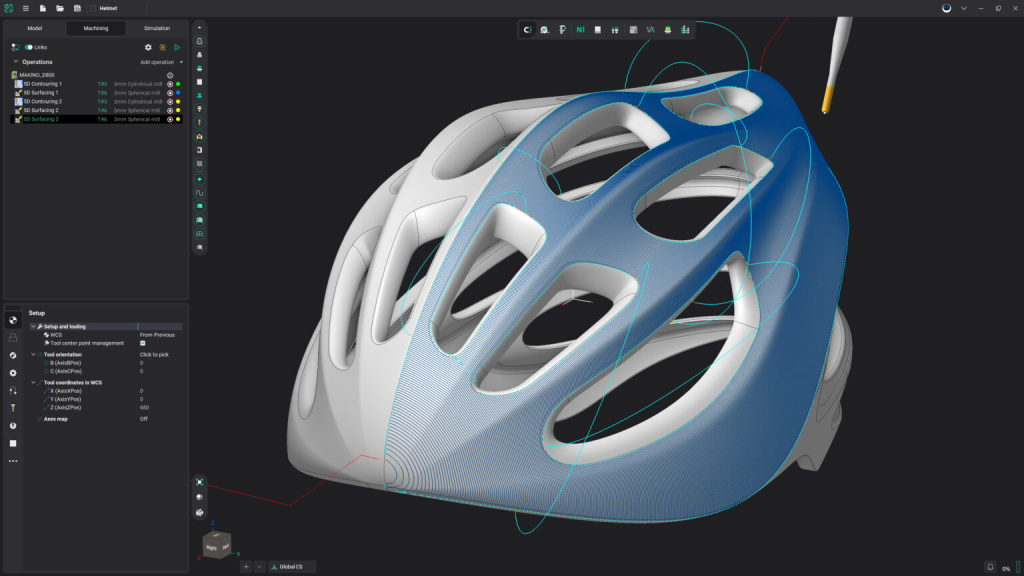
From a user’s perspective, ENCY presents a polished, modern interface with a streamlined workflow. The software is designed to run on high-resolution (4K) displays with a sleek dark-theme UI, reflecting a modern user experience that stands in contrast to many older CAD/CAM programs. The company highlights ENCY’s “natural workflow” and intuitive design, emphasizing that complex tasks (like programming a 5-axis milling operation or a multi-robot cell) can be accomplished through logical, simplified steps.
In summary, ENCY Software and its flagship product offer a unified CAD/CAM solution that merges capabilities typically found in separate CAD, CAM, and robot programming tools. The vendor’s mission is to transform manufacturing processes by breaking down silos between design, machining, and robotics – all supported by collaborative cloud features and AI automation. ENCY is not just another CAD/CAM program; it’s presented as a platform for the future of digital manufacturing.
Application Areas of the ENCY Software
One of the impressive aspects of ENCY is the sheer breadth of its application domains. Because it supports both CNC machining and robotic operations, ENCY finds use in a wide range of industries and manufacturing scenarios. The software’s developers have intentionally made it versatile, aiming to serve use cases from heavy industrial manufacturing to delicate artistic fabrication. Key application areas include:
-
Traditional CNC Machining: ENCY excels in generating toolpaths for milling and turning operations on CNC machine tools. It supports everything from simple 2.5-axis milling on a three-axis mill up to complex 5-axis simultaneous machining on advanced CNC centers. This includes specialized strategies like optimized adaptive roughing (to remove bulk material efficiently) and high-precision finishing for complex surfaces. The system is also capable of programming mill-turn machines and multi-channel lathes (such as Swiss-type automatics), where synchronized control of multiple spindles and tool turrets is required. For example, a job shop can use ENCY to program a multi-axis mill-turn part with cross-drilling and simultaneous milling operations, taking advantage of the software’s multi-channel synchronization features.
-
Multiaxis and Complex Toolpath Applications: Beyond standard milling, ENCY provides solutions for niche but critical applications like impeller and turbine blade machining (common in aerospace and energy sectors). It includes proprietary multi-axis toolpaths and machine-aware strategies that can handle the tricky geometry of impellers or blisks. Similarly, ENCY can generate collision-checked 5-axis trimming or cutting paths for industries like automotive (e.g., trimming thermoformed parts) or shipbuilding (cutting complex curves in sheet metal). The software’s machine-aware toolpath calculation means it accounts for a machine’s kinematics and limits when generating moves, which is particularly important in 5-axis work to avoid singularities or axis range issues.
-
Additive Manufacturing (3D Printing): Unusually for a CAM system, ENCY also addresses additive processes. It can create paths for both planar layer-by-layer additive manufacturing and non-planar deposition (where a robot or multi-axis machine lays material in curves or on existing geometries). This makes ENCY applicable to hybrid manufacturing scenarios and 3D printing with materials like metals, plastics, or concrete. For instance, a company doing metal additive manufacturing could use ENCY to generate the toolpaths for a directed energy deposition process, then switch to subtractive mode to mill critical surfaces – all within the same project environment. ENCY’s support for dynamic feed rates in additive ensures that deposition can be optimized (slower on corners, faster on straight runs, etc., to control bead geometry). In fact, a recent ENCY update added a “corner feed” feature giving users fine control over extrusion rates during 3D printing, helping minimize material waste and improve print quality.
-
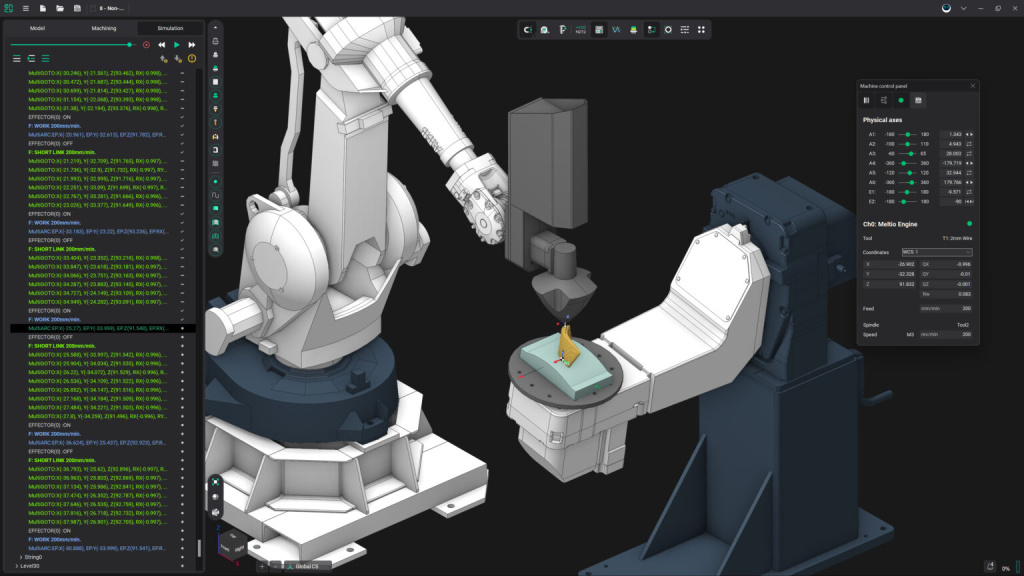
Industrial Robotics Programming: ENCY’s capabilities extend fully into the realm of industrial robots. ENCY Robot, one of the product’s modules, is a complete offline programming solution for robotic arms. This means users can program a 6-axis robot (or a robot with additional external axes/positioners) to perform tasks such as machining, welding, painting, inspection, or pick-and-place, all in the virtual environment before executing it on the shop floor. Application examples include:
-
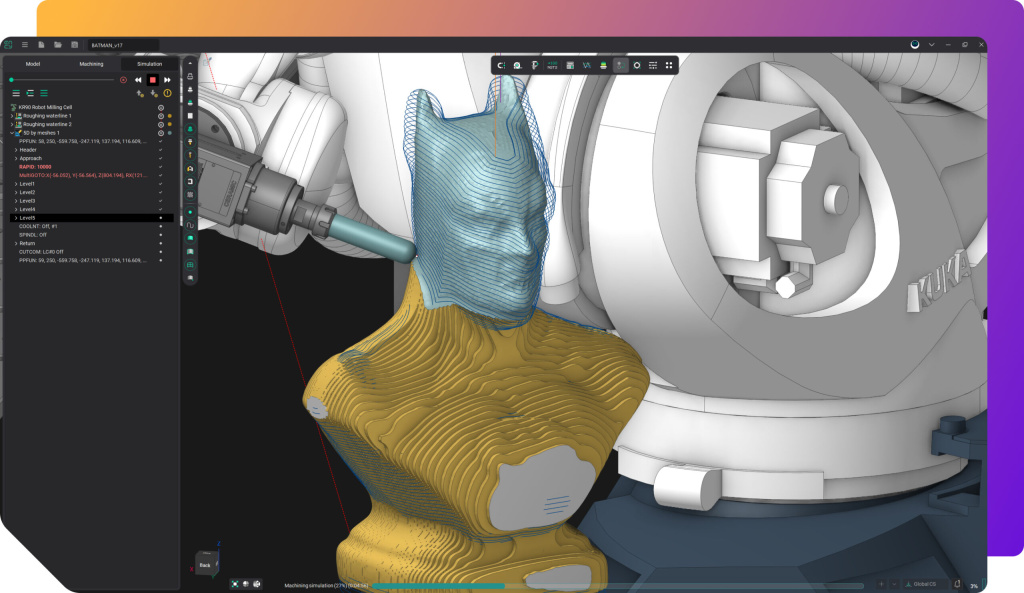
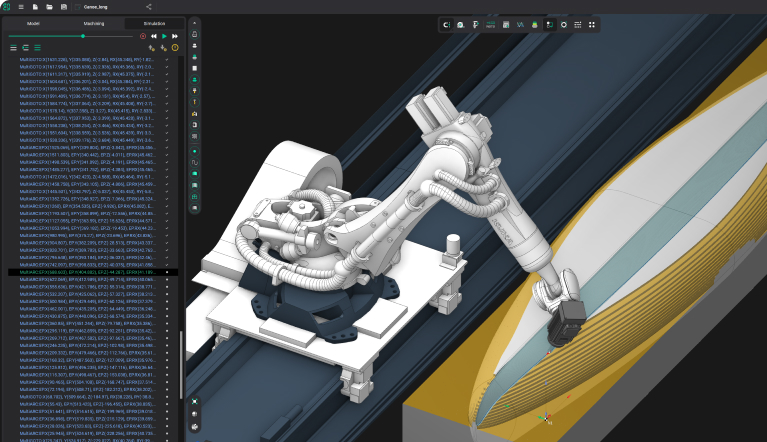
Robotic Machining: Using an industrial robot as a flexible CNC machine for milling or drilling operations. ENCY can generate the robot’s joint motions and tool paths to, say, rough out a large sculpture from a block of foam or to trim composite material edges on an aircraft component. It accounts for robot kinematics and singularities, and can optimize paths to maintain smooth motion.
-
Welding and Cutting: ENCY provides dedicated features for programming welding robots, including weave patterns, torch angle control, and even the import of welding seam geometry from CAD. A fabrication shop could program multi-pass welds on a large structure with ENCY, simulating the process to ensure proper reach and angles. Similarly, for laser or plasma cutting robots, ENCY can plan the cut sequence and angle to achieve precise results.
-
Polishing, Deburring, and Surface Finishing: For manufacturers of molds or high-end products (e.g., jewelry, medical implants), ENCY allows programming robots to polish or deburr complex shapes. It can create toolpaths that follow organic curves and apply the right pressure and patterns as a human would, automating labor-intensive finishing processes.
-
Additive & Hybrid Robotics: ENCY also combines its additive know-how with robotics – e.g., programming a robotic arm to perform concrete 3D printing for construction components or to lay down resin in molds. This is part of the system’s vision of unifying processes: the same software could program a robot to 3D-print a structure and then mill certain features on it.
-
-
Custom Machine Integration: Thanks to the MachineMaker module (a zero-code digital twin builder), ENCY can be applied to almost any custom machinery. Users can import 3D models of their specific CNC machine or robot cell and use MachineMaker to define its kinematics without writing code. This expands ENCY’s applicability to niche or bespoke machines outside the mainstream catalog. For example, an experimental 7-axis gantry or a dual-robot cooperative work cell can be modeled and programmed via ENCY, even if the machine is one-of-a-kind. This flexibility means application areas aren’t limited to what’s predefined – new use cases can be accommodated by creating digital twins of new machines and robots.
-
Education and Research: ENCY’s all-in-one nature and modern interface make it a strong candidate for educational use as well. Universities and training centers can use ENCY to teach students about both CNC machining and robotics in one platform, illustrating concepts of toolpath planning, kinematics, and manufacturing process integration. Because it includes simulation and visualization, students can experiment safely in virtual environments. Moreover, the presence of an AI assistant can help guide learners with suggestions, making it a learning-friendly tool. The company’s collaboration with research institutions (discussed later) also underscores its role in advanced manufacturing R&D settings.
Given this breadth, it’s clear that ENCY is not confined to one niche of manufacturing. The industries explicitly targeted by ENCY Software range from aerospace and automotive, through energy, medical devices, electronics, to woodworking and arts. A jet engine maker could use ENCY for 5-axis machining of turbine parts; an automotive prototyping lab could use it to program robots for clay modeling; a dental implant manufacturer might leverage its multi-axis milling for crowns and its additive features for custom implants; and an entertainment company could use it to mill large foam sculptures for theme parks. ENCY’s capability to handle both subtractive and additive processes, both CNC and robotic equipment, and both engineering and artistic projects gives it a uniquely wide application footprint in the CAD/CAM software landscape.
History and Development: Founders and Key Evolution Stages
The ENCY system may be new, but its heritage runs deep. In fact, the story of ENCY is interwoven with the history of one of the oldest CAD/CAM software lineages to emerge from Eastern Europe. SprutCAM – a well-known CAM program first released in 1997 – is the direct precursor to ENCY. SprutCAM was developed by SPRUT Technology, a company founded back in 1987 by Alexander Kharadziev. For decades, SprutCAM grew as an all-in-one CAM solution catering to both CNC machining and, eventually, robotic programming. Notably, Alexander Kharadziev is the father of ENCY’s current CEO, Andrei Kharatsidi.
From that launch point, ENCY’s development has proceeded at a brisk pace. The initial release (often termed version 1.0) was quickly followed by incremental updates as the company gathered user feedback and expanded features:
-
In late 2024, ENCY Software released updates 1.0.3 and 1.0.4, which introduced new features particularly enhancing MachineMaker (the digital twin builder) and ENCY Clouds (the collaboration platform). These updates improved things like radial coordinate system support and project sharing workflows, showing the team’s focus on refining user experience early on.
-
By early 2025, ENCY version 1.0.5 was launched, bringing a host of improvements with a special focus on additive manufacturing capabilities. This included the aforementioned “corner feed” control for extrusion and various other toolpath enhancements and stability fixes. The emphasis on additive in this update signaled ENCY’s commitment to be a leader in hybrid manufacturing solutions.
-
In March 2025, ENCY Software rolled out version 1.1 of the software. This update expanded the software’s machining strategies (for example, introducing lathe operations for robots, so that a robot could emulate a lathe to some extent) and offered finer control in text engraving and NC code editing. The 1.1 release also polished the integration between ENCY and ENCY Tuner (making it easier to jump from CAM programming to G-code tweaking), and included numerous usability improvements and bug fixes – reflecting the rapid maturation of the product just months after launch.
Just as significant as software version milestones are the community and ecosystem developments. ENCY Software has actively engaged with the user community and industry bodies to establish itself. They have set up a global network of authorized dealers and integration partners to distribute and support ENCY in various regions. By the end of 2024, partnerships were in place in regions like Western Europe and the Middle East – for instance, ENCY held an exclusive premiere event in Turkey in November 2024 to introduce the software to that market, indicating a strategic push into key manufacturing hubs. The company’s social media presence and forums (such as their LinkedIn and Practical Machinist threads) also started filling with early user discussions, further spreading awareness.
A testament to how quickly ENCY has gained traction is the announcement of the ENCY World Conference 2025. In February 2025, ENCY Software declared that it will host its first global user conference in June 2025 in Limassol, Cyprus. This multi-day event is set to bring together industry leaders, ENCY users, dealers, and the company’s own engineers for technical masterclasses, networking, and a showcase of the latest innovations (including a deeper look at “ENCY X”, the underlying ecosystem platform). Planning such a conference less than a year from product launch speaks to the momentum ENCY has gathered and the company’s confidence in building a community around their platform.
Business Metrics and Global Reach
As a private young company, ENCY Software has not publicly disclosed detailed financials or user counts. However, there are several indicators of the venture’s market traction and global reach.
CEO Andrei Kharatsidi and his team have explicitly stated they are not looking for a quick acquisition or exit. “We want to build something that lasts… We’re not looking to be acquired. We’re looking to make a real difference in how machining and robotics are approached,” says Andrew Lovygin, reflecting the company’s long-term vision of independence and impact. This ethos implies that, for now, any revenues are being reinvested into the company to improve the product and expand its reach, rather than pulled as profit.
User Base Size: While exact user numbers are not published, ENCY’s user base can be estimated through its community engagement and deployments:
-
The trial downloads and sign-ups since launch reportedly number in the thousands, given the interest at events like IMTS 2024 and the broad online marketing campaign that followed. ENCY offers a free 30-day trial, which has been actively promoted; this usually indicates a strategy to convert trial users into paid subscribers. If even a fraction of IMTS visitors and online respondents became users, ENCY might have accumulated a few hundred early adopters (companies or individuals) by early 2025.
-
On social media, ENCY’s official pages gained traction quickly. For instance, the company’s LinkedIn page and Facebook profile gathered a few hundred followers within months, and there’s engagement from CAM engineers worldwide discussing the new system. Additionally, ENCY’s presence on forums like Practical Machinist and CNCZone (where CAM programmers exchange advice) hints at a growing word-of-mouth footprint; users there have begun comparing ENCY’s features to established systems, indicating that people are testing it out in real shop environments.
-
ENCY Software has also invested in educational outreach, offering its software to training centers and universities. This could boost the user base (students, educators) significantly, albeit not in revenue terms immediately. It does, however, seed the market with future professionals familiar with ENCY.
Global Reach and Market Presence: From the outset, ENCY was conceived as an international product. Launching at IMTS in the USA and incorporating in the EU were clear signals of global ambition. The company’s strategy for global reach includes:
-
Building an international dealer and distributor network. ENCY Software’s website features a “Find Dealer” section, indicating authorized resellers across different regions. By the end of 2024, ENCY had dealers or partners in multiple countries, including in Europe (such as CNC Solutions in Belgium and Datentechnik Reitz in Germany), Asia (e.g., a partner for the Turkish market, as evidenced by their Istanbul event), and likely North America (either direct sales from Cyprus or via local representatives). These partners help localize sales and support, making it easier for customers to adopt ENCY with local training and service.
-
Industry Trade Shows and Events: Apart from IMTS 2024, ENCY has been or plans to be present at major industry exhibitions and conferences. Their product was slated for demonstration at EMO (the big European machine tool expo) and other national shows via distributors. ENCY’s team also organized live webinars and participated in partner events (for example, SprutCAM’s network in Latin America or Europe introduced ENCY in their circles). This multi-channel presence helps raise awareness globally beyond just English-speaking markets.
-
World Conference 2025: As mentioned, the upcoming ENCY World Conference in June 2025 is a global gathering – the company has invited attendees from all over: end-users, machine tool builders, robotic integrators, and academic partners. This event is not only a user conference but also serves as a statement of ENCY’s arrival on the world stage of CAD/CAM. Industry leaders will give talks, and ENCY Software will provide early access previews of upcoming technologies to international delegates. Such an event helps consolidate a worldwide community and will likely generate further adoption through the enthusiasm of attendees who return to their home countries with new knowledge.
-
Online Reach: ENCY has leveraged online platforms to ensure even those who cannot attend events can learn about the product. The company’s official YouTube channel hosts tutorial series (created in collaboration with experienced CAM trainers) that have viewers around the globe. Additionally, ENCY has engaged in content marketing – publishing articles on their site (in multiple languages) about general manufacturing trends, which subtly promotes the ENCY approach. This content has been picked up by tech news outlets and blogs, further extending ENCY’s reach into communities in India, China, and South America, where manufacturing professionals are always scouting for modern solutions.
Competitive Position: In terms of market positioning, ENCY enters a field dominated by established CAD/CAM software like Mastercam, Siemens NX, HyperMill, and others for CNC, and specialized robot programming tools or plugins for robotics. Its competitive advantage is the integrated approach and modern platform. Industry analysts have noted that ENCY is carving out a niche for companies that want a single solution rather than maintaining separate CAM software for machines and separate offline programming software for robots. The market response has been positive among small-to-medium enterprises who see value in consolidation, whereas larger enterprises are evaluating how ENCY might complement or replace parts of their workflow. ENCY’s business model appears to be subscription-based licensing (common for modern software), and the company has to demonstrate ongoing value through frequent improvements – which so far it has delivered via the steady stream of updates.
One challenge for ENCY Software as a business is converting intrigue into commitments in a conservative industry. Many machine shops and factories are slow to change their software workflows due to risk; however, ENCY’s strategy of providing ENCY Tuner (to accommodate legacy G-code) and emphasizing ease of transition is directly aimed at lowering this barrier. Early metrics of success for ENCY might therefore include not just raw sales, but the number of testimonial case studies they can generate. By early 2025, ENCY has started to accumulate success stories – for example, a case where a manufacturer replaced two separate software systems with ENCY and reportedly shortened their programming time, or where a robotics integrator used ENCY Robot to deploy a complex cell faster than expected. These qualitative metrics help build credibility.
In conclusion, while we lack hard numbers on revenue or total users, ENCY’s business trajectory in its first year shows a rapidly expanding global presence and a growing community of adopters. The company’s willingness to partner (rather than go alone in each market), its engagement with the press and events, and its leadership’s clear vision of independent, sustainable growth all suggest that ENCY is on a solid path. If it continues delivering technical innovation and supporting its users, ENCY Software could soon become a notable mid-sized player in the CAD/CAM industry, with a truly worldwide footprint.
Partnerships, Collaborations, and Industry Relationships
From its inception, ENCY Software recognized the importance of collaboration – both in terms of technology development and market adoption. The company has pursued partnerships on multiple fronts: with research institutions, industry organizations, and through strategic alliances that boost its capabilities or credibility. Below are some of the notable partnerships and collaborations involving ENCY:
- Research Collaboration with DAMRC: One of ENCY’s headline partnerships is with the Danish Advanced Manufacturing Research Center (DAMRC). Announced on March 17, 2025, this collaboration aims to advance the field of robotic machining – using robots for tasks traditionally done by CNC machines. The partnership will leverage ENCY’s state-of-the-art robotic programming and simulation tools alongside DAMRC’s expertise in machining research. Key focus areas include optimizing robot toolpaths for complex material removal, improving machining parameter selection for robotic systems, and validating the quality and accuracy of robot-machined parts. The two organizations plan to share knowledge and even co-author technical publications on their findings, which could influence standards and best practices in the industry. They also intend to develop educational programs to help upskill manufacturers in using robotic machining effectively. This partnership not only helps ENCY refine its product (with feedback from DAMRC’s labs) but also positions ENCY at the forefront of a cutting-edge trend. As Christian Skov Lillelund, COO of DAMRC, noted in the joint release, the collaboration is about providing industry with “more efficient, flexible, and innovative robotic machining solutions.” In the same release, CEO Andrei Kharatsidi echoed that sentiment from ENCY’s perspective, saying “this partnership with DAMRC aligns perfectly with our objective to drive the adoption of robotic machining worldwide.” By teaming up with a respected institution like DAMRC, ENCY gains validation as an industrial-grade solution and potentially opens doors to working with DAMRC’s member companies (which include major manufacturers in Europe).
- Industry Associations and Initiatives: ENCY Software has joined or engaged with various industry associations that promote manufacturing technology. For example, the company is a member of local tech clusters such as TechIsland in Cyprus and participates in EU programs related to digital innovation in manufacturing. These involvements grant ENCY a voice in industry discussions and sometimes funding opportunities for R&D. Additionally, ENCY representatives have been active in conferences (virtual and physical) discussing topics like AI in manufacturing and next-gen CAD/CAM workflows – positioning themselves as thought leaders and collaborators in shaping the future of the industry.
-
Academic Partnerships: Beyond the high-profile DAMRC partnership, ENCY is reaching out to academia. The company has provided software licenses to certain universities for research projects. In one instance, ENCY Software partnered with a technical university’s robotics department to use ENCY Robot for an experimental 3D printing robotic arm project. By supporting such projects, ENCY not only tests its software in novel applications but also nurtures relationships with professors and labs that could recommend ENCY in the future or spin off startups that use it. These low-key partnerships often fly under the radar but can be valuable; ENCY is effectively creating evangelists in the academic world.
- Dealer and OEM Partnerships: As mentioned earlier, ENCY relies on regional dealers to sell and support the product. Many of these dealers are themselves companies with deep roots in CAD/CAM or CNC machine distribution. Partnering with them gives ENCY local credibility and access to established customer networks. For example, Datentechnik Reitz in Germany, a firm known for providing tailored CAD/CAM solutions, partnered with ENCY to introduce it to the German market. Similarly, in the Benelux region, CNC Solutions (a Belgian CNC software provider) added ENCY to their portfolio, promoting how ENCY can rapidly take a user from design to manufactured part. These partnerships are essentially reseller agreements, but they often involve co-marketing efforts, joint seminars, and shared technical training.
- Another important category is potential OEM partnerships – meaning partnerships with machine tool builders or robotics manufacturers. While ENCY Software has not announced any formal OEM bundling deals yet, they have been working closely to ensure compatibility with machines from big brands. ENCY’s support for over 60 models of KUKA collaborative robots (added in update 1.0.6) shows a de-facto technical partnership on the integration level. It wouldn’t be surprising if ENCY seeks official partnerships with companies like KUKA, Fanuc, or ABB in the future, to perhaps certify ENCY as an approved offline programming software for those robots. On the CNC side, partnerships with machine tool builders could involve creating digital twins for their entire product line in MachineMaker and distributing ENCY to their customers as part of an automation package. Given Andrei Kharatsidi’s connections in the industry, ENCY is likely exploring such collaborations behind the scenes.
- No Mergers or Acquisitions (Yet): Regarding mergers and acquisitions, ENCY Software’s story so far does not include any mergers or acquisitions. The company was built from the ground up (albeit with intellectual and human capital that transitioned from SprutCAM Tech) and remains an independent entity. There is no indication that ENCY Software has been acquired by or is under the umbrella of any larger corporation; in fact, the leadership’s statements suggest the opposite intention. Similarly, ENCY Software has not made any acquisitions of other companies. It’s possible in the future that if ENCY needs a particular technology (for instance, a specialized simulation engine or AI module) it could acquire a smaller firm or form a joint venture, but up to early 2025 nothing of that sort has been announced.
- Collaborations with End-User Companies: Often, the best innovation feedback comes from close work with early customers. ENCY Software has engaged in pilot projects with certain end-users in aerospace and automotive sectors to vet its advanced features. While the names of these companies are usually kept confidential, ENCY’s product managers have referenced working closely with a “European automotive manufacturer” to develop the multi-robot additive functionality, and with an aerospace turbine producer to test the impeller machining module. Such collaborations are mutually beneficial: the companies get early access to new technology and can influence its development to suit their needs, and ENCY gets real-world validation and a potential showcase case study.
In conclusion, partnerships and collaborations are central to ENCY Software’s strategy. The company has skillfully aligned itself with research leaders (to push technology boundaries), local experts (to push market adoption), and likely soon with hardware OEMs (to push integration and sales). These alliances enhance ENCY’s credibility and accelerate its innovation. By working with respected organizations like DAMRC and enthusiastic regional partners, ENCY extends its small team’s reach tremendously. It’s the kind of ecosystem-building that a modern software company needs to thrive in the industrial software market. As ENCY grows, we can expect more such partnerships to be announced, potentially including cloud service partnerships (for its collaboration platform), AI partnerships (to deepen its AI features), and educational partnerships (to train the next generation on ENCY). So far, ENCY has struck a healthy balance: collaborating widely while maintaining independence and control over its core product vision.
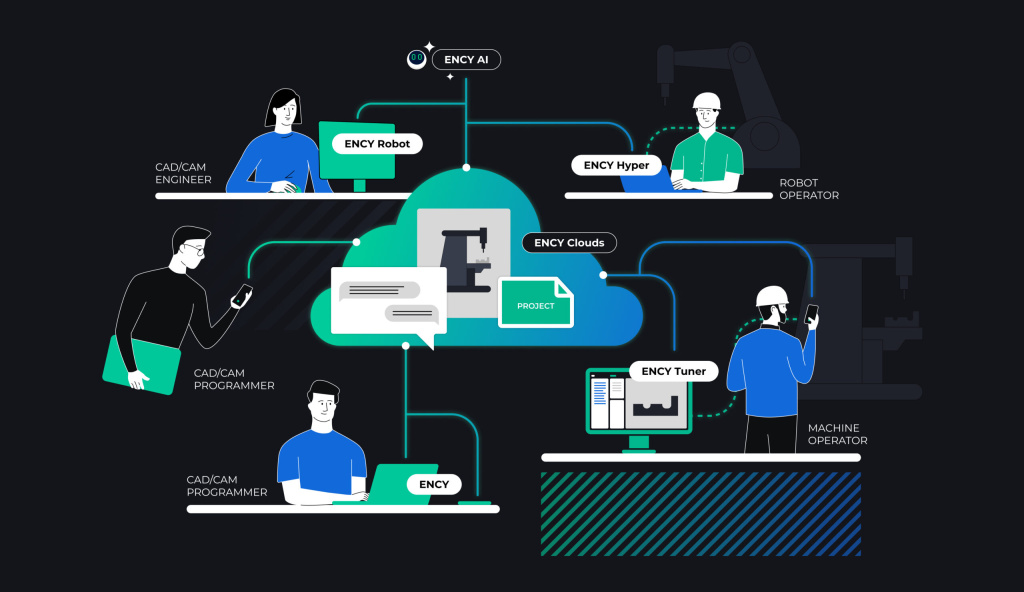
Key Innovations, Features, and Strengths of the ENCY System
What truly sets ENCY apart in the CAD/CAM landscape is its collection of innovations and unique features. The system was built with a “clean sheet” approach, aiming to address the pain points of existing solutions and add novel capabilities that anticipate the future of manufacturing. Here are the most noteworthy features and strengths of ENCY:
-
All-in-One Solution: It uniquely merges multiple functionalities (CAD/CAM for CNC + OLP for robots + simulation + cloud) that often require separate tools. This integration is its cornerstone advantage.
-
Ease of Use: A modern interface and automation (AI suggestions, intuitive UX) lower the learning curve and improve productivity, addressing a common complaint that advanced CAD/CAM software are too complex.
-
Collaboration: Built-in cloud collaboration and AI-assisted support streamline how teams work together, which is increasingly important in a distributed and fast-paced manufacturing world.
-
Innovation-Driven: Features like AI-driven strategy planning, digital twin creation without coding, and integrated additive manufacturing show that ENCY is forward-looking, ready for contemporary manufacturing trends like Industry 4.0.
-
Continuity and Reliability: By providing tools to incorporate legacy knowledge (via G-code import, etc.), ENCY doesn’t force a disruptive break from the past – instead it offers a guided path to the future. This is a subtle but crucial strength in winning over companies that have years of proven programs they trust.
-
Strong Technical Foundation: High-fidelity simulation, machine-aware toolpaths, and customization options give confidence that ENCY can handle difficult, high-end tasks and can be tailored to special needs.
Together, these features make ENCY a standout in the CAD/CAM software field and underpin its claim of being a “CAD/CAM for a new generation.” It’s a rare example of a ground-up redesign of such software in recent years, which allows it to incorporate modern technologies and user expectations from the start, rather than bolting them onto decades-old architectures.
Leadership Perspectives and Vision
The leadership of ENCY Software – many of whom are veteran technologists in this domain – frequently articulate a vision that goes beyond just selling software. They talk about changing the culture of manufacturing software usage. CEO Andrei Kharatsidi often emphasizes how ENCY is meant to address stagnation in the CAM industry. In his words: “Outdated CAD/CAM software no longer meets the demands of modern production.” He notes how older systems have “interfaces stuck in the last century” and how users end up stitching together “fragmented tools” to accomplish their goals. This clear-eyed critique of the status quo is what drove ENCY’s development. Kharatsidi’s vision is to provide a platform that is as integrated as modern manufacturing environments require – essentially future-proofing users for the next few decades of technological change.
Andrei Kharatsidi also brings a personal passion to the project, being a second-generation CAM developer. In interviews, he’s mentioned how witnessing the evolution of the industry from his father’s time to now inspired him to take bold steps. He often says that ENCY is not just a business for him but a mission to keep his family’s legacy of innovation alive in a new era and to ensure that the technology keeps advancing. That likely informs ENCY’s aggressive adoption of AI and advanced features – the team is not content with incremental improvements; they strive for leaps.
Andrew Lovygin, as the channel director, voices the company’s market strategy and ethos. His quote “We’re not looking to be acquired” speaks volumes about ENCY Software’s mindset. Unlike some startups that aim to be bought by a giant, ENCY wants to become a giant in its own right, or at least a lasting independent player. This implies a commitment to users that ENCY will continue to be developed with their long-term needs in mind, and not be swallowed and discontinued by a competitor. Lovygin also often talks about user feedback; being on the front lines with partners and customers, he stresses that ENCY’s roadmap is heavily influenced by user input. This customer-centric approach is something he promotes in webinars and events – encouraging users to voice their needs because ENCY, as a nimble company, can often implement requested features faster than one might expect.
Another leadership perspective comes in the context of ENCY’s community building. The decision to host ENCY World Conference 2025 in Cyprus reflects an understanding that a strong user community can be a competitive advantage. The leadership team wants ENCY to be more than software; they want it to be a movement among “manufacturing superheroes” (a phrase they’ve playfully used in marketing for the conference). By celebrating user achievements (they plan to acknowledge outstanding projects and dealer contributions at the conference), the ENCY team is fostering a sense of belonging and loyalty. It’s clear the leadership learned from the SprutCAM years that an engaged community not only helps with word-of-mouth marketing but also enriches the product via shared knowledge and support.
Looking forward, ENCY’s leadership often hints at what’s next:
-
ENCY Hyper: slated as a future product, which Andrei Kharatsidi has described as a “versatile real-time robot programming software” likely aimed at simplifying direct teaching of robots with tablet interfaces and mixing augmented reality. This indicates ENCY’s venture into more interactive control, possibly enabling users to jog robots or machines in real space and have ENCY capture those motions for programming.
-
Further AI integration: Kharatsidi mentioned integrating AI “to boost productivity” and hinted that the AI will not require explicit prompts in future – it will observe and assist proactively. This could mean predictive suggestions, automated error fixes, or even generative design elements (letting AI propose design modifications for better manufacturability).
-
Platform Openness: Leadership has stated they want ENCY to facilitate collaboration among not just users but also other software providers. This is interesting – perhaps in the future ENCY might offer APIs that other CAD or PLM (Product Lifecycle Management) systems can plug into, or integrate with IoT platforms to feed back production data for adaptive manufacturing. By describing ENCY as an “ecosystem”, they envision it as one component in a larger digital thread connecting design, planning, execution, and feedback.
The tone from the top is one of ambition and optimism. ENCY’s leaders talk about transforming workflows and empowering engineers to step out of their comfort zones and try new things (as evidenced by their promotional messaging). They acknowledge that manufacturing is an “ever-changing frontier” and explicitly aim to challenge engineers to embrace risk and innovation, with ENCY being the tool that gives them confidence to do so. It’s a forward-leaning narrative that positions ENCY not just as a response to what the industry is today, but as a catalyst for what the industry could be tomorrow.
In conclusion, the leadership of ENCY Software is guiding the company with a clear focus on innovation, user empowerment, and community building. Their quotes and actions align to paint a picture of a company that is driven by a vision: to “go beyond CAD/CAM” (as one company slogan puts it) and usher in a new paradigm where software is not the bottleneck but the enabler of creative, efficient manufacturing. This vision, coupled with ENCY’s strong technical foundation, suggests that the ENCY CAD/CAM system will continue to evolve rapidly and could significantly influence the direction of manufacturing technology in the years ahead.
Vendor: ENCY Software