
Edgecam: Three Decades at the Leading Edge of CAD/CAM Software
Overview and Key Applications
Edgecam is a leading computer-aided manufacturing (CAM) software system used for programming CNC machines to produce precise components. Developed originally in the United Kingdom, Edgecam specializes in generating toolpaths for milling, turning, and multi-axis mill-turn machining centers. It enables manufacturers to create, optimize, and verify NC (numerical control) code for a wide range of machining applications – from simple 2-axis operations to complex simultaneous 5-axis cutting. Today Edgecam is part of Hexagon AB’s Manufacturing Intelligence division, following a series of acquisitions over its long history.
Engineers and CNC programmers use Edgecam to streamline the production of parts in numerous industries. Notably, it is widely adopted in sectors such as aerospace (for aircraft and space vehicle components), automotive and transportation (for vehicle parts and tooling), energy and oil & gas (for heavy equipment parts), and general manufacturing. Mold and die makers also leverage Edgecam’s high-precision strategies for toolmaking, and many subcontracting job shops rely on Edgecam to handle diverse and complex machining jobs. The software’s flexibility and broad capability make it suitable for both small machine shops and large manufacturing enterprises. Edgecam has also made inroads in technical education, where its ease of use and rich feature set help train the next generation of manufacturing engineers.
One key strength of Edgecam is its ability to integrate with popular CAD (computer-aided design) systems. The software can directly import and work with native CAD files from systems like SolidWorks, Autodesk Inventor, Solid Edge, PTC Pro/ENGINEER (Creo), CATIA, and others without requiring data conversion. This seamless CAD compatibility ensures that design data retains full integrity and accuracy when brought into Edgecam for toolpath programming. By reading native 3D models and features, Edgecam can automatically recognize machinable features (such as holes, pockets, and bosses) and apply appropriate cutting strategies. This saves time and reduces errors compared to relying on neutral file formats like IGES or STEP. In addition, Edgecam is known for its strong integration with CAD updates – if the original CAD model changes, Edgecam can often update the toolpaths associatively, preserving the manufacturing intent.
Edgecam’s application span includes virtually all standard machining processes. Its modules cover 2D and 3D milling, turning (lathe operations), multi-tasking mill-turn programming, and even specialized processes like wire EDM (electrical discharge machining). Users can program everything from simple prismatic parts to complex free-form surfaces and multi-sided components. Advanced CNC machine configurations, such as multi-spindle and multi-turret lathes or 5-axis machining centers, are supported through dedicated strategies that help avoid collisions and maximize machine capabilities. For instance, Edgecam’s mill-turn environment allows synchronized control of milling heads and turning spindles in one seamless programming workflow, which is crucial for modern complex mill-turn CNC machines. The software also provides a robust machine simulation tool, enabling users to visualize and verify the cutting process in a virtual environment. This 3D simulation checks for collisions or toolpath errors and helps optimize the machining sequence before any actual cutting is done on expensive machinery.
History and Product Evolution
The roots of Edgecam trace back to the early 1980s. The original development began under the company name Pathtrace, which was founded in 1983 in the UK (in collaboration with the University of Surrey in its earliest days). In its first decade, Pathtrace’s flagship product went through several incarnations on early computer systems. Initially, the company developed a CAM system called PMS (Pathtrace Manufacturing System) for the Commodore PET microcomputer – an unusually forward-thinking move at a time when most CAM software ran on large mainframes. By embracing the nascent personal computer platform, the small team at Pathtrace aimed to bring CAM capabilities to a wider range of manufacturers. In 1988, as IBM PC compatibles became popular, Pathtrace introduced an improved DOS-based system named PAMS (Pathtrace Advanced Manufacturing System). PAMS provided a menu-driven interface (as opposed to the strict command-line input of the earlier PMS), making it somewhat more user-friendly for programming machining operations on a PC.
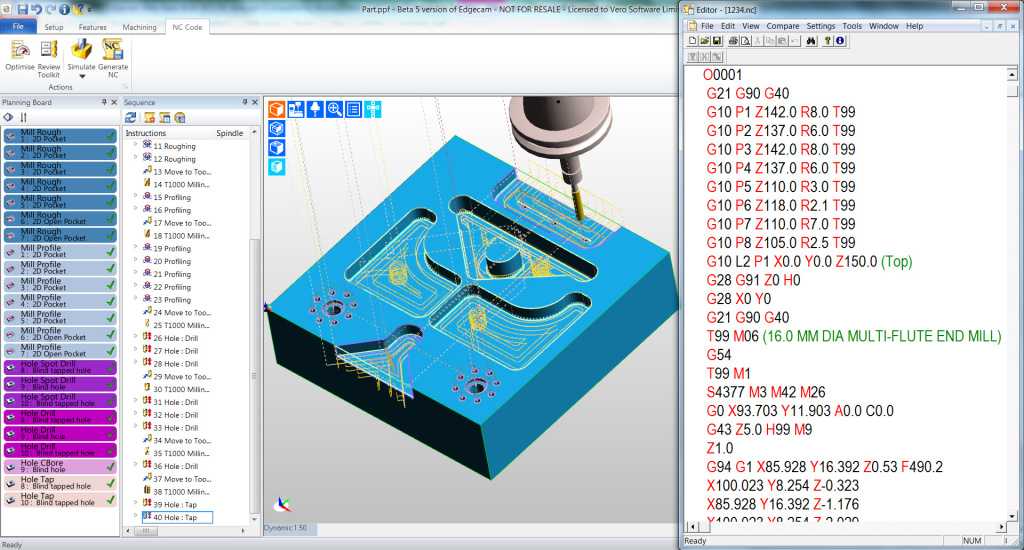
A pivotal moment in the product’s evolution came in 1995. That year, coinciding with the launch of Microsoft Windows 95, Pathtrace released the first version of “EdgeCAM” – a newly overhauled CAM software with a full Windows graphical user interface. In fact, the company’s rebranding to the Edgecam name occurred on the exact day Windows 95 was released, underscoring the significance of the shift from DOS to a modern GUI environment. According to Raf Lobato, who was a technical director and later Edgecam’s General Manager, the first release of Edgecam replaced the old text-based menus with intuitive graphical icons and windows, bringing a familiar Windows “look and feel” to CAM programming. This change greatly improved ease of use and reflected Edgecam’s ethos of being on the “leading edge” of technology (a philosophy that even inspired the product’s name). At the time, Edgecam offered traditional 2D drawing tools and wireframe/surface modeling capabilities to support toolpath generation, since solid modeling was still an emerging trend.
By the late 1990s, 3D solid modeling had started to revolutionize CAD. Rather than developing its own proprietary solid modeling kernel, Edgecam took a unique approach in 1999: it chose to support all the major solid model formats natively. This strategy allowed Edgecam to directly open files from a variety of CAD systems (such as SolidWorks, Mechanical Desktop, Pro/ENGINEER, Solid Edge, and later Inventor and CATIA) and generate toolpaths on the solid geometry without intermediate translation. Edgecam’s developers saw that the industry was moving from wireframe designs to solid models, and they positioned the software to work with whichever CAD platform the user preferred. This foresight meant that Edgecam users could import designs with full fidelity and avoid the data exchange problems (loss of precision, missing features, etc.) that often plagued other CAM systems when translating through neutral formats. To this day, the ability to seamlessly read and machine native CAD models is a hallmark of Edgecam, simplifying programming workflows and ensuring accuracy.
Throughout the 2000s and 2010s, Edgecam continued to advance with new features and adaptations to industry changes. The software adopted support for high-speed machining techniques and multi-axis machining as these became more prevalent. For example, in the early 2000s, Edgecam introduced advanced “rest machining” cycles (efficiently removing remaining material with smaller tools after a roughing pass) to minimize redundant cutting. By mid-2000s, Edgecam was adding more automated strategies and improving simulation capabilities to handle increasingly complex CNC equipment.
A significant innovation was the introduction of Edgecam Strategy Manager in the 2000s – a knowledge-based machining system that allowed users to capture their best practices and machining logic in a decision-tree style framework. Strategy Manager let manufacturing engineers create custom rules and templates for how different features should be machined (for example, automatically selecting preferred tools, speeds, and strategies for a given feature type and material). These strategies could then be applied repeatedly to similar parts, dramatically reducing programming time and enforcing consistency. Edgecam was one of the first CAM systems to offer such an open, user-editable knowledge base for process automation. This innovation gave companies the ability to codify the expertise of their top programmers and standardize it across the team.
Another breakthrough came with Edgecam’s Waveform Roughing strategy, introduced in the early 2010s. Waveform Roughing is a high-speed machining technique that maintains a constant tool load by using smooth trochoidal toolpaths. Unlike traditional roughing (where a cutter might plow full-width into material at corners, causing stress and requiring slow speeds), Waveform’s toolpath dynamically adjusts to keep cutting forces consistent, enabling higher speeds and deeper cuts safely. This results in significantly faster material removal while also extending tool life and reducing wear on the machine. Manufacturers who adopted Edgecam’s Waveform Roughing reported substantial productivity gains, with some describing the technology as “pushing the boundaries of traditional milling” in how aggressively yet reliably it could remove stock. High-efficiency toolpath strategies like Waveform have since become essential for industries working with tough materials (e.g., titanium or hardened alloys in aerospace) where maximizing machining efficiency is critical.
Edgecam also rolled out a simplified interface mode called Workflow around 2013. The Workflow concept was aimed at new users and fast job turnaround – when activated, Edgecam’s Workflow guides the programmer through a streamlined process: automatically loading the part model, setting up the initial stock and machine, and suggesting an ideal sequence of operations. It essentially provides an easy starting template for programming a new part, which the user can then tweak. This lowers the learning curve for less experienced users and speeds up routine jobs, making CAM programming more accessible without sacrificing control for power users.
Over the years, Edgecam has regularly updated its software, typically releasing major updates twice a year. New versions have brought enhancements in toolpath algorithms, expanded support for cutting techniques, user interface improvements, and integrations with new CAD versions. By staying current with industry needs – such as adaptive machining, additive/subtractive hybrid manufacturing trends, and Industry 4.0 connectivity – Edgecam has managed to remain a relevant solution as manufacturing technology evolves. Its longevity (over 30 years on the market) speaks to a successful adaptation to each era’s technological demands.
Company and Ownership Timeline
Edgecam’s journey is not only one of technological innovation but also of notable corporate changes. The software originated with Pathtrace Ltd., the company that developed and sold Edgecam from its inception through the 1990s and early 2000s. Pathtrace was a private UK-based firm headquartered in Reading, England, with subsidiaries abroad to handle international markets. By the early 2000s, Pathtrace had established a strong presence in the CAM industry – it had a particularly close partnership with CAD vendors, even becoming Autodesk’s “Global Preferred CAM Partner” in the mid-2000s due to Edgecam’s integration with Autodesk’s Inventor CAD software. Around that time, Pathtrace reported that Edgecam was the CAM system of choice for many users of CAD packages like SolidWorks and Solid Edge as well, thanks to its associative CAD link.
In 2006, a major industry consolidation occurred: Pathtrace (and Edgecam) was acquired by Planit Holdings, a larger British CAD/CAM conglomerate. Planit was known for owning several manufacturing software brands, including Alphacam (a CAM system tailored to woodworking and metal cutting) and Radan (a CAM system for sheet metal fabrication). With the addition of Edgecam, Planit significantly expanded its portfolio in the mainstream mechanical CAM segment. The acquisition was part of a wave of CAM industry consolidation in the mid-2000s. Planit’s Chief Operating Officer at the time, Bryan Pryce, noted that Edgecam was “a well-respected and highly capable offline programming system” and that adding Pathtrace’s products to Planit’s lineup would reinforce their commitment to the manufacturing sector. Pathtrace also brought along global reach – it had offices not just in the UK but also in the United States, China, and Japan, along with a network of resellers in dozens of other countries. Folding Edgecam into Planit instantly gave the combined company a much larger customer base worldwide. Industry reports indicated that after acquiring Pathtrace, Planit’s total global customer count jumped to around 50,000 licensed users across all its software products, putting the group among the top CAM vendors in terms of installed seats.
Edgecam continued to thrive under Planit’s ownership, benefiting from shared resources and technology with its sister products. Planit often allowed each brand to retain its identity and focus (acknowledging the loyalty of Edgecam’s user community), while also encouraging technology exchange where possible. For instance, some toolpath algorithms or optimization techniques could be shared internally between the different CAM packages. During the late 2000s, Edgecam’s development kept momentum, and its market reach grew further.
A significant next chapter came in 2011. Planit Holdings was merged with (or acquired by) Vero Software, another UK-based CAD/CAM vendor that had its own slate of products (notably including the VISI mold & die software and the PEPS and Machining Strategist CAM packages). The union of Vero and Planit effectively brought together an even larger collection of CAM software brands under one roof – Edgecam now became one of the flagship products of Vero Software’s portfolio. This merger created what was described as the world’s largest specialist CAM software company at the time. According to CAM industry analysts, the combined Vero-Planit entity became the third-largest CAM/CAD vendor globally by market share (trailing only the much larger general CAD/CAM providers Dassault Systèmes and Siemens PLM). Richard Smith, the CEO of Vero Software, remarked that the expanded offering would accelerate the company’s growth and that they would “continue to invest in all of the products” (Edgecam included) to deliver even higher productivity to customers. Notably, the merger was backed by private equity investment (Battery Ventures helped finance it, as Vero was aiming to scale up through acquisitions).
Under Vero Software in the early 2010s, Edgecam was one of several synergistic brands, each targeting different niches of manufacturing. Edgecam focused on production machining (milling, turning, general CAM), Alphacam handled woodworking and specialty cutting, Radan covered sheet metal, VISI targeted mold design and electrode machining, and others like Cabinet Vision handled cabinetry/joinery industries. Vero allowed these brands to co-exist and often cross-pollinate technology while streamlining the companies’ operations. Edgecam’s development headquarters remained in the UK, and the product retained its strong identity and user base even as corporate ownership changed.
The most recent major ownership change came in 2014, when Hexagon AB – a large Sweden-based technology conglomerate – acquired Vero Software (and with it, Edgecam and the other CAM products). Hexagon is a global provider of design, measurement, and visualization technologies, known for its metrology equipment (measurement devices and software) and software solutions in various fields. The acquisition of Vero was part of Hexagon’s strategy to strengthen its software offerings in the manufacturing domain. By adding CAM software to its portfolio, Hexagon sought to create an end-to-end ecosystem from design through manufacturing and quality control. Edgecam and its sister CAM systems were integrated into Hexagon’s Manufacturing Intelligence division. Hexagon’s President and CEO Ola Rollén stated that Vero’s suite of manufacturing software, combined with Hexagon’s global footprint and technologies, would enable higher productivity for customers and support the vision of integrating all data and processes across the manufacturing lifecycle. At the time of the Hexagon acquisition, Vero Software had an annual revenue of approximately €80 million (2013) and offices in 13+ countries, reflecting how far Edgecam’s parent company had grown from its small UK origins. Hexagon’s acquisition brought even more resources and stability to Edgecam’s development, along with potential integrations with Hexagon’s metrology and manufacturing automation systems.
Since becoming part of Hexagon, Edgecam has continued to be marketed under the Vero Software brand (often referred to as Hexagon Manufacturing Intelligence’s production software line). The product has seen further development aligning with Hexagon’s smart manufacturing initiatives, such as connectivity with shop-floor metrology, and recently, incorporation into Hexagon’s Nexus platform (a cloud-based collaboration and data exchange framework for manufacturing software).
Throughout these transitions, Edgecam’s user community has remained global. As of the mid-2010s, Edgecam was reportedly used in at least 26 countries worldwide, supported by a network of dozens of resellers and Hexagon’s direct offices. The installed user base likely numbers in the tens of thousands. Even early on, by 2001 Pathtrace had noted nearly 20,000 Edgecam seats installed globally – a figure that would only have grown through the 2000s. By around 2006, industry sources cited over 28,000 Edgecam licenses worldwide, and with the mergers adding complementary customer bases, the broader Edgecam/Planit family reached around 50,000 users. While exact current figures aren’t publicly disclosed, Edgecam’s longevity and continuous use by manufacturers around the world indicate its substantial penetration in the CAM market. The product has also been recognized through industry awards indirectly – for example, Vero Software (as the parent of Edgecam) won the Queen’s Award for Enterprise in International Trade twice (2010 and 2014), reflecting the export success and global reach of its CAM solutions.
Features and Innovations
Edgecam’s enduring popularity can be attributed to a combination of rich features, innovation in automation, and practical ease-of-use on the shop floor. Some of the key features and strengths of the system include:
-
Comprehensive Milling and Turning Capabilities: Edgecam provides a complete suite of machining cycles for 2½-axis and 3-axis milling, high-speed milling, 4/5-axis simultaneous milling, as well as 2-axis and multi-axis turning. Users can perform roughing, finishing, threading, drilling, tapping, and a host of advanced cycles. The software excels at programming mill-turn centers (multi-function CNC machines that perform both milling and turning in one), offering synchronization tools and turret control to safely coordinate complex operations. This breadth allows companies to standardize on one CAM system for multiple types of machines and operations.
-
High-Speed Machining Strategies: With the advent of harder materials and the need for faster production, Edgecam incorporated high-speed machining strategies like the aforementioned Waveform Roughing. The intelligent roughing cycle in Edgecam automatically applies trochoidal toolpaths and smooth approaches to avoid heavy cuts, maintaining consistent chip load. This lets machines run at optimal feed rates even in difficult materials, significantly cutting down roughing time. The software also offers advanced finishing strategies optimized for quality and efficiency – for instance, specialized Z-level finishing, constant cusp machining for smooth surface finish, and even support for undercut machining (using lollipop or T-slot cutters) which is particularly useful in aerospace and automotive parts with complicated geometries.
-
Feature Recognition and Knowledge-Based Machining: A standout capability of Edgecam is its use of feature-based machining. When working with a solid model, Edgecam’s feature recognition can automatically identify key features such as pockets, holes, slots, and bosses. Once identified, these features can be machined using predefined strategies or templates. The Edgecam Solid Machinist module, tightly integrated with popular CAD systems, not only imports the geometry but also the design intent of features. Building on this, the Strategy Manager (knowledge base) allows companies to encode their best practices. For example, a company can define how a “through hole of diameter X in material Y” should be drilled (which tool, what peck cycles, speeds, etc.) and have Edgecam apply that rule whenever such a feature is recognized. This dramatically reduces programming time for families of parts and ensures consistency and optimal processes are used every time. Over years of use, many Edgecam customers build up extensive libraries of strategies that become a valuable asset, encapsulating hard-won manufacturing knowledge.
-
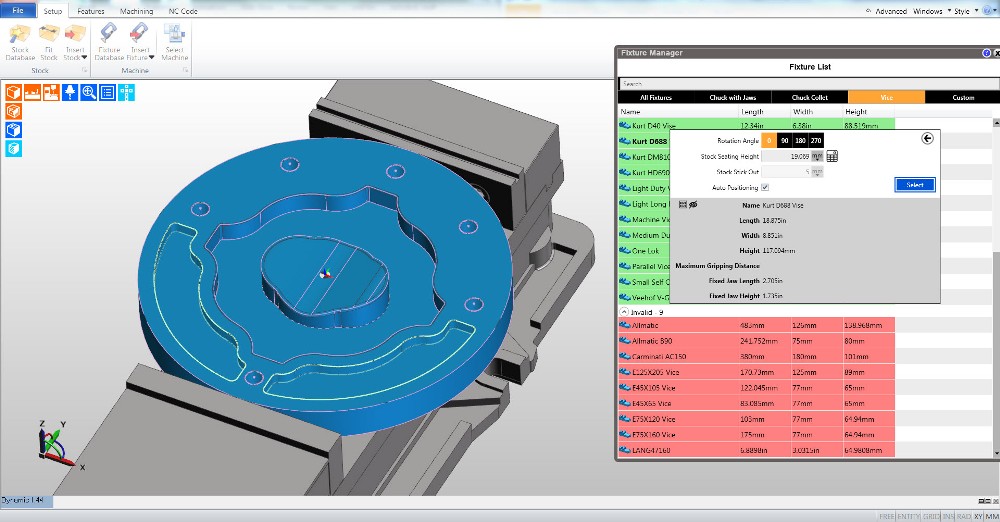
Seamless CAD Integration and Data Integrity: As noted, Edgecam is CAD-neutral but CAD-friendly – it works equally well with models from various design systems. This focus on interoperability means engineers aren’t forced to use a particular CAD package to benefit from Edgecam. The system reads native files (including assemblies) and preserves the design intent. Because no translation is needed, data integrity is guaranteed, avoiding mistakes that can come from format conversions. Edgecam also supports a wide range of industry file standards (IGES, DXF, Parasolid, STEP, etc.), but whenever possible, users load the native files for efficiency. This strength in data handling made Edgecam a preferred CAM solution in multi-CAD environments or supply chains where different customers might provide designs in different formats.
-
Ease of Use and Workflow: Despite its sophisticated capabilities, Edgecam has long been marketed for its user-friendly interface. The Windows-based GUI, adopted early in 1995, has continually evolved with modern UI practices. Commands are accessible through intuitive menus and icons, and the software provides visual feedback like cut previews and real-time toolpath display. The Workflow mode introduced in recent versions is an example of Edgecam’s focus on guiding the user. When activated, Workflow automatically takes the user through logical steps – component setup, machining feature detection, tooling selection, strategy selection, toolpath generation, simulation, and NC code output. At each step, defaults are intelligently assigned (which the user can override), allowing even relatively novice programmers to generate a safe and optimized machining program. Experienced users benefit from Workflow by getting a head start on routine jobs, which they can then refine with manual tweaks. This balance between automation and user control is a key philosophy in Edgecam’s design.
-
Simulation and Verification: Edgecam includes a robust simulation engine that lets users visualize the machining operations on a virtual machine. This includes the ability to simulate tool changes, part repositioning, and the actual material removal, resulting in a “machined part” model that can be compared against the original design to ensure accuracy. The simulator checks for collisions between the tool, workpiece, and machine components, which is critical when programming complex multi-axis moves or tight setups. By proving out programs virtually, companies reduce the risk of errors that could lead to scrapped parts or damaged machines. It also allows optimization – users can test different approaches or adjust feed rates in the simulation to see their effect on cycle time, all before cutting metal. Such digital validation has become essential as CNC machines perform increasingly complex unattended operations.
-
Extensibility and Customization: Over time, Edgecam has provided various ways to customize and extend its functionality. This includes an API for automating tasks or integrating with other systems, a tool for creating custom post-processors (to output NC code tailored to specific machine/control combinations), and the ability to incorporate custom macros or scripts. Advanced users or OEM partners can create add-ons that enhance Edgecam for specialized applications. This flexibility has allowed Edgecam to be integrated into broader manufacturing workflows – for example, tied into an ERP/MRP system like Javelin for scheduling, or used alongside tool management systems for a complete production solution. Edgecam has also been used in tandem with coordinate measuring machine (CMM) software (especially after joining Hexagon, a metrology leader) to form closed-loop manufacturing processes where measurement results can trigger CAM program adjustments.
-
Continuous Development and Support: As part of a major corporation (Hexagon) and with a history of dedicated development, Edgecam benefits from ongoing R&D and customer support. Regular releases each year provide new features and keep the software current with CNC technology advancements. Users with maintenance contracts gain access to technical support, online forums (Edgecam has had a global user community portal), and training resources. This level of support and improvement has been a deciding factor for many companies to invest in Edgecam long-term, as they can be confident the software will not stagnate or become obsolete.

Leadership and Market Perspective
Edgecam’s leadership team and parent companies have often emphasized a commitment to innovation and customer productivity. From its early days, the people behind Edgecam recognized shifts in the industry and adapted accordingly. “In those days most CAM software was designed for mainframe systems, but when the first generation of PCs came along, Pathtrace embraced these small machines – believing, quite rightly, that they were the future,” noted Raf Lobato in an interview reflecting on Edgecam’s beginnings. That forward-looking mindset has continued through the decades.
When Planit acquired Pathtrace in 2006, Planit’s COO Bryan Pryce underscored that it was a strategic move to strengthen their offerings for engineering manufacturing. He praised Edgecam as “highly capable” and complementary to Planit’s existing tools, signaling that the new ownership valued what Edgecam brought and would invest in it further. Indeed, through the subsequent mergers, each new parent company saw Edgecam as a key asset.
After the 2011 merger that created the new Vero Software, Vero’s CEO Richard Smith reassured users that all product lines (Edgecam included) would continue strong: “We fully recognize the importance of product branding and customer loyalty, and therefore it is important to emphasize that we will continue to invest in all of the products… We will move forward together with the expertise, knowledge and resources necessary to deliver even higher levels of productivity to our customers.” This statement was an important message to the many manufacturing firms using Edgecam, indicating that their software would be supported and improved as part of the larger portfolio.
Hexagon’s acquisition in 2014 further solidified Edgecam’s place in a broader manufacturing technology strategy. Hexagon CEO Ola Rollén highlighted the synergy, saying that Vero (Edgecam’s parent) had “a unique suite of manufacturing software solutions” and the “expertise and knowledge to deliver even higher levels of productivity.” By combining Hexagon’s global reach and complementary technologies with Edgecam’s domain-specific strength, the goal was to enable manufacturers to integrate all stages from design to production to quality in a data-driven loop.
Edgecam’s story is thus one of continuous growth and adaptation, backed by a leadership focus on remaining at the forefront (“leading edge”) of CAM innovation. From a small pioneer bringing CAM to desktop PCs, it evolved into a cornerstone of a multi-national software suite. Along the way, it has empowered countless manufacturers to improve their processes. As manufacturing enters the age of smart factories and digital twins, Edgecam continues to be positioned as a critical component of the production engineering toolkit, ensuring that the gap between digital design and physical product is bridged efficiently and intelligently.