
NCG CAM: A Standalone CAM Solution with a Toolmaker’s Heritage
The information is currently being reviewed and updated. If you notice any errors or inaccuracies, please let us know.
NCG CAM and Its Vendor
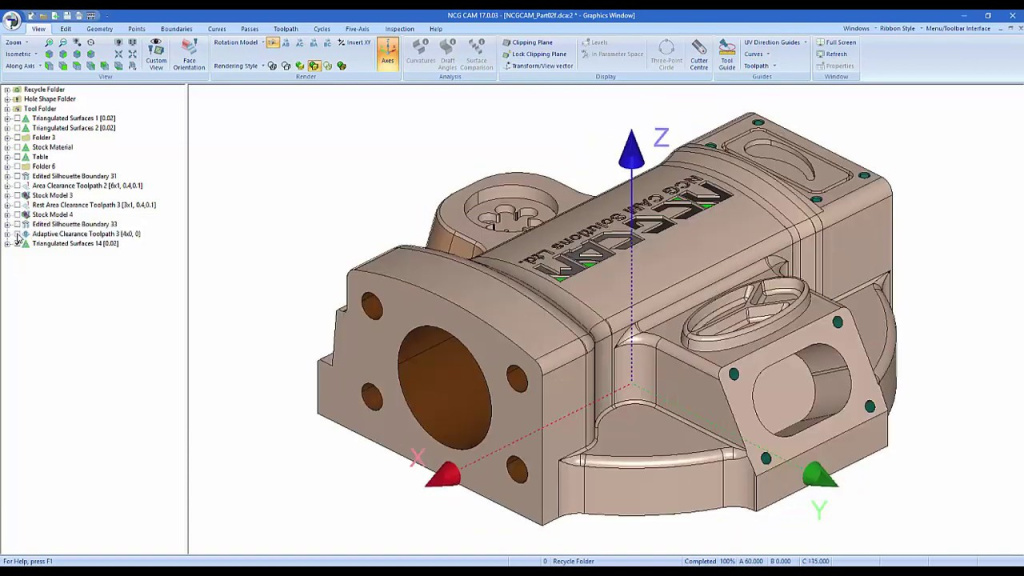
NCG CAM is a standalone CAM software application designed for generating toolpaths to manufacture complex 3D parts. Unlike CAM tools that are add-ons to specific CAD platforms, NCG CAM operates independently while still accepting models from all major CAD systems in standard formats. The product is especially geared towards high-speed machining, meaning it generates optimized, smooth cutting paths that enable faster milling while reducing tool wear. Typical uses include machining prototypes, precision components, and tooling such as molds and dies.
The software’s vendor, NCG CAM Solutions Ltd, is a private CAM software company based in Cambridge, England. Established in 2009, NCG CAM Solutions took over development of this CAM system from its predecessors and has since continued to enhance the product. The company positions NCG CAM as a “powerful, reliable and affordable” advanced 3D CAM solution, emphasizing its user-friendly interface and efficient toolpath calculation. NCG CAM Solutions offers perpetual software licenses to customers, with optional maintenance contracts for ongoing updates in some regions. This is a notable stance at a time when many competitors are moving to subscription-only models. The company supports a global customer base through an international network of resellers and provides services like technical support and custom post-processor development to ensure users can fully utilize the software.
Areas of Application and Industries
NCG CAM is utilized across a range of industries that require complex 3D machining and fine surface finishes. Its capabilities are especially valued in sectors where molds, patterns, and prototypes are central to production. Key application areas and industries include:
-
Mold and Die Manufacturing: Toolmakers use NCG CAM to program the machining of injection molds, blow molds, casting patterns, stamping dies, forging dies, and EDM electrodes. The software’s high-speed machining strategies produce the smooth surfaces and accurate details needed in these tools, and its reliability allows unattended “lights-out” machining for long mold cavity milling jobs.
-
Automotive and Aerospace Prototyping: Companies in automotive and aerospace industries employ NCG CAM to craft prototype components and tooling. The software can handle the sculpted surfaces of automotive design models and the precision required for aerospace components. For example, earlier generations of the software were used to machine turbine blade dies for jet engines.
-
Product Prototyping and General Manufacturing: Job shops and product development firms use NCG CAM for one-off prototypes, models, and short-run manufacturing of complex parts. Its ease of use makes it suitable for programming directly on the shop floor, enabling CNC operators to quickly generate toolpaths for custom jobs without extensive CAM training.
-
Medical Devices and Jewelry: In the medical sector, NCG CAM has been used for machining implants and surgical components that have organic shapes requiring smooth finishes. Likewise, jewelry manufacturers benefit from the software’s ability to accurately mill intricate 3D designs in wax or metal with fine detail.
-
Motorsports and Others: High-performance engineering fields like motorsports also leverage NCG CAM to produce components such as engine parts or tooling with tight tolerances and polished surface requirements. Anywhere that precision 3-axis or 5-axis milling of complex geometry is needed, NCG CAM can be found as part of the workflow.
While NCG CAM is not intended for simpler 2D machining or high-volume production machining—it lacks dedicated modules for turning or wire EDM, for example—it excels in the advanced 3-axis and multi-axis milling niche. Its typical users are machining departments that need a reliable CAM tool for hard-to-machine shapes and who value a straightforward, focused toolset.
History of the Product and Evolution
The origins of NCG CAM can be traced back to the late 1970s. The technology was born from NC Graphics, a Cambridge-based CAM software firm founded in 1977 by Dr. Arthur Flutter. Dr. Flutter, a Cambridge University PhD in CAD/CAM, initially developed software for industries like footwear design and ship hull fabrication before shifting focus to toolmaking. By the late 1980s, NC Graphics had released ToolMaker, a CAD/CAM system for tool-and-die machining, establishing the company’s reputation in the UK manufacturing sector.
A major turning point came in the mid-1990s when NC Graphics collaborated with a German cutting tool manufacturer, DEPO GmbH, to create a new high-speed machining software. This resulted in a product called DEPOCAM, first released in 1997 as a standalone 3-axis CAM system tailored for high-speed surface milling. In some markets, the same software was branded as Machining Strategist, but it was essentially the same product co-developed by NC Graphics to provide a “complete HSM experience” for mold and die makers. DepoCAM/Machining Strategist introduced innovations in toolpath calculation that allowed much faster milling of complex 3D shapes, significantly cutting down machining time while improving surface quality. The software was “developed by toolmakers for toolmakers,”reflecting NC Graphics’ deep engagement with the toolmaking industry’s practical needs.
Throughout the early 2000s, NC Graphics’ CAM technology gained industry recognition. In 2002, a competitor, Vero International, acquired the Machining Strategist product and its development team, although NC Graphics retained rights to continue selling DepoCAM independently. NC Graphics also licensed its machining algorithms to several other CAM vendors. In fact, its high-speed machining kernel proved so effective that it was licensed to five of the top ten CAM software companies by the mid-2000s, including to CNC Software for incorporation into Mastercam. This behind-the-scenes influence meant that even some competing CAM packages were using NC Graphics’ technology under the hood for advanced 3D toolpaths.
Despite these technical successes, NC Graphics as a business faced challenges by the mid-2000s. Its legacy ToolMaker product was aging and sales had declined. In May 2007, the U.S.-based engineering software company PTC (Parametric Technology Corporation) acquired NC Graphics for $7.2 million. At the time of the acquisition, NC Graphics was a small outfit with only 15 employees, but it held valuable CAM technology and expertise. PTC rebranded the flagship product as Pro/TOOLMAKER and aimed to integrate it into its Pro/ENGINEER CAD suite, pushing further development of five-axis capabilities. However, PTC’s foray into CAM was short-lived.
In an unusual twist, two years after the acquisition, the original NC Graphics technology returned to independent hands. On June 1, 2009, Dr. Arthur Flutter — NC Graphics’ founder — and Mr. Dieter Trinkner, who had been NC Graphics’ reseller partner in Germany, arranged to buy back the source code license and full rights to the DepoCAM software from PTC. They formed a new company, NCG CAM Solutions Ltd, in Cambridge and rehired key former NC Graphics developers to continue the product’s development. The rejuvenated software was re-launched under a new name, NCG CAM, marking the start of its modern era.
Since 2009, NCG CAM Solutions has released regular updates to the software, adding features and refinements while retaining the core focus on efficient 3D machining. In its early re-releases, the company introduced an optional module for simultaneous five-axis milling, expanding beyond the traditional 3-axis and 3+2 (positional five-axis) modes. Over the next decade, NCG CAM’s user interface and capabilities continued to evolve. A significant update came in 2019 with NCG CAM v17, which overhauled the interface to a modern ribbon-style design for improved usability. By the 2020s, the software had incorporated features such as adaptive clearing (for intelligent rest-roughing of leftover material), enhanced drilling automation, and expanded import compatibility with the latest CAD systems like SOLIDWORKS and PTC Creo. As of 2025, NCG CAM has seen over twenty major version releases since its inception (counting its DepoCAM lineage), and it remains under active development by its Cambridge-based team.
Business Performance and Market Presence
NCG CAM Solutions Ltd is a relatively small player in the CAM software market, but it has maintained stable growth and a dedicated user base in its niche. The company is privately held and has operated for over a decade since its 2009 founding, achieving profitability through software license sales worldwide. While exact financial figures are not publicly disclosed, industry estimates place NCG CAM Solutions’ annual revenue in the low single-digit millions of USD, with roughly a dozen to two dozen employees on staff. Industry analysis has pegged the company’s annual revenue in the range of $4–5 million, reflecting a lean operation relative to its output.
Despite its size, NCG CAM Solutions punches above its weight in global reach. The company sells its software primarily through an international network of value-added resellers. As of the mid-2020s, NCG CAM has resellers or distribution partners in over two dozen countries spanning Europe, Asia, North America, South America, and Australia. Key markets include the United Kingdom and Germany (where its roots lie), as well as countries like Spain, Italy, Turkey, India, China, Japan, South Korea, the United States, and many others where specialized manufacturing industries are present. This global reseller strategy has allowed NCG CAM to serve customers in diverse regions without maintaining large direct sales offices.
In terms of user base, NCG CAM is not as widely used as some heavyweight CAM platforms owned by larger corporations (such as Mastercam, Siemens NX, or Autodesk’s Fusion 360 and PowerMill). However, within the mold-making and precision prototyping community, NCG CAM has a loyal following. Users often cite the software’s reliability and the personal support provided by the NCG CAM Solutions team as reasons they stick with it. At the company’s ten-year anniversary in 2019, NCG CAM Solutions reported a 41% growth in sales over the previous year, crediting a surge of new customers who were seeking perpetual-license CAM software rather than being forced into subscription-only tools by other vendors. This suggests that a segment of the CAM market values NCG CAM’s business model and has contributed to its steady growth.
Geographically, NCG CAM’s customer base is widespread but often concentrated in communities of practice. For example, in South Korea, a former distributor of a major CAM brand switched to promoting NCG CAM in 2023 as an alternative solution for high-end toolmaking, signaling growing recognition in Asia of this niche product. Likewise, small manufacturing firms from Eastern Europe to South America have adopted NCG CAM for its specific strengths. The software’s footprint, while modest compared to industry giants, is truly international.
Mergers, Acquisitions, Partnerships, and Collaborations
Throughout its history, the NCG CAM product has been involved in several notable mergers and partnerships, reflecting its journey through the CAM industry landscape.
One of the earliest collaborations was with DEPO GmbH in the 1990s, which was instrumental in the creation of the original DepoCAM software. This partnership combined NC Graphics’ software expertise with DEPO’s cutting tool knowledge, producing a CAM system finely tuned for high-speed machining with DEPO cutting tools. The result not only benefited users of DEPO tooling but also laid the groundwork for NCG CAM’s emphasis on high-speed, high-precision toolpaths.
In the early 2000s, as NC Graphics grew the DepoCAM/Machining Strategist product, it entered into strategic agreements with other software companies. Notably, in 2002 Vero Software (known for products like VISI) acquired the rights to Machining Strategist, absorbing some of NC Graphics’ team in the process. NC Graphics, however, retained its core technology and continued serving customers under the DepoCAM name. Around the same time, NC Graphics licensed its machining algorithms to multiple CAM vendors to be used as components inside their own software. This collaboration-by-licensing meant that NC Graphics’ high-speed machining routines had a far wider impact than the direct customer base of DepoCAM alone. The most prominent example was the license to CNC Software, the maker of Mastercam, which integrated NC Graphics’ 3D toolpath engine for advanced machining capabilities. Similar arrangements existed with other CAM developers, underscoring how valued NC Graphics’ innovations were within the industry.
The acquisition of NC Graphics by PTC in 2007 was a major corporate development for the product. For PTC, a large CAD vendor, the deal was an opportunity to offer an integrated CAM solution (as Pro/TOOLMAKER) to its customers. While PTC did enhance the software (adding more five-axis support, for instance) and briefly marketed it, PTC’s core focus remained on its CAD and PLM offerings. The fit was not ideal long-term, and PTC eventually decided to divest the CAM line. The 2009 management buyout led by Arthur Flutter and Dieter Trinkner effectively reversed that merger, spinning the CAM product back out as an independent entity. This maneuver is relatively rare in the software world and demonstrated the commitment of the original team to keep the product alive and evolving outside of a corporate giant’s shadow.
Since re-establishing independence, NCG CAM Solutions has forged its own partnerships to support the product. The company works closely with NC Graphics GmbH (the German branch led by Dieter Trinkner) which not only resells the software in German-speaking countries but also collaborates in development and technical support. NCG CAM Solutions also maintains partnerships with CAD vendors for interoperability; for example, it is an official third-party CAM partner for SOLIDWORKS and offers direct integration compatibility with PTC Creo, allowing seamless import of model files from those systems. Additionally, NCG CAM can be used in conjunction with verification and machine simulation tools (such as CGTech’s Vericut) and is often part of a broader digital workflow in a machine shop.
On the distribution front, NCG CAM’s collaborations with local resellers often involve co-hosting training events and workshops to promote high-speed machining techniques. In some regions, the company has signed exclusive distribution agreements – for instance, partnering with a South Korean firm (formerly Hankook Delcam, now rebranded as HD Solutions) to represent NCG CAM after that firm parted ways with a larger CAM supplier. These kinds of collaborations have helped NCG CAM gain credibility as a viable alternative in markets traditionally dominated by bigger names.
To date, NCG CAM Solutions has not made any acquisitions of other companies itself. Instead, its growth strategy has been organic and partnership-driven. The company’s leadership has indicated they prefer to focus on their niche and excel in it, rather than expanding through mergers that might dilute their focus. This strategy appears to have paid off in maintaining the quality and specialization of the NCG CAM product over time.
Innovations, Features, and Strengths
NCG CAM’s longevity and continued relevance can be attributed to several distinctive features and innovations that set it apart in the CAM software arena. The core strengths of the system revolve around its high-speed machining prowess, user-friendly design, and targeted functionality for complex 3D work.
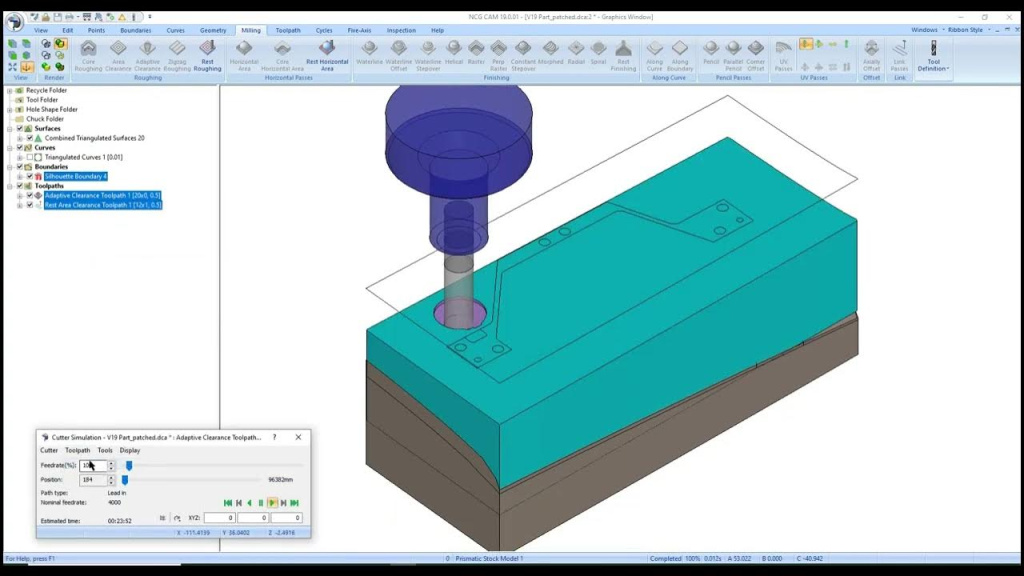
High-Speed Machining Optimization: From its inception, NCG CAM (as DepoCAM) was built to optimize toolpaths for high-speed milling. It prioritizes constant cutter engagement and smooth motion rather than sharp corners or abrupt changes in direction. In practice, these strategies allow machines to run at higher feed rates with less vibration. The benefits to users are multifold – cycle times are shorter, cutting tools last longer, and the CNC machines experience less wear and tear. Techniques like trochoidal milling, spiral toolpaths, and rest milling (to remove leftover material after roughing) are integral to NCG CAM. Even as competitors have widely adopted HSM strategies, NCG CAM’s algorithms remain highly regarded; many users note that the software reliably produces stable toolpaths that require little manual tweaking.
Advanced 3D and 5-Axis Capabilities: NCG CAM provides a comprehensive suite of 3-axis machining operations (Z-level roughing, Z-level finishing, raster passes at various angles, pencil milling for corners, and more), as well as support for 3+2 axis machining (also known as five-axis positioning, where the tool can be oriented to fixed tilt angles between cuts). For shops needing full five-axis simultaneous machining, NCG CAM offers a dedicated 5-axis add-on module. This module is tailored for mold and die applications – for instance, it includes strategies like swarf cutting (using the side of the cutter to machine inclined walls) for efficient finishing, and automatic 3-to-5-axis conversion of certain toolpaths to reach undercut areas. While NCG CAM’s five-axis capabilities require the additional module and are not as general-purpose as some larger 5-axis CAM suites, they cover common needs in the toolmaking domain. By focusing on those specific uses, NCG CAM can deliver efficient multi-axis toolpaths without overwhelming the user with complexity.
Ease of Use and Learning Curve: One hallmark of NCG CAM is its remarkably short learning curve. The interface is designed to be intuitive for someone with machining knowledge, even if they are not a CAM specialist by trade. New users often can program simple jobs within a day of training. The UI presents clear menus and, in recent versions, uses a ribbon-style toolbar to organize functions logically. Users who only occasionally program CNC jobs – such as a workshop supervisor or a lead machinist who primarily works on the shop floor – find that they can jump into NCG CAM and create or edit toolpaths without having to memorize convoluted workflows. This “shop-floor programming”orientation is a conscious design choice, making NCG CAM a practical tool on the production floor, not just in the engineering office. All post-processors (which translate the toolpaths into machine-specific CNC code) are written in-house by NCG CAM Solutions, simplifying the process for end-users. A customer can obtain a ready-made post-processor for their specific CNC machine from NCG CAM Solutions and trust that it has been thoroughly tested for accuracy, which further streamlines adoption.
Quality of Output (Surface Finish): Due to its heritage in mold and die making, NCG CAM puts special emphasis on generating toolpaths that yield excellent surface finishes. It offers fine control over step-over distances and generates smooth arc movements instead of many tiny line segments, resulting in sleek cutter motion. The software also provides strategies like “corner offset” toolpaths that ensure even material removal in internal corners and fillets. The outcome is that parts machined with NCG CAM often require minimal hand finishing or polishing – a critical advantage when manufacturing tooling or high-precision prototypes. Combined with its rest machining functions that automatically target any uncut areas from previous operations, NCG CAM helps ensure that the final product comes out true to the CAD model with a high-quality finish, reducing the need for time-consuming manual rework.
Integration and Compatibility: As a standalone system, NCG CAM isn’t tied to one CAD package, which many users see as a strength. It can import industry-standard file formats like IGES, STEP, and STL, as well as native files from systems such as SOLIDWORKS, CATIA, Creo (Pro/ENGINEER), and others. This flexibility allows NCG CAM to slot into different CAD/CAM environments. For example, a toolmaker might design a mold in a CAD program like SolidWorks, then use NCG CAM to generate the milling toolpaths for that mold, and finally run the NC code through a simulation program to verify it – all with smooth data transfer at each step. NCG CAM’s openness means a manufacturer can adopt it without overhauling their existing CAD workflows or data formats.
Perpetual Licensing Model: An interesting aspect of NCG CAM is not a technical feature but a business choice – the decision to continue offering perpetual software licenses. As many larger software firms in CAD/CAM are pushing cloud-based subscriptions, NCG CAM Solutions has committed to the traditional model where a customer purchases a license once and can use the software indefinitely. Many in the industry view this positively, as it gives customers assurance they won’t be locked out of their CAM tools if they choose not to renew a subscription. This policy, coupled with pricing that is often more accessible than high-end CAM suites, has attracted some smaller manufacturers who operate on tight budgets and prefer a one-time investment over ongoing fees. It also aligns with the expectations of many machine shops that their software, like their machines, should be an owned asset that doesn’t suddenly turn off due to a lapsed payment.
In summary, NCG CAM’s strengths lie in doing a specific set of tasks exceedingly well. It may not have every bell and whistle, but what it does – advanced milling of complex geometries – it does with reliability and efficiency. This focus has allowed NCG CAM to survive and thrive alongside far larger competitors by serving the needs of a specialized segment of the manufacturing market.
Leadership and Company Philosophy
NCG CAM’s company leadership, many of whom have been associated with the product since the NC Graphics days, consistently emphasize a customer-centric philosophy and a passion for the craft of CAM. The team’s extensive experience in the industry shapes how they develop and support the software. In fact, every member of the support and development team is said to have hands-on machining or CAM background, which helps them relate directly to user needs.
At the launch of NCG CAM Solutions in 2009, the mood was one of enthusiasm for returning to an independent path. “We are very excited about this opportunity and look forward to offering customers an excellent product, complete with a first-class technical support service,” said John Ellis, the company’s Head of Customer Support, when the new venture was announced. This statement captures the spirit with which the small team set out to carve its place in the market — focusing not just on the software itself, but also on accompanying it with strong technical support and service.
A decade later, as the company celebrated its 10-year anniversary, that commitment to users had clearly become a core part of NCG CAM’s identity. “Having worked with our software since it was first developed as DEPOCAM 22 years ago, it really is an exciting time,” noted Estelle Dunsmuir, NCG CAM Solutions’ Sales and Marketing Director, in 2019, reflecting on the product’s long journey. “Customer care and support is of the utmost importance to us, so passing our success down to the customers is a must,” Dunsmuir added. Her remarks came as NCG CAM was experiencing record sales growth, and the company chose to share that success by offering significant discounts to customers — a gesture aligning with their philosophy of putting customers first.
These insights from NCG CAM’s leadership highlight key aspects of the company’s mission: a deep-rooted belief in their product’s value (forged over decades of development) and a dedication to treating customers as long-term partners. In an industry where smaller software firms can struggle to compete with conglomerates, NCG CAM Solutions appears to compete by building strong relationships, listening to user feedback for improvements, and staying true to its niche focus rather than chasing every trend. It’s a strategy that has kept this CAM software both relevant and respected well into the 21st century.
Vendor: NCG CAM Solutions