
PEPS CAD/CAM System: Evolution of a Manufacturing Powerhouse
The information is currently being reviewed and updated. If you notice any errors or inaccuracies, please let us know.
Introduction
PEPS (Production Engineering Productivity System) is a versatile CAD/CAM software suite known for its strength in CNC programming and wide-ranging manufacturing applications. Developed and sold by Camtek GmbH, a German company based near Stuttgart, PEPS provides an integrated environment for designing geometrical models and generating NC programs for CNC machine tools. The software features its own CAD drawing tools and also imports models from other CAD systems, making it CAD-independent and highly flexible.
Camtek GmbH positions PEPS as a machine-independent solution that can serve engineering businesses of all sizes by supporting many types of machining operations with a consistent, user-friendly interface. The company prides itself on offering powerful functionality with simplicity, aiming to minimize training time while maximizing productivity. PEPS has been credited with extending the useful life of older CNC machines by enabling them to produce complex components efficiently, thus helping manufacturers avoid costly equipment upgrades.
Areas of Application
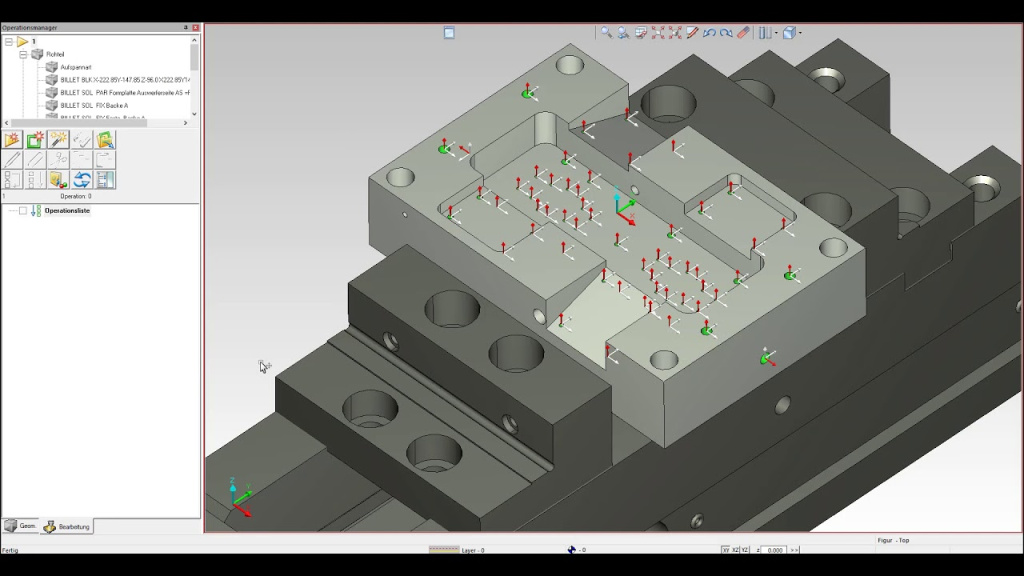
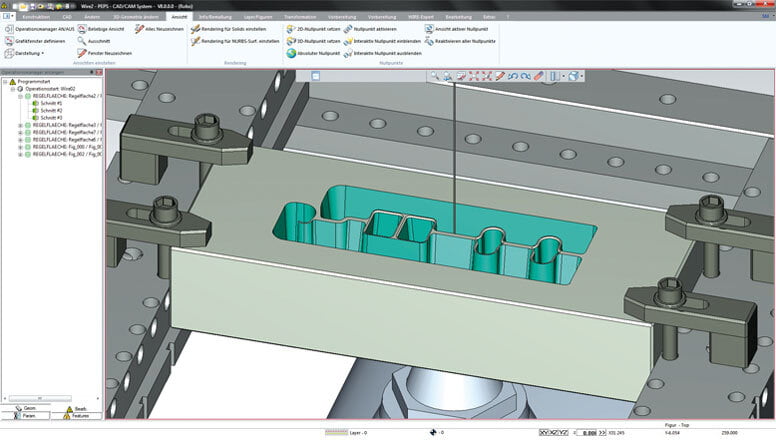
PEPS is a comprehensive CAM system catering to a broad spectrum of manufacturing processes. It is particularly renowned for its capabilities in Wire EDM (wire electrical discharge machining), where it holds a market-leading position for precision programming of EDM machines. Beyond EDM, PEPS modules cover 3- to 5-axis laser cutting, 2- to 5-axis milling, multi-axis turning (including mill-turn operations), and specialized sheet metal fabrication processes like punching and waterjet cutting. The software even extends to tube cutting, robot machining, and other niche processes, making it a one-stop CAM solution for diverse industries.
In practical terms, companies use PEPS in areas such as tool and die manufacturing, mold making, mechanical engineering, microtechnology, and general metalworking and sheet metal fabrication. The system’s flexibility means it can handle everything from small precision parts (as in microtechnology) to large-scale fabrications (such as structural tube cutting in architecture). Notably, PEPS’s tube cutting module is used to calculate precise intersection geometries for steel frameworks in construction, a task of growing importance as modern buildings increasingly rely on complex steel joints. Thanks to its modular design, users can deploy only the relevant PEPS modules for their needs – for example, a job shop focused on wire EDM can use the dedicated EDM module, while an automotive supplier might utilize milling, turning, and laser cutting modules in tandem.
History and Development
The roots of the PEPS CAD/CAM system date back to the early 1980s in the United Kingdom. Camtek Limited (UK)was founded in 1983 by Geoff Hawkesford and Mike Anstey, who were pioneers in computer-aided manufacturing software. Under Hawkesford’s guidance, the team developed the initial PEPS platform as one of the first Windows-based CAM systems for milling, turning, and fabrication. This was a significant innovation at a time when many competitors were still on DOS or proprietary systems. Over the late 1980s and early 1990s, PEPS evolved into a powerful CAM toolkit with a built-in macro programming language and support for C/VB extensibility, allowing advanced users to customize and automate tasks. This power and openness caught the attention of major machine tool manufacturers. Notably, Japanese machine builder Yamazaki Mazak adopted the PEPS platform for its proprietary CAMWARE and SpaceCAM software in the 1990s, underscoring PEPS’s reputation for cutting-edge capability in industrial settings.
A pivotal development in the PEPS story was the focus on Wire EDM technology. In the late 1980s, Camtek’s engineers began creating a ground-up CAM solution specifically for Wire EDM, collaborating closely with local extrusion die manufacturers to perfect the technology. The resulting Wire EDM module was highly successful and drew interest from EDM machine producers, including the Swiss firm Charmilles (now part of GF Machining Solutions). This Wire EDM expertise led to international expansion: Camtek GmbH was established in 1993 in Weinstadt, Germany, by two former Charmilles engineers, Hermann “Jimmy” Grimm and Paul Staib. Camtek GmbH’s mission was to distribute PEPS in German-speaking markets and contribute to its development, especially leveraging the founders’ EDM know-how. From the outset, the German office did more than sales – it started co-developing new modules, custom functions, and intelligent post-processors in tandem with the UK team.
The mid-1990s saw further growth. Camtek USA Inc. was incorporated in 1996 to serve North America, headed by Rob Thompson, a veteran Camtek developer who had worked on the Mazak projects. The U.S. branch, joined by experts like Alan Weeks, fine-tuned the software for the American market and became a premier provider of Wire EDM CAM solutions in the U.S., particularly for machine brands and user needs not well addressed by domestic software at the time.
As PEPS gained a global footprint, corporate developments followed. In 1999, founder Geoff Hawkesford retired and Camtek (UK) was sold to another CAM software vendor specializing in sheet metal. This ownership was short-lived. By 2006, Vero International Software (a UK-based CAD/CAM group known for products like VISI) acquired Camtek and the PEPS product line, aiming to merge Camtek’s production-oriented CAM expertise with Vero’s portfolio. Camtek had by then amassed over 23 years in the CAM market and boasted a user base exceeding 15,000 seats across more than 60 countries. Integrating PEPS into Vero’s stable meant new opportunities for synergy: Vero could enhance both its VISI mold-and-die software and the PEPS line by sharing technology and expertise. Camtek’s focus areas – production machining, Wire EDM, laser, and tube cutting – complemented Vero’s offerings, expanding the solutions available to customers.
Camtek GmbH in Germany, however, remained an independent entity during and after this transition. It continued as a master distributor and development partner for PEPS, contributing especially to the Wire EDM module and other advanced features. A major turning point came at the end of 2009: Camtek GmbH acquired the rights to the PEPS source code from Vero, granting the German team full independence to drive the software’s development. In parallel, Camtek’s developers (in partnership with Camtek UK’s veterans) had already been working on a next-generation product. In 2009, they unveiled OPTICAM, the first completely in-house development by Camtek GmbH. OPTICAM was conceived as a fully integrated Wire EDM programming solution that would run inside mainstream CAD systems (initially SolidWorks). It was essentially the evolution of PEPS’s strengths packaged as a plug-in: it carried forward PEPS’s robust EDM strategies and openness, but with a new architecture that allowed seamless operation inside CAD environments. OPTICAM’s design emphasized portability between CAD platforms, high automation (up to nearly 100% automated NC code generation via feature recognition), and extensibility through a modern API (including C++ and Python support).
Throughout the 2010s, Camtek GmbH continued to innovate on both fronts – advancing PEPS as a stand-alone CAM and expanding OPTICAM’s integrations. In 2010, PEPS saw the addition of automated Feature Recognition for milling and EDM, introduced through new modules called MILL-Expert and WIRE-Expert. These modules allowed users to automatically recognize features (like holes, pockets, bosses) in 3D CAD models and apply pre-defined machining strategies, significantly speeding up programming. By 2011, PEPS’s Wire EDM capabilities grew further with support for additional rotary axes and a full machine kinematics simulation, enabling users to visualize multi-axis EDM operations and avoid collisions or errors before sending code to the machine. Over time, free-form surface cutting with wire (for complex tapering and 4-axis motions) became possible, keeping PEPS at the forefront of EDM software.
Another collaboration highlight was in 2014, when Camtek’s OPTICAM was integrated into the hyperCAD-S platform (the CAD framework for the hyperMILL CAM software by Open Mind). This move, pairing OPTICAM’s EDM prowess with a popular CAD/CAM environment, demonstrated Camtek’s strategy of partnering rather than competing – leveraging each other’s strengths to benefit end-users. In subsequent years, Camtek also made OPTICAM available as an add-on in other CAM systems like GibbsCAM and Siemens NX, broadening its reach through strategic integrations.
Meanwhile, corporate ownership of the PEPS intellectual property shifted again at the macro level. Vero Software, after a few years under private equity, was itself acquired by the Swedish industrial tech group Hexagon AB in August 2014. Hexagon’s acquisition of Vero brought PEPS (as part of Vero’s product suite) under the umbrella of Hexagon’s Manufacturing Intelligence division. However, by that time Camtek GmbH had its independent license to develop PEPS, ensuring that development continued regardless of corporate reshuffling. In practice, Hexagon’s CAM portfolio (which included brands like Edgecam, VISI, Radan, WorkNC, and others) listed PEPS as its specialist solution for Wire EDM and multi-axis laser programming, while Camtek GmbH focused on serving and expanding the PEPS user base primarily in Europe and other direct markets.
Camtek GmbH marked its 30th anniversary in 2023, celebrating three decades of continuous presence in the CAD/CAM industry. From a small distributor in 1993, the company had grown into the central force behind PEPS development. As of 2025, Camtek GmbH remains a relatively small but highly specialized firm (around 40 employees) with a close-knit, engineering-driven culture. The longevity of PEPS – over 40,000 installations worldwide over more than 25 years – stands as a testament to its adaptability and the steady improvements made through each version.
Business Footprint and User Base
PEPS’s longevity has translated into a substantial global user community. By the mid-2000s, as noted, the software had about 15,000 users in over 60 countries. This number has grown significantly; Camtek reports that PEPS now has over 40,000 installations worldwide, reflecting continuous adoption in new markets and industries. Users range from small job shops to large enterprises, and the software’s flexibility allows it to be tailored for each scale. Camtek’s customer roster features well-known industrial names: automotive giants like BMW and Daimler, technology and engineering conglomerates like Robert Bosch and Siemens, tooling specialists such as Schuler, precision manufacturers like Carl Zeiss, and even luxury goods makers like Montblanc and Chopard. The diversity of these clients – from car makers to pen manufacturers – underscores the broad applicability of PEPS in different manufacturing scenarios.
Geographically, PEPS has a strong presence in Europe (especially Germany, Austria, Switzerland, and the UK where it originated), and significant penetration in Asia and the Americas through partnerships. Camtek GmbH coordinates a network of international sales and support partners to reach customers in various regions. For example, GF Machining Solutions (the machine tool division of Georg Fischer) is a partner in multiple countries, given their interest in EDM solutions; other resellers represent PEPS across Europe (Benelux, Scandinavia, Eastern Europe), Asia (China, Southeast Asia), and North America (where Camtek’s spin-off, OPTISOLUTIONS LLC, handles distribution and support for the U.S. market). This partner network ensures local training, support, and customization where needed, which is crucial in the CAM software business.
On the business indicators side, Camtek GmbH as a private company does not publicly disclose detailed financials like revenue. However, some insight can be gleaned: the company’s scale (40 employees) suggests a focused operation, and its longevity with continuous product sales points to a stable business. The CAD/CAM market is competitive, but by carving out a niche in wire EDM and related processes, PEPS has maintained a loyal customer base. It’s also worth noting that the company invests heavily in R&D relative to its size – having an in-house development team continually adding features and new products (like OPTICAM) implies that a significant portion of its revenue is reinvested into product improvement.
Mergers, Acquisitions, and Partnerships
The journey of PEPS has involved several important mergers and partnerships, reflecting the dynamic nature of the CAD/CAM industry. A key event was the 2006 acquisition of Camtek Ltd (UK) by Vero International Software. Vero’s interest in Camtek was largely due to the success of PEPS in production machining and wire EDM – areas that complemented Vero’s own strengths in mold, die, and general CAM (with their flagship VISI software). By bringing Camtek’s team and technology on board, Vero aimed to create a more comprehensive product lineup. “We are delighted,” said Don Babbs, managing director of Vero at the time of the deal, emphasizing that adding the Camtek people and products would “allow us to enhance both the PEPS and VISI-Series product ranges as well as adding world-class solutions for the wire EDM market, advanced production CAM, and specialist solutions for laser and tube cutting.” This strategic move recognized that Camtek’s expertise would augment Vero’s offerings, enabling cross-pollination of features (for instance, sharing PEPS’s robust EDM module with VISI’s user base, and integrating VISI’s 3D design strengths into future PEPS improvements).
From Camtek’s perspective, the merger opened access to Vero’s larger distribution network worldwide. Brian Warner, then managing director of Camtek, noted the positive outlook, saying “the synergy of our joint products and development activities, coupled with the close proximity of Vero International’s UK headquarters and the size of their overseas network will allow us to increase the visibility and penetration of our PEPS CAD/CAM suite around the world.” In essence, Camtek saw the partnership as a chance to put PEPS on a bigger stage globally, leveraging Vero’s sales channels in Asia and the Americas where Camtek had less presence.
Another significant corporate development was Hexagon AB’s 2014 acquisition of Vero Software. By this point, Vero had accumulated several CAM brands (including PEPS, VISI, Edgecam, Surfcam, and more) and was an attractive target for Hexagon, a Swedish multinational known for industrial measurement and production solutions. Hexagon’s acquisition folded Vero’s products into Hexagon’s Manufacturing Intelligence division, which also houses metrology equipment and production software. This broader corporate parentage has indirectly benefited PEPS by situating it within a larger ecosystem of manufacturing solutions. For example, Hexagon has the reach to form high-profile partnerships – such as with major machine tool builders – and to ensure that technologies like PEPS are visible to a wide audience at industry trade shows and events. However, it’s worth emphasizing that Camtek GmbH’s unique arrangement (having the rights to develop PEPS independently since 2009) means the German team retains a great deal of autonomy over the software’s direction, even while cooperating with Hexagon/Vero on certain technical or sales fronts.
Partnerships have not been limited to corporate parents. Camtek has a history of collaboration with CNC machine manufacturers and other CAD/CAM firms to improve compatibility and performance. Early on, Camtek worked with EDM machine OEMs (like Charmilles and AGIE) to incorporate machine-specific technology data and post-processor support into PEPS, making it a preferred CAM solution that some machine makers officially recommended to their customers. As mentioned, Mazak’s use of the PEPS platform for their in-house CAM systems in the ‘90s was a strong endorsement. In later years, Camtek co-developed high-end post-processors with leading machine and controller makers (ensuring, for instance, that PEPS could output ready-to-run code for advanced 5-axis laser cutters or complex mill-turn centers without requiring manual NC code tweaks). The company also formed technology partnerships to embed its solutions into other software: a Solid Edge CAD direct interface allows seamless import of Solid Edge models into PEPS, and the OPTICAM plug-in initiative has forged ties with CAD giants like Dassault Systèmes (SOLIDWORKS) and Siemens (NX) to bring Camtek’s CAM algorithms inside those CAD platforms. These collaborations benefit end users by reducing data translation hassles and integrating design-to-manufacturing workflows.
Camtek’s distribution partnerships around the world (with independent resellers and local CNC suppliers) can also be seen as a form of collaboration: many of these partners, such as WESTCAM in Austria or APIC in Germany, not only sell PEPS but also contribute by localizing the software, creating tutorials in local languages, and sometimes developing custom add-ons for regional industry needs. This close feedback loop with the user community via partners has helped Camtek prioritize features that solve real-world shop floor problems.
Innovations and Key Features
Over its lifespan, PEPS has introduced numerous innovations that have kept it competitive with far larger CAM software brands. A cornerstone of its appeal is the combination of powerful functionality with ease of use. The system was early to adopt a graphical Windows-based user interface for CAM programming, which made it approachable for users transitioning from manual G-code programming or older text-based systems. Short learning curves and quick programming turnaround are frequently cited by users as reasons they stick with PEPS.
Some of the key features and strengths of PEPS include:
-
Feature-Based Machining & Automation: Through modules like MILL-Expert and WIRE-Expert, PEPS can automatically detect features (holes, pockets, bosses, etc.) in a solid model and apply pre-set machining strategies. This drastically cuts down programming time, especially for repetitive or complex parts, and ensures consistency in how features are machined. Advanced users can customize the feature recognition rules and strategies, effectively embedding their machining best practices into the software’s logic. In some scenarios (particularly in Wire EDM), PEPS can generate an entire NC program automatically with minimal human intervention – a capability enhanced further in OPTICAM, which aims for nearly 100% automated code generation for EDM jobs.
-
Comprehensive Machining Module Suite: PEPS isn’t limited to one process – it offers dedicated modules for different machining types, all within a unified environment. This means a user can program a part that requires milling, drilling, and wire cutting in one session, using one software, which ensures consistency and saves time. Each module is developed with deep domain knowledge – for instance, the Wire EDM module includes specialized functions like automatic wire threading instructions, multiple cutting passes (rough and skim cuts) with optimal offsets, and strategies to minimize wire breaks and optimize cutting during unattended operations.
-
High-Quality Post-Processors: Camtek has long emphasized the importance of robust post-processing (the translation of CAM toolpaths into the exact NC code format required by a specific machine and controller). PEPS’s post-processor library covers a vast array of machine tools – from common 3-axis mills and 2-axis lathes to complex 4-axis wire EDMs and 5-axis laser cutting systems. These post-processors are known for producing “ready to run” code, meaning shops do not need to hand-edit the G-code or worry about errors on the machine. Company philosophy has been that customers should not have to tweak output code; it should be correct and optimized from the start. This reliability in code output improves shop efficiency (less trial-and-error and debugging on the machine) and trust in the CAM system. Additionally, Camtek’s recent development of a “Technic Transfer” feature allows NC programs created for one machine brand to be easily adapted to another, by smart mapping of cycles and functions – a valuable tool for manufacturers who might upgrade or switch machines but want to reuse their proven programs.
-
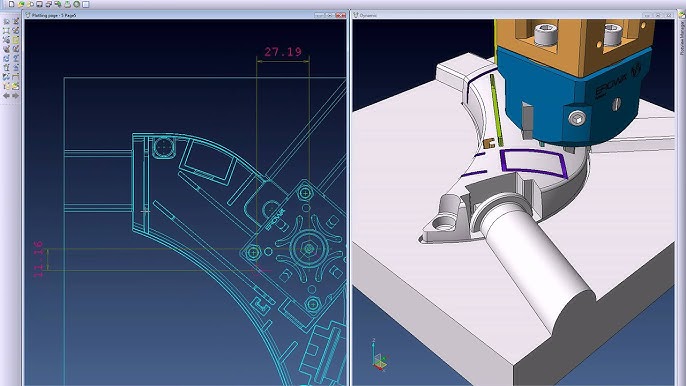
3D Simulation and Verification: PEPS includes simulation tools that let programmers visualize the machining process in 3D, checking for errors such as collisions, gouges, or areas where material remains uncut. For complex operations like 4-axis wire EDM or multi-axis laser cutting, the simulation can show the wire path or laser head movement in relation to the part and fixture, providing confidence before anything is executed on the actual machine. In wire EDM, for example, the software can simulate how the wire will thread through start holes, how the part will be detached (slug removal), and even show the effect of skim cuts on surface finish. This reduces costly mistakes and material waste.
-
Macro Programming and Extensibility: A legacy strength of PEPS, stemming from its early days, is the ability for users to extend the software’s capabilities through macros or scripts. This is a bit of an “expert” feature, but many advanced users have leveraged it to automate repetitive tasks or to create custom calculation routines for unique machining challenges. For instance, a user could write a macro to generate a complex toolpath pattern not available by default, or to automatically create a series of set-up documentation. This kind of openness endeared PEPS to a segment of power-users who appreciated being able to tailor the CAM to their exact needs. Modern iterations, via OPTICAM, even introduced Python scripting for those inclined toward higher-level programming.
-
Integration with CAD and Other Systems: PEPS can import geometry from virtually any CAD system, supporting standard formats like IGES, STEP, DXF, as well as direct native import for certain platforms (SOLIDWORKS, CATIA, etc.). The seamless import means designers can use their CAD tool of choice and trust that PEPS will accurately bring in the model without loss of fidelity, ready for toolpath programming. Moreover, Camtek offers integration services to link PEPS with company databases, ERP systems, or tool management systems. This way, CAM programming with PEPS can fit into a larger digital thread – for example, pulling tool lists from a central database or pushing estimated cycle times into an ERP for scheduling.
It is in the specialized details, particularly for wire EDM, that PEPS truly shines. An experienced toolmaker, Peter Kuppelwieser – owner of FIREWIRE Werkzeugbau in Austria – described how PEPS transformed his business’s capabilities. In his words, after trying many CAM systems, PEPS is “by far the best CAM system that exists” for his needs, allowing the quick and straightforward programming of even complicated workpieces under strict quality standards. Summing up his experience, he said: “PEPS is simply brilliant!” This kind of user testimony highlights features like the software’s Projection Wizard (automatically creating geometry for constant-Z cuts in EDM), intelligent pocketing and tagging options for EDM cuts, and rich technology databases for different machine brands – all functions that help an expert achieve results more efficiently.
Leadership and Vision
Camtek GmbH’s leadership has consistently focused on innovation and customer-driven development. The company’s relatively small size has not prevented it from articulating big ambitions in the CAM space. Camtek’s co-founder in Germany, Hermann Grimm, and his team cultivated a culture where engineers often work closely with end-users (in industries like moldmaking or precision engineering) to anticipate and solve problems before they even arise on the shop floor. This proactive ethos was inherited from the company’s early days and remains evident in how new features are rolled out – often directly addressing pain points voiced by users.
Insight into the company’s direction can be gleaned from the leadership voices at key moments. When Camtek joined forces with Vero in 2006, Vero’s CEO at the time publicly emphasized expanding into new domains (like advanced mill/turn and high-speed milling strategies) and enhancing both companies’ products through combined talent. This implied a vision where PEPS would not remain static in its niche but grow to tackle even broader manufacturing challenges (a vision that bore fruit in later features and in OPTICAM’s creation). Camtek’s management, for their part, highlighted expanding global reach – indicating a priority to ensure PEPS wasn’t just a European secret weapon, but a globally recognized name in CAM.
Today, as an independent developer within the Hexagon-connected world, Camtek’s leadership continues to stress technical excellence and customer service. Celebrating 30 years in 2023, the company projected confidence about the future, positioning itself as a “close-knit, family organization” that looks forward to the next decades of innovation. This combination of familial company culture with forward-looking tech development suggests that Camtek intends to stay responsive and agile – focusing on what they know best (like wire EDM and CNC programming efficiency) while also exploring how to integrate new technologies (for instance, supporting additive manufacturing or robotic automation could be logical expansions down the line, given their welding fixture product Nucleo hints at diversification).
In terms of broader direction, being part of Hexagon’s ecosystem could mean PEPS may play a role in smart manufacturing initiatives. Hexagon often talks about bridging design, manufacturing, and quality processes. PEPS, with its machine programming focus, might integrate more tightly with measurement systems or IoT platforms to enable closed-loop machining (e.g., adjusting toolpaths based on inspection feedback). While Camtek hasn’t publicly detailed such plans, their partnership-friendly approach and Hexagon’s portfolio suggest that PEPS will remain a key piece in the puzzle of end-to-end digital manufacturing solutions.
Finally, company leaders regularly affirm their commitment to customer support and custom solutions. Camtek GmbH provides not just software, but also training, consulting, and tailored development for clients with special requirements. This service-oriented approach is part of their vision: to be not just a software vendor, but a long-term partner to manufacturers. It’s an approach that has earned them long-standing relationships with clients (some of the big-name customers have been using PEPS for decades), which in turn feeds back into the product’s evolution. As manufacturing enters the era of Industry 4.0, Camtek’s leadership is likely to continue balancing its niche expertise with collaborations that keep PEPS and OPTICAM relevant in a connected, automated factory landscape.
Vendor: Hexagon