
Octopuz: Revolutionizing Offline Robotic Programming
Introduction and Overview
Octopuz is a CAD/CAM-based software platform designed for offline robotic programming and simulation. Developed by the Canadian company Octopuz Inc., it enables users to program industrial robot tasks on a computer without interrupting production on the factory floor. In practical terms, Octopuz creates a virtual environment where complex robot motions and processes can be planned, simulated, and optimized before sending instructions to real robotic equipment. This approach, known as Offline Robot Programming (OLRP), helps manufacturers keep their robots online and productive while new programs are being developed. The software supports a wide range of robot brands and applications, reflecting the vendor’s mission to “take complex robotic programming and make it easy.”
The company is headquartered in Waterloo, Ontario, and its official website (Octopuz.com) provides further technical details and customer resources. Octopuz’s rise in the robotics industry highlights how innovative software can simplify automation for businesses of all sizes.
Application Areas and Use Cases
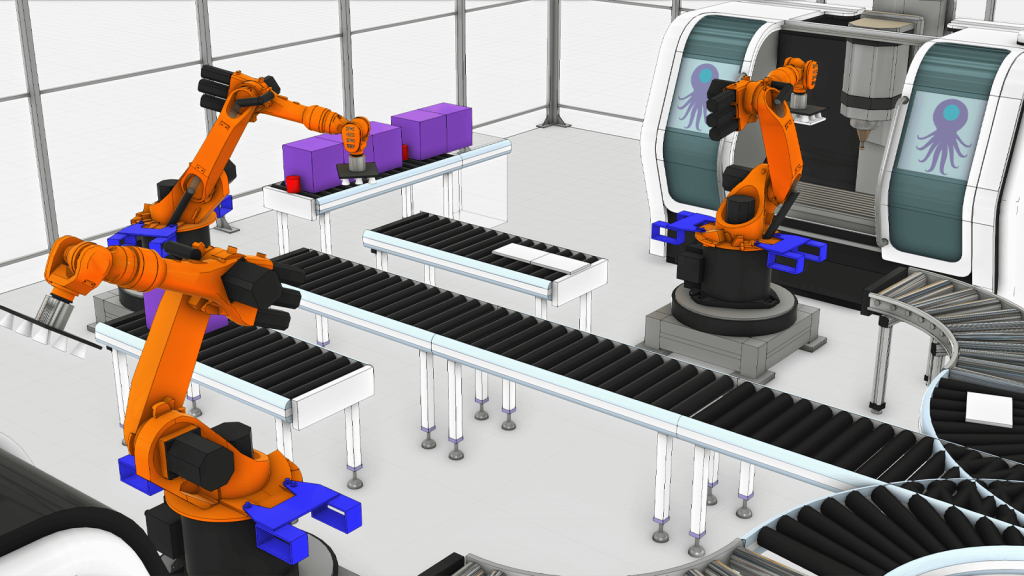
Octopuz is used across numerous industries and application areas where robotic automation is critical. Its flexibility makes it suitable for automotive manufacturing, aerospace component production, metal fabrication, consumer goods, and even emerging fields like additive manufacturing. The software shines in path-sensitive processes – tasks that require precise control of a robot’s movement through space. For example, robotic welding (both arc and spot welding) is a common application, as Octopuz can program optimal weld paths and angles for multiple robot arms. Cutting and material removal processes (such as milling, grinding, deburring, and laser cutting) are also supported, allowing robots to machine parts with complex geometries. In addition, Octopuz can handle painting and coating applications, adhesive dispensing, material handling and palletizing tasks, as well as assembly operations.
Because Octopuz works with a virtual cell model, it’s not limited to one type of robot or task. A single project in Octopuz might involve programming a robot to pick up parts (material handling), then trim edges (cutting), and finally perform a quality inspection – all in one seamless simulation. This versatility has made Octopuz popular among system integratorswho design robotic workcells for clients. An integrator can use Octopuz to prototype an entire automation solution digitally: importing 3D models of the workpiece, fixtures, and robot, then simulating the workflow. Sales engineers also use these simulations as visual demonstrations for customers, accelerating deal cycles by showing exactly how a robot will operate in the customer’s factory. From small job shops seeking to automate a single process, to global corporations running multiple robot fleets, Octopuz provides a platform to program, visualize, and refine robotic operations across a broad spectrum of industrial use cases.
Origins and Development History
Octopuz’s story began in the early 2010s amid growing demand for more accessible robot programming tools. The software was first created in 2013 by In-House Solutions, a Canadian CAD/CAM software company with decades of experience in manufacturing technology. In-House Solutions (often abbreviated IHS) was founded in the 1980s by Edward House and had made its name as a top reseller and developer for CNC programming software (notably Mastercam) and early robotic software add-ons. By 2013, IHS saw many manufacturing clients struggling to program industrial robots for complex jobs – especially customers who were not robotics experts. Sensing an opportunity, the company embarked on developing a new product that would combine two domains: traditional CAD/CAM path programming and robotic cell simulation. The result was launched as Octopuz (pronounced like “Octopus”) in January 2014.
“Octopuz is the integration of CAD/CAM technologies for CAD-to-Path and simulation/visualization technologies for robots,” In-House Solutions announced at the product’s debut. The choice of name evokes an octopus’s ability to manage multiple arms – fitting for a system that can coordinate many robot arms at once. From the outset, Octopuz was intended as a versatile and mainstream solution, not a niche academic tool. It built on In-House Solutions’ deep familiarity with machine tool programming (thanks to Mastercam) and paired that with a 3D simulation engine. Early development involved partnerships to source technology: IHS became an OEM partner of Mastercam (to leverage its toolpath generation for robotic machining) and also partnered with Visual Components, a Finnish company known for 3D factory simulation. These partnerships provided core components under the hood, allowing Octopuz to enter the market with robust features in its first release.
The founding team behind Octopuz included industry veterans. Edward “Ed” House, the CEO of In-House Solutions, was a driving force, bringing over 30 years of manufacturing software experience to the project. Under House’s leadership, the Octopuz team took a “revolutionary approach” – as they described it – by fully merging offline robot programming with accurate process simulation. This was a departure from earlier robotics software that often focused either on programming or on simulation, but not both in one package. “OCTOPUZ is ideal for any industry utilizing robotic manufacturing technologies,” Ed House said in 2014, highlighting the team’s ambition to make the platform broadly applicable. “No other platform has the reach and versatility to take interface simplicity and core power to this level. Our customers have to experience it to believe it.” This statement reflected the confidence IHS had in Octopuz’s ease-of-use and powerful underpinnings.
Over time, Octopuz evolved from a new entrant into a recognized player in the robotics software market. In its first few years, development focused on expanding compatibility with robot brands and adding application-specific modules. By supporting more robot controllers (such as ABB, FANUC, KUKA, Yaskawa/Motoman, Kawasaki, and many others), Octopuz quickly grew its appeal among integrators who often work with multiple robot manufacturers. The software’s version updates introduced features like automatic collision detection, reachability analysis (to warn if a robot could not reach a programmed point), and multi-robot synchronization. Within a couple of years of launch, Octopuz gained the ability to program several robots simultaneously in one cell simulation – a complex capability that helped distinguish it from some competitors.
Growth, Business Footprint, and Market Presence
Octopuz Inc. was formally established as a separate entity (distinct from In-House Solutions) to drive this product’s growth. The company’s headquarters remain in Waterloo, Ontario – a city known for its tech startups and engineering talent. From this base, Octopuz expanded its market reach internationally through distributors and resellers. By the mid-2010s, the software was being adopted by customers not only in Canada and the United States, but also in Europe and Asia. In 2014, In-House Solutions opened a European office in Germany to promote Octopuz, appointing a local Managing Director to tailor solutions for the EU market. The following year, the world’s largest Mastercam dealer – JBM Corporation of Japan – signed on as an official Octopuz reseller, bringing the platform into the Japanese manufacturing sector. Similar partnerships were forged in China (with Jinan Aotto Technologies), in Russia (with Pride Automatics), and in other regions like Finland, India, and Latin America via integrator networks. This reseller model allowed Octopuz’s relatively small team to tap into local sales expertise and support networks around the globe.
As a business, Octopuz Inc. has kept a focused profile. It is a privately held company and, unlike some software startups, it did not rely on large rounds of venture capital funding to grow. Instead, growth was largely organic, supported by revenue from software licensing and services. By 2020, industry analysts estimated Octopuz’s annual revenues in the range of $7–8 million USD, with a team of a few dozen employees. (Octopuz’s LinkedIn page lists the company size as 11–50 employees, which aligns with these figures.) While modest in size, the company punches above its weight by operating in a niche with high demand – providing productivity gains to manufacturers that can justify premium software investments. Octopuz’s user base includes both small machine shops and big-name corporations. For instance, automotive OEMs and Tier 1 suppliers have used Octopuz to program robotic welding lines; aerospace firms have used it for trimming composite parts with robots; and universities or technical colleges have used the software as a teaching tool in robotics labs.
Geographically, Octopuz today has users across North America, Europe, and Asia, reflecting the universal need for efficient robot programming solutions. The software is available in multiple languages and supports region-specific robot models, which has helped adoption in non-English-speaking markets. Octopuz Inc. often participates in industry trade shows (such as the Automate show in the US and various robotics expos in Europe/Asia) to demonstrate its capabilities. As of the mid-2020s, the company remains a recognized specialist in offline programming, competing with a handful of other solutions in this domain. Competitors include products like Robotmaster (now part of Hypertherm), RoboDK, and some robot manufacturer-provided OLP tools. In this competitive landscape, Octopuz has carved out its market share by emphasizing a user-friendly interface, broad device compatibility, and the backing of a strong support team.
Mergers, Acquisitions, and Partnerships
Throughout its history, Octopuz’s journey has been marked not only by organic growth but also by strategic partnerships and eventually an acquisition. One of the earliest key partnerships, as mentioned, was with Mastercam and its developer CNC Software. In-House Solutions had a long-standing relationship with CNC Software (Ed House had been a Mastercam distributor since the 1980s), and this culminated in IHS becoming an OEM supplier of Mastercam technology for use within Octopuz. The benefit was mutual: Octopuz gained powerful CAD/CAM path generation capabilities, and Mastercam’s ecosystem gained an avenue into the robotics field. Another pivotal partnership was with Visual Components, whose 3D simulation engine was incorporated to enhance Octopuz’s visualization of robotic cells. “We are extremely excited about our new OEM partnership with Visual Components. Their simulation and visualization software is world-class and their people are exceptional,” Ed House remarked during the launch phase, underscoring the importance of that collaboration.
As Octopuz matured, the company sought technology partners to keep its software on the cutting edge. A notable collaboration in recent years has been with Spatial Corp, a subsidiary of Dassault Systèmes known for its 3D modeling kernels. In developing the next generation Octopuz platform (often referred to internally as Octopuz 2.0), Octopuz Inc. worked with Spatial to integrate advanced CAD import and modeling capabilities. This allowed Octopuz to handle complex CAD files more efficiently and offer a modern user interface. “The success of our product depended on a trusted, capable partner with experience in 3D CAD modeling to help us realize our vision. Spatial is that partner and more,” said James Schnarr, Senior Product Manager at Octopuz, highlighting how crucial the 3D engine is to the OLRP experience. This partnership helped Octopuz introduce features like on-the-fly CAD editing, cloud-based licensing, and user account login – so programmers can use Octopuz from any computer with their credentials, no longer tied to a single workstation. The result was a more flexible and powerful system, reinforcing Octopuz’s innovative edge.
On the commercial side, Octopuz’s network of resellers and integrator partners grew steadily. In several press releases, the company announced new authorized resellers in different countries, often established automation solution providers. For example, the 2017 partnership with Pride Automatics in Russia extended Octopuz’s reach into Eastern Europe’s welding industry. The CEO of Pride Automatics, Evgeny Popravko, noted that adopting Octopuz would give them a strong competitive advantage, allowing them “to create 3D cells for customers, calculate parameters and price faster than competitors, and [deliver] fast offline programming” for multiple robot brands. Such collaborations not only expanded Octopuz’s sales channels but also provided real-world feedback to improve the product for diverse use cases.
The most significant corporate development came in early 2021, when Octopuz was acquired by ESAB Group Canada Inc. ESAB is a global leader in welding and cutting equipment, a company with over a century of history in industrial fabrication technology. The acquisition was a strategic move by ESAB to bolster its portfolio in robotic welding automation. Octopuz’s software – particularly its strengths in programming welding robots offline – complemented ESAB’s hardware offerings. In the announcement of the deal, Octopuz’s leadership expressed optimism about joining forces with a larger industrial group. Rob and Jon House, co-CEOs of Octopuz at the time, stated, “We are pleased to announce that OCTOPUZ has been acquired by ESAB. ESAB’s global reach and commitment to continued investment will help to accelerate our progress… We are incredibly excited to join the ESAB family as we continue our journey to change the way that industrial robots are programmed!” With this acquisition, Octopuz became an independent business unit within ESAB. The core team, including management, engineering, and support staff, was retained, ensuring continuity for existing customers.
For ESAB, integrating Octopuz meant adding a strong offline programming brand to their digital solutions lineup. It signaled that traditional welding companies see software as key to the future of automation. Meanwhile for Octopuz, being under the ESAB umbrella provided resources to grow faster, access to ESAB’s global customer base, and deeper penetration into welding-centric applications. Since the acquisition, Octopuz has continued to operate from Waterloo, but now with the backing of an international corporation. The move also reflects a broader trend in the industry: mergers between robotics software specialists and larger automation firms aiming to offer turnkey automated solutions (hardware + software together).
Innovations, Features, and Strengths
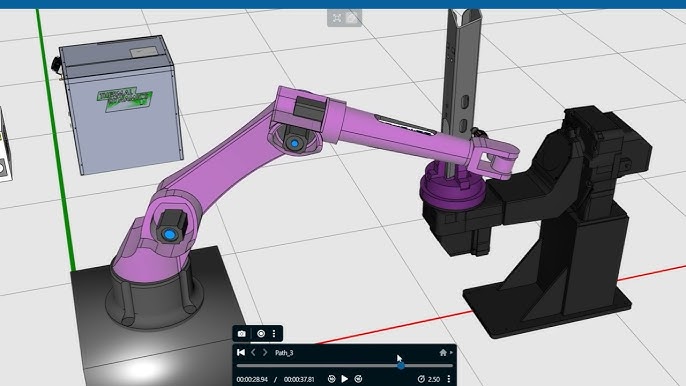
Octopuz’s competitive strengths stem from its innovative features and the guiding philosophy of simplifying robotics. One of the software’s hallmark features is its ability to program multiple robots and external devices in one coordinated simulation. An Octopuz user can import an entire workcell – including robots, tool fixtures, positioners (e.g., rotating tables), and even CNC machines – and program interactions between them. For example, if one robot must hand-off a part to another, or two robots must work in tandem (such as carrying a long beam together), Octopuz can simulate and program those complex multi-robot scenarios. This multi-robot synchronization, combined with the support for a large number of robot brands, gives Octopuz a unique versatility. A manufacturer with different robot models on their factory floor can rely on one software (Octopuz) to program all of them, rather than using each robot OEM’s proprietary programming tools.
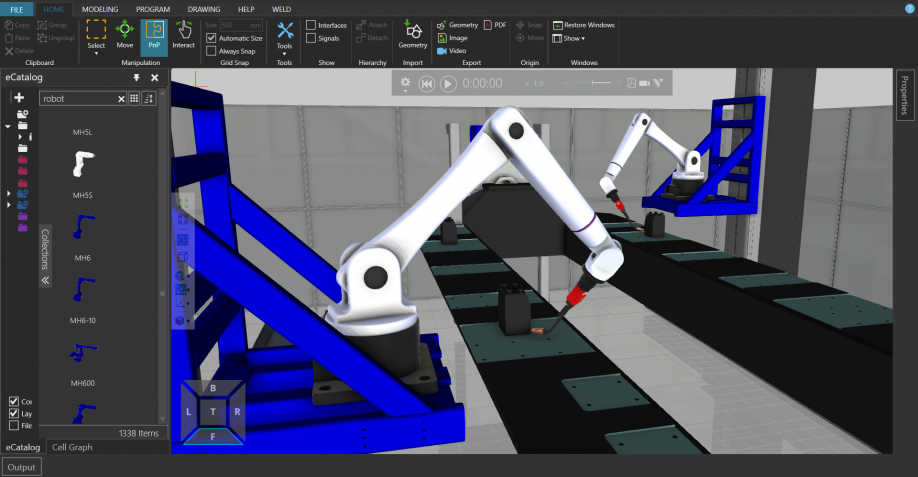
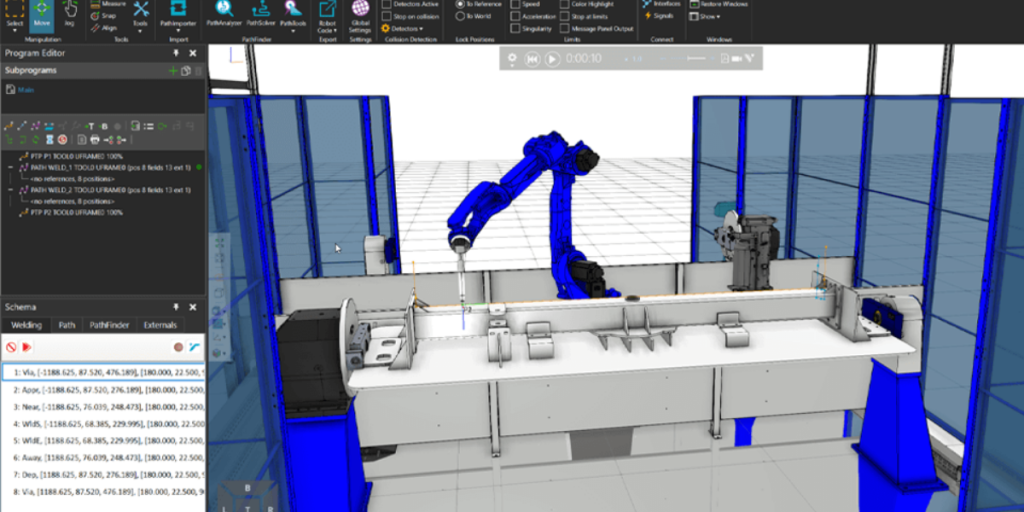
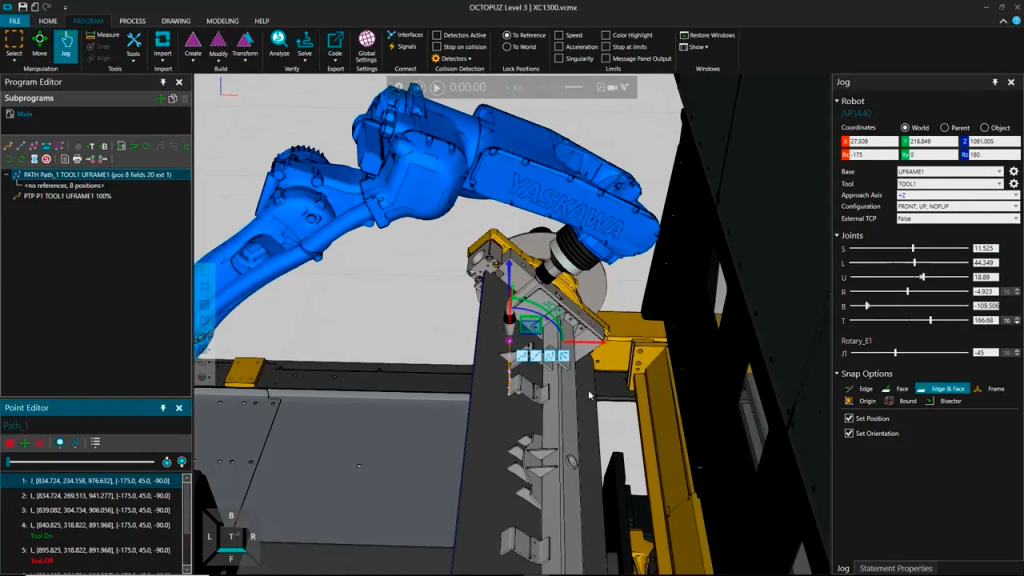
Another innovation is Octopuz’s emphasis on path optimization and error avoidance. The software automatically checks for common robot programming issues: singularity (when a robot’s joint alignment causes a mathematical degeneracy), reach limitations, collisions between the robot and workpiece or cell fixtures, and so forth. The user is warned of these issues during the simulation stage, allowing them to adjust the path or cell layout before any real-world run. Additionally, Octopuz can optimize the robot’s path for efficiency – minimizing cycle time by smoothing movements and reducing extraneous motions. This is critical in high-volume production where saving a few seconds per cycle can translate to major productivity gains. An intuitive graphical interface helps programmers fine-tune the robot’s path points and orientations using drag-and-drop and slider controls, rather than writing lines of code.
Octopuz’s user experience has been continually refined through its versions. In the latest generation (often referred to as Octopuz 2.0 series), the interface was redesigned to be more modern and workflow-oriented. The concept of “cell templates” was introduced – pre-defined environments for common robotic setups that let users start a project with one click, loading in a typical arrangement of robots and tools. This saves time on configuring the digital cell for each new job. The software also added a library of application-specific process wizards: for instance, a welding wizard might allow the user to specify a seam line on a CAD model and automatically generate a welding path with proper approach and departure moves, torch angles, and weave patterns. Similarly, for painting or coating, Octopuz can generate a spray path that ensures even coverage, based on surface geometry. These intelligent tools encapsulate expert knowledge and make it available to users who may not be robotics gurus.
Integration capabilities are another strength of Octopuz. It can import CAD models from virtually any mainstream CAD system (SOLIDWORKS, AutoCAD, CATIA, etc.), thanks to integrated translators. It also can import toolpaths from CAM software; for example, a user can bring in a milling toolpath from Mastercam or other CAM packages, and Octopuz will convert it into a robot motion program. This is extremely useful for applications like robotic trimming or drilling, where the path might have been initially created for a CNC machine. By bridging the gap between CAD/CAM and robotics, Octopuz enables a more unified workflow in digital manufacturing. Once the programming in Octopuz is complete, the software outputs robot-specific code that can be uploaded to the actual robot’s controller. Octopuz supports code generation for dozens of robot brands and controller models, meaning it writes the precise command language (whether it’s FANUC’s TP, ABB’s RAPID, KUKA’s KRL, etc.) needed for that robot.
One of the key innovations touted by Octopuz is how it improves operational efficiency for businesses. By programming robots offline, companies avoid the traditional downtime that would occur if they programmed using the teach pendant on the factory floor (which requires taking the robot out of production). Instead, with Octopuz, a manufacturer can keep producing parts with their robot while an engineer concurrently develops the next job program in the virtual environment. This parallel development can dramatically increase uptime. According to Octopuz, some users have been able to cut programming time by half or more, and reduce costly production stoppages, by switching to an offline approach.
Octopuz also offers a flexible licensing model (particularly after its modernization efforts). Users can have networked licenses or login-based licensing, so teams in different locations can share access to the software. This became especially valuable during the COVID-19 pandemic when many engineers worked from home – they could still log into Octopuz and program robots remotely. The company has leaned into such cloud-ready features to stay current with how customers use software in increasingly distributed and digital workplaces.
Leadership and Vision – In Their Own Words
Octopuz’s leadership has consistently articulated a vision of making advanced robotics more accessible. From the early days under Ed House’s guidance to the current team, their statements reflect the core values of innovation and user-centric design. Edward House, the founder who led the creation of Octopuz, emphasized versatility and power combined with simplicity. “OCTOPUZ provides capabilities not found in other robot programming software options… No other platform has this level of reach and versatility with such simplicity,” House asserted during a 2014 interview, underlining how Octopuz was differentiated from existing tools at the time. This vision was crucial for convincing manufacturers to try a new solution in place of established methods.
As the product gained traction, those at the helm of Octopuz highlighted the tangible benefits it brought to customers. In a case study about a complex automotive part project, one Octopuz representative noted that the software is “intentionally designed to minimize the time it takes to create the program, and subsequently, to minimize the cycle time of the production itself.” That focus on end-to-end efficiency – from programming to production – became a selling point that Octopuz leaders stressed in discussions with industry.
In recent years, Rob House and Jon House, who took on leadership roles (and share the same surname as Ed House, indicating the family-driven nature of the business), have spoken about the future of Octopuz within the larger automation picture. Upon the acquisition by ESAB, they wrote to customers, “We want to extend a special thanks to all of you… We are more committed than ever about serving you and shaping the future of offline robot programming.” This message conveyed continuity and dedication to the product’s roadmap even as the company entered a new corporate chapter.
Another voice from Octopuz’s leadership team is James Schnarr, Senior Product Manager, who often communicates the technical vision. Speaking about the partnership with Spatial and the next-gen software, Schnarr said, “Our 3D world is the very core of our Offline Robot Programming experience; it’s where users interact with their robot environment and simulate their next production job. …Spatial helped us realize that vision.” His insight reveals how Octopuz sees technology partnerships as extensions of their team’s capabilities, all geared towards delivering a better experience for the user. The stress on a “3D world” highlights Octopuz’s belief that a rich, accurate simulation is fundamental to successful programming – essentially, if you can perfect it in the digital twin, you can trust it on the shop floor.
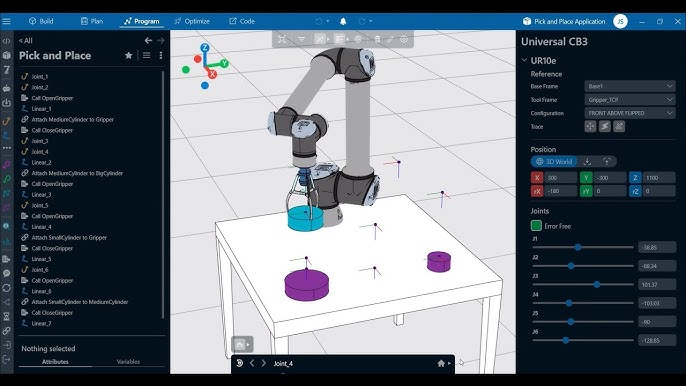
Looking at the company’s direction, Octopuz’s leadership frequently mentions emerging trends and how they plan to address them. They have discussed integrating more “smart” features such as automatic path planning with AI assistance, deeper analytics to compare simulated vs. actual performance, and support for collaborative robots (cobots) which are increasingly popular. In fact, Octopuz has already made its software compatible with several cobot brands and even had a listing in Universal Robots’ UR+ ecosystem for approved third-party solutions.
Through these quotes and communications, it’s clear that Octopuz’s leaders see their software as part of a larger movement to modernize manufacturing. They often underscore an almost educational mission: empowering companies that are new to robotics to deploy automation quickly and successfully. “Our focus is to provide a robotic software solution that not only enables companies to reach a higher level of efficiency with their processes, but also opens opportunities for them to enter new markets,” one company statement reads. This reflects the broader business promise that adopting Octopuz can transform a company’s capabilities – not just doing the same work faster, but taking on new kinds of work that were previously inaccessible without advanced robotics.
Conclusion
From its inception as an innovative project within a Canadian CAD/CAM firm to its status as a globally-used robotics programming platform, Octopuz has had a remarkable journey. It emerged at a time when manufacturers were seeking to bridge a skills gap – wanting to use robots for complex tasks without having to invest enormous time in learning difficult programming languages or shutting down production for trial-and-error teaching. Octopuz provided a solution by bringing the sophisticated planning into the digital realm, effectively sandboxing the robot’s brain on a computer. Over the years, it expanded in capability, kept pace with industry 4.0 trends, and cultivated a loyal user base.
Today, Octopuz stands out for its blend of user-friendliness and technical depth. Its ability to handle a multitude of robot brands, coordinate multi-robot systems, and simulate full process cells gives it a unique place in the market. The company’s strategic moves – from partnering with technology providers to joining forces with a manufacturing giant like ESAB – indicate a forward momentum aimed at staying at the forefront of robotic automation software.
The story of Octopuz also illustrates how important interdisciplinary innovation is in modern manufacturing: success required knowledge of mechanical processes, software engineering, 3D simulation, and user experience design all coming together. Each advancement in the product has potentially saved companies countless hours of downtime and improved safety by reducing on-site programming. As factories continue to adopt more robots, the role of offline programming systems like Octopuz is set to grow further.
In summary, Octopuz has transformed from a newcomer addressing a niche need into a pioneering force in offline robot programming. Its journey reflects a clear vision – echoed by its leadership’s words – of making robotics more accessible and productive for industries worldwide. For any business looking to innovate with industrial robots, Octopuz represents both a piece of advanced software and a partner with a decade-long pedigree in simplifying the complex. It will be exciting to watch how Octopuz, under the backing of ESAB and guided by its passionate team, continues to influence the way robots are programmed in the years to come.
Vendor: ESAB