
Cimatron: Four Decades of CAD/CAM Innovation in Manufacturing
Overview and Vendor Background
Cimatron is a veteran computer-aided design and manufacturing (CAD/CAM) software suite that specializes in solutions for tooling and production machining. First established in 1982 in Israel (under the original name “MicroCAD”), the company has since grown into a global provider of industrial design software for manufacturers. Over its four-decade history, Cimatron has catered to toolmakers and part manufacturers by offering an end-to-end platform to design complex molds, dies, jigs, electrodes, and other tooling components, and to generate the numerical control (NC) code needed to machine them. The software’s vendor, originally an independent firm called Cimatron Ltd., became known for this integrated CAD/CAM approach long before such integration was common. Headquartered in Givat Shmuel, Israel during its rise, Cimatron expanded worldwide with subsidiaries or distributors across North America, Europe, and Asia, serving customers in over 40 countries. By the 2010s, the company boasted more than 40,000 installations of its software worldwide – a testament to its broad adoption in industry.
Today, the Cimatron product line is part of a larger corporate family. After years of independence and public trading on the NASDAQ exchange (ticker symbol CIMT), Cimatron was acquired in 2015 by the U.S.-based 3D Systems Corporation. Later, in 2020, it was divested and merged into a new CAD/CAM conglomerate called CAMBRIO, and subsequently, in 2021, CAMBRIO (including Cimatron) was acquired by Sandvik, a Swedish engineering group. Under Sandvik’s wing, Cimatron continues to be developed as a key component of the company’s digital manufacturing solutions portfolio. The official website (cimatron.com) now highlights Cimatron as an integrated tooling software within Sandvik’s Manufacturing and Machining Solutions division, reflecting its current vendor status. Despite these corporate changes, the Cimatron brand and software have remained focused on their core mission: providing comprehensive CAD/CAM capabilities to manufacturing professionals.
Application Areas in Industry
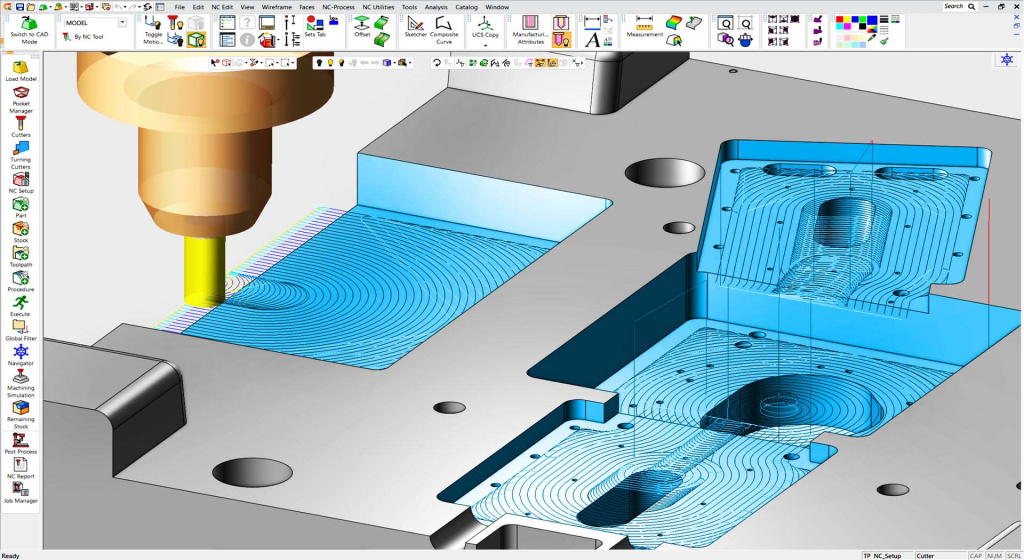
Cimatron’s software is primarily used in the tooling industry – that is, the design and manufacture of the molds, dies, and fixtures required to produce finished goods. A hallmark of Cimatron is its strength in injection mold design for plastics and stamping die design for sheet metal. For example, automotive suppliers use Cimatron to design the intricate injection molds that form plastic components like car dashboards and interior trim, which often involve hundreds of precisely interlocking parts. “There are hundreds of parts that go into making a dashboard, and they all have to be precisely designed and built so that they work together,” explained Danny Haran, a former CEO of Cimatron, emphasizing the importance of software in ensuring such precision. Cimatron is used to model each piece of the mold assembly – from cavity and core inserts down to cooling channels and ejector pins – and then to generate the toolpaths for CNC machines to cut those pieces with high accuracy.
A view of Cimatron’s CAD/CAM interface, here illustrating a complex 3D part (in this case, a shoe sole) prepared for manufacturing. The software allows detailed design of products or tooling and then creates CNC machining paths (highlighted in pink) for production. Such integrated design-to-production capability is used in industries ranging from footwear and consumer goods to automotive and aerospace.
Besides plastic molds, Cimatron is equally well-suited for metal forming dies. In metal stamping, heavy presses shape parts out of metal sheets using dies that often progress through multiple stages. Designing these progressive dies is a complex task that Cimatron helps automate – ensuring that each bending or punching step is correctly engineered. The software also supports discrete part machining for industries like aerospace, where components (for example, turbine blades) are milled one-by-one from solid metal. In such cases, engineers use Cimatron’s NC programming tools to plan multi-axis milling and turning operations, often involving advanced 5-axis CNC machines. The system is capable of handling the full range of machining processes – from simple 2.5-axis milling of prismatic parts to the programming of sophisticated mill-turn and wire EDM operations for high-precision components.
Across industries, Cimatron’s users include automotive OEMs and their suppliers, consumer electronics and appliance manufacturers, makers of toys and consumer goods, medical device manufacturers, and even specialty sectors like optics and telecom. An example on the smaller end of the scale: Cimatron is used to design and manufacture tiny plastic connectors for water pipes, where accuracy is crucial to prevent leaks. On the larger end: it’s used for heavy industrial parts like aerospace turbine blades made of titanium, which must be machined with extremely tight tolerances. In all these applications, the common thread is that Cimatron helps bridge the gap between design and manufacturing – allowing companies to go from a product concept or part geometry to the tooling and NC code needed to actually produce it.
Notably, Cimatron has also supported niche manufacturing domains. For instance, in the footwear industry, specialized mold inserts for shoe soles can be designed using Cimatron (as illustrated by the example image above). In another niche, Cimatron’s software was extended (in partnership with its Italian distributors) to include a module called ShoeExpress, tailored for designing shoe molds and heels. This underscores the software’s flexibility in serving very specific manufacturing needs. Overall, whether it’s an automotive injection mold, a progressive die for sheet metal, or a custom jig or electrode for EDM, Cimatron provides tools to design the piece, simulate its function (e.g. checking mold operation or die kinematics), and then drive the manufacturing equipment to create it.
Origins and Early Development
Cimatron’s journey began in the early 1980s amid a burgeoning era for CAD/CAM technology. The firm was founded in 1982 by a team of Israeli software engineers under the name MicroCAD. In its earliest days, MicroCAD worked on manufacturing software projects for the Israeli Air Force, focusing on solutions to improve fabrication processes for aerospace parts. By 1984, the young company had released its first commercial CAD and CAM software packages, called MultiCaddand MultiCam, aimed at small- to medium-sized tool shops. These products offered computer-aided drafting and NC programming capabilities that were quite advanced for the time, when many toolmakers still relied on paper blueprints and manual programming.
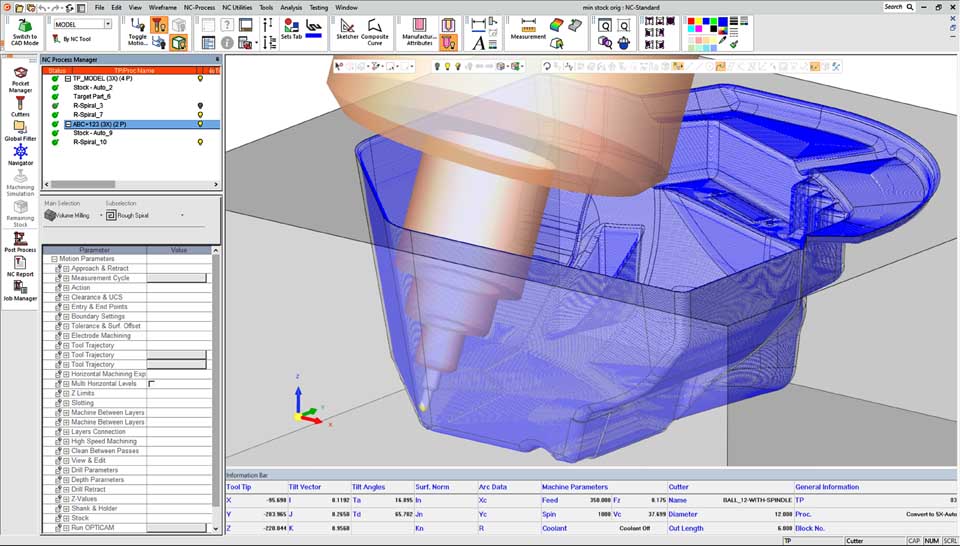
As the product matured and the vision expanded beyond the initial military focus, the company rebranded. In 1987, MicroCAD officially changed its name to Cimatron Ltd., reflecting a new identity centered on “Computer Integrated Manufacturing” (the “CIM” in its name hints at this). The late 1980s saw Cimatron developing one of its defining offerings: an integrated CAD/CAM software environment. In 1990, Cimatron launched what it claimed to be the world’s first fully integrated CAD/CAM system, known as Cimatron IT. This was a significant milestone – it meant that a tooling designer could perform both design and NC toolpath programming within one platform, without needing to export data between separate CAD and CAM programs. At a time when many competitors offered either CAD or CAM in isolation (or in loose combination), Cimatron’s integrated approach was forward-thinking and gave it a technical edge in the tooling market.
The 1990s brought further evolution. In March 1996, Cimatron held an initial public offering on NASDAQ, a step that provided capital for growth and raised its international profile. By then, Cimatron had established subsidiaries in key markets – the United States, Germany, and others – to sell and support its software abroad. The next big leap in technology came in 1999 with the introduction of CimatronE, a new generation of the software built for the Windows operating system. CimatronE (the “E” often said to stand for “enhanced” or “enterprise”) combined the company’s years of tooling domain knowledge into a modern GUI-based package suitable for Windows PCs, replacing or augmenting the older DOS/Unix-based Cimatron IT. This transition to Windows opened the door to a broader user base just as PCs were becoming ubiquitous on engineers’ desks.
In the early 2000s, Cimatron expanded its global footprint and product capabilities. The company often employed a strategy of working with local distributors in various countries, sometimes acquiring stakes in those distributors to strengthen its presence. A case in point was Microsystem Srl in Italy – Cimatron’s long-time distributor there. In 2005, Cimatron acquired a 27.5% stake in Microsystem (with an option to buy it outright), cementing its commitment to the Italian market. Microsystem had developed complementary applications (like the aforementioned ShoeExpress for shoe mold design) that ran on Cimatron’s platform, and its founder Enrico Gardini joined Cimatron’s management, bringing deep domain expertise. By 2008, Cimatron went on to acquire 100% of Microsystem, turning that distribution arm into a full-fledged part of the company. Moves like this helped Cimatron localize its product for specific markets and industries, as well as provide on-the-ground support to customers.
Throughout this period, Cimatron’s core focus remained on the tooling lifecycle – often marketing itself as providing solutions “from quoting to delivery.” In practice, this meant the software was evolving to not only do design and CAM programming, but also to assist with upfront cost estimation (quoting) and project management of toolmaking. By the mid-2000s, thousands of tool shops and manufacturers – in automotive, consumer plastics, and electronics sectors especially – were relying on Cimatron. An “About Cimatron” note from 2005 highlighted that over 8,500 customers were using its solutions worldwide by that time, and the company maintained an extensive distribution network in more than 35 countries to support this user base.
Growth, Mergers and Acquisitions
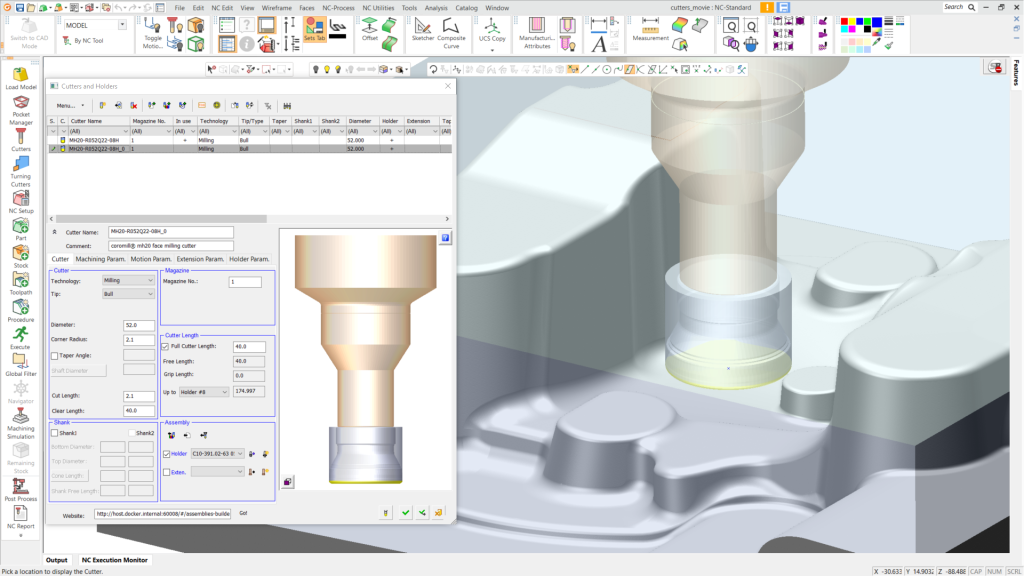
As the manufacturing software industry matured, Cimatron pursued both organic growth and strategic acquisitions to enhance its market position. One pivotal moment came in January 2008, when Cimatron announced a merger with the U.S.-based firm Gibbs and Associates – the developer of the popular GibbsCAM software. GibbsCAM was well-known for its strength in production machining and multi-axis CNC programming, particularly in the 2- to 5-axis milling and turning arena. By contrast, Cimatron’s forte was in tooling (molds and dies) and the associated design-for-manufacture features. The merger thus brought together two complementary product lines under one roof.
Danny Haran, then President and CEO of Cimatron, described the logic of the deal: “We are excited about the merger and the potential synergy. Being able to offer a complete range of high-end products for the entire manufacturing industry will bring great value to our customers,” he said, noting that the combination would create a more competitive, financially efficient company positioned for growth. From Cimatron’s perspective, acquiring GibbsCAM filled a gap in its portfolio – suddenly it could serve not just toolmakers but also production machinists who needed powerful toolpath programming for mass-produced parts. GibbsCAM excelled in areas like mill-turn (the hybrid of milling and turning in one machine) and had a strong following in industries that do high-volume CNC work. “Millturn is the fastest growing sector in manufacturing… Gibbs has a best-in-class product focused on production, [whereas] Cimatron has traditionally focused on tooling,” Haran explained in an interview around that time.
The merger was also geographically synergistic. Gibbs and Associates (founded by Bill Gibbs in 1982 in the US) had about 70% of its sales in North America, whereas Cimatron’s base was stronger in Europe and Asia (with particular strength in markets like Germany, Israel, Italy, and Japan). Combining their distribution networks meant each could reach new customers in regions where the other was well-established. Bill Gibbs, the founder of GibbsCAM, remained with the new combined company as President of the GibbsCAM product line and Vice Chairman of Cimatron Ltd., ensuring continuity. His enthusiasm matched Haran’s; at the time of the merger he commented that bringing together “two well-known names in the CAD/CAM industry” opened exciting opportunities, such as selling GibbsCAM through Cimatron’s channels in key markets worldwide.
The Cimatron-GibbsCAM union roughly doubled the company’s scale. Together they projected annual revenues above $40 million in 2008, moving Cimatron into the ranks of the top ten CAM software vendors globally. The expanded Cimatron Ltd. now had two flagship product families: CimatronE (for tool design & manufacturing) and GibbsCAM (for production machining). The combined product suite could address a wider array of manufacturing scenarios, from one-off tooling jobs to mass production, and from 2.5-axis operations up through 5-axis and multi-task machining. This breadth was important in a market that was still quite fragmented – as Haran noted, even the “Big 3” CAD/CAM giants (then Siemens PLM/UGS, Dassault Systèmes, and PTC) together accounted for only a modest portion of the CAM market. By focusing on its niches, Cimatron aimed to continue growing despite competition from those larger PLM vendors.
In the years following the Gibbs merger, Cimatron reaped some gains. It achieved record financial results around 2010–2012; for example, in 2010 the company reported its highest-ever quarterly revenue ($11 million in Q4 2010), and in 2012 it reached annual revenues of $42.3 million with healthy profitability. Industry analysts like CIMdata listed Cimatron among the leading CAM software suppliers by revenue, and even predicted it to be one of the fastest-growing CAM companies in the early 2010s. The company also continued to innovate (more on technical innovations below) and to explore new domains – notably dabbling in the emerging field of additive manufacturing. In 2013, Cimatron’s management announced they were researching 3D printing technologies and even set up a 3D Printing Advisory Board, bringing on industry expert Terry Wohlers as an advisor. This showed Cimatron’s awareness of the shifting landscape in manufacturing, where additive methods were starting to complement traditional subtractive machining.
By late 2014, Cimatron’s consistent performance and unique position in the CAD/CAM niche caught the attention of a bigger player: 3D Systems. 3D Systems (based in Rock Hill, South Carolina) is a leader in 3D printing and additive manufacturing solutions. In November 2014, 3D Systems announced a deal to acquire Cimatron Ltd. for approximately $97 million in cash. The acquisition was part of 3D Systems’ strategy to offer end-to-end digital fabrication solutions – from design software all the way to 3D printers and manufacturing services. Avi Reichental, then CEO of 3D Systems, said that Cimatron’s products were a “perfect strategic fit” to expand his company’s design-to-manufacturing digital thread, and would bring synergies in product development and marketing. For Cimatron, this was an opportunity to leverage 3D Systems’ global reach and resources. Danny Haran, Cimatron’s CEO at the time, noted, “We have always been focused on providing comprehensive, cost-effective solutions that streamline manufacturing cycles and shorten product delivery time, and as part of 3D Systems we can substantially accelerate our progress and extend our reach and impact”. The deal closed in early 2015, after which Cimatron was delisted from NASDAQ and became a subsidiary of 3D Systems.
Under 3D Systems, Cimatron operated alongside other software acquisitions (like Geomagic for 3D scanning and GibbsCAM which was part of the Cimatron deal). However, this chapter would last only about five years. By 2020, 3D Systems decided to refocus on its core business of additive manufacturing and to shed some of its peripheral units. This led to a spin-off deal for Cimatron. In late 2020, 3D Systems agreed to sell the Cimatron and GibbsCAM businesses to an investment firm, Battery Ventures, for $65 million. The timing coincided with a period of financial difficulty for 3D Systems and a broader industry pullback during the pandemic, making the divestiture part of a turnaround strategy. 3D Systems’ CEO Jeffrey Graves commented that the sale aligned with the company’s plan to focus on additive solutions and build on its core strengths.
Battery Ventures, for its part, grouped Cimatron and GibbsCAM with another of its software holdings – a company called SigmaTEK Systems (maker of SigmaNEST sheet metal fabrication software) – to form a new entity. In 2021 this new umbrella organization was officially launched as CAMBRIO. CAMBRIO’s goal was to be a diversified CAD/CAM software powerhouse serving fabrication, toolmaking, and production machining markets. Robbie Payne, the CEO of SigmaTEK who became CEO of CAMBRIO, noted the strong fit: “We are often serving the same customer profile and trying to solve similar industry issues with innovative software technology. As a combined entity, we will continue to invest in each of the individual products, make our customers more productive, and enlarge our distribution capability,” Payne said, emphasizing the plan to grow Cimatron and GibbsCAM together with the existing team. This effectively returned Cimatron to a more CAM-focused software company environment, after its stint inside a 3D printing firm.
The story comes full circle in mid-2021, when global engineering firm Sandvik announced that it would acquire CAMBRIO from Battery Ventures. Sandvik, a company known for its metal-cutting tools and mining equipment, had in recent years been investing heavily in digital manufacturing software to complement its physical tool business. Acquiring CAMBRIO (and with it, Cimatron) gave Sandvik a significant CAM software portfolio. Stefan Widing, CEO of Sandvik, explained that this move was in line with Sandvik’s strategy to provide solutions across the entire component manufacturing value chain – “from design and planning to preparation, production and verification,” covering both toolmaking and general machining.
With Sandvik as the current corporate parent, Cimatron finds itself backed by a major industrial player that views software as a key piece of the future of manufacturing. Sandvik completed the CAMBRIO acquisition in the latter half of 2021, integrating Cimatron into its Sandvik Manufacturing Solutions division. As of 2025, Cimatron continues to be updated (the latest release being referred to as Cimatron 2025) with new features and support, now under the auspices of a large multinational but still focused on its niche of CAD/CAM for tooling.
Technical Features and Innovations
Over the decades, Cimatron’s software has introduced a number of innovations and unique features tailored to its core users – tool designers and NC programmers. A central theme of Cimatron’s value proposition is integration. The idea of having design and NC programming in one cohesive system was relatively novel when Cimatron IT debuted in 1990, and it remains a selling point today. This integration means that changes in a mold design, for example, can automatically propagate to the machining operations, reducing rework and errors. By maintaining associativity between CAD and CAM, Cimatron allows for iterative development of a tool design with less manual data transfer.
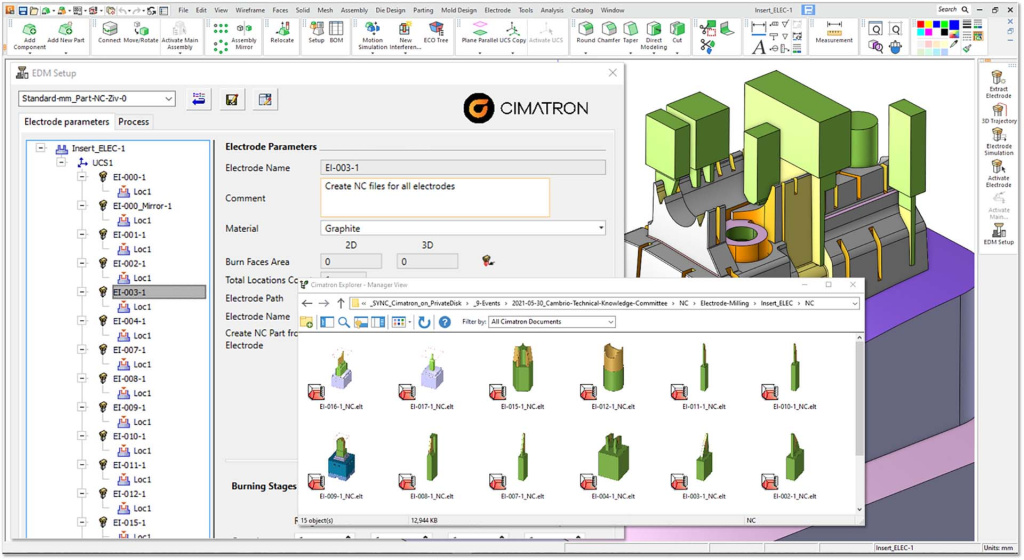
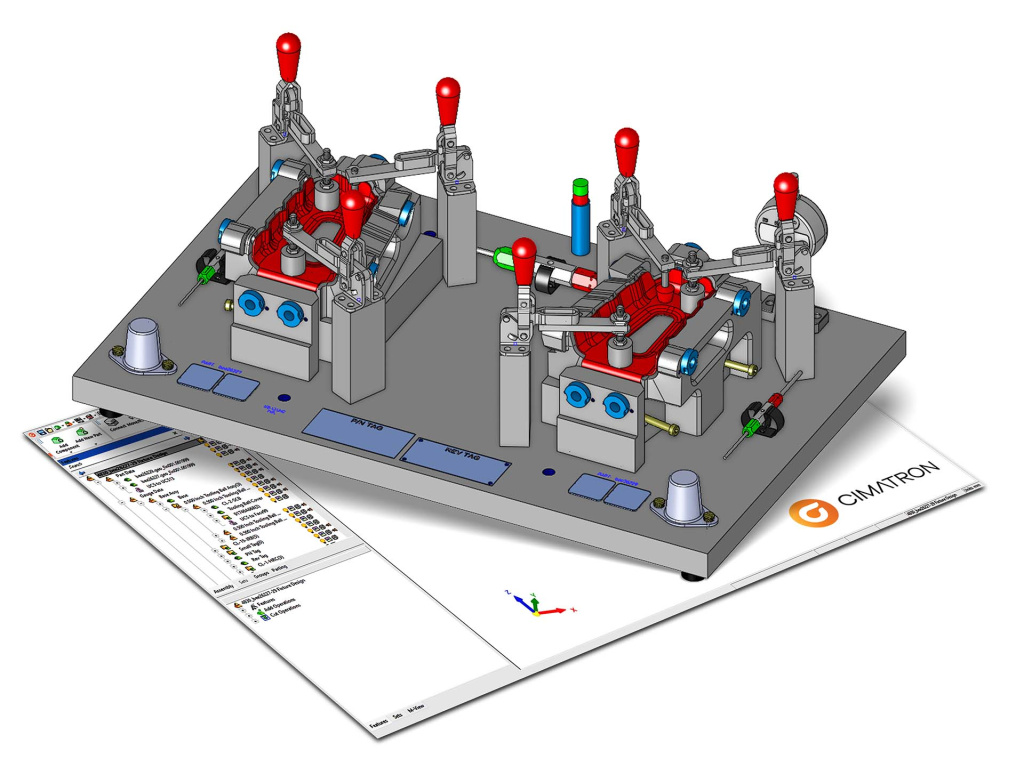
CimatronE (the modern incarnation) includes specialized modules that address each step of the toolmaking process. These include Mold Design, Die Design, and Electrode Design modules, each providing libraries of standard components and automated functions. For instance, a mold designer using Cimatron can easily generate core and cavity inserts from a part model, create parting surfaces, add standard mold base plates, and even auto-generate the electrodes needed for EDM (electrical discharge machining) to burn out detailed features. The software handles a variety of geometries (surfaces, solids, and wireframe) and supports advanced surfacing needed for complex shapes like those found in consumer product molds or automotive body panel dies. A key strength has been handling of import data: toolmakers often receive part designs from various CAD systems, so Cimatron is built to import and heal geometry from formats like IGES, STEP, etc., enabling the tooling work to proceed regardless of the source CAD.
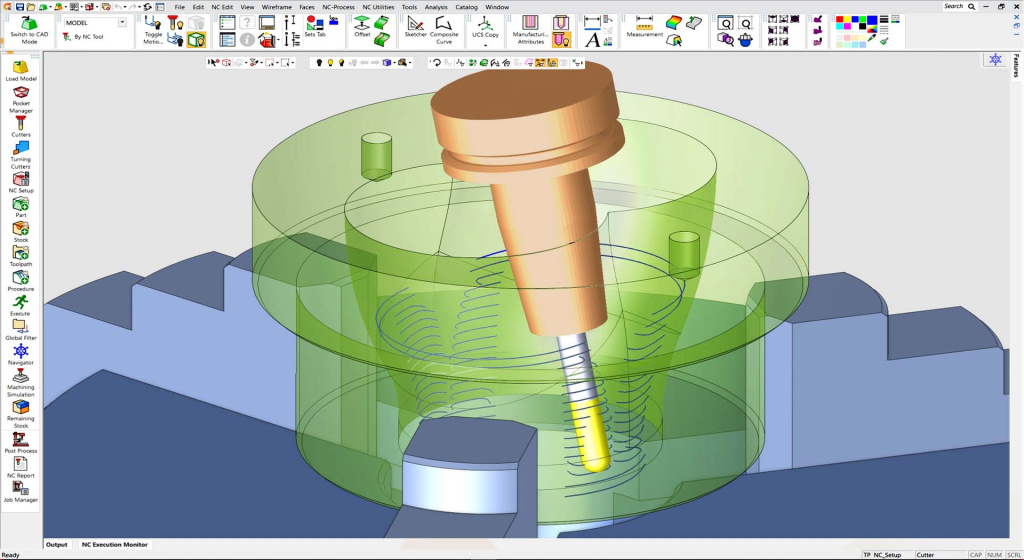
On the CAM side, Cimatron provides comprehensive NC programming capabilities. It covers 2.5-axis milling (e.g., drilling, pocketing), 3-axis and 5-axis surface machining (for sculpted shapes), turning, mill-turn (multi-axis lathes), and even wire EDM cutting strategies. The system includes simulation and verification tools so users can check for collisions or toolpath correctness before sending code to the machine. One notable hardware/software innovation from Cimatron was the introduction of the CimatronE SuperBox around 2010 – a dedicated processing unit that could be added to a network to offload heavy toolpath calculations. This effectively acted as a CAM computation accelerator: toolpaths, especially complex 3D or 5-axis ones, can be very CPU-intensive to calculate, so the SuperBox allowed shops to generate these in a fraction of the time by using a specialized server. It was an example of Cimatron looking at the practical bottlenecks in machine shops (programming time) and trying to solve them with a unique solution.
Another area of innovation has been motion simulation and analysis for tooling. Recognizing that designing a mold or die isn’t just about static geometry, Cimatron collaborated with simulation specialists to incorporate kinematic analysis. In 2010, Cimatron partnered with LEDAS Ltd. to integrate a constraint-based motion solver into CimatronE. This allowed mold designers to simulate the opening and closing of a mold or the movement of sliders, lifters, and other mechanism in their tool design, complete with collision detection to ensure nothing crashes during operation. By catching potential problems in software (such as an ejector pin hitting a core insert when the mold closes), toolmakers could avoid costly mistakes. This motion simulator was developed with LEDAS’s technology and was fully embedded in the CimatronE interface, another example of adding value specifically for toolmakers’ needs.
Cimatron has also prided itself on domain-specific automation. For example, in electrode design, the software can automatically extract the geometry that needs an EDM electrode (such as a deep rib or pocket that a normal cutter can’t reach), create the electrode model, and generate the NC program for machining that electrode – all in a streamlined workflow. In die design, it provides tools for laying out progressive strip designs and optimizing material usage. These kinds of features are highly specialized, and they illustrate Cimatron’s focus on being a one-stop solution for its niche.
In recent years, keeping up with industry trends, Cimatron has begun incorporating artificial intelligence (AI) and automation enhancements into its CAD/CAM processes. A new feature set marketed as Cimatron CAD-AI (or sometimes called “Cimatron Copilot”) was introduced, aiming to further reduce manual work for the user. This technology uses AI algorithms to automatically recognize features in a CAD model – such as holes, pockets, and slots – which is especially useful in mold design where a part might have dozens of such features that need corresponding tooling actions.
By automatically detecting these, Cimatron can suggest or even auto-generate aspects of the design or manufacturing process (for example, selecting appropriate toolpath strategies for each feature). This integration of AI into the CAD/CAM workflow reflects the broader trend in manufacturing software to use machine learning for boosting productivity. According to Cimatron’s description, the AI feature recognition works seamlessly with its CAM automation to make it “easier than ever for manufacturers to automate the generation of accurate toolpaths,” thereby saving time and reducing the chance of human error. Such developments show that even after 40+ years, Cimatron is evolving with technology – from early CAD on mainframes in the 80s, to Windows integration in the 90s, to AI-driven assistance in the 2020s.
Competitive Landscape and Strengths
In the competitive CAD/CAM software landscape, Cimatron has carved out a strong reputation in the tooling segment. One of its key competitive strengths is that dedication to toolmaking workflows. Unlike more general CAD systems (e.g., those by Siemens or Dassault) that cater to a wide range of design activities, Cimatron has been optimized for manufacturing preparation tasks. This specialization means that many features in Cimatron are ready out-of-the-box for a mold maker or die designer – things like mold plate templates, cooling line design, electrode makers, or die strip layout utilities are built-in, whereas a general CAD user might need custom add-ons or manual work to do the same. As a result, companies that primarily build tooling have often found that Cimatron can get the job done with less effort and greater reliability for their specific needs.
Another strength frequently cited by users is the integration of CAD and CAM in one interface. Toolmakers often operate on tight schedules where design changes happen in parallel with machining. In Cimatron, if a part design changes late in the process, the tool design and toolpaths can be updated associatively, potentially avoiding a full reprogramming from scratch. This can shorten delivery times – a crucial factor in industries like automotive, where delays in tooling can delay a whole vehicle launch. Cimatron’s marketing claims that using their integrated system can shorten tool delivery time by up to 70% and even yield a return on investment in as little as six months for a tooling shop. While such figures naturally vary by case, they underscore the productivity focus of the software.
Local support and expertise have also been part of Cimatron’s competitive positioning. The company (and its acquirers) invested in having technical support teams and partners who understand toolmaking. For instance, Cimatron’s presence in places like Michigan (a hub for automotive tooling in the U.S.) or in German automotive centers meant that knowledgeable engineers could assist customers on-site or in their local language. According to the company, one advantage is that Cimatron “has local training and support from tooling experts” as part of its offering. This has helped build loyalty among traditional manufacturing clients who value hands-on support as much as software features.
Over the years, Cimatron faced competition from various quarters. In the high-end mold/die CAD space, competitors included the likes of Dassault Systèmes’ CATIA (often used by large automotive OEMs) and Siemens NX (formerly Unigraphics), as well as PTC’s Creo. However, those were usually part of broader PLM systems and came with higher price tags. Cimatron targeted the many mid-sized tooling shops worldwide that needed advanced capability but at a more accessible cost and without the complexity of a full PLM environment. In the CAM arena, competitors ranged from Mastercam and Delcam (now Autodesk) to specialty players like Open Mind’s hyperMILL (a leader in 5-axis machining). Danny Haran once noted that no one company dominated the CAM industry and that even the big CAD firms’ share was limited, implying there was ample room for focused players like Cimatron to thrive.
By merging with GibbsCAM, Cimatron also took on competition in the production machining segment, pitting itself against standalone CAM software rivals. The combined company’s strategy was to leverage cross-selling – e.g., introducing GibbsCAM users to Cimatron’s die design tools or vice versa – to compete effectively across a broader front.
One can gauge Cimatron’s enduring strength by its customer success stories. Many tool shops credit integrated CAD/CAM with drastically improving their throughput. For example, TK Mold & Engineering, a U.S. mold maker, has been a Cimatron user since its inception and reported significant reductions in lead times by using Cimatron to streamline everything from quoting to CNC machining in one system. They cited the integration and specialized mold tools as key to achieving up to 70% faster delivery of molds, allowing a small team to accomplish what would have required many more hours on disparate systems. Such real-world outcomes highlight why Cimatron, despite changing ownership and the rise of new technologies, remains a trusted tool in the arsenal of many manufacturing companies.
Leadership and Vision
Cimatron’s corporate journey has involved several leadership figures who helped shape its direction. In its early decades, the company’s founders and early executives – many of whom were Israeli tech pioneers – laid the groundwork for a culture focused on engineering excellence in manufacturing software. Through the 1990s and early 2000s, Cimatron was led by CEOs such as Zvika Naggan and later Danny Haran. Under Naggan, the company expanded in Europe (e.g., the Italian partnership) and pushed the integrated CAD/CAM envelope. Danny Haran, who joined Cimatron in 2003 and became CEO soon after, steered the company through the GibbsCAM merger and the global financial crisis period, returning it to growth by 2010. Haran’s background in larger tech companies (he had come from roles at Comverse Technology) likely helped Cimatron sharpen its business strategy and investor relations. He often spoke about balancing organic growth with acquisitions – in a 2008 interview he mentioned, “I like to keep an open mind about balancing organic and acquisitive growth. We’re tight on budget control,” reflecting a pragmatic approach to scaling the business.
When 3D Systems acquired Cimatron in 2015, the leadership transitioned, with Cimatron’s management integrating into the larger 3D Systems structure. Throughout that process, voices like Yossi Ben-Shalom – Cimatron’s chairman of the board at the time and co-managing partner of its major shareholder DBSI – praised the team’s accomplishments. “Our entire Board of Directors is proud of Cimatron and its management’s long-term success in building a great company with leading products that create sustained customer and shareholder value,” Ben-Shalom said, highlighting the pride in how far the once small Israeli firm had come.
After the spin-out in 2020, new leadership under CAMBRIO (Robbie Payne and team) took charge, focusing on synergy across products. And now within Sandvik, Cimatron’s direction is guided by the vision of Sandvik’s digital manufacturing leadership, such as Mathias Johansson (President of Sandvik’s Design & Planning Automation division), who expressed enthusiasm for how CAMBRIO’s offerings (Cimatron included) enable customers “to further increase productivity in the broader value chain” and align with a shared desire to automate workflows for efficiency and sustainability.
Throughout these changes, the people behind Cimatron – from its R&D teams to product managers – have often been industry veterans intimately familiar with manufacturing. This has ensured that the software’s development stayed closely aligned with what users on the shop floor need. One example from the technical side is Roy Sterenthal, a long-time Vice President of R&D at Cimatron, who drove partnerships like the LEDAS simulation integration and championed improvements based on user feedback. The continuity of such expertise has helped Cimatron maintain its identity and quality, even as corporate ownership shifted.
Looking ahead, Cimatron’s leadership under Sandvik signals an ambition to keep the software at the cutting edge of manufacturing technology. Sandvik has stated a strategic commitment to software that can automate and improve the manufacturing process end-to-end. For Cimatron users, this likely means continued investment in the platform, potential integration with Sandvik’s other solutions (for example, linking tool data from Sandvik’s cutting tool business into Cimatron’s CAM for better toolpath optimization), and a stable home for the product’s future development.
After more than 40 years, Cimatron stands as a noteworthy example of a niche engineering software product that evolved, survived industry consolidations, and still thrives. From its modest beginnings serving local tool shops and the Air Force in Israel, to becoming an international brand with tens of thousands of users, the Cimatron story mirrors the evolution of CAD/CAM technology itself. It has transitioned through eras of mainframes to PCs to cloud and AI, each time adapting its toolset to the needs of manufacturers. And through it all, the core mission has remained constant: to help people manufacture products better, faster, and more efficiently through the intelligent use of software.
Vendor: Sandvik