
CATIA: Dassault Systèmes’ CAD/CAM Powerhouse and Its CAM Edge
Overview of CATIA and Dassault Systèmes
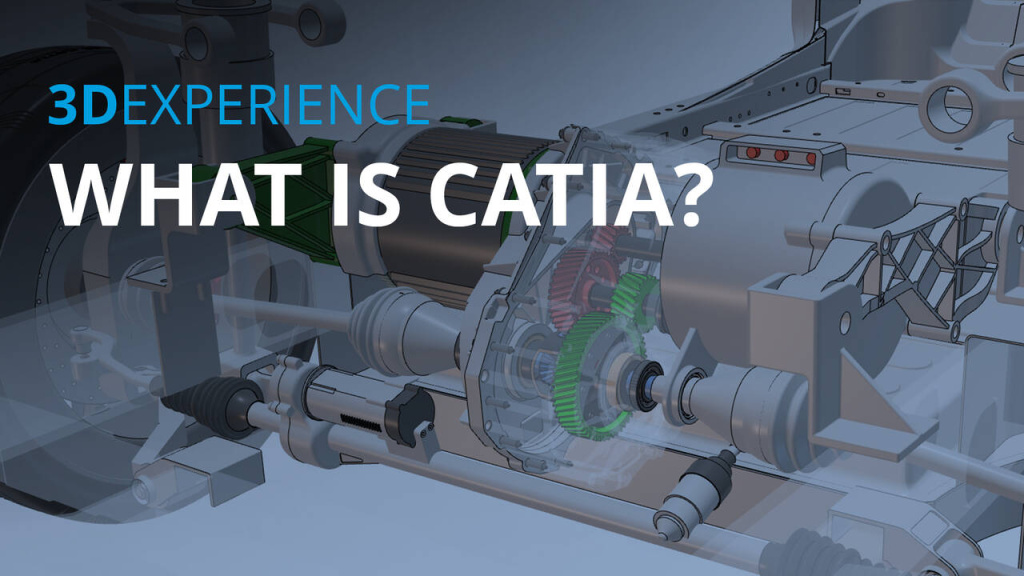
CATIA (an acronym for Computer-Aided Three-dimensional Interactive Application) is a flagship CAD/CAM/CAE software suite developed by the French company Dassault Systèmes. First released in the early 1980s, CATIA has grown into one of the most prominent solutions for product design and manufacturing in industries such as aerospace, automotive, industrial machinery, consumer goods, and more. Dassault Systèmes — the vendor behind CATIA — is a multinational software company headquartered in Vélizy-Villacoublay, France, known for its 3D design, engineering, and Product Lifecycle Management (PLM) software portfolio.
As an integrated CAD (Computer-Aided Design), CAM (Computer-Aided Manufacturing), and CAE (Computer-Aided Engineering) platform, CATIA enables companies to digitally conceptualize products, design intricate components and assemblies, simulate their behavior, and ultimately plan out their manufacturing processes within a unified environment. In practice, this means an engineer can use CATIA to sketch a product concept in 3D, refine it into a detailed model with precise dimensions and complex surfaces, analyze its performance under real-world conditions, and then generate the toolpaths and instructions for machining that product on a factory floor – all using the same software ecosystem. This end-to-end capability is a key part of Dassault Systèmes’ vision for digital continuity in product development, where design and manufacturing are tightly connected. It also embodies the company’s broader mission of providing “3DEXPERIENCE” universes – virtual 3D environments for innovation – to harmonize product, nature, and life.
From cars and airplanes to consumer electronics and even architectural projects, CATIA has been employed to design a vast array of products that shape the world around us. The software is especially renowned for its prowess in modeling complex, organic shapes and surfaces, which has made it a top choice in automotive and aerospace applications where aerodynamic and ergonomic forms are critical. (For instance, every new Boeing or Airbus aircraft model relies heavily on CATIA for its design.) Notably, CATIA’s versatility has even extended beyond traditional engineering fields – it was famously used by architect Frank Gehry for designing the curvilinear forms of his iconic buildings – underscoring the software’s broad creative potential. However, CATIA’s deepest strengths lie in bridging the gap between design and manufacturing, which is where its CAM capabilities come to the forefront.
Applications of CATIA with a Focus on CAM
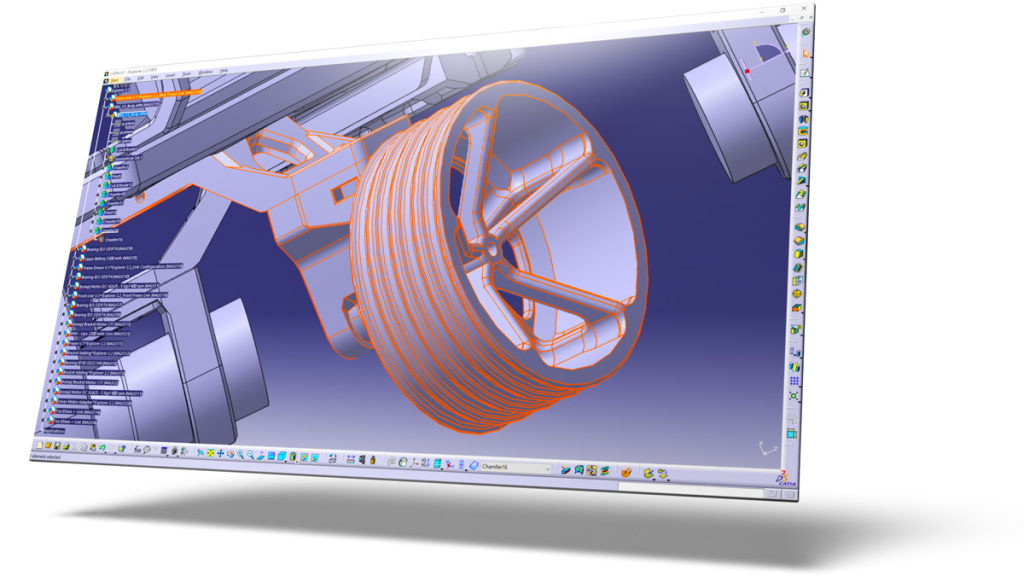
Originally conceived as a tool to streamline aircraft design and manufacturing, CATIA today is used in dozens of sectors for a wide range of applications. Engineers and designers leverage CATIA’s rich suite of features to create 3D mechanical parts, complex surface geometries (such as car body panels or aircraft fuselages), detailed assemblies (like an entire vehicle or machine composed of thousands of parts), and all associated drawings and documentation. The software supports specialized workbenches for everything from sheet metal design and composite materials to electrical systems and fluid systems design. This breadth allows companies to use CATIA as a one-stop solution for product development, maintaining consistency across various engineering disciplines.
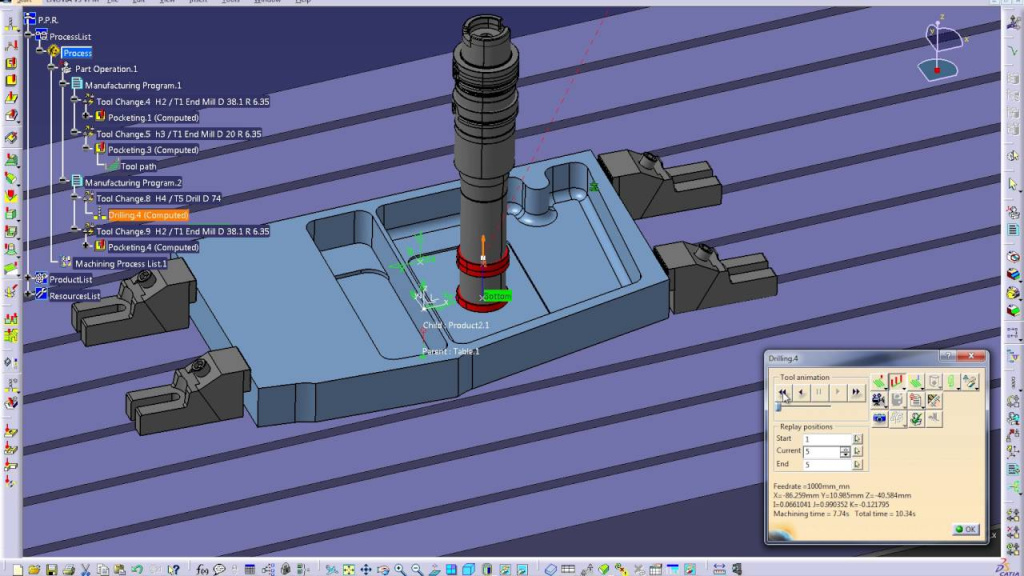
Where CATIA particularly shines is in Computer-Aided Manufacturing (CAM). Its CAM modules enable users to take digital designs and directly plan out how to manufacture them, bridging the traditional gap between the design office and the machine shop. In practice, CATIA’s CAM functionality allows manufacturing engineers to generate NC (Numerical Control) toolpaths for CNC machining operations based on the 3D model of the part. This includes programming of multi-axis milling, drilling, turning, and even complex 5-axis machining sequences needed for intricate shapes like turbine blades or impellers. Because the CAM tools are integrated within CATIA, any design change made to the 3D model can automatically propagate to update machining instructions – ensuring that production always uses the latest design iteration. This integration reduces errors that might otherwise occur when using separate CAD and CAM software.
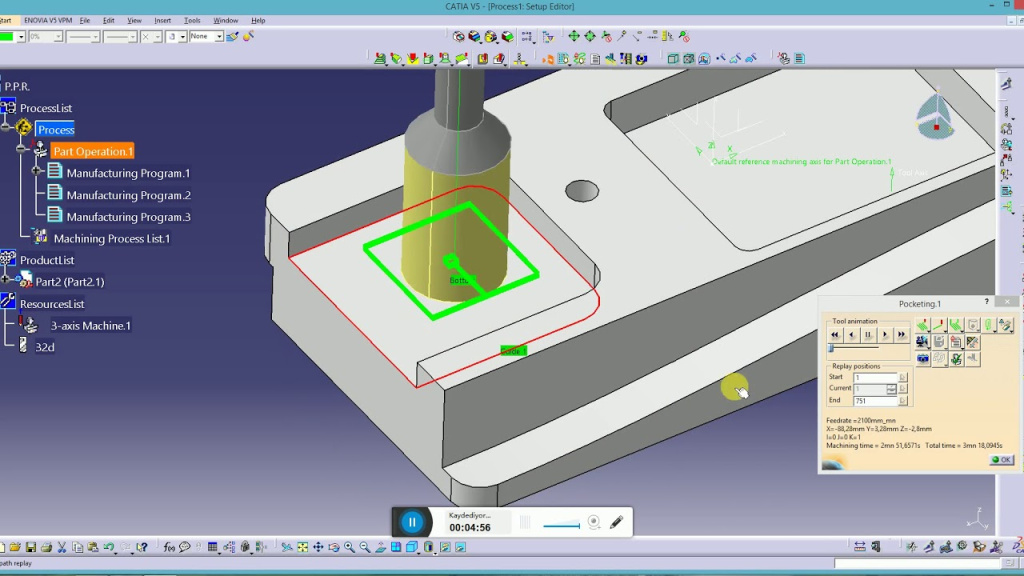
Manufacturing teams use CATIA to perform tasks such as: defining the machining features on a part (pockets, holes, surfaces to be milled), selecting the appropriate cutting tools and machining strategies, and simulating the material removal process virtually. The ability to simulate machining in CATIA is critical – it allows verification of the toolpaths to check for collisions or gouges, optimizing cutting parameters, and ensuring the part can be made to specifications before any real material is cut. By catching potential issues digitally, companies save time and cost on the shop floor. CATIA’s CAM applications extend to generating code for advanced multi-axis CNC machines, including those used in automotive body shops and aerospace factories, as well as programming robotic machining cells in conjunction with Dassault Systèmes’ DELMIA platform for digital manufacturing. In essence, CATIA’s CAM capabilities help turn virtual designs into real products by providing a direct line from the designer’s screen to the production equipment.
To illustrate, consider the aerospace industry: an aircraft wing or engine component often involves free-form surfaces and complex curves that must be machined from high-strength materials. CATIA enables aerospace manufacturers to design these components with the required precision and then generate the multi-axis machining routines to cut them out, all within one software environment. This was a revolutionary concept when CATIA was first introduced – many earlier CAD tools lacked built-in CAM, forcing companies to manually re-interpret designs for manufacturing. With CATIA, Dassault Systèmes offered an integrated solution where the same 3D data drives both design and manufacturing, greatly improving consistency and efficiency. This capability is a major reason why CATIA became an industry standard in aircraft and automobile production, where fabrication processes are as critical as the design itself.
Beyond machining, CATIA’s manufacturing applications also include tooling design (designing molds, dies, jigs, and fixtures), ergonomics and human-factor studies on assembly lines, and even additive manufacturing preparation in newer releases. The software’s flexibility allows it to be used in production planning and simulation, ensuring not only that individual parts are manufactured correctly, but also that they can be assembled smoothly in the final product. By focusing on the CAM aspect, we see that CATIA isn’t just about making things look good on a computer screen – it’s about guaranteeing that those digital creations can be realized efficiently in the physical world.
History of CATIA’s Development
CATIA’s origins date back to the late 1970s, born from a desire to revolutionize how airplanes were designed and built. In 1977, French aerospace company Avions Marcel Dassault (today Dassault Aviation) initiated an in-house project to develop advanced 3D design software. At the time, Dassault’s engineers were working on fighter jet programs (such as the Mirage aircraft) and needed better tools for designing aerodynamic surfaces and ensuring those designs could be manufactured via numerical control machining. The project was code-named “CATI” (for Conception Assistée Tridimensionnelle Interactive, French for “interactive three-dimensional design”). CATI’s goal was to integrate 3D computer modeling with CADAM (an earlier 2D CAD system used by Dassault) and to drastically cut down the design-to-manufacturing cycle time by enabling true 3D representation of aircraft parts.
By 1981, the success of CATI internally led Dassault’s management to spin off the software venture into a new company: Dassault Systèmes was founded that year as a dedicated software subsidiary to further develop and commercialize CATI. The newly-formed Dassault Systèmes (DS) renamed the software to CATIA, and its first CEO was Francis Bernard– the aerospace engineer who had championed the CATI project and now co-founded the software company. Dassault Systèmes’ mission was clear: build CATIA into a product that could serve not only Dassault Aviation’s needs but also be sold to other industries facing similar design challenges.
A crucial early step was DS’s partnership with IBM. In 1981, Dassault Systèmes signed a global marketing and distribution agreement with IBM, allowing IBM to sell and support CATIA alongside its own hardware. At the time, IBM dominated the computing market (especially high-end workstations and mainframes), so this alliance gave CATIA worldwide reach that a small startup like DS could not have achieved alone. Francis Bernard later reflected on this pivotal moment “Without the partnership with IBM, we would not have established the Dassault Systèmes company. It was the key decision factor.”
In 1982, CATIA Version 1 was officially released (as an add-on to IBM’s CADAM software initially). This marked CATIA’s first appearance in the wider market. The early 1980s were a formative period; CATIA was adopted in niche areas of aerospace and defense that required 3D capabilities. Its ability to model complex 3D surfaces and directly generate NC instructions started to set it apart from more traditional CAD tools. Dassault Systèmes continued improving the software through the 1980s with Version 2 and Version 3 releases that expanded functionality. CATIA V3, launched in 1986, introduced enhancements like integrating computer-aided engineering (CAE) analysis and running on UNIX workstations in addition to mainframes.A landmark event in CATIA’s history came in 1986 when aerospace giant Boeing chose CATIA as its core CAD/CAM system for designing airplanes. Boeing’s adoption of CATIA was a massive vote of confidence in the software. Boeing had extremely demanding requirements – for the development of aircraft such as the 777, it needed a system capable of handling millions of parts, complex curvatures, and global collaboration among engineering teams. CATIA proved up to the task, in large part due to its unified design-and-manufacturing approach. By standardizing on CATIA across all divisions by the late 1990s, Boeing deployed roughly 9,000 CATIA workstations, making it one of the world’s largest CATIA users. The company noted that CATIA’s ability to support a broad set of design and manufacturing needs “in an integrated fashion” was key to its selection as an enterprise standard. This early adoption by Boeing (as well as other companies like General Dynamics’ Electric Boat division for ship design) cemented CATIA’s reputation in the aerospace and defense sector.
Throughout the late 1980s and early 1990s, CATIA’s capabilities grew and its user base expanded into automotive and other industries. CATIA Version 4 (V4) arrived in 1994, bringing the concept of the 3D Digital Mock-Up (DMU) – the ability to create a full virtual 3D prototype of an entire product and its sub-systems. With V4, for example, a car manufacturer could assemble all the digital parts of a car in CATIA and inspect fits, interferences, and motions virtually, greatly reducing the need for physical prototypes. This was a significant innovation for its time and kept CATIA at the cutting edge of CAD technology.
Meanwhile, Dassault Systèmes as a company was also evolving. Bernard Charlès, a visionary engineer who joined DS in 1983, took on increasing leadership through the years and became CEO in 1995, succeeding Francis Bernard. Under Charlès’ guidance, DS accelerated its global growth and broadened its scope beyond just CATIA. One challenge that highlighted CATIA’s importance (and the need for continuous improvement) was the development of Airbus’ A380 superjumbo jet in the late 1990s. Different Airbus design teams had used different CATIA versions (some on V4, some on the newer V5), leading to data incompatibilities that reportedly caused costly delays in the A380 program. This incident underscored how critical CATIA had become to complex projects – when not managed properly, its centrality could become a bottleneck. Dassault Systèmes learned from this and pushed to ensure better compatibility and data management in future releases.
CATIA Version 5 (V5) was introduced in 1998, representing a complete rewrite of the software architecture to modernize it and support Windows NT platforms alongside UNIX. V5 was object-oriented and offered a more intuitive user interface, which helped attract a wider user base in sectors like industrial machinery and consumer goods. V5 remains widely used even decades later, a testament to its robustness. In the 2000s, Dassault Systèmes introduced CATIA Version 6 (V6), which was deeply integrated with the company’s new 3DEXPERIENCE platform – essentially connecting CATIA with a broader cloud-based PLM environment for collaboration across the extended enterprise. Today, CATIA continues to evolve under the 3DEXPERIENCE umbrella, incorporating cutting-edge technologies like cloud computing, artificial intelligence, and virtual twin experiences.
From its humble start as a specialized in-house tool, CATIA’s development journey illustrates how it continuously adapted to the changing landscape of engineering. Its trajectory also mirrors the rise of Dassault Systèmes from a small startup in 1981 to a global software powerhouse in the present day.
Business Metrics and Market Presence
Dassault Systèmes has grown into one of the largest software companies in Europe, and CATIA has been a major contributor to that success. As of the mid-2020s, Dassault Systèmes (often abbreviated as DS) has impressive business metrics that highlight its reach in the industry. The company’s annual revenues are on the order of 5–6 billion Euros per year, with €5.67 billion reported in 2022 alone. This revenue comes not only from CATIA but also from a portfolio of other software brands DS has developed or acquired (such as SOLIDWORKS, ENOVIA, DELMIA, SIMULIA, etc., which we’ll discuss shortly). DS is a publicly traded company (listed on Euronext Paris) and has consistently delivered growth, reflecting strong demand for its solutions in the market.
In terms of user base, CATIA and Dassault Systèmes’ products serve a vast community worldwide. Over 300,000 enterprise customers – ranging from large corporations to small businesses – use DS software, collectively representing tens of millions of end-users. Dassault Systèmes has stated it supports around 25 million users in 140+ countries across 12 different industries, meaning its tools (with CATIA often at the core for 3D design and manufacturing) have a truly global footprint. These users span aerospace companies, automobile manufacturers, industrial equipment makers, consumer product designers, life sciences companies, architecture firms, and beyond.
Geographically, Dassault Systèmes has a balanced presence: Europe (where it originated) remains a strong market, but North America and Asia (especially countries like the United States, China, Japan, India, and South Korea) are equally critical to its business. The company has more than 190 offices worldwide and operates in over 140 countries, underscoring its global reach. It’s notable that emerging economies have also adopted CATIA for developing their own aerospace and automotive programs, thanks to DS’s push into those markets.
Another metric of note is the human capital behind CATIA and its sister products: Dassault Systèmes employs roughly 20,000–25,000 people worldwide (about 23,800 as of 2022). Many of these are research and development engineers, support specialists, and industry consultants who continually enhance the software and help customers implement it effectively. The company invests heavily in R&D (a significant percentage of revenue each year) to stay at the forefront of technology. For example, DS has research centers in France, the United States, India, and other countries working on everything from advanced simulation algorithms to new user interface designs and cloud services for the 3DEXPERIENCE platform.
In the marketplace, CATIA is often positioned at the high end of CAD/CAM solutions, competing with other advanced platforms like Siemens NX and PTC Creo. Despite competition, CATIA has maintained a strong market positionparticularly in aerospace and automotive, where it’s estimated to have a major share of OEMs (Original Equipment Manufacturers) and their suppliers. Many top-tier manufacturers consider proficiency in CATIA a prerequisite for their design and engineering suppliers, which in turn amplifies the user base and reinforces the software’s dominance as an industry standard. This network effect means that knowing CATIA is a valuable skill for engineers in certain fields, further entrenching it in engineering education and industry practice.
To summarize, the numbers behind Dassault Systèmes and CATIA highlight a software that isn’t just a niche tool, but a foundational technology used by hundreds of thousands of organizations globally, generating billions in economic value. It reflects how integral digital design and manufacturing software have become to modern industry – and CATIA is at the heart of that transformation.
Mergers, Acquisitions, Partnerships, and Collaborations
Dassault Systèmes’ journey has been characterized not only by organic growth with CATIA but also by strategic acquisitions and partnerships that expanded its capabilities and market reach. Over the decades, DS transitioned from a single-product company into a diversified software group, often through high-profile acquisitions:
- IBM Partnership (1981–2010): The collaboration with IBM was fundamental in CATIA’s early growth. IBM’s global salesforce and support network helped place CATIA into companies around the world throughout the 1980s and 1990s. For nearly 30 years, IBM was the primary channel to market CATIA (and later other DS software) globally.
- This partnership eventually wound down in the 2010s as Dassault Systèmes built its own direct sales channels, but it remains a textbook example of a symbiotic tech partnership. In the words of Francis Bernard, IBM’s involvement was like a dream scenario that gave DS instant global credibility. Indeed, Boeing’s decision to adopt CATIA in 1986 was facilitated by IBM’s endorsement and support, illustrating how crucial this collaboration was in landing big accounts.
- Early Industry Collaborations: Beyond IBM, DS’s early collaborations were often with its key customers. For instance, as mentioned, Boeing became not just a customer but a development partner of sorts – pushing CATIA’s capabilities further and co-developing methodologies for large-scale 3D design. Similarly, European aerospace company Airbus and various automotive manufacturers in Germany (like BMW and Mercedes-Benz) and Japan (like Honda) worked closely with Dassault Systèmes in CATIA’s formative years. These relationships sometimes involved custom developments and feature requests that later became part of the standard software. The user community even formed an organization (COE – the CATIA Operators Exchange) to collaborate and influence CATIA’s direction.
- Acquisition of CADAM (1992): In the early 1990s, Dassault Systèmes took a significant step by acquiring CADAM from IBM. CADAM was a 2D CAD system originally developed by Lockheed; IBM had been reselling it. With this acquisition, DS not only gained a large customer base of CADAM users (especially in aerospace) but also signaled its intent to control its destiny beyond the IBM partnership. DS integrated CADAM technology and even released a product called CATIA-CADAM, before fully moving users to CATIA’s 3D world.
- SOLIDWORKS (1997): A major expansion move was the acquisition of SolidWorks in 1997. SolidWorks is a mid-range CAD software that, unlike CATIA, was aimed at Windows PCs and meant for broader usage (smaller companies, more straightforward mechanical design tasks). By buying SolidWorks, Dassault Systèmes gained a huge new customer segment and effectively entered the mainstream CAD market. SolidWorks continued to operate as a separate brand (with its own strong community), giving DS a two-tier portfolio: CATIA for high-end, complex design in large enterprises, and SolidWorks for mid-market and smaller teams. This acquisition has been enormously successful, as SolidWorks became one of the most widely used 3D CAD tools globally, contributing significantly to DS’s revenue and user count.
- ENOVIA and PLM (late 90s): In 1998, DS acquired a company called MatrixOne and technology from IBM’s Product Manager software, which formed the basis of ENOVIA – DS’s PLM (Product Lifecycle Management) solution. ENOVIA provides data management and collaboration for design content, complementing CATIA. This was part of DS’s strategy to offer not just design tools, but also the infrastructure to manage all the data and processes around product development (such as version control, BOM management, workflows, etc.). The integration of CATIA with ENOVIA meant that companies could have a single environment to manage their 3D models and all related information across the product lifecycle.
- DELMIA (2000): Recognizing the importance of digital manufacturing, DS created the DELMIA brand in 2000, which was built in part through the acquisition of manufacturing simulation companies (Deneb Robotics and others). DELMIA focuses on the manufacturing side – things like simulating factory operations, robotics programming, and ergonomics. DELMIA works closely with CATIA’s manufacturing outputs; for instance, CATIA might create the NC program for a part, while DELMIA can simulate the entire production line that makes that part. This further solidified Dassault Systèmes’ CAM and production planning credentials, especially in automotive assembly and aerospace fabrication.
- ABAQUS (2005): In 2005, Dassault Systèmes acquired ABAQUS, a leading Finite Element Analysis (FEA) and simulation software, and subsequently launched the SIMULIA brand. This move brought advanced simulation (stress analysis, thermal analysis, etc.) into the fold. While CATIA had some built-in CAE tools, acquiring Abaqus gave DS a best-in-class analysis tool to offer its users. Over time, SIMULIA has been integrated such that a CATIA user can pass their design to SIMULIA for high-end analysis seamlessly. This was a strategic acquisition to ensure Dassault Systèmes could cover the “A” (analysis) in CAE as strongly as it did CAD and CAM.
- Expanding Portfolio (2010s): The 2010s saw Dassault Systèmes continuing to diversify. Notably, in 2014 it acquired Accelrys (a scientific software firm) and later branded its bio-chemistry/life-sciences applications as BIOVIA. In 2019, DS made its largest acquisition to date by purchasing Medidata Solutions, a cloud-based software company for clinical trials, for $5.8 billion. Medidata formed the core of a new Life Sciences segment for DS, indicating an expansion beyond traditional engineering into healthcare. While these moves are somewhat tangential to CATIA directly, they reflect the company’s ambitions to apply its 3D modeling and simulation expertise to a broader “digitization of life” – from molecules to cities.
- Recent Collaborations: Dassault Systèmes continues to form strategic partnerships with major industry players. For example, in 2021 it partnered with Sanofi to use virtual twin technology in designing flexible production lines for vaccines. In the automotive sector, DS extended a long-term partnership with Hyundai Motor in 2022 for digital transformation initiatives. Another headline collaboration is with BMW Group: in 2023, BMW signed a strategic partnership with Dassault Systèmes to develop BMW’s next-generation global engineering platform using DS’s 3DEXPERIENCE (which includes CATIA). This is a significant win, as it indicates BMW’s trust in DS to support the design of its future vehicles and an example of a deep collaboration where DS’s software becomes embedded in a customer’s core processes for decades. These partnerships often involve joint innovation: DS experts working closely with the company’s engineers to tailor solutions, optimize workflows, and sometimes co-develop new features needed by the customer (which later might benefit other users too).
Innovations, Standout Features, and CAM Strengths of CATIA
CATIA is often regarded as more than just a CAD program; over the years it has introduced or popularized numerous innovations in the CAD/CAM field. One of its longstanding strengths is the richness of its features – covering the entire spectrum from conceptual design to manufacturing – and the depth of functionality in each of those areas for solving complex engineering problems. Let’s highlight a few of CATIA’s notable innovations and features, especially those relevant to its CAM capabilities:
- Integrated Design-to-Manufacturing: As stressed earlier, CATIA was a pioneer in offering a truly integrated CAD/CAM environment. From the very first version, CATIA included modules for NC (Numerical Control) machining alongside design. This was revolutionary in the early 1980s when most CAD systems focused only on drafting or geometry, leaving manufacturing as a separate task. CATIA’s approach meant that manufacturing considerations could be introduced early in the design phase. For example, a designer could check the manufacturability of a part’s geometry by simulating toolpaths in CATIA and adjust the design accordingly to make machining easier. This integration has only deepened with time – modern CATIA allows for concurrent engineering, where designers and manufacturing engineers work on the same 3D data simultaneously, ensuring that the product design and the manufacturing plan evolve together harmoniously.
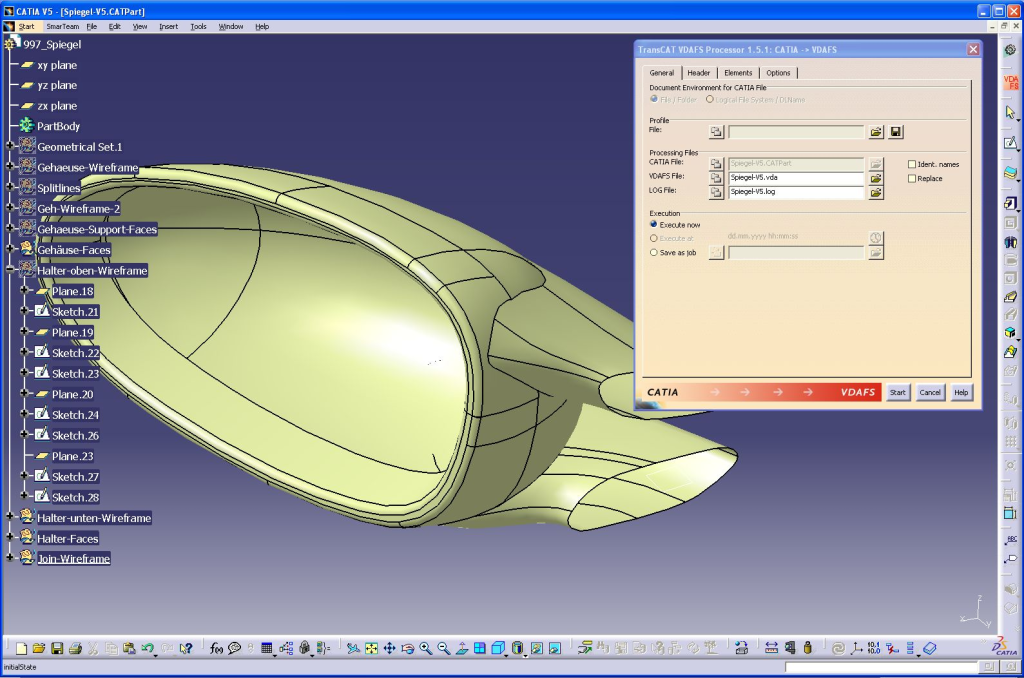
- 3D Solid and Surface Modeling Excellence: CATIA has always been at the forefront of 3D modeling technology. It excels at solid modeling (constructive geometry, boolean operations, etc.) and surface modeling(free-form curves and surfaces). For industries like automotive and aerospace, CATIA’s ability to create Class-A surfaces (high-quality curvature continuous surfaces used in car exteriors and aircraft skins) is essential. The software provides advanced surface creation tools that allow designers to sculpt complex shapes with precision. This is a strength that indirectly benefits CAM: when the 3D model accurately represents the intended complex shape, the toolpaths generated from it will produce a high-quality physical surface. Many competing systems historically lacked either the advanced surfacing or the integrated machining – CATIA provided both, which was a differentiator. A designer could design an aerodynamic wing surface and immediately generate the machining strategy to mill the molds for that surface, all in CATIA.
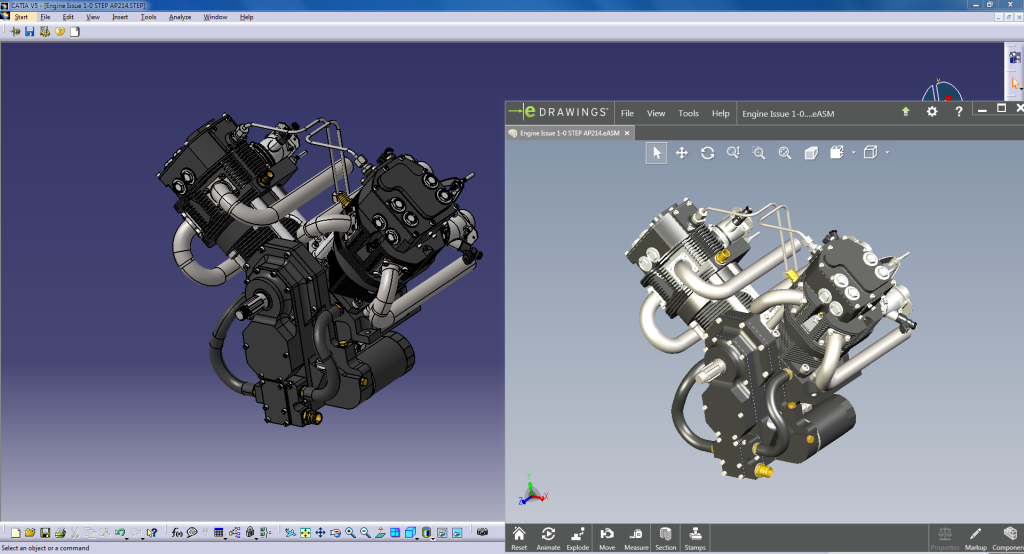
- Digital Mock-Up & Assembly Handling: With CATIA V4 and onwards, the concept of Digital Mock-Up (DMU) allowed entire products (like a full aircraft or automobile) to be assembled and visualized in 3D. The ability to handle extremely large assemblies with thousands of parts has been a notable feature. For manufacturing, this means CATIA can also simulate assembly sequences and check for clearance issues when putting parts together. It also means that toolpaths can be verified in context – for instance, ensuring that a cutting tool has sufficient clearance around a fixtured part during machining. This holistic view of the product and process in 3D space is a big advantage for planning manufacturing operations in crowded factory environments.
- Knowledge-Based Engineering and Automation: CATIA incorporated knowledge-based engineering features, allowing companies to embed their know-how and rules into the design process. Users can create templates and rules – for example, automating the design of a sheet metal bracket by inputting parameters, or auto-generating manufacturing features based on design features. In CAM, this knowledgeware can automate choosing machining processes for recognized features (like automatically identifying all holes in a part and suggesting drilling operations for them). By capturing best practices, CATIA helps standardize manufacturing processes and reduce programming time.
- Multi-Axis and Advanced Machining Capabilities: CATIA’s CAM modules support everything from 2.5-axis milling and turning up to 5-axis simultaneous milling and even multi-axis laser cutting or waterjet cutting. The software can optimize tool orientation in 5-axis machining to maintain ideal cutting conditions on complex surfaces – a critical requirement in making molds or aerospace components. CATIA also provides high-speed machining strategies (important for modern high spindle speed mills) and has specialized approaches for specific tasks (e.g., machining of blisks or turbine blades often found in turbomachinery). Over time, DS added machining simulation so that G-code (machine code) can be verified, including simulating the machine tool kinematics itself to ensure no collisions between machine components. This ensures that what is programmed in CATIA will work on the actual CNC machine exactly as intended.
- PLM Integration and Collaboration: In recent years, one of CATIA’s standout features is how well it integrates with the broader PLM environment. On the 3DEXPERIENCE platform, CATIA is not a standalone app but part of a connected system where designs are linked to requirements, simulations, manufacturing plans, and even downstream in-service data. This means an engineer working on CATIA can easily pull in input from a colleague doing a stress analysis in SIMULIA or push a design change notification to a manufacturing planner in DELMIA. The collaborative aspect is enhanced by cloud technology – teams in different locations can work on the same assembly in real-time, for instance. All of this reduces iteration loops and errors. For CAM, an integrated PLM means that as soon as a design is released, the manufacturing team gets the updated model and can start programming the machining, with full traceability of changes. It also means that if a problem is found during manufacturing, that feedback can be traced back to requirements or design decisions captured in the system.
- Realistic Simulation and Virtual Twins: Dassault Systèmes has been a thought leader in promoting virtual twin experiences. CATIA, together with SIMULIA and DELMIA, allows the creation of a virtual twin of not just the product but also the manufacturing system. For example, a factory can be virtually recreated: CATIA defines the products and tooling, DELMIA defines the robots and machines, and SIMULIA can even simulate stresses or ergonomics. This means companies can experiment in the virtual world – try different manufacturing cell layouts, different machining parameters, etc. – to optimize before implementing in the real world. A good example of innovation here is in ergonomics: DS has demonstrated how assembly workers’ tasks can be simulated with virtual mannequins to ensure the product design is adjusted for ease of assembly. While not purely CAM, these innovations augment CATIA’s value proposition as an all-encompassing solution.
- User Experience and Extensibility: Over generations, CATIA’s user interface and programming interfaces have evolved. CATIA V5 and now CATIA on 3DEXPERIENCE have relatively modern interfaces that, despite the complexity of the software, try to make advanced tools accessible (with context-sensitive toolbars, 3D graphical toolpath editors, etc.). The software is also extensible; companies can write macros or C++/Python scripts to automate repetitive CAM tasks or integrate CATIA with other systems. Many large companies have custom CATIA add-ons tailored to their specific manufacturing processes. This flexibility to extend and customize has been a quiet strength – it means CATIA can adapt to unique processes (like perhaps an unusual machining technique or proprietary machine) more easily than off-the-shelf solutions that don’t allow deep customization.
Despite these strengths, it’s worth noting that CATIA’s comprehensive nature also comes with complexity. Mastering the full breadth of CATIA, especially its CAM capabilities, requires significant training and experience. Dassault Systèmes mitigates this by offering role-based modules (so a user sees just the tools relevant to their job, e.g., a 3-axis machining programmer sees the interface tailored to that). Additionally, the cost of CATIA has traditionally been high, which is why it’s often used by larger enterprises with the most complex needs, whereas smaller firms might opt for simpler or cheaper solutions unless they truly require CATIA’s power.
Nonetheless, what makes CATIA stand out, particularly in CAM, is the confidence it gives that if something can be designed in CATIA, it can likely also be manufactured with CATIA’s tools. That end-to-end assurance, plus the program’s proven track record on some of humanity’s most advanced engineering projects (from jetliners to high-speed trains to innovative automobiles), has maintained CATIA’s position as a leader. Every release of CATIA brings incremental innovations – recently focusing on cloud collaboration, additive manufacturing, generative design (letting AI suggest shapes), and more – keeping it at the cutting edge of technology while preserving the robust CAM foundation built over decades.
Executive Perspectives and Vision
The story of CATIA would be incomplete without touching on the vision and words of those who led Dassault Systèmes. The company’s executives have often articulated a forward-looking, almost philosophical vision for what they aim to achieve with technologies like CATIA. A consistent theme in their perspective is the fusion of imagination with realization – that is, enabling people not just to dream up ideas but to actually make them real in a sustainable, efficient way. CATIA is one of the primary tools through which this vision is executed, by providing a virtual universe where ideas take shape and then translating those into physical products.
Bernard Charlès, who has been CEO of Dassault Systèmes since 1995, is known for his passionate statements about the role of virtual technology in solving real-world problems. Under his leadership, DS embraced slogans like “Product, Nature, and Life” and initiatives such as the “3DEXPERIENCE” platform to extend the impact of its software beyond industry into areas like healthcare and cities. At the inauguration of Dassault Systèmes’ North American HQ in Boston in 2011, Charlès highlighted how the company’s vision goes beyond just software tools: “What you see behind me is not just a building. It is a living laboratory for our Dassault Systèmes vision. From this place, we will reach out to the world with our technology and services. This is where we will help creative people visualize solutions to the challenges that face the world, validate that those visions will work, and plan how to bring those visions to life in the most efficient, sustainable way possible.”
In this quote, while Charlès was speaking about the new campus, his words encapsulate the ethos behind CATIA and DS’s products in general: the idea of a “living laboratory” where ideas are visualized, validated, and brought to life efficiently and sustainably is essentially what CATIA enables in a digital sense. It allows companies to experiment and innovate virtually (in the lab) before committing to physical reality, thereby improving real-world outcomes.
Executives at Dassault Systèmes frequently emphasize innovation and collaboration. Charlès and others (like Pascal Daloz, the current Deputy CEO, or Philippe Laufer, the long-time CEO of the CATIA brand) have noted that one of DS’s core values is collaborative innovation – breaking silos between departments (design, engineering, manufacturing, marketing) by using a common platform. They often speak about the concept of the “virtual twin” as a transformative approach: a virtual twin of a product or even a human organ that can be used to predict behavior and optimize before anything is built or any patient is treated. This forward-thinking approach has kept CATIA relevant as more than just a drafting tool, but as part of a larger ecosystem aimed at solving broad challenges (for example, reducing waste through better simulation and planning, or enabling mass customization in manufacturing).
Another notable executive voice is that of Francis Bernard, the original CEO and co-founder. In interviews reflecting on DS’s success, Bernard highlighted the importance of certain decisions and philosophies. Beyond the IBM partnership remark quoted earlier, he often conveyed a belief in the potential of 3D technology to change engineering. Ray Kurland, a CAD industry analyst who knew Bernard, once described him as “a tireless executive and a true believer in the potential of CATIA and 3D modeling to change the engineering design world – and he proved to be right.”
Bernard’s early conviction that 3D CAD/CAM was the future was not a commonly held view in the late 1970s when 2D drawings were still king. That visionary stance at the executive level drove CATIA’s development philosophy: invest in 3D, even when computing power was a limitation; integrate manufacturing to 3D even when others didn’t see the need; pursue the most complex challenges (like an entire airplane in 3D) even if it hadn’t been done before.In more recent commentary, Dassault Systèmes executives tie CATIA and its related technologies into themes of sustainability and social impact. The company launched the “Only Progress is Human” initiative, with Charlès asserting that technology should contribute to solving environmental and societal challenges. This aligns with pushing CATIA to support things like lightweighting of products (to save material and fuel), designing sustainable cities, and working on life sciences projects (e.g., virtual twins of the human heart for medical research). The underlying message from leadership is that the tools DS creates (with CATIA as a cornerstone) are ultimately in service of improving the real world – making innovation not just about profit but about sustainability and quality of life.
To conclude with an executive perspective that wraps up the significance of CATIA within Dassault Systèmes: Pascal Daloz, an executive who has overseen strategy at DS, once referred to CATIA as the “crown jewel” of the company’s portfolio – it’s the original product that opened the door to all the others. The continued investment in CATIA’s CAM capabilities, its integration in the 3DEXPERIENCE platform, and its deployment in new domains all reflect a top-down belief at DS that virtual design and manufacturing solutions can drive real-world progress. The strong leadership vision and the direct quotes from those leaders reinforce why CATIA is not just software, but a reflection of a company’s decades-long passion to “harmonize product, nature, and life” through innovation.
Vendor: Dassault Systèmes